CATLab

CAT 2018 DILR Questions — Slot 2

The actual Data Interpretation & Logical Reasoning section from CAT 2018, Slot 2 — 32 questions in original paper order, each with a full worked solution. Tap an option (or type your answer) to check yourself before reading the solution.

32 questions24 MCQ · 8 TITA60 min section0/32 attempted
Set · Mixed Charts & Caselets

The base exchange rate of a currency X with respect to a currency Y is the number of units of currency Y which is equivalent in value to one unit of currency X. Currency exchange outlets buy currency at buying exchange rates that are lower than base exchange rates, and sell currency at selling exchange rates that are higher than base exchange rates. A currency exchange outlet uses the local currency L to buy and sell three international currencies A, B, and C, but does not exchange one international currency directly with another. The base exchange rates of A, B and C with respect to L are in the ratio 100:120:1. The buying exchange rates of each of A, B, and C with respect to L are 5% below the corresponding base exchange rates, and their selling exchange rates are 10% above their corresponding base exchange rates. The following facts are known about the outlet on a particular day: 1. The amount of L used by the outlet to buy C equals the amount of L it received by selling C. 2. The amounts of L used by the outlet to buy A and B are in the ratio 5:3. 3. The amounts of L the outlet received from the sales of A and B are in the ratio 5:9. 4. The outlet received 88000 units of L by selling A during the day. 5. The outlet started the day with some amount of L, 2500 units of A, 4800 units of B, and 48000 units of C. 6. The outlet ended the day with some amount of L, 3300 units of A, 4800 units of B, and 51000 units of C.

Q1Mixed Charts & CaseletsTITA

How many units of currency A did the outlet buy on that day?

Show solution

Correct answer: 1200

Let the base rates (units of local currency L per unit) be A=100kA=100k, B=120kB=120k, C=kC=k, matching the ratio 100:120:1100:120:1. The outlet buys at 5% below base (0.95×0.95\timesbase) and sells at 10% above base (1.10×1.10\timesbase).

Pin down kk:

  1. Selling A brought in 88000 L at a selling rate of 1.10×100k=110k1.10\times100k=110k, so units of A sold =88000110k=800k=\dfrac{88000}{110k}=\dfrac{800}{k}.
  2. A's stock rose from 2500 to 3300, a gain of 800, so (A bought) −- (A sold) =800=800, giving A bought =800+800k=800+\dfrac{800}{k}. The L spent buying A is (800+800k)(0.95)(100k)=76000k+76000\left(800+\tfrac{800}{k}\right)(0.95)(100k)=76000k+76000.
  3. Sales of A and B are in ratio 5:95:9, so sale of B =88000×95=158400=88000\times\tfrac95=158400 L. At B's selling rate 1.10×120k=132k1.10\times120k=132k, units of B sold =1200k=\dfrac{1200}{k}.
  4. B's stock is unchanged, so B bought == B sold =1200k=\dfrac{1200}{k}, and L spent buying B =1200k(0.95)(120k)=136800=\dfrac{1200}{k}(0.95)(120k)=136800.
  5. L used to buy A and B are in ratio 5:35:3: 76000k+76000136800=53⇒k=2\dfrac{76000k+76000}{136800}=\dfrac53\Rightarrow k=2.

So the base rates are A = 200, B = 240, C = 2; buying rates 190, 228, 1.90; selling rates 220, 264, 2.20.

CurrencyBaseBuyingSellingUnits boughtUnits sold
A2001902201200400
B240228264600600
C21.902.202200019000

This question — units of A bought. With k=2k=2, A sold =8002=400=\dfrac{800}{2}=400; since A bought −- A sold =800=800, A bought =800+400=1200=800+400=1200.

💡 Teacher tip: Carry the whole rate scale as one unknown kk; the two buy/sell ratios pin it down without ever needing the absolute base rates first.

Answer: 1200 units
Q2Mixed Charts & CaseletsMCQ

How many units of currency C did the outlet sell on that day?

Show solution

Correct answer: B

Let the base rates (units of local currency L per unit) be A=100kA=100k, B=120kB=120k, C=kC=k, matching the ratio 100:120:1100:120:1. The outlet buys at 5% below base (0.95×0.95\timesbase) and sells at 10% above base (1.10×1.10\timesbase).

Pin down kk:

  1. Selling A brought in 88000 L at a selling rate of 1.10×100k=110k1.10\times100k=110k, so units of A sold =88000110k=800k=\dfrac{88000}{110k}=\dfrac{800}{k}.
  2. A's stock rose from 2500 to 3300, a gain of 800, so (A bought) −- (A sold) =800=800, giving A bought =800+800k=800+\dfrac{800}{k}. The L spent buying A is (800+800k)(0.95)(100k)=76000k+76000\left(800+\tfrac{800}{k}\right)(0.95)(100k)=76000k+76000.
  3. Sales of A and B are in ratio 5:95:9, so sale of B =88000×95=158400=88000\times\tfrac95=158400 L. At B's selling rate 1.10×120k=132k1.10\times120k=132k, units of B sold =1200k=\dfrac{1200}{k}.
  4. B's stock is unchanged, so B bought == B sold =1200k=\dfrac{1200}{k}, and L spent buying B =1200k(0.95)(120k)=136800=\dfrac{1200}{k}(0.95)(120k)=136800.
  5. L used to buy A and B are in ratio 5:35:3: 76000k+76000136800=53⇒k=2\dfrac{76000k+76000}{136800}=\dfrac53\Rightarrow k=2.

So the base rates are A = 200, B = 240, C = 2; buying rates 190, 228, 1.90; selling rates 220, 264, 2.20.

CurrencyBaseBuyingSellingUnits boughtUnits sold
A2001902201200400
B240228264600600
C21.902.202200019000

This question — units of C sold. The L spent buying C equals the L earned selling C: 1.90×(C bought)=2.20×(C sold)1.90\times(\text{C bought})=2.20\times(\text{C sold}), so C bought: C sold =22:19=22:19. C's stock rose from 48000 to 51000, a gain of 3000, so C bought −- C sold =3000=3000. With the ratio 22:1922:19 the difference is 3 parts =3000=3000, so one part =1000=1000 and C sold =19×1000=19000=19\times1000=19000.

Answer: 19000 (Choice B)

Q3Mixed Charts & CaseletsTITA

What was the base exchange rate of currency B with respect to currency L on that day?

Show solution

Correct answer: 240

Let the base rates (units of local currency L per unit) be A=100kA=100k, B=120kB=120k, C=kC=k, matching the ratio 100:120:1100:120:1. The outlet buys at 5% below base (0.95×0.95\timesbase) and sells at 10% above base (1.10×1.10\timesbase).

Pin down kk:

  1. Selling A brought in 88000 L at a selling rate of 1.10×100k=110k1.10\times100k=110k, so units of A sold =88000110k=800k=\dfrac{88000}{110k}=\dfrac{800}{k}.
  2. A's stock rose from 2500 to 3300, a gain of 800, so (A bought) −- (A sold) =800=800, giving A bought =800+800k=800+\dfrac{800}{k}. The L spent buying A is (800+800k)(0.95)(100k)=76000k+76000\left(800+\tfrac{800}{k}\right)(0.95)(100k)=76000k+76000.
  3. Sales of A and B are in ratio 5:95:9, so sale of B =88000×95=158400=88000\times\tfrac95=158400 L. At B's selling rate 1.10×120k=132k1.10\times120k=132k, units of B sold =1200k=\dfrac{1200}{k}.
  4. B's stock is unchanged, so B bought == B sold =1200k=\dfrac{1200}{k}, and L spent buying B =1200k(0.95)(120k)=136800=\dfrac{1200}{k}(0.95)(120k)=136800.
  5. L used to buy A and B are in ratio 5:35:3: 76000k+76000136800=53⇒k=2\dfrac{76000k+76000}{136800}=\dfrac53\Rightarrow k=2.

So the base rates are A = 200, B = 240, C = 2; buying rates 190, 228, 1.90; selling rates 220, 264, 2.20.

CurrencyBaseBuyingSellingUnits boughtUnits sold
A2001902201200400
B240228264600600
C21.902.202200019000

This question — the base rate of B. The three ratio clues force k=2k=2 (shown above), and B=120k=120×2=240B=120k=120\times2=240.

Answer: 240

Q4Mixed Charts & CaseletsMCQ

What was the buying exchange rate of currency C with respect to currency L on that day?

Show solution

Correct answer: D

Let the base rates (units of local currency L per unit) be A=100kA=100k, B=120kB=120k, C=kC=k, matching the ratio 100:120:1100:120:1. The outlet buys at 5% below base (0.95×0.95\timesbase) and sells at 10% above base (1.10×1.10\timesbase).

Pin down kk:

  1. Selling A brought in 88000 L at a selling rate of 1.10×100k=110k1.10\times100k=110k, so units of A sold =88000110k=800k=\dfrac{88000}{110k}=\dfrac{800}{k}.
  2. A's stock rose from 2500 to 3300, a gain of 800, so (A bought) −- (A sold) =800=800, giving A bought =800+800k=800+\dfrac{800}{k}. The L spent buying A is (800+800k)(0.95)(100k)=76000k+76000\left(800+\tfrac{800}{k}\right)(0.95)(100k)=76000k+76000.
  3. Sales of A and B are in ratio 5:95:9, so sale of B =88000×95=158400=88000\times\tfrac95=158400 L. At B's selling rate 1.10×120k=132k1.10\times120k=132k, units of B sold =1200k=\dfrac{1200}{k}.
  4. B's stock is unchanged, so B bought == B sold =1200k=\dfrac{1200}{k}, and L spent buying B =1200k(0.95)(120k)=136800=\dfrac{1200}{k}(0.95)(120k)=136800.
  5. L used to buy A and B are in ratio 5:35:3: 76000k+76000136800=53⇒k=2\dfrac{76000k+76000}{136800}=\dfrac53\Rightarrow k=2.

So the base rates are A = 200, B = 240, C = 2; buying rates 190, 228, 1.90; selling rates 220, 264, 2.20.

CurrencyBaseBuyingSellingUnits boughtUnits sold
A2001902201200400
B240228264600600
C21.902.202200019000

This question — the buying rate of C. The base rate of C is k=2k=2, and buying is 5% below base: 0.95×2=1.900.95\times2=1.90.

Answer: 1.90 (Choice D)

Set · Data Tables

There are only four brands of entry level smartphones called Azra, Bysi, Cxqi, and Dipq in a country. Details about their market share, unit selling price, and profitability (defined as the profit as a percentage of the revenue) for the year 2016 are given in the table below. In 2017, sales volume of entry level smartphones grew by 40% as compared to that in 2016. Cxqi offered a 40% discount on its unit selling price in 2017, which resulted in a 15% increase in its market share. Each of the other three brands lost 5% market share. However, the profitability of Cxqi came down to half of its value in 2016. The unit selling prices of the other three brands and their profitability values remained the same in 2017 as they were in 2016.

2016 details:

BrandMarket Share (%)Unit Selling Price (Rs.)Profitability (%)
Azra4015,00010
Bysi2520,00030
Cxqi1530,00040
Dipq2025,00030
Q5Data TablesMCQ

The brand that had the highest revenue in 2016 is:

Show solution

Correct answer: C

Let the total number of phones sold in 2016 be VV. For each brand, revenue == (its share of VV) ×\times unit price. Working in units of VV:

BrandVolumePrice (Rs.)Revenue
Azra0.40V0.40V15,0006,000V6{,}000V
Bysi0.25V0.25V20,0005,000V5{,}000V
Cxqi0.15V0.15V30,0004,500V4{,}500V
Dipq0.20V0.20V25,0005,000V5{,}000V

The largest is Azra at 6,000V6{,}000V. (The options are listed in a different order — Azra is the third choice.)

Answer: Azra (Choice C)

Q6Data TablesMCQ

The brand that had the highest profit in 2016 is:

Show solution

Correct answer: C

Profit == profitability ×\times revenue. Using VV for total 2016 volume:

BrandRevenueProfitabilityProfit
Azra6,000V6{,}000V10%600V600V
Bysi5,000V5{,}000V30%1,500V1{,}500V
Cxqi4,500V4{,}500V40%1,800V1{,}800V
Dipq5,000V5{,}000V30%1,500V1{,}500V

Cxqi wins with 1,800V1{,}800V — its smaller revenue is more than made up for by the highest profit margin.

Answer: Cxqi (Choice C)

Q7Data TablesMCQ

The brand that had the highest profit in 2017 is:

Show solution

Correct answer: A

First update everything to 2017:

  • Total volume grows 40%: now 1.4V1.4V.
  • Cxqi's share rises 15 percentage points (15%→30%15\% \to 30\%); the other three each lose 5 points: Azra 40%→35%40\% \to 35\%, Bysi 25%→20%25\% \to 20\%, Dipq 20%→15%20\% \to 15\% (these still add to 100%).
  • Cxqi's price is cut 40%: 30,000→18,00030{,}000 \to 18{,}000. Other prices unchanged.
  • Cxqi's profitability halves: 40%→20%40\% \to 20\%. Others unchanged.

Now compute 2017 profit == profitability ×\times share ×1.4V×\times 1.4V \times price:

BrandVolumePriceRevenueProfitabilityProfit
Azra0.49V0.49V15,0007,350V7{,}350V10%735V735V
Bysi0.28V0.28V20,0005,600V5{,}600V30%1,680V1{,}680V
Cxqi0.42V0.42V18,0007,560V7{,}560V20%1,512V1{,}512V
Dipq0.21V0.21V25,0005,250V5{,}250V30%1,575V1{,}575V

Bysi is highest at 1,680V1{,}680V.

Answer: Bysi (Choice A)

Q8Data TablesMCQ

The complete list of brands whose profits went up in 2017 from 2016 is:

Show solution

Correct answer: A

Compare each brand's profit in 2016 with 2017. (2017 uses total volume 1.4V1.4V, with the new shares 35/20/15% for Azra/Bysi/Dipq at unchanged prices and margins, and Cxqi at 30% share, price 18,000, margin 20%.)

Brand2016 profit2017 profitChange
Azra600V600V735V735Vup
Bysi1,500V1{,}500V1,680V1{,}680Vup
Cxqi1,800V1{,}800V1,512V1{,}512Vdown
Dipq1,500V1{,}500V1,575V1{,}575Vup

Only Cxqi falls — its price cut and halved margin outweigh its bigger volume. Profits rose for Azra, Bysi and Dipq.

Answer: Azra, Bysi, Dipq (Choice A)

Set · Puzzles

Each visitor to an amusement park needs to buy a ticket. Tickets can be Platinum, Gold, or Economy. Visitors are classified as Old, Middle-aged, or Young. The following facts are known about visitors and ticket sales on a particular day: 1. 140 tickets were sold. 2. The number of Middle-aged visitors was twice the number of Old visitors, while the number of Young visitors was twice the number of Middle-aged visitors. 3. Young visitors bought 38 of the 55 Economy tickets that were sold, and they bought half the total number of Platinum tickets that were sold. 4. The number of Gold tickets bought by Old visitors was equal to the number of Economy tickets bought by Old visitors.

Q9PuzzlesMCQ

If the number of Old visitors buying Platinum tickets was equal to the number of Middle-aged visitors buying Platinum tickets, then which among the following could be the total number of Platinum tickets sold?

Show solution

Correct answer: D

Head counts. With Middle =2×=2\timesOld and Young =2×=2\timesMiddle, and a total of 140: O+2O+4O=140⇒O=20,  M=40,  Y=80O+2O+4O=140\Rightarrow O=20,\;M=40,\;Y=80.

Ticket facts.

  • Economy total is 55; Young bought 38 of them, so Old + Mid Economy =17=17 (an odd number — keep this in mind).
  • Young bought half of all Platinum: YP=P2YP=\tfrac{P}{2}, so Old + Mid Platinum =P2=\tfrac{P}{2}.
  • Old bought equal Gold and Economy: OG=OEOG=OE.
  • Since Economy =55=55, Platinum + Gold =85=85, i.e. G=85−PG=85-P; and Young Gold =80−P2−38=42−P2=80-\tfrac{P}{2}-38=42-\tfrac{P}{2}.
OldMidYoungTotal
PlatinumOPOPMPMPP2\tfrac{P}{2}PP
GoldOG=OEOG=OEMGMG42−P242-\tfrac{P}{2}85−P85-P
EconomyOEOEMEME3855
Total204080140

This question — if Old-Platinum equals Mid-Platinum, what could total Platinum be? Then OP=MP=P4OP=MP=\tfrac{P}{4}, so PP must be a multiple of 4 — only 32 or 36 among the options. The Old row gives OP+OG+OE=20OP+OG+OE=20 with OG=OEOG=OE, so OG=20−OP2OG=\dfrac{20-OP}{2}.

  • P=36⇒OP=9⇒OG=5.5P=36\Rightarrow OP=9\Rightarrow OG=5.5 — not a whole number, impossible.
  • P=32⇒OP=8⇒OG=6P=32\Rightarrow OP=8\Rightarrow OG=6 — valid.

💡 Teacher tip: The odd total OE+ME=17OE+ME=17 combined with OG=OEOG=OE quietly does most of the work across this whole set.

Answer: 32 (Choice D)

Q10PuzzlesTITA

If the number of Old visitors buying Platinum tickets was equal to the number of Middle-aged visitors buying Economy tickets, then the number of Old visitors buying Gold tickets was

Show solution

Correct answer: 3

Head counts. With Middle =2×=2\timesOld and Young =2×=2\timesMiddle, and a total of 140: O+2O+4O=140⇒O=20,  M=40,  Y=80O+2O+4O=140\Rightarrow O=20,\;M=40,\;Y=80.

Ticket facts.

  • Economy total is 55; Young bought 38 of them, so Old + Mid Economy =17=17 (an odd number — keep this in mind).
  • Young bought half of all Platinum: YP=P2YP=\tfrac{P}{2}, so Old + Mid Platinum =P2=\tfrac{P}{2}.
  • Old bought equal Gold and Economy: OG=OEOG=OE.
  • Since Economy =55=55, Platinum + Gold =85=85, i.e. G=85−PG=85-P; and Young Gold =80−P2−38=42−P2=80-\tfrac{P}{2}-38=42-\tfrac{P}{2}.
OldMidYoungTotal
PlatinumOPOPMPMPP2\tfrac{P}{2}PP
GoldOG=OEOG=OEMGMG42−P242-\tfrac{P}{2}85−P85-P
EconomyOEOEMEME3855
Total204080140

This question — if Old-Platinum equals Mid-Economy, find Old-Gold. Let OP=ME=aOP=ME=a. Since OE+ME=17OE+ME=17, we get OE=17−aOE=17-a, and OG=OE=17−aOG=OE=17-a. The Old row totals 20:

OP+OG+OE=a+(17−a)+(17−a)=34−a=20⇒a=14.OP+OG+OE=a+(17-a)+(17-a)=34-a=20\Rightarrow a=14.

So OG=17−14=3OG=17-14=3.

Answer: 3

Q11PuzzlesTITA

If the number of Old visitors buying Gold tickets was strictly greater than the number of Young visitors buying Gold tickets, then the number of Middle-aged visitors buying Gold tickets was

Show solution

Correct answer: 0

Head counts. With Middle =2×=2\timesOld and Young =2×=2\timesMiddle, and a total of 140: O+2O+4O=140⇒O=20,  M=40,  Y=80O+2O+4O=140\Rightarrow O=20,\;M=40,\;Y=80.

Ticket facts.

  • Economy total is 55; Young bought 38 of them, so Old + Mid Economy =17=17 (an odd number — keep this in mind).
  • Young bought half of all Platinum: YP=P2YP=\tfrac{P}{2}, so Old + Mid Platinum =P2=\tfrac{P}{2}.
  • Old bought equal Gold and Economy: OG=OEOG=OE.
  • Since Economy =55=55, Platinum + Gold =85=85, i.e. G=85−PG=85-P; and Young Gold =80−P2−38=42−P2=80-\tfrac{P}{2}-38=42-\tfrac{P}{2}.
OldMidYoungTotal
PlatinumOPOPMPMPP2\tfrac{P}{2}PP
GoldOG=OEOG=OEMGMG42−P242-\tfrac{P}{2}85−P85-P
EconomyOEOEMEME3855
Total204080140

This question — if Old-Gold is strictly more than Young-Gold, find Mid-Gold. From the Gold row, MG=(85−P)−OG−(42−P2)=(43−P2)−OGMG=(85-P)-OG-\left(42-\tfrac{P}{2}\right)=\left(43-\tfrac{P}{2}\right)-OG. Since Young-Gold is 42−P242-\tfrac{P}{2}, this is MG=(YG+1)−OGMG=(YG+1)-OG.

Now OG>YGOG>YG means OG≥YG+1OG\ge YG+1, which forces MG≤0MG\le0. A ticket count can't be negative, so MG=0MG=0.

Answer: 0

Q12PuzzlesMCQ

Which of the following statements MUST be FALSE?

Show solution

Correct answer: D

Head counts. With Middle =2×=2\timesOld and Young =2×=2\timesMiddle, and a total of 140: O+2O+4O=140⇒O=20,  M=40,  Y=80O+2O+4O=140\Rightarrow O=20,\;M=40,\;Y=80.

Ticket facts.

  • Economy total is 55; Young bought 38 of them, so Old + Mid Economy =17=17 (an odd number — keep this in mind).
  • Young bought half of all Platinum: YP=P2YP=\tfrac{P}{2}, so Old + Mid Platinum =P2=\tfrac{P}{2}.
  • Old bought equal Gold and Economy: OG=OEOG=OE.
  • Since Economy =55=55, Platinum + Gold =85=85, i.e. G=85−PG=85-P; and Young Gold =80−P2−38=42−P2=80-\tfrac{P}{2}-38=42-\tfrac{P}{2}.
OldMidYoungTotal
PlatinumOPOPMPMPP2\tfrac{P}{2}PP
GoldOG=OEOG=OEMGMG42−P242-\tfrac{P}{2}85−P85-P
EconomyOEOEMEME3855
Total204080140

This question — which must be false? Check "Old and Mid bought equal numbers of Economy tickets," i.e. OE=MEOE=ME. But OE+ME=17OE+ME=17, an odd number, so two equal whole numbers can't add to it. Impossible — this statement must be false. (The other three can each be arranged.)

Answer: The numbers of Old and Middle-aged visitors buying Economy tickets were equal (Choice D)

Set · Mixed Charts & Caselets

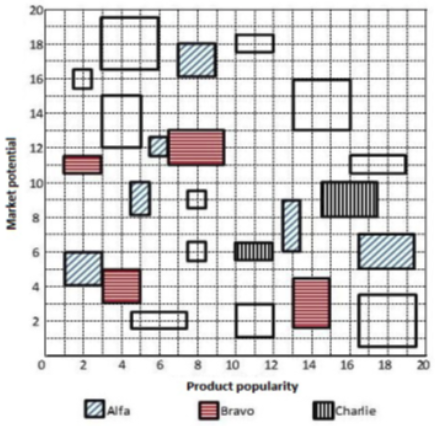
Each of the 23 boxes in the picture below represents a product manufactured by one of the following three companies: Alfa, Bravo and Charlie. The area of a box is proportional to the revenue from the corresponding product, while its centre represents the Product popularity and Market potential scores of the product (out of 20). The shadings of some of the boxes have got erased. The companies classified their products into four categories based on a combination of scores (out of 20) on the two parameters - Product popularity and Market potential as given below (see table).

PromisingBlockbusterDoubtfulNo-hope
Product popularity score> 10> 10<= 10<= 10
Market potential score> 10<= 10> 10<= 10

The following facts are known: 1. Alfa and Bravo had the same number of products in the Blockbuster category. 2. Charlie had more products than Bravo but fewer products than Alfa in the No-hope category. 3. Each company had an equal number of products in the Promising category. 4. Charlie did not have any product in the Doubtful category, while Alfa had one product more than Bravo in this category. 5. Bravo had a higher revenue than Alfa from products in the Doubtful category. 6. Charlie had a higher revenue than Bravo from products in the Blockbuster category. 7. Bravo and Charlie had the same revenue from products in the No-hope category. 8. Alfa and Charlie had the same total revenue considering all products.

Chart for this set — reading the chart is part of the question
Q13Mixed Charts & CaseletsMCQ

Considering all companies' products, which product category had the highest revenue?

Show solution

Correct answer: B

What we need

Across all three companies, which of the four product categories brought in the highest total revenue?

📐 Reading the picture: every box edge lands on a gridline, so a box's area in grid squares is just its width times its height, counted straight off the grid — and that area is the product's revenue, in units of the smallest (1 × 1) box. The box's centre gives its Product popularity and Market potential scores, which drop it into one of the four categories using the cut-offs in the table above. The hatching tells you the company, and several boxes have had theirs erased.

Step 1 — Sort the 23 boxes by category

Read each box's centre, apply the cut-offs, and list the areas. The shading does not matter yet.

Category (score rule)Shaded boxes (area)Erased boxes (area)Total
Promising (pop > 10, pot > 10)—9, 3, 214
Blockbuster (pop > 10, pot ≤ 10)6, 2, 3, 6, 69, 436
Doubtful (pop ≤ 10, pot > 10)4, 1, 6, 29, 6, 129
No-hope (pop ≤ 10, pot ≤ 10)2, 4, 43, 1, 115

As a check, the four totals come to 14+36+29+15=9414 + 36 + 29 + 15 = 94, which is the total area of all 23 boxes.

Step 2 — Add up each category

For this question the erased shadings never need recovering — a category's revenue is the sum of its box areas whoever made them:

  • Promising: 9+3+2=149 + 3 + 2 = 14
  • Blockbuster: 6+2+3+6+6+9+4=366 + 2 + 3 + 6 + 6 + 9 + 4 = 36
  • Doubtful: 9+4+1+6+1+6+2=299 + 4 + 1 + 6 + 1 + 6 + 2 = 29
  • No-hope: 2+4+4+3+1+1=152 + 4 + 4 + 3 + 1 + 1 = 15

Blockbuster is the largest at 36.

💡 Teacher tip: the question asks about category revenue, not company revenue, so you can answer it before doing any of the eight-fact deduction the rest of the set needs. Do this one first.

Answer: Blockbuster (Choice B)

Q14Mixed Charts & CaseletsMCQ

Which of the following is the correct sequence of numbers of products Bravo had in No-hope, Doubtful, Promising and Blockbuster categories respectively?

Show solution

Correct answer: A

This one needs the erased shadings recovered. Set up each category with its boxes; the shaded ones are known and the eight facts pin down the erased ones.

Reconstruction, fact by fact:

  1. Doubtful (erased boxes worth 9, 6, 1): Fact 4 says Charlie has none here and Alfa has exactly one more than Bravo. So the three erased boxes split as Alfa two, Bravo one, Charlie zero. Fact 5 says Bravo's Doubtful revenue beats Alfa's, so Bravo takes the big box worth 9, and Alfa takes the 6 and the 1.
  2. Promising (erased 9, 3, 2): Fact 3 says all three companies have equal counts here — one box each.
  3. No-hope (erased 3, 1, 1): Fact 2 says Charlie has more than Bravo but fewer than Alfa. The only split that works is Alfa 1, Charlie 2, Bravo 0 among these erased boxes. Fact 7 (Bravo's No-hope revenue equals Charlie's, which is 4 from Bravo's shaded box) forces Charlie's two erased boxes to total 4 — the 3 and one of the 1's.
  4. Blockbuster (erased 9, 4): Fact 1 says Alfa and Bravo have equal counts. Alfa already has two shaded here and Bravo one, so the two erased boxes go one to Bravo and one to Charlie. Fact 6 (Charlie's Blockbuster revenue beats Bravo's) makes Bravo take the smaller box (4) and Charlie the bigger (9).
  5. Promising split: Fact 8 (Alfa's grand total equals Charlie's) is the tie-breaker; the totals work out with Alfa's Promising box the 2, Charlie's the 9, and Bravo's the 3.

Now count Bravo's boxes in each category:

CategoryBravo's boxesCount
No-hopeshaded 41
Doubtfulshaded 6, shaded 2, erased 93
Promisingerased 31
Blockbustershaded 6, erased 42

Sequence (No-hope, Doubtful, Promising, Blockbuster) = 1, 3, 1, 2.

Answer: 1, 3, 1, 2 (Choice A)

Q15Mixed Charts & CaseletsMCQ

Which of the following statements is NOT correct?

Show solution

Correct answer: B

Using the recovered assignment (erased boxes pinned down by the eight facts), here are each company's revenues by category, in area units:

CategoryAlfaBravoCharlie
Promising239
Blockbuster3+6=93+6=96+4=106+4=106+2+9=176+2+9=17
Doubtful4+1+6+1=124+1+6+1=126+2+9=176+2+9=170
No-hope2+4+1=72+4+1=743+1=43+1=4

Test each statement:

  • A. Alfa's Blockbuster (9) equals Charlie's Promising (9). True.
  • B. Bravo's Blockbuster (10) greater than Alfa's Doubtful (12)? No — 10<1210 < 12. False.
  • C. Bravo's No-hope (4) equals Charlie's No-hope (4). True.
  • D. Total No-hope (15) less than total Doubtful (29). True.

The statement that is NOT correct is B.

Answer: Choice B

Q16Mixed Charts & CaseletsMCQ

If the smallest box on the grid is equivalent to revenue of Rs.1 crore, then what approximately was the total revenue of Bravo in Rs. crore?

Show solution

Correct answer: C

Once the erased boxes are assigned (Bravo takes the big Doubtful box worth 9 so its Doubtful revenue tops Alfa's, the smaller Blockbuster box worth 4 by Fact 6, and the Promising box worth 3 by Fact 8), just add up Bravo's areas:

CategoryBravo's boxesArea
Promising33
Blockbuster6, 410
Doubtful6, 2, 917
No-hope44

Total =3+10+17+4=34= 3 + 10 + 17 + 4 = 34 area units. With the smallest box (1 area unit) worth Rs. 1 crore, Bravo's revenue is about Rs. 34 crore.

Answer: 34 (Choice C)

Set · Scheduling & Sequencing

Seven candidates, Akil, Balaram, Chitra, Divya, Erina, Fatima, and Ganeshan, were invited to interview for a position. Candidates were required to reach the venue before 8 am. Immediately upon arrival, they were sent to one of three interview rooms: 101, 102, and 103. The following venue log shows the arrival times for these candidates. Some of the names have not been recorded in the log and have been marked as '?'. Additionally here are some statements from the candidates: Balaram: I was the third person to enter Room 101. Chitra: I was the last person to enter the room I was allotted to. Erina: I was the only person in the room I was allotted to. Fatima: Three people including Akhil were already in the room that I was allotted to when I entered it. Ganeshan: I was one among the two candidates allotted to Room 102.

Venue log (arrival times):

Time7:10 AM7:15 AM7:25 AM7:30 AM7:40 AM7:45 AM
PersonAkil, ???ChitraFatima?
Q17Scheduling & SequencingMCQ

What best can be said about the room to which Divya was allotted?

Show solution

Correct answer: A

Seven candidates go into three rooms (101, 102, 103). First work out how many people each room holds, using the statements:

  • Fatima found three people (including Akil) already inside when she entered — so her room has 3+1=43 + 1 = 4 people.
  • Erina was alone — her room has 1 person.
  • That leaves 7−4−1=27 - 4 - 1 = 2 for the third room, and Ganeshan says his room (102) had exactly two candidates. So Room 102 holds 2, and the 4-person and 1-person rooms are 101 and 103 in some order.

Which is which? Balaram says he was the third person into Room 101, so Room 101 has at least 3 people — it must be the 4-person room. Then Room 103 is the single-person room (Erina).

Now place people. Room 101 (4 people) is Fatima's room, Akil was already inside, and Balaram was third in. Chitra says she was the last into her room; she cannot be the fourth person of Room 101 because that fourth person is Fatima (Fatima entered when three were already there). So Chitra is not in 101 — she goes to Room 102 with Ganeshan. That leaves Divya as the fourth member of Room 101.

RoomCandidates
101 (4)Akil, Divya, Balaram, Fatima
102 (2)Ganeshan, Chitra
103 (1)Erina

So Divya was in Room 101.

Answer: Definitely Room 101 (Choice A)

Q18Scheduling & SequencingMCQ

Who else was in Room 102 when Ganeshan entered?

Show solution

Correct answer: D

From the room reconstruction, Room 102 holds exactly two people: Ganeshan and Chitra.

RoomCandidates
101Akil, Divya, Balaram, Fatima
102Ganeshan, Chitra
103Erina (alone)

Chitra says she was the last to enter her room, so in Room 102 she came second — after Ganeshan. That means when Ganeshan walked in, Chitra wasn't there yet, and she is the only other person in the room. So no one was already inside.

Answer: No one (Choice D)

Q19Scheduling & SequencingMCQ

When did Erina reach the venue?

Show solution

Correct answer: A

Use the log together with the solved rooms:

Time7:107:157:257:307:407:45
PersonAkil,???ChitraFatima?
RoomOrder of entry
101Akil (1st), Divya (2nd), Balaram (3rd), Fatima (4th)
102Ganeshan, then Chitra
103Erina alone

Fatima is the fourth into Room 101, and she arrives at 7:40. So Balaram (3rd) and Divya (2nd) must both arrive before 7:40. Ganeshan enters Room 102 before Chitra, and Chitra is at 7:30 — so Ganeshan is also before 7:40. That's three people (Divya, Balaram, Ganeshan) filling the three unknown slots before 7:40: the second 7:10 person, 7:15, and 7:25.

That uses up every early unknown. The only name left unplaced is Erina, and the only empty slot is 7:45. So Erina arrived at 7:45.

Answer: 7:45 am (Choice A)

Q20Scheduling & SequencingMCQ

If Ganeshan entered the venue before Divya, when did Balaram enter the venue?

Show solution

Correct answer: A

From the arrangement, Room 101 fills in the order Akil, Divya, Balaram, Fatima — so in arrival time Divya must come before Balaram. We already know Erina is the 7:45 arrival, which leaves the three slots 7:10 (the second person), 7:15 and 7:25 for Divya, Balaram and Ganeshan, with Divya before Balaram.

Now add the new condition: Ganeshan arrived before Divya. That forces the full order Ganeshan < Divya < Balaram across those three early slots: Ganeshan=7:10,Divya=7:15,Balaram=7:25.\text{Ganeshan} = 7{:}10,\quad \text{Divya} = 7{:}15,\quad \text{Balaram} = 7{:}25.

Any other arrangement either puts Divya after Balaram or Ganeshan after Divya, both not allowed.

So Balaram entered at 7:25.

Answer: 7:25 am (Choice A)

Set · Data Tables

An agency entrusted to accredit colleges looks at four parameters: faculty quality (F), reputation (R), placement quality (P), and infrastructure (I). The four parameters are used to arrive at an overall score, which the agency uses to give an accreditation to the colleges. In each parameter, there are five possible letter grades given, each carrying certain points: A (50 points), B (40 points), C (30 points), D (20 points), and F (0 points). The overall score for a college is the weighted sum of the points scored in the four parameters. The weights of the parameters are 0.1, 0.2, 0.3 and 0.4 in some order, but the order is not disclosed. Accreditation is awarded based on the following scheme (see table). Eight colleges apply for accreditation, and receive the grades in the four parameters (F, R, P, and I) shown in the table. It is further known that in terms of overall scores: 1. High Q is better than Best Ed; 2. Best Ed is better than Cosmopolitan; and 3. Education Aid is better than A-one.

Accreditation scheme:

RangeAccreditation
Overall score >= 45AAA
35 <= Overall score < 45BAA
25 <= Overall score < 35BBA
15 <= Overall score < 25BBB
Overall score < 15Junk

Grades of the eight colleges (F, R, P, I):

CollegeFRPI
A-oneAAAB
Best EdBCDD
CosmopolitanBDDC
DominanceDDBC
Education AidAABA
FancyAABB
GlobalCFDD
High QCDDB
Q21Data TablesMCQ

What is the weight of the faculty quality parameter?

Show solution

Correct answer: D

Grades carry points A 50, B 40, C 30, D 20, F 0. The four weights are 0.1, 0.2, 0.3, 0.4 in some order, one each for faculty (F), reputation (R), placement (P), infrastructure (I).

Turn the three ranking clues into inequalities:

  1. High Q beats Best Ed. Comparing grade-points, this reduces to 2wI>wF+wR2w_I>w_F+w_R.
  2. Best Ed beats Cosmopolitan, which reduces to wR>wIw_R>w_I.
  3. Education Aid beats A-one, which reduces to wI>wPw_I>w_P.

So wR>wI>wPw_R>w_I>w_P, and 2wI>wF+wR2w_I>w_F+w_R. The only way to fit {0.1,0.2,0.3,0.4}\{0.1,0.2,0.3,0.4\} to that is

wF=0.1,wR=0.4,wP=0.2,wI=0.3w_F=0.1,\quad w_R=0.4,\quad w_P=0.2,\quad w_I=0.3

(check: 0.4>0.3>0.20.4>0.3>0.2, and 2×0.3=0.6>0.1+0.4=0.52\times0.3=0.6>0.1+0.4=0.5). So Score =0.1F+0.4R+0.2P+0.3I=0.1F+0.4R+0.2P+0.3I.

CollegeFRPIScoreAccreditation
A-one5050504047AAA
Best Ed4030202026BBA
Cosmopolitan4020203025BBA
Dominance2020403027BBA
Education Aid5050405048AAA
Fancy5050404045AAA
Global300202013Junk
High Q3020204027BBA

This question — the weight of faculty quality. From the forced solution, wF=0.1w_F=0.1.

💡 Teacher tip: Convert each ranking clue into an inequality first — together they leave exactly one legal weight order, so you never test all 24 permutations.

Answer: 0.1 (Choice D)

Q22Data TablesTITA

How many colleges receive the accreditation of AAA?

Show solution

Correct answer: 3

Grades carry points A 50, B 40, C 30, D 20, F 0. The four weights are 0.1, 0.2, 0.3, 0.4 in some order, one each for faculty (F), reputation (R), placement (P), infrastructure (I).

Turn the three ranking clues into inequalities:

  1. High Q beats Best Ed. Comparing grade-points, this reduces to 2wI>wF+wR2w_I>w_F+w_R.
  2. Best Ed beats Cosmopolitan, which reduces to wR>wIw_R>w_I.
  3. Education Aid beats A-one, which reduces to wI>wPw_I>w_P.

So wR>wI>wPw_R>w_I>w_P, and 2wI>wF+wR2w_I>w_F+w_R. The only way to fit {0.1,0.2,0.3,0.4}\{0.1,0.2,0.3,0.4\} to that is

wF=0.1,wR=0.4,wP=0.2,wI=0.3w_F=0.1,\quad w_R=0.4,\quad w_P=0.2,\quad w_I=0.3

(check: 0.4>0.3>0.20.4>0.3>0.2, and 2×0.3=0.6>0.1+0.4=0.52\times0.3=0.6>0.1+0.4=0.5). So Score =0.1F+0.4R+0.2P+0.3I=0.1F+0.4R+0.2P+0.3I.

CollegeFRPIScoreAccreditation
A-one5050504047AAA
Best Ed4030202026BBA
Cosmopolitan4020203025BBA
Dominance2020403027BBA
Education Aid5050405048AAA
Fancy5050404045AAA
Global300202013Junk
High Q3020204027BBA

This question — how many colleges get AAA? AAA needs a score of at least 45. From the table those are A-one (47), Education Aid (48) and Fancy (45) — three colleges.

Answer: 3

Q23Data TablesTITA

What is the highest overall score among the eight colleges?

Show solution

Correct answer: 48

Grades carry points A 50, B 40, C 30, D 20, F 0. The four weights are 0.1, 0.2, 0.3, 0.4 in some order, one each for faculty (F), reputation (R), placement (P), infrastructure (I).

Turn the three ranking clues into inequalities:

  1. High Q beats Best Ed. Comparing grade-points, this reduces to 2wI>wF+wR2w_I>w_F+w_R.
  2. Best Ed beats Cosmopolitan, which reduces to wR>wIw_R>w_I.
  3. Education Aid beats A-one, which reduces to wI>wPw_I>w_P.

So wR>wI>wPw_R>w_I>w_P, and 2wI>wF+wR2w_I>w_F+w_R. The only way to fit {0.1,0.2,0.3,0.4}\{0.1,0.2,0.3,0.4\} to that is

wF=0.1,wR=0.4,wP=0.2,wI=0.3w_F=0.1,\quad w_R=0.4,\quad w_P=0.2,\quad w_I=0.3

(check: 0.4>0.3>0.20.4>0.3>0.2, and 2×0.3=0.6>0.1+0.4=0.52\times0.3=0.6>0.1+0.4=0.5). So Score =0.1F+0.4R+0.2P+0.3I=0.1F+0.4R+0.2P+0.3I.

CollegeFRPIScoreAccreditation
A-one5050504047AAA
Best Ed4030202026BBA
Cosmopolitan4020203025BBA
Dominance2020403027BBA
Education Aid5050405048AAA
Fancy5050404045AAA
Global300202013Junk
High Q3020204027BBA

This question — the highest overall score. Reading the score column, the maximum is 48 (Education Aid).

Answer: 48

Q24Data TablesMCQ

How many colleges have overall scores between 31 and 40, both inclusive?

Show solution

Correct answer: A

Grades carry points A 50, B 40, C 30, D 20, F 0. The four weights are 0.1, 0.2, 0.3, 0.4 in some order, one each for faculty (F), reputation (R), placement (P), infrastructure (I).

Turn the three ranking clues into inequalities:

  1. High Q beats Best Ed. Comparing grade-points, this reduces to 2wI>wF+wR2w_I>w_F+w_R.
  2. Best Ed beats Cosmopolitan, which reduces to wR>wIw_R>w_I.
  3. Education Aid beats A-one, which reduces to wI>wPw_I>w_P.

So wR>wI>wPw_R>w_I>w_P, and 2wI>wF+wR2w_I>w_F+w_R. The only way to fit {0.1,0.2,0.3,0.4}\{0.1,0.2,0.3,0.4\} to that is

wF=0.1,wR=0.4,wP=0.2,wI=0.3w_F=0.1,\quad w_R=0.4,\quad w_P=0.2,\quad w_I=0.3

(check: 0.4>0.3>0.20.4>0.3>0.2, and 2×0.3=0.6>0.1+0.4=0.52\times0.3=0.6>0.1+0.4=0.5). So Score =0.1F+0.4R+0.2P+0.3I=0.1F+0.4R+0.2P+0.3I.

CollegeFRPIScoreAccreditation
A-one5050504047AAA
Best Ed4030202026BBA
Cosmopolitan4020203025BBA
Dominance2020403027BBA
Education Aid5050405048AAA
Fancy5050404045AAA
Global300202013Junk
High Q3020204027BBA

This question — how many colleges score between 31 and 40 inclusive? The scores are 47, 26, 25, 27, 48, 45, 13, 27. None of them lands in the 31–40 band, so the count is 0.

Answer: 0 (Choice A)

Set · Puzzles

According to a coding scheme the sentence: "Peacock is designated as the national bird of India" is coded as 5688999 35 1135556678 56 458 13666689 1334 79 13366. This coding scheme has the following rules: a: The scheme is case-insensitive (does not distinguish between upper case and lower case letters). b: Each letter has a unique code which is a single digit from among 1,2,3, ..., 9. c: The digit 9 codes two letters, and every other digit codes three letters. d: The code for a word is constructed by arranging the digits corresponding to its letters in a non-decreasing sequence. Answer these questions on the basis of this information.

Q25PuzzlesMCQ

What best can be concluded about the code for the letter L?

Show solution

Correct answer: A

This is a classic "crack the substitution" set. Each word's letters become digits, and then those digits are sorted into non-decreasing order before being written. So for each coded word we know the multiset of digits its letters use — just not the order.

First line up every word with its given code:

WordLettersSorted code
PeacockP e a c o c k5 6 8 8 9 9 9
isi s3 5
designatedd e s i g n a t e d1 1 3 5 5 5 6 6 7 8
asa s5 6
thet h e4 5 8
nationaln a t i o n a l1 3 6 6 6 6 8 9
birdb i r d1 3 3 4
ofo f7 9
Indiai n d i a1 3 3 6 6

Now peel the letters off one at a time, always starting from the shortest words:

  1. "is" = {3, 5}, so {i,s}={3,5}\{i, s\} = \{3, 5\}.
  2. "as" = {5, 6}. Since ss is 3 or 5, and 5 is the shared value, s=5s = 5; then a=6a = 6, and back in "is", i=3i = 3.
  3. "India" = {1, 3, 3, 6, 6}. With i=3i = 3 (twice) and a=6a = 6, the two letters n,dn, d must supply the leftover {1,6}\{1, 6\}.
  4. "bird" = {1, 3, 3, 4}. With i=3i = 3, the letters b,r,db, r, d supply {1,3,4}\{1, 3, 4\}. Since dd has to be 1 or 6, it must be d=1d = 1. That forces n=6n = 6, and leaves {b,r}={3,4}\{b, r\} = \{3, 4\}.
  5. "designated" = {1,1,3,5,5,5,6,6,7,8}. Remove the known letters d,d,s,i,n,ad, d, s, i, n, a (that is 1,1,5,3,6,61, 1, 5, 3, 6, 6) and {5,5,7,8}\{5, 5, 7, 8\} remains for e,e,g,te, e, g, t. So e=5e = 5, and {g,t}={7,8}\{g, t\} = \{7, 8\}.
  6. "the" = {4, 5, 8}. With e=5e = 5 we get {t,h}={4,8}\{t, h\} = \{4, 8\}; since tt is 7 or 8, t=8t = 8, h=4h = 4, and therefore g=7g = 7.
  7. "national" = {1,3,6,6,6,6,8,9}. Remove n,n,a,a,t,in, n, a, a, t, i and the letters o,lo, l supply {1,9}\{1, 9\}.
  8. "of" = {7, 9}, so oo is 7 or 9; combined with {1,9}\{1, 9\} it must be o=9o = 9, giving l=1l = 1 and f=7f = 7.
  9. "Peacock" = {5,6,8,8,9,9,9}. With e=5,a=6,o=9e = 5, a = 6, o = 9 removed, {8,8,9,9}\{8, 8, 9, 9\} is left for P,c,c,kP, c, c, k. If cc were 8 then PP and kk would both be 9 — three letters on digit 9, but 9 codes only two. So c=9c = 9, and P=k=8P = k = 8.

Putting it together:

DigitLetters known
1d, l
3i, and one of {b, r}
4h, and the other of {b, r}
5s, e
6a, n
7g, f
8t, P, k
9o, c

The question asks for L, pinned down in step 8: l=1l = 1.

Answer: 1 (Choice A)

Q26PuzzlesMCQ

What best can be concluded about the code for the letter B?

Show solution

Correct answer: A

Working through the nine coded words (matching each word to its sorted digit-code and peeling letters off from the shortest words first) fixes almost every letter: s=5, a=6, i=3, d=1, n=6, e=5, t=8, h=4, g=7, o=9, l=1, f=7, c=9, P=k=8.s=5,\ a=6,\ i=3,\ d=1,\ n=6,\ e=5,\ t=8,\ h=4,\ g=7,\ o=9,\ l=1,\ f=7,\ c=9,\ P=k=8.

The only pair we cannot separate is bb and rr. They come from "bird" = {1, 3, 3, 4}: with i=3i = 3 and d=1d = 1 already known, bb and rr take the remaining {3,4}\{3, 4\} — but nothing in the data tells us which is which.

So bb is either 3 or 4.

Answer: 3 or 4 (Choice A)

Q27PuzzlesMCQ

For how many digits can the complete list of letters associated with that digit be identified?

Show solution

Correct answer: B

After cracking the code, the digit → letter table looks like this. Remember each of digits 1–8 codes three letters and digit 9 codes two; a blank means that slot's letter never appears in the sentence, so we can't name it.

DigitLetters we can nameSlotsFully known?
1d, l3no (1 open)
2—3no (3 open)
3i, one of {b,r}3no (1 open)
4h, one of {b,r}3no (1 open)
5s, e3no (1 open)
6a, n3no (1 open)
7g, f3no (1 open)
8t, P, k3yes
9o, c2yes

A digit's list is "completely identified" only when every slot is filled by a known letter. Only two digits reach that bar: digit 8 (t, P, k — all three) and digit 9 (o, c — both). Every other digit still has at least one unknown letter.

So the count is 2.

Answer: 2 (Choice B)

Q28PuzzlesMCQ

Which set of letters CANNOT be coded with the same digit?

Show solution

Correct answer: C

We use the cracked code. The capacity rule is the key: each of digits 1–8 holds exactly three letters, digit 9 holds exactly two, and here is how many slots are already taken by known letters:

DigitKnown lettersOpen slots
5s, e1
3i, one of {b,r}1
4h, one of {b,r}1
2—3
8t, P, k0 (full)
9o, c0 (full)

For a set of letters to share one digit, that digit must have enough free room for the new (so-far-unknown) letters in the set. Test each option:

  • S, E, Z: S and E are both 5; digit 5 has one open slot, so Z could also be 5. Possible.
  • I, B, M: I is 3; B can be 3 (it is 3-or-4), and M could take digit 3's open slot. Possible.
  • S, U, V: S is 5, so all three would have to be 5 — but digit 5 has only one free slot while U and V are two new letters. Two into one won't fit. Impossible.
  • X, Y, Z: none appears in the sentence, and digit 2 has three empty slots, so all three can sit on 2. Possible.

The set that cannot share a digit is S, U, V.

Answer: Choice C

Set · Set Theory: LR

Fun Sports (FS) provides training in three sports - Gilli-danda (G), Kho-Kho (K), and Ludo (L). Currently it has an enrollment of 39 students each of whom is enrolled in at least one of the three sports. The following details are known: 1. The number of students enrolled only in L is double the number of students enrolled in all the three sports. 2. There are a total of 17 students enrolled in G. 3. The number of students enrolled only in G is one less than the number of students enrolled only in L. 4. The number of students enrolled only in K is equal to the number of students who are enrolled in both K and L. 5. The maximum student enrollment is in L. 6. Ten students enrolled in G are also enrolled in at least one more sport.

Q29Set Theory: LRTITA

What is the minimum number of students enrolled in both G and L but not in K?

Show solution

Correct answer: 4

Fun Sports has 39 students spread across three sports, and every student does at least one. The clean way to handle a three-set problem is to name the seven regions of the Venn diagram and turn each clue into an equation.

RegionMeaning
aaonly G
bbonly K
cconly L
ddG and K only
eeG and L only
ffK and L only
ggall three

Turning the clues into equations:

  1. Only L is double all-three: c=2gc = 2g.
  2. Total in G is 17: a+d+e+g=17a + d + e + g = 17.
  3. Only G is one less than only L: a=c−1=2g−1a = c - 1 = 2g - 1.
  4. Only K equals (K and L): b=f+gb = f + g.
  5. L has the largest enrolment.
  6. Ten of the G students do a second sport: d+e+g=10d + e + g = 10.

From clue 6, d+e+g=10d+e+g=10, and since ∣G∣=a+(d+e+g)=a+10=17|G| = a + (d+e+g) = a + 10 = 17, we get a=7a = 7. Then clue 3 gives 2g−1=72g - 1 = 7, so g=4g = 4 and c=2g=8c = 2g = 8. Also d+e=10−g=6d + e = 10 - g = 6.

Now use the total of 39: 7+b+8+6+f+4=397 + b + 8 + 6 + f + 4 = 39, so b+f=14b + f = 14. With clue 4 (b=f+4b = f + 4): f=5f = 5, b=9b = 9.

Every region is now fixed except how the 6 in d+ed+e split:

RegionValue
only G (aa)7
only K (bb)9
only L (cc)8
G∩K only (dd)dd
G∩L only (ee)6−d6 - d
K∩L only (ff)5
all three (gg)4

Finally use clue 5. Here ∣K∣=18+d|K| = 18 + d and ∣L∣=23−d|L| = 23 - d; for L to stay the largest we need 23−d≥18+d23 - d \ge 18 + d, i.e. d≤2d \le 2. So d∈{0,1,2}d \in \{0, 1, 2\}.

The question wants the minimum of "G and L but not K", which is region e=6−de = 6 - d. To make it smallest, take the largest allowed d=2d = 2: emin⁡=6−2=4.e_{\min} = 6 - 2 = 4.

Answer: 4

Q30Set Theory: LRMCQ

If the numbers of students enrolled in K and L are in the ratio 19:22, then what is the number of students enrolled in L?

Show solution

Correct answer: C

Use the same solved diagram. From the clues, every region is fixed except the split of the 6 students across the two G-and-L overlaps, controlled by one number dd:

RegionValue
only G7
only K9
only L8
G∩K only (dd)dd
G∩L only6−d6-d
K∩L only5
all three4

This gives the two group totals ∣K∣=9+d+5+4=18+d|K| = 9 + d + 5 + 4 = 18 + d and ∣L∣=8+(6−d)+5+4=23−d|L| = 8 + (6-d) + 5 + 4 = 23 - d.

We're told ∣K∣:∣L∣=19:22|K|: |L| = 19: 22: 18+d23−d=1922⇒22(18+d)=19(23−d).\frac{18+d}{23-d} = \frac{19}{22} \Rightarrow 22(18+d) = 19(23-d). 396+22d=437−19d⇒41d=41⇒d=1.396 + 22d = 437 - 19d \Rightarrow 41d = 41 \Rightarrow d = 1.

So ∣L∣=23−1=22|L| = 23 - 1 = 22.

Answer: 22 (Choice C)

Q31Set Theory: LRTITA

Due to academic pressure, students who were enrolled in all three sports were asked to withdraw from one of the three sports. After the withdrawal, the number of students enrolled in G was six less than the number of students enrolled in L, while the number of students enrolled in K went down by one. After the withdrawal, how many students were enrolled in both G and K?

Show solution

Correct answer: 2

Start from the solved diagram (before any withdrawal). One free number dd (the G-and-K-only overlap) still controls the split, with ∣G∣=17|G| = 17, ∣K∣=18+d|K| = 18 + d, ∣L∣=23−d|L| = 23 - d, and G∩L-only =6−d= 6 - d.

RegionValue
only G7
only K9
only L8
G∩K onlydd
G∩L only6−d6-d
K∩L only5
all three4

Now the 4 "all three" students each drop exactly one sport. Say xx drop G, yy drop K, zz drop L, so x+y+z=4x + y + z = 4.

Translate the two new facts:

  1. "K went down by one" means exactly one of these students left K: y=1y = 1.
  2. "G is now six less than L." After the drops, ∣G∣′=17−x|G|' = 17 - x (only the G-droppers reduce G) and ∣L∣′=(23−d)−z|L|' = (23 - d) - z. Setting ∣G∣′=∣L∣′−6|G|' = |L|' - 6: 17−x=(23−d−z)−6=17−d−z⇒x=d+z.17 - x = (23 - d - z) - 6 = 17 - d - z \Rightarrow x = d + z.

Since y=1y = 1, we have x+z=3x + z = 3, so x=3−zx = 3 - z. Combining with x=d+zx = d + z: 3−z=d+z3 - z = d + z, i.e. 2z=3−d2z = 3 - d. For zz to be a whole number dd must be odd, and the only value allowed (d≤2d \le 2) is d=1d = 1, giving z=1z = 1 and x=2x = 2.

Each of the 4 now moves from the centre into a pairwise overlap:

Overlap after withdrawalNew count
G∩K onlyold dd + those who dropped L =1+1=2= 1 + 1 = 2
G∩L onlyold (6−d)(6-d) + those who dropped K =5+1=6= 5 + 1 = 6
K∩L onlyold 5 + those who dropped G =5+2=7= 5 + 2 = 7
all three00

"Both G and K" now means (G∩K only) + (all three) =2+0=2= 2 + 0 = 2.

Answer: 2

Q32Set Theory: LRMCQ

Due to academic pressure, students who were enrolled in all three sports were asked to withdraw from one of the three sports. After the withdrawal, the number of students enrolled in G was six less than the number of students enrolled in L, while the number of students enrolled in K went down by one. After the withdrawal, how many students were enrolled in both G and L?

Show solution

Correct answer: A

This is the same withdrawal scenario as the previous question, so we reuse those results. Starting from the solved diagram, the two withdrawal facts ("K falls by one" and "G ends six less than L") force the free number d=1d = 1, and the four all-three students split as x=2x = 2 drop G, y=1y = 1 drops K, z=1z = 1 drops L.

After they move out of the centre:

Overlap after withdrawalNew count
G∩K only1+1=21 + 1 = 2
G∩L only5+1=65 + 1 = 6
K∩L only5+2=75 + 2 = 7
all three00

"Both G and L" means (G∩L only) + (all three) =6+0=6= 6 + 0 = 6.

Quick check: ∣G∣′=7+2+6+0=15|G|' = 7 + 2 + 6 + 0 = 15 and ∣L∣′=8+6+7+0=21|L|' = 8 + 6 + 7 + 0 = 21, and indeed 15=21−615 = 21 - 6. ✓

Answer: 6 (Choice A)