CATLab

CAT 2023 DILR Questions — Slot 1

The actual Data Interpretation & Logical Reasoning section from CAT 2023, Slot 1 — 20 questions in original paper order, each with a full worked solution. Tap an option (or type your answer) to check yourself before reading the solution.

20 questions12 MCQ · 8 TITA40 min section0/20 attempted
Set · Puzzles

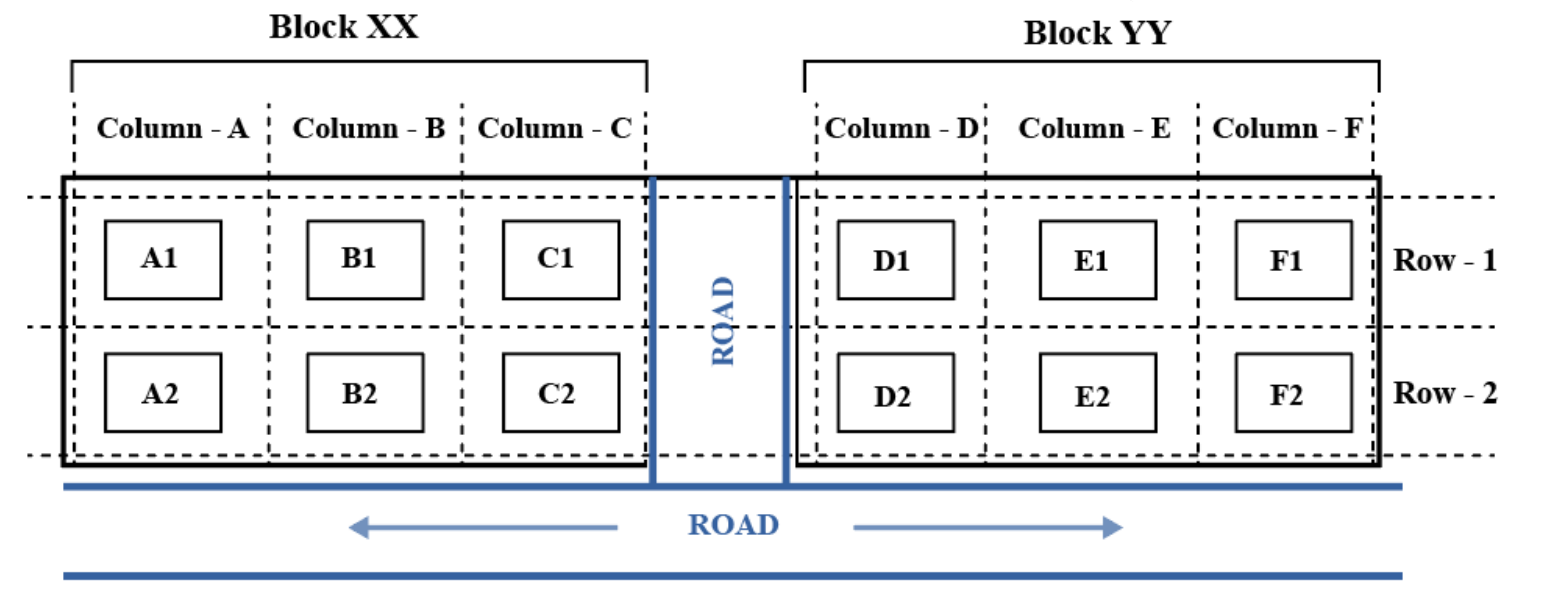
The schematic diagram below shows 12 rectangular houses in a housing complex. House numbers are mentioned in the rectangles representing the houses. The houses are located in six columns - Column-A through Column-F, and two rows - Row-1 and Row-2. The houses are divided into two blocks - Block XX and Block YY. The diagram also shows two roads, one passing in front of the houses in Row-2 and another between the two blocks. Some of the houses are occupied. The remaining ones are vacant and are the only ones available for sale. The road adjacency value of a house is the number of its sides adjacent to a road. For example, the road adjacency values of C2, F2, and B1 are 2, 1, and 0, respectively. The neighbour count of a house is the number of sides of that house adjacent to occupied houses in the same block. For example, E1 and C1 can have the maximum possible neighbour counts of 3 and 2, respectively. The base price of a vacant house is Rs. 10 lakhs if the house does not have a parking space, and Rs. 12 lakhs if it does. The quoted price (in lakhs of Rs.) of a vacant house is calculated as (base price) + 5 × (road adjacency value) + 3 × (neighbour count). The following information is also known. 1. The maximum quoted price of a house in Block XX is Rs. 24 lakhs. The minimum quoted price of a house in block YY is Rs. 15 lakhs, and one such house is in Column-E. 2. Row-1 has two occupied houses, one in each block. 3. Both houses in Column-E are vacant. Each of Column-D and Column-F has at least one occupied house. 4. There is only one house with parking space in Block YY.

Schematic layout of 12 rectangular houses in a housing complex. Six columns (Column-A to Column-F) and two rows (Row-1, Row-2). Houses are split into two blocks. Block XX = Columns A, B, C. Block YY = Columns D, E, F. A road runs between the two blocks (vertical, separating Block XX from Block YY) and another road runs in front of Row-2 (horizontal, along the bottom).

Column-AColumn-BColumn-C(road)Column-DColumn-EColumn-F
Row-1A1B1C1D1E1F1
Row-2A2B2C2D2E2F2

Block XX contains A1, B1, C1, A2, B2, C2. Block YY contains D1, E1, F1, D2, E2, F2. The road between blocks lies between Column-C and Column-D. The Row-2 road runs along the bottom edge of Row-2 houses.

Q1PuzzlesTITA

How many houses are vacant in Block XX?

Show solution

Correct answer: 3

Twelve houses sit in two rows and six columns. Block XX is columns A, B, C; Block YY is columns D, E, F. One road runs vertically between column C and column D; another runs horizontally along the bottom of Row-2.

ABC‖ road ‖DEF
Row-1A1B1C1D1E1F1
Row-2A2B2C2D2E2F2

Road-adjacency value = number of a house's sides touching a road:

A1B1C1D1E1F1A2B2C2D2E2F2
001100112211

Neighbour count = number of a house's sides touching occupied houses in the same block (a road or the block boundary never counts). For a vacant house, quoted price =base+5×(road value)+3×(neighbour count)= \text{base} + 5 \times (\text{road value}) + 3 \times (\text{neighbour count}), where base =10= 10 without parking or 1212 with parking.

Pinning Block XX from "highest price in XX = 24". Testing each house, the only vacant one that can reach exactly 24 is B2: road value 1, no parking, price =10+5+3n=15+3n= 10 + 5 + 3n = 15 + 3n, which is 24 only when n=3n = 3 — so all three of B2's block-neighbours A2, C2, B1 are occupied. Row-1 has just one occupied house per block, so B1 is XX's occupied Row-1 house and A1, C1 are vacant.

Pinning Block YY from "lowest price = 15, reached in column E". E1 and E2 are both vacant. Block YY has exactly one house with parking, and columns D and F each need an occupied house. Row-1 has one occupied YY house, and since E1 is vacant it is D1 or F1.

  • If D1 were the occupied one, F1 would be vacant; then E1 and F1 are both low-road-value vacant houses worth base+3\text{base} + 3, and with only one parking to go round, at least one of them is 10+3=13<1510 + 3 = 13 < 15 — breaking the "lowest = 15" rule. So this case fails.
  • Hence F1 is occupied, D1 is vacant, and column D's occupied house is D2.

E1's neighbours are D1 (vacant), F1 (occupied), E2 (vacant), so its neighbour count is 1 and its price is base+3\text{base} + 3. For the lowest price to be 15, E1 must carry the parking: 12+3=1512 + 3 = 15. That uses up YY's single parking, so every other vacant YY house has base 10.

Solved grid (✔ occupied, ∘ vacant; F2 is the one house the clues leave open):

ABCDEF
Row-1∘ A1✔ B1∘ C1∘ D1∘ E1 (parking)✔ F1
Row-2✔ A2∘ B2✔ C2✔ D2∘ E2? F2

Definitely occupied: B1, A2, C2, F1, D2. Definitely vacant: A1, C1, B2, D1, E1, E2. Only F2 is undetermined.

This question. Block XX is A1, B1, C1, A2, B2, C2. The occupied ones are B1, A2, C2; the vacant ones are A1, C1, B2 — that is 3 vacant houses.

💡 Teacher tip: The single number "24" cracks the whole block: only B2 can reach it, and only when all three of its neighbours are occupied.

Answer: 3

Q2PuzzlesMCQ

Which of the following houses is definitely occupied?

Show solution

Correct answer: C

Twelve houses sit in two rows and six columns. Block XX is columns A, B, C; Block YY is columns D, E, F. One road runs vertically between column C and column D; another runs horizontally along the bottom of Row-2.

ABC‖ road ‖DEF
Row-1A1B1C1D1E1F1
Row-2A2B2C2D2E2F2

Road-adjacency value = number of a house's sides touching a road:

A1B1C1D1E1F1A2B2C2D2E2F2
001100112211

Neighbour count = number of a house's sides touching occupied houses in the same block (a road or the block boundary never counts). For a vacant house, quoted price =base+5×(road value)+3×(neighbour count)= \text{base} + 5 \times (\text{road value}) + 3 \times (\text{neighbour count}), where base =10= 10 without parking or 1212 with parking.

Pinning Block XX from "highest price in XX = 24". Testing each house, the only vacant one that can reach exactly 24 is B2: road value 1, no parking, price =10+5+3n=15+3n= 10 + 5 + 3n = 15 + 3n, which is 24 only when n=3n = 3 — so all three of B2's block-neighbours A2, C2, B1 are occupied. Row-1 has just one occupied house per block, so B1 is XX's occupied Row-1 house and A1, C1 are vacant.

Pinning Block YY from "lowest price = 15, reached in column E". E1 and E2 are both vacant. Block YY has exactly one house with parking, and columns D and F each need an occupied house. Row-1 has one occupied YY house, and since E1 is vacant it is D1 or F1.

  • If D1 were the occupied one, F1 would be vacant; then E1 and F1 are both low-road-value vacant houses worth base+3\text{base} + 3, and with only one parking to go round, at least one of them is 10+3=13<1510 + 3 = 13 < 15 — breaking the "lowest = 15" rule. So this case fails.
  • Hence F1 is occupied, D1 is vacant, and column D's occupied house is D2.

E1's neighbours are D1 (vacant), F1 (occupied), E2 (vacant), so its neighbour count is 1 and its price is base+3\text{base} + 3. For the lowest price to be 15, E1 must carry the parking: 12+3=1512 + 3 = 15. That uses up YY's single parking, so every other vacant YY house has base 10.

Solved grid (✔ occupied, ∘ vacant; F2 is the one house the clues leave open):

ABCDEF
Row-1∘ A1✔ B1∘ C1∘ D1∘ E1 (parking)✔ F1
Row-2✔ A2∘ B2✔ C2✔ D2∘ E2? F2

Definitely occupied: B1, A2, C2, F1, D2. Definitely vacant: A1, C1, B2, D1, E1, E2. Only F2 is undetermined.

This question. Check the four options against the grid: A1 is vacant, F2 is undetermined, D2 is occupied and B1 is occupied. Of the listed options, B1 is definitely occupied (it is the occupied neighbour that lets B2 reach 24, and it is Row-1's XX occupant).

Answer: B1

Q3PuzzlesMCQ

Which of the following options best describes the number of vacant houses in Row-2?

Show solution

Correct answer: D

Twelve houses sit in two rows and six columns. Block XX is columns A, B, C; Block YY is columns D, E, F. One road runs vertically between column C and column D; another runs horizontally along the bottom of Row-2.

ABC‖ road ‖DEF
Row-1A1B1C1D1E1F1
Row-2A2B2C2D2E2F2

Road-adjacency value = number of a house's sides touching a road:

A1B1C1D1E1F1A2B2C2D2E2F2
001100112211

Neighbour count = number of a house's sides touching occupied houses in the same block (a road or the block boundary never counts). For a vacant house, quoted price =base+5×(road value)+3×(neighbour count)= \text{base} + 5 \times (\text{road value}) + 3 \times (\text{neighbour count}), where base =10= 10 without parking or 1212 with parking.

Pinning Block XX from "highest price in XX = 24". Testing each house, the only vacant one that can reach exactly 24 is B2: road value 1, no parking, price =10+5+3n=15+3n= 10 + 5 + 3n = 15 + 3n, which is 24 only when n=3n = 3 — so all three of B2's block-neighbours A2, C2, B1 are occupied. Row-1 has just one occupied house per block, so B1 is XX's occupied Row-1 house and A1, C1 are vacant.

Pinning Block YY from "lowest price = 15, reached in column E". E1 and E2 are both vacant. Block YY has exactly one house with parking, and columns D and F each need an occupied house. Row-1 has one occupied YY house, and since E1 is vacant it is D1 or F1.

  • If D1 were the occupied one, F1 would be vacant; then E1 and F1 are both low-road-value vacant houses worth base+3\text{base} + 3, and with only one parking to go round, at least one of them is 10+3=13<1510 + 3 = 13 < 15 — breaking the "lowest = 15" rule. So this case fails.
  • Hence F1 is occupied, D1 is vacant, and column D's occupied house is D2.

E1's neighbours are D1 (vacant), F1 (occupied), E2 (vacant), so its neighbour count is 1 and its price is base+3\text{base} + 3. For the lowest price to be 15, E1 must carry the parking: 12+3=1512 + 3 = 15. That uses up YY's single parking, so every other vacant YY house has base 10.

Solved grid (✔ occupied, ∘ vacant; F2 is the one house the clues leave open):

ABCDEF
Row-1∘ A1✔ B1∘ C1∘ D1∘ E1 (parking)✔ F1
Row-2✔ A2∘ B2✔ C2✔ D2∘ E2? F2

Definitely occupied: B1, A2, C2, F1, D2. Definitely vacant: A1, C1, B2, D1, E1, E2. Only F2 is undetermined.

This question. Row-2 is A2, B2, C2, D2, E2, F2. From the grid A2, C2, D2 are occupied; B2 and E2 are vacant; F2 is the one open house.

  • If F2 is occupied, the vacant Row-2 houses are B2, E2 — 2.
  • If F2 is vacant, they are B2, E2, F2 — 3.

So the count is either 2 or 3.

Answer: Either 2 or 3

Q4PuzzlesTITA

What is the maximum possible quoted price (in lakhs of Rs.) for a vacant house in Column-E?

Show solution

Correct answer: 21

Twelve houses sit in two rows and six columns. Block XX is columns A, B, C; Block YY is columns D, E, F. One road runs vertically between column C and column D; another runs horizontally along the bottom of Row-2.

ABC‖ road ‖DEF
Row-1A1B1C1D1E1F1
Row-2A2B2C2D2E2F2

Road-adjacency value = number of a house's sides touching a road:

A1B1C1D1E1F1A2B2C2D2E2F2
001100112211

Neighbour count = number of a house's sides touching occupied houses in the same block (a road or the block boundary never counts). For a vacant house, quoted price =base+5×(road value)+3×(neighbour count)= \text{base} + 5 \times (\text{road value}) + 3 \times (\text{neighbour count}), where base =10= 10 without parking or 1212 with parking.

Pinning Block XX from "highest price in XX = 24". Testing each house, the only vacant one that can reach exactly 24 is B2: road value 1, no parking, price =10+5+3n=15+3n= 10 + 5 + 3n = 15 + 3n, which is 24 only when n=3n = 3 — so all three of B2's block-neighbours A2, C2, B1 are occupied. Row-1 has just one occupied house per block, so B1 is XX's occupied Row-1 house and A1, C1 are vacant.

Pinning Block YY from "lowest price = 15, reached in column E". E1 and E2 are both vacant. Block YY has exactly one house with parking, and columns D and F each need an occupied house. Row-1 has one occupied YY house, and since E1 is vacant it is D1 or F1.

  • If D1 were the occupied one, F1 would be vacant; then E1 and F1 are both low-road-value vacant houses worth base+3\text{base} + 3, and with only one parking to go round, at least one of them is 10+3=13<1510 + 3 = 13 < 15 — breaking the "lowest = 15" rule. So this case fails.
  • Hence F1 is occupied, D1 is vacant, and column D's occupied house is D2.

E1's neighbours are D1 (vacant), F1 (occupied), E2 (vacant), so its neighbour count is 1 and its price is base+3\text{base} + 3. For the lowest price to be 15, E1 must carry the parking: 12+3=1512 + 3 = 15. That uses up YY's single parking, so every other vacant YY house has base 10.

Solved grid (✔ occupied, ∘ vacant; F2 is the one house the clues leave open):

ABCDEF
Row-1∘ A1✔ B1∘ C1∘ D1∘ E1 (parking)✔ F1
Row-2✔ A2∘ B2✔ C2✔ D2∘ E2? F2

Definitely occupied: B1, A2, C2, F1, D2. Definitely vacant: A1, C1, B2, D1, E1, E2. Only F2 is undetermined.

This question. Column E has E1 and E2, both vacant.

  • E1: road value 0, parking (base 12), neighbour count 1 (only F1 occupied) — price =12+0+3=15= 12 + 0 + 3 = 15, fixed.
  • E2: road value 1, base 10 (parking is used up by E1), neighbours D2 (occupied), F2 (open), E1 (vacant). If F2 is occupied the neighbour count is 2, giving 10+5+6=2110 + 5 + 6 = 21; if F2 is vacant it is 1818.

The largest possible is E2 = 21 (when F2 is occupied).

Answer: 21

Q5PuzzlesMCQ

Which house in Block YY has parking space?

Show solution

Correct answer: A

Twelve houses sit in two rows and six columns. Block XX is columns A, B, C; Block YY is columns D, E, F. One road runs vertically between column C and column D; another runs horizontally along the bottom of Row-2.

ABC‖ road ‖DEF
Row-1A1B1C1D1E1F1
Row-2A2B2C2D2E2F2

Road-adjacency value = number of a house's sides touching a road:

A1B1C1D1E1F1A2B2C2D2E2F2
001100112211

Neighbour count = number of a house's sides touching occupied houses in the same block (a road or the block boundary never counts). For a vacant house, quoted price =base+5×(road value)+3×(neighbour count)= \text{base} + 5 \times (\text{road value}) + 3 \times (\text{neighbour count}), where base =10= 10 without parking or 1212 with parking.

Pinning Block XX from "highest price in XX = 24". Testing each house, the only vacant one that can reach exactly 24 is B2: road value 1, no parking, price =10+5+3n=15+3n= 10 + 5 + 3n = 15 + 3n, which is 24 only when n=3n = 3 — so all three of B2's block-neighbours A2, C2, B1 are occupied. Row-1 has just one occupied house per block, so B1 is XX's occupied Row-1 house and A1, C1 are vacant.

Pinning Block YY from "lowest price = 15, reached in column E". E1 and E2 are both vacant. Block YY has exactly one house with parking, and columns D and F each need an occupied house. Row-1 has one occupied YY house, and since E1 is vacant it is D1 or F1.

  • If D1 were the occupied one, F1 would be vacant; then E1 and F1 are both low-road-value vacant houses worth base+3\text{base} + 3, and with only one parking to go round, at least one of them is 10+3=13<1510 + 3 = 13 < 15 — breaking the "lowest = 15" rule. So this case fails.
  • Hence F1 is occupied, D1 is vacant, and column D's occupied house is D2.

E1's neighbours are D1 (vacant), F1 (occupied), E2 (vacant), so its neighbour count is 1 and its price is base+3\text{base} + 3. For the lowest price to be 15, E1 must carry the parking: 12+3=1512 + 3 = 15. That uses up YY's single parking, so every other vacant YY house has base 10.

Solved grid (✔ occupied, ∘ vacant; F2 is the one house the clues leave open):

ABCDEF
Row-1∘ A1✔ B1∘ C1∘ D1∘ E1 (parking)✔ F1
Row-2✔ A2∘ B2✔ C2✔ D2∘ E2? F2

Definitely occupied: B1, A2, C2, F1, D2. Definitely vacant: A1, C1, B2, D1, E1, E2. Only F2 is undetermined.

This question. To keep Block YY's lowest price at 15 (reached in column E), E1 must hold the parking: its neighbour count is 1, so without parking it would be 10+3=1310 + 3 = 13, dropping the minimum below 15. Giving E1 parking makes it 12+3=1512 + 3 = 15, and since YY has exactly one parking house, no other YY house has it.

Answer: E1

Set · Puzzles

Faculty members in a management school can belong to one of four departments - Finance and Accounting (F&A), Marketing and Strategy (M&S), Operations and Quants (O&Q) and Behaviour and Human Resources (B&H). The numbers of faculty members in F&A, M&S, O&Q and B&H departments are 9, 7, 5 and 3 respectively. Prof. Pakrasi, Prof. Qureshi, Prof. Ramaswamy and Prof. Samuel are four members of the school's faculty who were candidates for the post of the Dean of the school. Only one of the candidates was from O&Q. Every faculty member, including the four candidates, voted for the post. In each department, all the faculty members who were not candidates voted for the same candidate. The rules for the election are listed below. 1. There cannot be more than two candidates from a single department. 2. A candidate cannot vote for himself/herself. 3. Faculty members cannot vote for a candidate from their own department. After the election, it was observed that Prof. Pakrasi received 3 votes, Prof. Qureshi received 14 votes, Prof. Ramaswamy received 6 votes and Prof. Samuel received 1 vote. Prof. Pakrasi voted for Prof. Ramaswamy, Prof. Qureshi for Prof. Samuel, Prof. Ramaswamy for Prof. Qureshi and Prof. Samuel for Prof. Pakrasi.

Q6PuzzlesMCQ

Which two candidates can belong to the same department?

Show solution

Correct answer: A

Setting up. Department sizes are F&A 9, M&S 7, O&Q 5, B&H 3 (24 faculty in all). The four candidates are Pakrasi (P), Qureshi (Q), Ramaswamy (R) and Samuel (S). Rules: everyone votes; within a department all the non-candidates vote for the same person; nobody votes for themselves or for a candidate from their own department; exactly one candidate is from O&Q; at most two candidates per department.

The tally: P 3, Q 14, R 6, S 1 (adds to 24 ✓). The candidates' own votes are given: P→R, Q→S, R→Q, S→P.

Separate each candidate's total into "one candidate ballot" plus "department blocks":

CandidateVote from a candidateStill needed from blocks
P (3)S→P2
Q (14)R→Q13
R (6)P→R5
S (1)Q→S0

The 20 non-candidates split into department blocks. Since exactly one candidate is in O&Q, its block is 51=45-1=4. Matching the needed numbers to possible block sizes: the "2" can only be the B&H block (size 2), the "5" must be the M&S block (size 5, so M&S has 2 candidates), which leaves F&A with no candidate — its whole block of 9 goes to Q, and with the O&Q block of 4 that gives Q his 13. S gets no block at all.

Placing the candidates. M&S holds two candidates; R can't be one (its own block votes R). Q and S can't share a department (Q votes S), so the M&S pair must be Pakrasi and Qureshi. That leaves Ramaswamy and Samuel for O&Q and B&H — one each, and either arrangement obeys every rule.

The solved picture:

DepartmentSizeCandidates in itIts non-candidate block voted for
F&A9noneQureshi (9 votes)
M&S7Pakrasi & QureshiRamaswamy (5 votes)
O&Q5one of Ramaswamy / SamuelQureshi (4 votes)
B&H3the other of Ramaswamy / SamuelPakrasi (2 votes)

Check: Q =9+4+1=14=9+4+1=14, R =5+1=6=5+1=6, P =2+1=3=2+1=3, S =1=1. ✓

This question — which two candidates can be in the same department?

The only department that holds two candidates is M&S, and that pair is Pakrasi and Qureshi. No other pair can share a department: R is barred from M&S, and Samuel cannot sit with Pakrasi (he voted for Pakrasi) or with Qureshi (Qureshi voted for him).

Answer: Prof. Pakrasi and Prof. Qureshi

Q7PuzzlesMCQ

Which of the following can be the number of votes that Prof. Qureshi received from a single department?

Show solution

Correct answer: D

Recall the solved picture (from splitting each candidate's votes into one candidate ballot plus whole-department blocks):

DepartmentSizeCandidates in itIts non-candidate block voted for
F&A9noneQureshi (9 votes)
M&S7Pakrasi & QureshiRamaswamy (5 votes)
O&Q5one of Ramaswamy / SamuelQureshi (4 votes)
B&H3the other of Ramaswamy / SamuelPakrasi (2 votes)

This question — how many votes could Qureshi have got from a single department?

Qureshi's 14 votes come from: the F&A block — all 9 faculty; the O&Q block of 4 (plus Ramaswamy's own vote, 1, if Ramaswamy sits in O&Q, so 4 or 5 from there); and 0 or 1 from B&H depending on where Ramaswamy sits. M&S gives him nothing.

So a single department can contribute 9 (F&A), 4 or 5 (O&Q), or 0/1 (B&H). Of the options 7, 6, 8, 9, only 9 is achievable.

Answer: 9

Q8PuzzlesMCQ

If Prof. Samuel belongs to B&H, which of the following statements is/are true? Statement A: Prof. Pakrasi belongs to M&S. Statement B: Prof. Ramaswamy belongs to O&Q

Show solution

Correct answer: D

Recall the solved picture:

DepartmentSizeCandidates in itIts non-candidate block voted for
F&A9noneQureshi (9 votes)
M&S7Pakrasi & QureshiRamaswamy (5 votes)
O&Q5one of Ramaswamy / SamuelQureshi (4 votes)
B&H3the other of Ramaswamy / SamuelPakrasi (2 votes)

Ramaswamy and Samuel take O&Q and B&H, one each — that is the only piece left open.

This question — if Samuel belongs to B&H

If Samuel is in B&H, then Ramaswamy must be the O&Q candidate. Now test both statements:

  • Statement A: "Pakrasi belongs to M&S." Pakrasi is always in the M&S pair — true.
  • Statement B: "Ramaswamy belongs to O&Q." With Samuel in B&H, Ramaswamy is forced into O&Q — true.

Both hold.

Answer: Both statements A and B

Q9PuzzlesMCQ

What best can be concluded about the candidate from O&Q?

Show solution

Correct answer: B

Recall the solved picture:

DepartmentSizeCandidates in itIts non-candidate block voted for
F&A9noneQureshi (9 votes)
M&S7Pakrasi & QureshiRamaswamy (5 votes)
O&Q5one of Ramaswamy / SamuelQureshi (4 votes)
B&H3the other of Ramaswamy / SamuelPakrasi (2 votes)

This question — what can we conclude about the O&Q candidate?

The M&S pair is Pakrasi and Qureshi, and F&A has no candidate, so the single O&Q candidate must be Ramaswamy or Samuel. Both arrangements (Ramaswamy in O&Q, or Samuel in O&Q) fit every clue, so we cannot pin it down further.

Answer: It was either Prof. Ramaswamy or Prof. Samuel.

Q10PuzzlesMCQ

Which of the following statements is/are true? Statement A: Non-candidates from M&S voted for Prof. Qureshi. Statement B: Non-candidates from F&A voted for Prof. Qureshi.

Show solution

Correct answer: B

Recall the solved picture:

DepartmentSizeCandidates in itIts non-candidate block voted for
F&A9noneQureshi (9 votes)
M&S7Pakrasi & QureshiRamaswamy (5 votes)
O&Q5one of Ramaswamy / SamuelQureshi (4 votes)
B&H3the other of Ramaswamy / SamuelPakrasi (2 votes)

This question — evaluating the two statements

  • Statement A: "Non-candidates from M&S voted for Qureshi." The M&S block (5 votes) actually went to Ramaswamyfalse.
  • Statement B: "Non-candidates from F&A voted for Qureshi." The whole F&A block of 9 went to Qureshitrue.

Answer: Only statement B

Set · Scheduling & Sequencing

A visa processing office (VPO) accepts visa applications in four categories - US, UK, Schengen, and Others. The applications are scheduled for processing in twenty 15-minute slots starting at 9:00 am and ending at 2:00 pm. Ten applications are scheduled in each slot. There are ten counters in the office, four dedicated to US applications, and two each for UK applications, Schengen applications and Others applications. Applicants are called in for processing sequentially on a first-come-first-served basis whenever a counter gets freed for their category. The processing time for an application is the same within each category. But it may vary across the categories. Each US and UK application requires 10 minutes of processing time. Depending on the number of applications in a category and time required to process an application for that category, it is possible that an applicant for a slot may be processed later. On a particular day, Ira, Vijay and Nandini were scheduled for Schengen visa processing in that order. They had a 9:15 am slot but entered the VPO at 9:20 am. When they entered the office, exactly six out of the ten counters were either processing applications, or had finished processing one and ready to start processing the next. Mahira and Osman were scheduled in the 9:30 am slot on that day for visa processing in the Others category. The following additional information is known about that day. 1. All slots were full. 2. The number of US applications was the same in all the slots. The same was true for the other three categories. 3. 50% of the applications were US applications. 4. All applicants except Ira, Vijay and Nandini arrived on time. 5. Vijay was called to a counter at 9:25 am.

Q11Scheduling & SequencingTITA

How many UK applications were scheduled on that day?

Show solution

Correct answer: 0

The office runs 20 slots of 15 minutes each from 9:00 am to 2:00 pm, with 10 applications booked per slot — 200 applications in all. There are 10 counters: 4 for US, 2 for UK, 2 for Schengen, 2 for Others. Each category has the same number of applications in every slot, and half of all applications are US.

Working out the category split per slot.

  1. US per day =50%×200=100= 50\% \times 200 = 100, so US per slot =100/20=5= 100/20 = 5 (filling the 4 US counters, each application taking 10 minutes).
  2. That leaves 105=510 - 5 = 5 per slot to share, in fixed numbers, among UK, Schengen and Others.
  3. Ira, Vijay and Nandini are three Schengen applicants in the 9:15 slot, so Schengen is at least 3 per slot. Mahira and Osman are two Others applicants in the 9:30 slot, so Others is at least 2 per slot.
  4. With UK + Schengen + Others = 5, Schengen 3\ge 3 and Others 2\ge 2, the only split is Schengen = 3, Others = 2, UK = 0.
CategoryCountersPer slotPer dayProcessing time
US4510010 min
UK20010 min
Schengen236012.5 min (found below)
Others22405\le 5 min (found below)

Finding the Schengen processing time. The 9:00 Schengen slot has three applicants; two start at 9:00 on the two counters and the third starts when a counter frees, at time tt later, finishing at 2t2t past 9:00. The trio Ira–Vijay–Nandini were the whole 9:15 Schengen slot but arrived at 9:20. Ira takes the counter that is already free at 9:20; Vijay takes the counter that frees when the 9:00 third applicant finishes, at 2t2t past 9:00. Vijay is called at 9:25, so 2t=252t = 25, giving t=12.5t = 12.5 minutes.

Schengen timeline (2 counters):

ApplicantStartEnd
9:00 first9:009:12:30
9:00 second9:009:12:30
9:00 third9:12:309:25
Ira9:209:32:30
Vijay9:259:37:30
Nandini9:32:309:45

The "six busy counters at 9:20" check. At 9:20 all four US counters are working and both Schengen counters are engaged (one on the 9:00 third applicant, the other just picked up Ira) — that is six. So the Others counters must both be idle at 9:20. Each Others slot brings 2 applicants; for the 9:00 pair and the 9:15 pair to both be done by 9:20, an Others application must take at most 5 minutes. Both counters then sit idle until Mahira and Osman start at 9:30.

This question. Each slot already has US = 5, Schengen = 3 and Others = 2, which sums to 10 with no room for UK. So UK is 0 per slot, and across all 20 slots the number of UK applications is 00.

💡 Teacher tip: "Six counters busy at 9:20" is the pivot clue — it is the only thing that forces the Others time down to 5 minutes and confirms UK is empty.

Answer: 0

Q12Scheduling & SequencingTITA

What is the maximum possible value of the total time (in minutes, nearest to its integer value) required to process all applications in the Others category on that day?

Show solution

Correct answer: 200

The office runs 20 slots of 15 minutes each from 9:00 am to 2:00 pm, with 10 applications booked per slot — 200 applications in all. There are 10 counters: 4 for US, 2 for UK, 2 for Schengen, 2 for Others. Each category has the same number of applications in every slot, and half of all applications are US.

Working out the category split per slot.

  1. US per day =50%×200=100= 50\% \times 200 = 100, so US per slot =100/20=5= 100/20 = 5 (filling the 4 US counters, each application taking 10 minutes).
  2. That leaves 105=510 - 5 = 5 per slot to share, in fixed numbers, among UK, Schengen and Others.
  3. Ira, Vijay and Nandini are three Schengen applicants in the 9:15 slot, so Schengen is at least 3 per slot. Mahira and Osman are two Others applicants in the 9:30 slot, so Others is at least 2 per slot.
  4. With UK + Schengen + Others = 5, Schengen 3\ge 3 and Others 2\ge 2, the only split is Schengen = 3, Others = 2, UK = 0.
CategoryCountersPer slotPer dayProcessing time
US4510010 min
UK20010 min
Schengen236012.5 min (found below)
Others22405\le 5 min (found below)

Finding the Schengen processing time. The 9:00 Schengen slot has three applicants; two start at 9:00 on the two counters and the third starts when a counter frees, at time tt later, finishing at 2t2t past 9:00. The trio Ira–Vijay–Nandini were the whole 9:15 Schengen slot but arrived at 9:20. Ira takes the counter that is already free at 9:20; Vijay takes the counter that frees when the 9:00 third applicant finishes, at 2t2t past 9:00. Vijay is called at 9:25, so 2t=252t = 25, giving t=12.5t = 12.5 minutes.

Schengen timeline (2 counters):

ApplicantStartEnd
9:00 first9:009:12:30
9:00 second9:009:12:30
9:00 third9:12:309:25
Ira9:209:32:30
Vijay9:259:37:30
Nandini9:32:309:45

The "six busy counters at 9:20" check. At 9:20 all four US counters are working and both Schengen counters are engaged (one on the 9:00 third applicant, the other just picked up Ira) — that is six. So the Others counters must both be idle at 9:20. Each Others slot brings 2 applicants; for the 9:00 pair and the 9:15 pair to both be done by 9:20, an Others application must take at most 5 minutes. Both counters then sit idle until Mahira and Osman start at 9:30.

This question. There are 40 Others applications over the day (2 per slot). Each takes the same time tOt_O, and the six-busy-counters condition forces tO5t_O \le 5 minutes. The total processing time is 40×tO40 \times t_O, largest when tO=5t_O = 5:

40×5=200 minutes.40 \times 5 = 200 \text{ minutes.}

Answer: 200

Q13Scheduling & SequencingMCQ

Which of the following is the closest to the time when Nandini’s application process got over?

Show solution

Correct answer: D

The office runs 20 slots of 15 minutes each from 9:00 am to 2:00 pm, with 10 applications booked per slot — 200 applications in all. There are 10 counters: 4 for US, 2 for UK, 2 for Schengen, 2 for Others. Each category has the same number of applications in every slot, and half of all applications are US.

Working out the category split per slot.

  1. US per day =50%×200=100= 50\% \times 200 = 100, so US per slot =100/20=5= 100/20 = 5 (filling the 4 US counters, each application taking 10 minutes).
  2. That leaves 105=510 - 5 = 5 per slot to share, in fixed numbers, among UK, Schengen and Others.
  3. Ira, Vijay and Nandini are three Schengen applicants in the 9:15 slot, so Schengen is at least 3 per slot. Mahira and Osman are two Others applicants in the 9:30 slot, so Others is at least 2 per slot.
  4. With UK + Schengen + Others = 5, Schengen 3\ge 3 and Others 2\ge 2, the only split is Schengen = 3, Others = 2, UK = 0.
CategoryCountersPer slotPer dayProcessing time
US4510010 min
UK20010 min
Schengen236012.5 min (found below)
Others22405\le 5 min (found below)

Finding the Schengen processing time. The 9:00 Schengen slot has three applicants; two start at 9:00 on the two counters and the third starts when a counter frees, at time tt later, finishing at 2t2t past 9:00. The trio Ira–Vijay–Nandini were the whole 9:15 Schengen slot but arrived at 9:20. Ira takes the counter that is already free at 9:20; Vijay takes the counter that frees when the 9:00 third applicant finishes, at 2t2t past 9:00. Vijay is called at 9:25, so 2t=252t = 25, giving t=12.5t = 12.5 minutes.

Schengen timeline (2 counters):

ApplicantStartEnd
9:00 first9:009:12:30
9:00 second9:009:12:30
9:00 third9:12:309:25
Ira9:209:32:30
Vijay9:259:37:30
Nandini9:32:309:45

The "six busy counters at 9:20" check. At 9:20 all four US counters are working and both Schengen counters are engaged (one on the 9:00 third applicant, the other just picked up Ira) — that is six. So the Others counters must both be idle at 9:20. Each Others slot brings 2 applicants; for the 9:00 pair and the 9:15 pair to both be done by 9:20, an Others application must take at most 5 minutes. Both counters then sit idle until Mahira and Osman start at 9:30.

This question. Nandini is the third of the trio. Ira finishes at 9:32:30 and Vijay at 9:37:30, so the next counter to free is Ira's at 9:32:30. Nandini starts then and takes 12.5 minutes:

9:32:30+12:30=9:45.9{:}32{:}30 + 12{:}30 = 9{:}45.

Among the options this is exactly 9:45 am.

Answer: 9:45 am

Q14Scheduling & SequencingMCQ

Which of the following statements is false?

Show solution

Correct answer: B

The office runs 20 slots of 15 minutes each from 9:00 am to 2:00 pm, with 10 applications booked per slot — 200 applications in all. There are 10 counters: 4 for US, 2 for UK, 2 for Schengen, 2 for Others. Each category has the same number of applications in every slot, and half of all applications are US.

Working out the category split per slot.

  1. US per day =50%×200=100= 50\% \times 200 = 100, so US per slot =100/20=5= 100/20 = 5 (filling the 4 US counters, each application taking 10 minutes).
  2. That leaves 105=510 - 5 = 5 per slot to share, in fixed numbers, among UK, Schengen and Others.
  3. Ira, Vijay and Nandini are three Schengen applicants in the 9:15 slot, so Schengen is at least 3 per slot. Mahira and Osman are two Others applicants in the 9:30 slot, so Others is at least 2 per slot.
  4. With UK + Schengen + Others = 5, Schengen 3\ge 3 and Others 2\ge 2, the only split is Schengen = 3, Others = 2, UK = 0.
CategoryCountersPer slotPer dayProcessing time
US4510010 min
UK20010 min
Schengen236012.5 min (found below)
Others22405\le 5 min (found below)

Finding the Schengen processing time. The 9:00 Schengen slot has three applicants; two start at 9:00 on the two counters and the third starts when a counter frees, at time tt later, finishing at 2t2t past 9:00. The trio Ira–Vijay–Nandini were the whole 9:15 Schengen slot but arrived at 9:20. Ira takes the counter that is already free at 9:20; Vijay takes the counter that frees when the 9:00 third applicant finishes, at 2t2t past 9:00. Vijay is called at 9:25, so 2t=252t = 25, giving t=12.5t = 12.5 minutes.

Schengen timeline (2 counters):

ApplicantStartEnd
9:00 first9:009:12:30
9:00 second9:009:12:30
9:00 third9:12:309:25
Ira9:209:32:30
Vijay9:259:37:30
Nandini9:32:309:45

The "six busy counters at 9:20" check. At 9:20 all four US counters are working and both Schengen counters are engaged (one on the 9:00 third applicant, the other just picked up Ira) — that is six. So the Others counters must both be idle at 9:20. Each Others slot brings 2 applicants; for the 9:00 pair and the 9:15 pair to both be done by 9:20, an Others application must take at most 5 minutes. Both counters then sit idle until Mahira and Osman start at 9:30.

This question. Key times: Nandini finishes at 9:45, Vijay at 9:37:30, while Mahira and Osman (Others, 9:30 slot) start at 9:30 and finish by 9:35.

  • "Osman completed before 9:45 am." Osman is done by 9:35 — true.
  • "Mahira started after Nandini's." Mahira starts at 9:30, Nandini at 9:32:30, so Mahira starts beforefalse.
  • "Osman completed before Vijay's." Osman by 9:35, Vijay at 9:37:30 — true.
  • "Mahira completed before Nandini's." Mahira by 9:35, Nandini at 9:45 — true.

The false statement is that Mahira's process started after Nandini's.

Answer: The application process of Mahira started after Nandini's.

Q15Scheduling & SequencingMCQ

When did the application processing for all US applicants get over on that day?

Show solution

Correct answer: A

The office runs 20 slots of 15 minutes each from 9:00 am to 2:00 pm, with 10 applications booked per slot — 200 applications in all. There are 10 counters: 4 for US, 2 for UK, 2 for Schengen, 2 for Others. Each category has the same number of applications in every slot, and half of all applications are US.

Working out the category split per slot.

  1. US per day =50%×200=100= 50\% \times 200 = 100, so US per slot =100/20=5= 100/20 = 5 (filling the 4 US counters, each application taking 10 minutes).
  2. That leaves 105=510 - 5 = 5 per slot to share, in fixed numbers, among UK, Schengen and Others.
  3. Ira, Vijay and Nandini are three Schengen applicants in the 9:15 slot, so Schengen is at least 3 per slot. Mahira and Osman are two Others applicants in the 9:30 slot, so Others is at least 2 per slot.
  4. With UK + Schengen + Others = 5, Schengen 3\ge 3 and Others 2\ge 2, the only split is Schengen = 3, Others = 2, UK = 0.
CategoryCountersPer slotPer dayProcessing time
US4510010 min
UK20010 min
Schengen236012.5 min (found below)
Others22405\le 5 min (found below)

Finding the Schengen processing time. The 9:00 Schengen slot has three applicants; two start at 9:00 on the two counters and the third starts when a counter frees, at time tt later, finishing at 2t2t past 9:00. The trio Ira–Vijay–Nandini were the whole 9:15 Schengen slot but arrived at 9:20. Ira takes the counter that is already free at 9:20; Vijay takes the counter that frees when the 9:00 third applicant finishes, at 2t2t past 9:00. Vijay is called at 9:25, so 2t=252t = 25, giving t=12.5t = 12.5 minutes.

Schengen timeline (2 counters):

ApplicantStartEnd
9:00 first9:009:12:30
9:00 second9:009:12:30
9:00 third9:12:309:25
Ira9:209:32:30
Vijay9:259:37:30
Nandini9:32:309:45

The "six busy counters at 9:20" check. At 9:20 all four US counters are working and both Schengen counters are engaged (one on the 9:00 third applicant, the other just picked up Ira) — that is six. So the Others counters must both be idle at 9:20. Each Others slot brings 2 applicants; for the 9:00 pair and the 9:15 pair to both be done by 9:20, an Others application must take at most 5 minutes. Both counters then sit idle until Mahira and Osman start at 9:30.

This question. US has 5 arrivals per slot across 4 counters at 10 minutes each. In each 15-minute slot the 4 counters can clear 4×1.5=64 \times 1.5 = 6 applications while only 5 arrive, so a small fixed backlog carries over and the finish time of each slot's last US applicant rises by 15 minutes per slot:

Slot startLast US of that slot finishes
9:009:20
9:159:35
9:309:50
...(+15 min each slot)

So the last US applicant of the slot starting at 9:00+15k9{:}00 + 15k minutes finishes at 9:20+15k9{:}20 + 15k. The final slot is the 20th (k=19k = 19):

9:20+15×19=9:20+285 min=2:05 pm.9{:}20 + 15 \times 19 = 9{:}20 + 285 \text{ min} = 2{:}05 \text{ pm.}

Answer: 2:05 pm

Set · Puzzles

Five restaurants, coded R1, R2, R3, R4 and R5 gave integer ratings to five gig workers - Ullas, Vasu, Waman, Xavier and Yusuf, on a scale of 1 to 5. The means of the ratings given by R1, R2, R3, R4 and R5 were 3.4, 2.2, 3.8, 2.8 and 3.4 respectively. The summary statistics of these ratings for the five workers is given below. * Range of ratings is defined as the difference between the maximum and minimum ratings awarded to a worker. The following is partial information about ratings of 1 and 5 awarded by the restaurants to the workers. (a) R1 awarded a rating of 5 to Waman, as did R2 to Xavier, R3 to Waman and Xavier, and R5 to Vasu. (b) R1 awarded a rating of 1 to Ullas, as did R2 to Waman and Yusuf, and R3 to Yusuf.

Summary statistics of ratings for the five workers (rows) vs statistic:

UllasVasuWamanXavierYusuf
Mean rating2.23.83.43.62.6
Median rating24443
Modal rating24551 and 4
Range of rating*33443
  • Range of ratings is defined as the difference between the maximum and minimum ratings awarded to a worker.
Q16PuzzlesTITA

How many individual ratings cannot be determined from the above information?

Show solution

Correct answer: 0

Setting up the grid. Five restaurants (R1–R5) each give an integer rating from 1 to 5 to five workers, so we have a 5×55\times5 table to fill. Two facts turn the averages into hard totals:

  • Multiply each restaurant's mean by 5 to get its row sum: R1 =17=17, R2 =11=11, R3 =19=19, R4 =14=14, R5 =17=17.
  • Multiply each worker's mean by 5 to get their column sum: Ullas =11=11, Vasu =19=19, Waman =17=17, Xavier =18=18, Yusuf =13=13. (Both sets add to 78 — a nice consistency check.)

Fixing each worker's five ratings from their sum, median, mode, range and the known 1's and 5's:

  1. Ullas (sum 11, median 2, mode 2, range 3, has a 1): the only set that fits is {1,2,2,2,4}\{1,2,2,2,4\}.
  2. Vasu (sum 19, median 4, mode 4, range 3, has a 5): only {2,4,4,4,5}\{2,4,4,4,5\}.
  3. Waman (sum 17, median 4, mode 5, range 4, has two 5's and a 1): the rest must be {2,4}\{2,4\}, giving {1,2,4,5,5}\{1,2,4,5,5\}.
  4. Xavier (sum 18, median 4, mode 5, range 4, has two 5's): the other three are {1,3,4}\{1,3,4\}, so {1,3,4,5,5}\{1,3,4,5,5\}.
  5. Yusuf (sum 13, median 3, modes 1 and 4, range 3, has two 1's): needs two 4's, so {1,1,3,4,4}\{1,1,3,4,4\}.

Placing the values using the row sums. R3 already has Waman 5, Xavier 5, Yusuf 1, so Ullas + Vasu =8=8, forcing both to 4. Ullas's remaining three cells must then all be 2. Working R2, R1, R4 and R5 the same way, everything lands in exactly one place.

The completed grid:

RestaurantUllasVasuWamanXavierYusufRow sum
R11453417
R22215111
R34455119
R42441314
R52524417

Every column matches its worker's mean, median, mode and range, so this grid is unique — there is no second way to fill it.

This question — how many ratings cannot be determined

Because the grid above is forced into one and only one arrangement, every single one of the 25 ratings is pinned down. None is left uncertain.

Answer: 0

Q17PuzzlesTITA

To how many workers did R2 give a rating of 4?

Show solution

Correct answer: 0

Recall the fully solved grid (built from the row and column sums plus each worker's median, mode and range — it is the unique fill):

RestaurantUllasVasuWamanXavierYusufRow sum
R11453417
R22215111
R34455119
R42441314
R52524417

This question — how many workers did R2 give a rating of 4?

Read across R2's row: Ullas 2, Vasu 2, Waman 1, Xavier 5, Yusuf 1. There is no 4 anywhere in that row.

Answer: 0

Q18PuzzlesTITA

What rating did R1 give to Xavier?

Show solution

Correct answer: 3

Recall the fully solved grid (the unique fill from the row/column sums and each worker's summary statistics):

RestaurantUllasVasuWamanXavierYusufRow sum
R11453417
R22215111
R34455119
R42441314
R52524417

This question — what rating did R1 give to Xavier?

In R1's row, Ullas 1, Waman 5 and Vasu 4 are already fixed, leaving Xavier + Yusuf =1710=7=17-10=7. Xavier's value comes from {1,3,4}\{1,3,4\} and Yusuf's from {3,4,4}\{3,4,4\}; the only pair adding to 7 that also keeps the R4 and R5 rows consistent is Xavier 3, Yusuf 4.

Answer: 3

Q19PuzzlesTITA

What is the median of the ratings given by R3 to the five workers?

Show solution

Correct answer: 4

Recall the fully solved grid:

RestaurantUllasVasuWamanXavierYusufRow sum
R11453417
R22215111
R34455119
R42441314
R52524417

This question — median of the five ratings R3 gave

R3's row is Ullas 4, Vasu 4, Waman 5, Xavier 5, Yusuf 1. Sort it: 1,4,4,5,51, 4, 4, 5, 5. The middle (third) value is the median.

Answer: 4

Q20PuzzlesMCQ

Which among the following restaurants gave its median rating to exactly one of the workers?

Show solution

Correct answer: C

Recall the fully solved grid:

RestaurantUllasVasuWamanXavierYusufRow sum
R11453417
R22215111
R34455119
R42441314
R52524417

This question — which restaurant gave its own median rating to exactly one worker?

Find each restaurant's median, then count how many of its five ratings equal that median:

RestaurantSorted ratingsMedianTimes median appears
R11, 3, 4, 4, 542
R21, 1, 2, 2, 522
R31, 4, 4, 5, 542
R41, 2, 3, 4, 431
R52, 2, 4, 4, 542

Only R4 gave its median rating (3) to exactly one worker — Yusuf.

Answer: R4