CATLab

CAT 2017 DILR Questions — Slot 2

The actual Data Interpretation & Logical Reasoning section from CAT 2017, Slot 2 — 32 questions in original paper order, each with a full worked solution. Tap an option (or type your answer) to check yourself before reading the solution.

32 questions24 MCQ · 8 TITA60 min section0/32 attempted
Set · Mixed Charts & Caselets

Funky Pizzeria was required to supply pizzas to three different parties. The total number of pizzas it had to deliver was 800, 70% of which were to be delivered to Party 3 and the rest equally divided between Party 1 and Party 2. Pizzas could be of Thin Crust (T) or Deep Dish (D) variety and come in either Normal Cheese (NC) or Extra Cheese (EC) versions. Hence, there are four types of pizzas: T-NC, T-EC, D-NC and D-EC. Partial information about proportions of T and NC pizzas ordered by the three parties is given below:

Thin crust (T)Normal cheese (NC)
Party 10.6
Party 20.550.3
Party 30.65
Total0.3750.52
Q1Mixed Charts & CaseletsMCQ

How many Thin Crust pizzas were to be delivered to Party 3?

Show solution

Correct answer: B

Set up the totals first. There are 800 pizzas in all. Party 3 gets 70%, i.e. 0.70×800=5600.70 \times 800 = 560. The remaining 800560=240800 - 560 = 240 are split equally, so Party 1 and Party 2 get 120 each.

Fill the Thin Crust (T) column. Overall Thin Crust =0.375×800=300= 0.375 \times 800 = 300.

  • Party 1: 0.6×120=720.6 \times 120 = 72
  • Party 2: 0.55×120=660.55 \times 120 = 66
  • Party 3 (by subtraction): 3007266=162300 - 72 - 66 = 162

Fill the Normal Cheese (NC) column. Overall Normal Cheese =0.52×800=416= 0.52 \times 800 = 416.

  • Party 2: 0.3×120=360.3 \times 120 = 36
  • Party 3: 0.65×560=3640.65 \times 560 = 364
  • Party 1 (by subtraction): 41636364=16416 - 36 - 364 = 16

Since Deep Dish == Total - Thin, and Extra Cheese == Total - Normal Cheese, the whole grid is now fixed:

PartyTotalThin (T)Deep Dish (D)Normal Cheese (NC)Extra Cheese (EC)
1120724816104
212066543684
3560162398364196
Total800300500416384

The question asks for Thin Crust pizzas going to Party 3. Reading straight off the Thin column, Party 3's Thin Crust count is 162.

Answer: 162 (Choice B)

Q2Mixed Charts & CaseletsMCQ

How many Normal Cheese pizzas were required to be delivered to Party 1?

Show solution

Correct answer: C

Set up the totals first. There are 800 pizzas in all. Party 3 gets 70%, i.e. 0.70×800=5600.70 \times 800 = 560. The remaining 800560=240800 - 560 = 240 are split equally, so Party 1 and Party 2 get 120 each.

Fill the Thin Crust (T) column. Overall Thin Crust =0.375×800=300= 0.375 \times 800 = 300.

  • Party 1: 0.6×120=720.6 \times 120 = 72
  • Party 2: 0.55×120=660.55 \times 120 = 66
  • Party 3 (by subtraction): 3007266=162300 - 72 - 66 = 162

Fill the Normal Cheese (NC) column. Overall Normal Cheese =0.52×800=416= 0.52 \times 800 = 416.

  • Party 2: 0.3×120=360.3 \times 120 = 36
  • Party 3: 0.65×560=3640.65 \times 560 = 364
  • Party 1 (by subtraction): 41636364=16416 - 36 - 364 = 16

Since Deep Dish == Total - Thin, and Extra Cheese == Total - Normal Cheese, the whole grid is now fixed:

PartyTotalThin (T)Deep Dish (D)Normal Cheese (NC)Extra Cheese (EC)
1120724816104
212066543684
3560162398364196
Total800300500416384

The question asks for Normal Cheese pizzas going to Party 1. This was the residual we found: 41636364=16416 - 36 - 364 = 16.

Answer: 16 (Choice C)

Q3Mixed Charts & CaseletsMCQ

For Party 2, if 50% of the Normal Cheese pizzas were of Thin Crust variety, what was the difference between the numbers of T-EC and D-EC pizzas to be delivered to Party 2?

Show solution

Correct answer: B

Set up the totals first. There are 800 pizzas in all. Party 3 gets 70%, i.e. 0.70×800=5600.70 \times 800 = 560. The remaining 800560=240800 - 560 = 240 are split equally, so Party 1 and Party 2 get 120 each.

Fill the Thin Crust (T) column. Overall Thin Crust =0.375×800=300= 0.375 \times 800 = 300.

  • Party 1: 0.6×120=720.6 \times 120 = 72
  • Party 2: 0.55×120=660.55 \times 120 = 66
  • Party 3 (by subtraction): 3007266=162300 - 72 - 66 = 162

Fill the Normal Cheese (NC) column. Overall Normal Cheese =0.52×800=416= 0.52 \times 800 = 416.

  • Party 2: 0.3×120=360.3 \times 120 = 36
  • Party 3: 0.65×560=3640.65 \times 560 = 364
  • Party 1 (by subtraction): 41636364=16416 - 36 - 364 = 16

Since Deep Dish == Total - Thin, and Extra Cheese == Total - Normal Cheese, the whole grid is now fixed:

PartyTotalThin (T)Deep Dish (D)Normal Cheese (NC)Extra Cheese (EC)
1120724816104
212066543684
3560162398364196
Total800300500416384

Now add the extra condition for Party 2: half of its Normal Cheese pizzas are Thin Crust.

Party 2 has 3636 Normal Cheese pizzas, so T-NC=D-NC=12×36=18.\text{T-NC} = \text{D-NC} = \tfrac{1}{2}\times 36 = 18.

Party 2's totals are Thin =66=66 and Deep Dish =54=54. The Extra Cheese counts are what's left after removing the Normal Cheese ones:

  • T-EC =6618=48= 66 - 18 = 48
  • D-EC =5418=36= 54 - 18 = 36

Difference =4836=12= 48 - 36 = \mathbf{12}.

Answer: 12 (Choice B)

Q4Mixed Charts & CaseletsMCQ

Suppose that a T-NC pizza cost as much as a D-NC pizza, but 3/5th of the price of a D-EC pizza.A D-EC pizza costs Rs. 50 more than a T-EC pizza, and the latter costs Rs. 500. If 25% of the Normal Cheese pizzas delivered to Party 1 were of Deep Dish variety, what was the total bill for Party 1?

Show solution

Correct answer: A

Set up the totals first. There are 800 pizzas in all. Party 3 gets 70%, i.e. 0.70×800=5600.70 \times 800 = 560. The remaining 800560=240800 - 560 = 240 are split equally, so Party 1 and Party 2 get 120 each.

Fill the Thin Crust (T) column. Overall Thin Crust =0.375×800=300= 0.375 \times 800 = 300.

  • Party 1: 0.6×120=720.6 \times 120 = 72
  • Party 2: 0.55×120=660.55 \times 120 = 66
  • Party 3 (by subtraction): 3007266=162300 - 72 - 66 = 162

Fill the Normal Cheese (NC) column. Overall Normal Cheese =0.52×800=416= 0.52 \times 800 = 416.

  • Party 2: 0.3×120=360.3 \times 120 = 36
  • Party 3: 0.65×560=3640.65 \times 560 = 364
  • Party 1 (by subtraction): 41636364=16416 - 36 - 364 = 16

Since Deep Dish == Total - Thin, and Extra Cheese == Total - Normal Cheese, the whole grid is now fixed:

PartyTotalThin (T)Deep Dish (D)Normal Cheese (NC)Extra Cheese (EC)
1120724816104
212066543684
3560162398364196
Total800300500416384

First work out the four prices.

  • T-EC =500= 500
  • D-EC =500+50=550= 500 + 50 = 550
  • T-NC and D-NC each cost 35\tfrac{3}{5} of a D-EC pizza =35×550=330= \tfrac{3}{5}\times 550 = 330

Now split Party 1's pizzas under the given condition. Party 1 has 1616 Normal Cheese pizzas, of which 25%25\% are Deep Dish:

  • D-NC =0.25×16=4= 0.25 \times 16 = 4, so T-NC =12= 12

Party 1's totals are Thin =72=72 and Deep Dish =48=48, so the Extra Cheese counts are:

  • T-EC =7212=60= 72 - 12 = 60
  • D-EC =484=44= 48 - 4 = 44

Bill for Party 1:

Sub-typeQtyPriceAmount
T-NC123303,960
D-NC43301,320
T-EC6050030,000
D-EC4455024,200
Total12059,480

Answer: Rs. 59,480 (Choice A)

Set · Ordering & Ranking

A tea taster was assigned to rate teas from six different locations — Munnar, Wayanad, Ooty, Darjeeling, Assam and Himachal. These teas were placed in six cups, numbered 1 to 6, not necessarily in the same order. The tea taster was asked to rate these teas on the strength of their flavour on a scale of 1 to 10. He gave a unique integer rating to each tea. Some other information is given below: 1. Cup 6 contained tea from Himachal. 2. Tea from Ooty got the highest rating, but it was not in Cup 3. 3. The rating of tea in Cup 3 was double the rating of the tea in Cup 5. 4. Only two cups got ratings in even numbers. 5. Cup 2 got the minimum rating and this rating was an even number. 6. Tea in Cup 3 got a higher rating than that in Cup 1. 7. The rating of tea from Wayanad was more than the rating of tea from Munnar, but less than that from Assam.

Q5Ordering & RankingTITA

What was the second highest rating given?

Show solution

Correct answer: 7

Let rkr_k be the rating of Cup kk. All six ratings are different whole numbers from 1 to 10.

Step 1 — Which cups are even. Clue 3 says r3=2r5r_3 = 2\,r_5, so Cup 3 is even. Clue 5 says Cup 2 is even. Clue 4 says exactly two cups are even — so those two are Cup 2 and Cup 3, and Cups 1, 4, 5, 6 are all odd.

Step 2 — Fix Cups 2, 5, 3, 1. Cup 2 is the minimum and is even, so the smallest even value, r2=2r_2 = 2. Then r5r_5 is odd and r3=2r5r_3 = 2\,r_5:

  • If r5=3r_5 = 3, then r3=6r_3 = 6. Cup 1 is odd, below 6 (clue 6: r3>r1r_3 > r_1) and not 3, so r1=5r_1 = 5. ✓
  • If r5=5r_5 = 5, then r3=10r_3 = 10 — the maximum. But the maximum belongs to Ooty (clue 2), and Ooty is not in Cup 3. ✗

So r1=5, r2=2, r3=6, r5=3r_1 = 5,\ r_2 = 2,\ r_3 = 6,\ r_5 = 3.

Step 3 — Cups 4 and 6. The remaining odd values are 7 and 9. Ooty has the highest rating and Cup 6 is Himachal (clue 1), so Ooty must be Cup 4: r4=9r_4 = 9 (Ooty) and r6=7r_6 = 7 (Himachal).

Solved ratings:

Cup123456
Rating526937
TeaOotyHimachal

The four teas Munnar, Wayanad, Assam, Darjeeling fill Cups 1, 2, 3, 5, and by clue 7 must satisfy Assam > Wayanad > Munnar.

Second highest rating. The six ratings are 9, 7, 6, 5, 3, 2. In decreasing order, the highest is 9 and the second highest is 7.

Answer: 7

Q6Ordering & RankingTITA

What was the number of the cup that contained tea from Ooty?

Show solution

Correct answer: 4

Let rkr_k be the rating of Cup kk. All six ratings are different whole numbers from 1 to 10.

Step 1 — Which cups are even. Clue 3 says r3=2r5r_3 = 2\,r_5, so Cup 3 is even. Clue 5 says Cup 2 is even. Clue 4 says exactly two cups are even — so those two are Cup 2 and Cup 3, and Cups 1, 4, 5, 6 are all odd.

Step 2 — Fix Cups 2, 5, 3, 1. Cup 2 is the minimum and is even, so the smallest even value, r2=2r_2 = 2. Then r5r_5 is odd and r3=2r5r_3 = 2\,r_5:

  • If r5=3r_5 = 3, then r3=6r_3 = 6. Cup 1 is odd, below 6 (clue 6: r3>r1r_3 > r_1) and not 3, so r1=5r_1 = 5. ✓
  • If r5=5r_5 = 5, then r3=10r_3 = 10 — the maximum. But the maximum belongs to Ooty (clue 2), and Ooty is not in Cup 3. ✗

So r1=5, r2=2, r3=6, r5=3r_1 = 5,\ r_2 = 2,\ r_3 = 6,\ r_5 = 3.

Step 3 — Cups 4 and 6. The remaining odd values are 7 and 9. Ooty has the highest rating and Cup 6 is Himachal (clue 1), so Ooty must be Cup 4: r4=9r_4 = 9 (Ooty) and r6=7r_6 = 7 (Himachal).

Solved ratings:

Cup123456
Rating526937
TeaOotyHimachal

The four teas Munnar, Wayanad, Assam, Darjeeling fill Cups 1, 2, 3, 5, and by clue 7 must satisfy Assam > Wayanad > Munnar.

Which cup is Ooty? Ooty has the highest rating, 9, and from the solved table that is Cup 4.

Answer: 4

Q7Ordering & RankingMCQ

If the tea from Munnar did not get the minimum rating, what was the rating of the tea from Wayanad?

Show solution

Correct answer: B

Let rkr_k be the rating of Cup kk. All six ratings are different whole numbers from 1 to 10.

Step 1 — Which cups are even. Clue 3 says r3=2r5r_3 = 2\,r_5, so Cup 3 is even. Clue 5 says Cup 2 is even. Clue 4 says exactly two cups are even — so those two are Cup 2 and Cup 3, and Cups 1, 4, 5, 6 are all odd.

Step 2 — Fix Cups 2, 5, 3, 1. Cup 2 is the minimum and is even, so the smallest even value, r2=2r_2 = 2. Then r5r_5 is odd and r3=2r5r_3 = 2\,r_5:

  • If r5=3r_5 = 3, then r3=6r_3 = 6. Cup 1 is odd, below 6 (clue 6: r3>r1r_3 > r_1) and not 3, so r1=5r_1 = 5. ✓
  • If r5=5r_5 = 5, then r3=10r_3 = 10 — the maximum. But the maximum belongs to Ooty (clue 2), and Ooty is not in Cup 3. ✗

So r1=5, r2=2, r3=6, r5=3r_1 = 5,\ r_2 = 2,\ r_3 = 6,\ r_5 = 3.

Step 3 — Cups 4 and 6. The remaining odd values are 7 and 9. Ooty has the highest rating and Cup 6 is Himachal (clue 1), so Ooty must be Cup 4: r4=9r_4 = 9 (Ooty) and r6=7r_6 = 7 (Himachal).

Solved ratings:

Cup123456
Rating526937
TeaOotyHimachal

The four teas Munnar, Wayanad, Assam, Darjeeling fill Cups 1, 2, 3, 5, and by clue 7 must satisfy Assam > Wayanad > Munnar.

Extra condition: Munnar did not get the minimum rating. The minimum rating is 2 (Cup 2), so Munnar is not in Cup 2. Munnar must then sit in one of Cups 1, 3, 5 (ratings 5, 6, 3), and by clue 7 it is the smallest of Munnar, Wayanad, Assam.

  • If Munnar = Cup 3 (rating 6): Wayanad and Assam would need ratings above 6, but the cups left (1, 2, 5) are 5, 2, 3 — none above 6. ✗
  • If Munnar = Cup 1 (rating 5): two ratings above 5 are needed, but only 6 (among 2, 6, 3) is above 5. ✗
  • If Munnar = Cup 5 (rating 3): ✓ Then Wayanad and Assam take Cups 1 and 3 (ratings 5 and 6). Since Assam > Wayanad, Assam = Cup 3 (6) and Wayanad = Cup 1 (5); Darjeeling takes Cup 2.

So Wayanad's rating is 5.

Answer: 5 (Choice B)
Q8Ordering & RankingMCQ

If cups containing teas from Wayanad and Ooty had consecutive numbers, which of the following statements may be true?

Show solution

Correct answer: B

Let rkr_k be the rating of Cup kk. All six ratings are different whole numbers from 1 to 10.

Step 1 — Which cups are even. Clue 3 says r3=2r5r_3 = 2\,r_5, so Cup 3 is even. Clue 5 says Cup 2 is even. Clue 4 says exactly two cups are even — so those two are Cup 2 and Cup 3, and Cups 1, 4, 5, 6 are all odd.

Step 2 — Fix Cups 2, 5, 3, 1. Cup 2 is the minimum and is even, so the smallest even value, r2=2r_2 = 2. Then r5r_5 is odd and r3=2r5r_3 = 2\,r_5:

  • If r5=3r_5 = 3, then r3=6r_3 = 6. Cup 1 is odd, below 6 (clue 6: r3>r1r_3 > r_1) and not 3, so r1=5r_1 = 5. ✓
  • If r5=5r_5 = 5, then r3=10r_3 = 10 — the maximum. But the maximum belongs to Ooty (clue 2), and Ooty is not in Cup 3. ✗

So r1=5, r2=2, r3=6, r5=3r_1 = 5,\ r_2 = 2,\ r_3 = 6,\ r_5 = 3.

Step 3 — Cups 4 and 6. The remaining odd values are 7 and 9. Ooty has the highest rating and Cup 6 is Himachal (clue 1), so Ooty must be Cup 4: r4=9r_4 = 9 (Ooty) and r6=7r_6 = 7 (Himachal).

Solved ratings:

Cup123456
Rating526937
TeaOotyHimachal

The four teas Munnar, Wayanad, Assam, Darjeeling fill Cups 1, 2, 3, 5, and by clue 7 must satisfy Assam > Wayanad > Munnar.

Extra condition: Wayanad's cup and Ooty's cup have consecutive numbers. Ooty is Cup 4, so Wayanad is in Cup 3 or Cup 5.

  • If Wayanad = Cup 3 (rating 6): Assam must be above 6, but the remaining cups (1, 2, 5) are 5, 2, 3. ✗
  • So Wayanad = Cup 5 (rating 3). Then Munnar must be below 3 → Munnar = Cup 2 (rating 2). Assam takes Cup 1 (5) or Cup 3 (6), and Darjeeling takes the other.

Now test the options under this arrangement:

  • Cup 5 contains Assam — Cup 5 is Wayanad. False.
  • Cup 1 contains Darjeeling — happens when Assam = Cup 3. This can be true.
  • Wayanad has a rating of 6 — Wayanad's rating is 3. False.
  • Darjeeling got the minimum rating — Darjeeling is in Cup 1 or 3 (rating 5 or 6); the minimum, 2, is Cup 2. False.

Answer: Cup 1 contains tea from Darjeeling (Choice B)

Set · Puzzles

A high security research lab requires the researchers to set a pass key sequence based on the scan of the five fingers of their left hands. When an employee first joins the lab, her fingers are scanned in an order of her choice, and then when she wants to re-enter the facility, she has to scan the five fingers in the same sequence. The lab authorities are considering some relaxations of the scan order requirements, since it is observed that some employees often get locked-out because they forget the sequence.

Q9PuzzlesTITA

The lab has decided to allow a variation in the sequence of scans of the five fingers so that at most two scans (out of five) are out of place. For example, if the original sequence is Thumb (T), index finger (I), middle finger (M), ring finger (R) and little finger (L) then TLMRI is also allowed, but TMRLI is not. How many different sequences of scans are allowed for any given person's original scan?

Show solution

Correct answer: 11

Compare a candidate sequence with the original position-by-position. A position is out of place if the finger there differs from the original finger in that position. At most two positions may be out of place.

  • 0 out of place: the original sequence itself — 1 way.
  • 1 out of place: impossible. If only one position had a different finger, that finger would have to be a duplicate, but all five fingers are distinct — you can never change exactly one position of an arrangement. — 0 ways.
  • 2 out of place: pick the two positions that differ and swap their fingers. The number of ways to choose 2 positions out of 5 is (52)=10.\binom{5}{2} = 10.

Total allowed = 1 + 0 + 10 = 11.

💡 Teacher tip: In any rearrangement, you can never have exactly one thing out of place — the misfit always needs a partner to swap with.

Answer: 11

Q10PuzzlesMCQ

The lab has decided to allow variations of the original sequence so that input of the scanned sequence of five fingers is allowed to vary from the original sequence by one place for any of the fingers. Thus, for example, if TIMRL is the original sequence, then ITRML is also allowed, but LIMRT is not. How many different sequences are allowed for any given person's original scan?

Show solution

Correct answer: C

Now the rule is different: each finger may end up at most one position away from its original spot. If a finger moves one step, the finger it pushes into must move the opposite step. So every allowed sequence is built from non-overlapping swaps of neighbours — each finger either stays put or trades places with an immediate neighbour.

Let ana_n be the count for nn fingers. Look at the last finger: either it stays (leaving an1a_{n-1} ways for the first n1n-1), or it swaps with its neighbour (leaving an2a_{n-2} ways for the rest). So an=an1+an2,a1=1, a2=2.a_n = a_{n-1} + a_{n-2}, \quad a_1 = 1,\ a_2 = 2.

This gives a3=3, a4=5, a5=8a_3 = 3,\ a_4 = 5,\ a_5 = 8.

Listing them for five fingers confirms 8: the original; the four single neighbour-swaps (positions 1-2, 2-3, 3-4, 4-5); and the three double swaps that don't overlap (1-2 & 3-4, 1-2 & 4-5, 2-3 & 4-5).

Answer: 8 (Choice C)

Q11PuzzlesTITA

The lab has now decided to require six scans in the pass key sequence, where exactly one finger is scanned twice, and the other fingers are scanned exactly once, which can be done in any order. For example, a possible sequence is TIMTRL. Suppose the lab allows a variation of the original sequence (of six inputs) where at most two scans (out of six) are out of place, as long as the finger originally scanned twice is scanned twice and other fingers are scanned once. How many different sequences of scans are allowed for any given person's original scan?

Show solution

Correct answer: 15

Now there are six scans: one finger appears twice and the other four once. As before, compare position-by-position with the original and allow at most two positions out of place.

  • 0 out of place: the original — 1 way.
  • 1 out of place: impossible, same reason as before — 0 ways.
  • 2 out of place: choose two positions and swap their contents. There are (62)=15\binom{6}{2} = 15 pairs of positions. But one of those pairs holds the two identical copies of the doubled finger — swapping them changes nothing, so it isn't a new sequence. Remove it: 151=1415 - 1 = 14 genuine swaps.

Total allowed = 1 + 0 + 14 = 15.

Answer: 15

Q12PuzzlesMCQ

The lab has now decided to require six scans in the pass key sequence, where exactly one finger is scanned twice, and the other fingers are scanned exactly once, which can be done in any order. For example, a possible sequence is TIMTRL. Suppose the lab allows a variation of the original sequence (of six inputs) so that input in the form of scanned sequence of six fingers is allowed to vary from the original sequence by one place for any of the fingers, as long as the finger originally scanned twice is scanned twice and other fingers are scanned once. How many different sequences of scans are allowed if the original scan sequence is LRLTIM?

Show solution

Correct answer: C

Original sequence: L R L T I M — the finger L appears twice (positions 1 and 3). The rule is the "each item moves at most one position" rule from before, now on six slots, and the two L's count as the same finger.

As established, sequences where every item stays within one place of its origin are exactly the ones built from non-overlapping neighbour swaps. For six slots that count is the next Fibonacci number: a6=a5+a4=8+5=13.a_6 = a_5 + a_4 = 8 + 5 = 13.

Breaking the 13 down: the original (1), five single neighbour-swaps, six pairs of disjoint swaps, and one triple of disjoint swaps.

Do the two L's cause any duplicates? The two L's start at positions 1 and 3. Because a neighbour swap only moves an item to an adjacent slot, an L from position 1 can reach slots 1–2, while an L from position 3 can reach slots 2–4 — they can never both land on the same target in two different ways. Writing the 13 sequences out confirms they are all distinct:

LRLTIM, RLLTIM, LLRTIM, LRTLIM, LRLITM, LRLTMI, RLTLIM, RLLITM, RLLTMI, LLRITM, LLRTMI, LRTLMI, RLTLMI.

So the number of allowed sequences is 13.

Answer: 13 (Choice C)

Set · Puzzles

An old woman had the following assets: (a) Rs. 70 lakh in bank deposits (b) 1 house worth Rs. 50 lakh (c) 3 flats, each worth Rs. 30 lakh (d) Certain number of gold coins, each worth Rs. 1 lakh. She wanted to distribute her assets among her three children; Neeta, Seeta and Geeta. The house, any of the flats or any of the coins were not to be split. That is, the house went entirely to one child; a flat went to one child and similarly, a gold coin went to one child.

Q13PuzzlesMCQ

Among the three, Neeta received the least amount in bank deposits, while Geeta received the highest. The value of the assets was distributed equally among the children, as were the gold coins. How much did Seeta receive in bank deposits (in lakhs of rupees)?

Show solution

Correct answer: C

Value up the estate. Bank deposits =70=70, house =50=50, three flats =3×30=90=3\times 30 = 90, and nn gold coins =n=n (each worth 1 lakh). Total value =70+50+90+n=(210+n)= 70 + 50 + 90 + n = (210 + n) lakh.

This scenario: the total value is shared equally, and the gold coins are shared equally.

Each child then gets value 210+n3\dfrac{210+n}{3} and coins n3\dfrac{n}{3}. So each child's non-coin value (house + flats + bank) is 210+n3n3=2103=70 lakh.\frac{210+n}{3} - \frac{n}{3} = \frac{210}{3} = 70 \text{ lakh}.

Each child must therefore build exactly 70 lakh out of {house 50, flats 30 each, bank 70}. The only way to place the one house and all three flats is:

  • House + 20 bank =70= 70
  • 2 flats + 10 bank =70= 70
  • 1 flat + 40 bank =70= 70

So the bank amounts are 10, 20, 40. Neeta got the least and Geeta the most:

ChildHouseFlatsBank
Neeta210
SeetaYes20
Geeta140

The question asks for Seeta's bank deposits. Seeta is the child who took the house plus 20 lakh in bank deposits.

Answer: Rs. 20 lakh (Choice C)

Q14PuzzlesTITA

Among the three, Neeta received the least amount in bank deposits, while Geeta received the highest. The value of the assets was distributed equally among the children, as were the gold coins. How many flats did Neeta receive?

Show solution

Correct answer: 2

Value up the estate. Bank deposits =70=70, house =50=50, three flats =3×30=90=3\times 30 = 90, and nn gold coins =n=n (each worth 1 lakh). Total value =70+50+90+n=(210+n)= 70 + 50 + 90 + n = (210 + n) lakh.

This scenario: the total value is shared equally, and the gold coins are shared equally.

Each child then gets value 210+n3\dfrac{210+n}{3} and coins n3\dfrac{n}{3}. So each child's non-coin value (house + flats + bank) is 210+n3n3=2103=70 lakh.\frac{210+n}{3} - \frac{n}{3} = \frac{210}{3} = 70 \text{ lakh}.

Each child must therefore build exactly 70 lakh out of {house 50, flats 30 each, bank 70}. The only way to place the one house and all three flats is:

  • House + 20 bank =70= 70
  • 2 flats + 10 bank =70= 70
  • 1 flat + 40 bank =70= 70

So the bank amounts are 10, 20, 40. Neeta got the least and Geeta the most:

ChildHouseFlatsBank
Neeta210
SeetaYes20
Geeta140

The question asks how many flats Neeta received. Neeta is the child who took 2 flats (plus 10 lakh in bank).

Answer: 2

Q15PuzzlesMCQ

The value of the assets distributed among Neeta, Seeta and Geeta was in the ratio of 1:2:3, while the gold coins were distributed among them in the ratio of 2:3:4. One child got all three flats and she did not get the house. One child, other than Geeta, got Rs. 30 lakh in bank deposits. How many gold coins did the old woman have?

Show solution

Correct answer: B

Value up the estate. Bank deposits =70=70, house =50=50, three flats =3×30=90=3\times 30 = 90, and nn gold coins =n=n (each worth 1 lakh). Total value =70+50+90+n=(210+n)= 70 + 50 + 90 + n = (210 + n) lakh.

This scenario: value is shared in the ratio 1:2:31:2:3 (Neeta: Seeta: Geeta) and coins in the ratio 2:3:42:3:4.

So the value shares are 210+n6, 210+n3, 210+n2\dfrac{210+n}{6},\ \dfrac{210+n}{3},\ \dfrac{210+n}{2}, and the coin values are 2n9, 3n9, 4n9\dfrac{2n}{9},\ \dfrac{3n}{9},\ \dfrac{4n}{9}.

Each child's non-coin value (house + flats + bank) is the value share minus the coin value:

  • Neeta: 210+n62n9=35n18\dfrac{210+n}{6} - \dfrac{2n}{9} = 35 - \dfrac{n}{18}
  • Seeta: 210+n3n3=70\dfrac{210+n}{3} - \dfrac{n}{3} = 70
  • Geeta: 210+n24n9=105+n18\dfrac{210+n}{2} - \dfrac{4n}{9} = 105 + \dfrac{n}{18}

Who holds the three flats (worth 90)? Only Geeta's non-coin value (105+n/18105 + n/18) is large enough to contain 90, so Geeta took all three flats — and, as told, not the house.

Place the house. Seeta's non-coin value is exactly 70, which must be the house (50) plus 20 in bank. So Seeta = house + 20 bank, and Neeta is left with bank only, 35n1835 - \dfrac{n}{18}.

Use the last clue — a child other than Geeta got 30 lakh in bank. Seeta has 20, so that child is Neeta: 35n18=30  n18=5  n=90.35 - \frac{n}{18} = 30 \ \Rightarrow\ \frac{n}{18} = 5 \ \Rightarrow\ n = 90.

With n=90n = 90, Geeta's bank =105+901890=105+590=20= 105 + \dfrac{90}{18} - 90 = 105 + 5 - 90 = 20.

Final distribution (n=90n = 90 coins):

ChildHouseFlats (value)BankCoins (value)Total
Neeta302050
Seeta502030100
Geeta3 (90)2040150

(Check: values 50:100:150=1:2:350:100:150 = 1:2:3; coins 20:30:40=2:3:420:30:40 = 2:3:4. Both ratios hold.)

The question asks for the number of gold coins. From the clue on Neeta's bank deposit, n=90n = \mathbf{90}.

Answer: 90 (Choice B)

Q16PuzzlesTITA

The value of the assets distributed among Neeta, Seeta and Geeta was in the ratio of 1:2:3, while the gold coins were distributed among them in the ratio of 2:3:4. One child got all three flats and she did not get the house. One child, other than Geeta, got Rs. 30 lakh in bank deposits. How much did Geeta get in bank deposits (in lakhs of rupees)?

Show solution

Correct answer: 20

Value up the estate. Bank deposits =70=70, house =50=50, three flats =3×30=90=3\times 30 = 90, and nn gold coins =n=n (each worth 1 lakh). Total value =70+50+90+n=(210+n)= 70 + 50 + 90 + n = (210 + n) lakh.

This scenario: value is shared in the ratio 1:2:31:2:3 (Neeta: Seeta: Geeta) and coins in the ratio 2:3:42:3:4.

So the value shares are 210+n6, 210+n3, 210+n2\dfrac{210+n}{6},\ \dfrac{210+n}{3},\ \dfrac{210+n}{2}, and the coin values are 2n9, 3n9, 4n9\dfrac{2n}{9},\ \dfrac{3n}{9},\ \dfrac{4n}{9}.

Each child's non-coin value (house + flats + bank) is the value share minus the coin value:

  • Neeta: 210+n62n9=35n18\dfrac{210+n}{6} - \dfrac{2n}{9} = 35 - \dfrac{n}{18}
  • Seeta: 210+n3n3=70\dfrac{210+n}{3} - \dfrac{n}{3} = 70
  • Geeta: 210+n24n9=105+n18\dfrac{210+n}{2} - \dfrac{4n}{9} = 105 + \dfrac{n}{18}

Who holds the three flats (worth 90)? Only Geeta's non-coin value (105+n/18105 + n/18) is large enough to contain 90, so Geeta took all three flats — and, as told, not the house.

Place the house. Seeta's non-coin value is exactly 70, which must be the house (50) plus 20 in bank. So Seeta = house + 20 bank, and Neeta is left with bank only, 35n1835 - \dfrac{n}{18}.

Use the last clue — a child other than Geeta got 30 lakh in bank. Seeta has 20, so that child is Neeta: 35n18=30  n18=5  n=90.35 - \frac{n}{18} = 30 \ \Rightarrow\ \frac{n}{18} = 5 \ \Rightarrow\ n = 90.

With n=90n = 90, Geeta's bank =105+901890=105+590=20= 105 + \dfrac{90}{18} - 90 = 105 + 5 - 90 = 20.

Final distribution (n=90n = 90 coins):

ChildHouseFlats (value)BankCoins (value)Total
Neeta302050
Seeta502030100
Geeta3 (90)2040150

(Check: values 50:100:150=1:2:350:100:150 = 1:2:3; coins 20:30:40=2:3:420:30:40 = 2:3:4. Both ratios hold.)

The question asks for Geeta's bank deposits. From the final table, Geeta received 20 lakh in bank deposits.

Answer: 20

Set · Linear Arrangements

Eight friends: Ajit, Byomkesh, Gargi, Jayanta, Kikira, Manik, Prodosh and Tapesh are going to Delhi from Kolkata by a flight operated by Cheap Air. In the flight, sitting is arranged in 30 rows, numbered 1 to 30, each consisting of 6 seats, marked by letters A to F from left to right, respectively. Seats A to C are to the left of the aisle (the passage running from the front of the aircraft to the back), and seats D to F are to the right of the aisle. Seats A and F are by the windows and referred to as Window seats, C and D are by the aisle and are referred to as Aisle seats while B and E are referred to as Middle seats. Seats marked by consecutive letters are called consecutive seats (or seats next to each other). A seat number is a combination of the row number, followed by the letter indicating the position in the row; e.g., 1A is the left window seat in the first row, while 12E is the right middle seat in the 12th row. Cheap Air charges Rs. 1000 extra for any seats in Rows 1, 12 and 13 as those have extra legroom. For Rows 2-10, it charges Rs. 300 extra for Window seats and Rs. 500 extra for Aisle seats. For Rows 11 and 14 to 20, it charges Rs. 200 extra for Window seats and Rs. 400 extra for Aisle seats. All other seats are available at no extra charge. The following are known: 1. The eight friends were seated in six different rows. 2. They occupied 3 Window seats, 4 Aisle seats and 1 Middle seat. 3. Seven of them had to pay extra amounts, totaling to Rs. 4600, for their choices of seat. One of them did not pay any additional amount. 4. Jayanta, Ajit and Byomkesh were sitting in seats marked by the same letter, in consecutive rows in increasing order of row numbers; but all of them paid different amounts for their choices of seat. One of these amounts may be zero. 5. Gargi was sitting next to Kikira, and Manik was sitting next to Jayanta. 6. Prodosh and Tapesh were sitting in seats marked by the same letter, in consecutive rows in increasing order of row numbers; but they paid different amounts for their choices of seat. One of these amounts may be zero.

Q17Linear ArrangementsMCQ

In which row was Manik sitting?

Show solution

Correct answer: A

The extra charge on a single seat depends on its row-zone and seat-type:

RowsWindow (A/F)Aisle (C/D)Middle (B/E)
1, 12, 13100010001000
2–103005000
11, 14–202004000
21–30000

Step 1 — Jayanta, Ajit, Byomkesh. They sit in the same seat-letter, three consecutive rows (in that order), and all pay different amounts. For three consecutive rows to give three different prices, they must straddle three different price-zones — the only such run is rows 10, 11, 12. So Jayanta = row 10, Ajit = row 11, Byomkesh = row 12.

Step 2 — Which letter? A middle seat costs 0 in both rows 10 and 11, so a middle letter can't give three different prices. So their shared letter is an Aisle seat:

  • Jayanta (row 10, aisle) = 500
  • Ajit (row 11, aisle) = 400
  • Byomkesh (row 12, aisle) = 1000

Step 3 — Manik sits next to Jayanta, i.e. also in row 10, in the other aisle seat: 500.

Step 4 — Total check drives the rest. Seven friends pay Rs. 4600 in total and one pays nothing. So far J + A + B + Manik = 500 + 400 + 1000 + 500 = 2400, leaving 2200 for the other four (Gargi, Kikira, Prodosh, Tapesh), one of whom pays 0.

  • Gargi sits next to Kikira (a Window + Middle adjacent pair). The only way an adjacent Window–Middle pair is expensive enough is a premium row (1, 12 or 13), where every seat is 1000. So Gargi = 1000 and Kikira = 1000 (2000 together).
  • Prodosh and Tapesh share a letter in consecutive rows with different prices; that leaves 200 + 0, i.e. a Window seat in row 20 (200) and row 21 (0). So Prodosh = 200, Tapesh = 0.

Now 2000 + 200 + 0 = 2200 ✓, and the seat-type tally is 3 Window, 4 Aisle, 1 Middle ✓.

Solved seating:

PersonRowTypeExtra
Jayanta10Aisle500
Manik10Aisle500
Ajit11Aisle400
Byomkesh12Aisle1000
Gargi1/12/13Window/Middle1000
Kikiranext to GargiMiddle/Window1000
Prodosh20Window200
Tapesh21Window0

This question — Manik's row. Manik sits next to Jayanta, who is in row 10, so Manik is in row 10.

Answer: Row 10 (Choice A)

Q18Linear ArrangementsMCQ

How much extra did Jayanta pay for his choice of seat?

Show solution

Correct answer: C

The extra charge on a single seat depends on its row-zone and seat-type:

RowsWindow (A/F)Aisle (C/D)Middle (B/E)
1, 12, 13100010001000
2–103005000
11, 14–202004000
21–30000

Step 1 — Jayanta, Ajit, Byomkesh. They sit in the same seat-letter, three consecutive rows (in that order), and all pay different amounts. For three consecutive rows to give three different prices, they must straddle three different price-zones — the only such run is rows 10, 11, 12. So Jayanta = row 10, Ajit = row 11, Byomkesh = row 12.

Step 2 — Which letter? A middle seat costs 0 in both rows 10 and 11, so a middle letter can't give three different prices. So their shared letter is an Aisle seat:

  • Jayanta (row 10, aisle) = 500
  • Ajit (row 11, aisle) = 400
  • Byomkesh (row 12, aisle) = 1000

Step 3 — Manik sits next to Jayanta, i.e. also in row 10, in the other aisle seat: 500.

Step 4 — Total check drives the rest. Seven friends pay Rs. 4600 in total and one pays nothing. So far J + A + B + Manik = 500 + 400 + 1000 + 500 = 2400, leaving 2200 for the other four (Gargi, Kikira, Prodosh, Tapesh), one of whom pays 0.

  • Gargi sits next to Kikira (a Window + Middle adjacent pair). The only way an adjacent Window–Middle pair is expensive enough is a premium row (1, 12 or 13), where every seat is 1000. So Gargi = 1000 and Kikira = 1000 (2000 together).
  • Prodosh and Tapesh share a letter in consecutive rows with different prices; that leaves 200 + 0, i.e. a Window seat in row 20 (200) and row 21 (0). So Prodosh = 200, Tapesh = 0.

Now 2000 + 200 + 0 = 2200 ✓, and the seat-type tally is 3 Window, 4 Aisle, 1 Middle ✓.

Solved seating:

PersonRowTypeExtra
Jayanta10Aisle500
Manik10Aisle500
Ajit11Aisle400
Byomkesh12Aisle1000
Gargi1/12/13Window/Middle1000
Kikiranext to GargiMiddle/Window1000
Prodosh20Window200
Tapesh21Window0

This question — Jayanta's extra. Jayanta is in an aisle seat in row 10, where an aisle seat costs Rs. 500.

Answer: Rs. 500 (Choice C)

Q19Linear ArrangementsMCQ

How much extra did Gargi pay for her choice of seat?

Show solution

Correct answer: D

The extra charge on a single seat depends on its row-zone and seat-type:

RowsWindow (A/F)Aisle (C/D)Middle (B/E)
1, 12, 13100010001000
2–103005000
11, 14–202004000
21–30000

Step 1 — Jayanta, Ajit, Byomkesh. They sit in the same seat-letter, three consecutive rows (in that order), and all pay different amounts. For three consecutive rows to give three different prices, they must straddle three different price-zones — the only such run is rows 10, 11, 12. So Jayanta = row 10, Ajit = row 11, Byomkesh = row 12.

Step 2 — Which letter? A middle seat costs 0 in both rows 10 and 11, so a middle letter can't give three different prices. So their shared letter is an Aisle seat:

  • Jayanta (row 10, aisle) = 500
  • Ajit (row 11, aisle) = 400
  • Byomkesh (row 12, aisle) = 1000

Step 3 — Manik sits next to Jayanta, i.e. also in row 10, in the other aisle seat: 500.

Step 4 — Total check drives the rest. Seven friends pay Rs. 4600 in total and one pays nothing. So far J + A + B + Manik = 500 + 400 + 1000 + 500 = 2400, leaving 2200 for the other four (Gargi, Kikira, Prodosh, Tapesh), one of whom pays 0.

  • Gargi sits next to Kikira (a Window + Middle adjacent pair). The only way an adjacent Window–Middle pair is expensive enough is a premium row (1, 12 or 13), where every seat is 1000. So Gargi = 1000 and Kikira = 1000 (2000 together).
  • Prodosh and Tapesh share a letter in consecutive rows with different prices; that leaves 200 + 0, i.e. a Window seat in row 20 (200) and row 21 (0). So Prodosh = 200, Tapesh = 0.

Now 2000 + 200 + 0 = 2200 ✓, and the seat-type tally is 3 Window, 4 Aisle, 1 Middle ✓.

Solved seating:

PersonRowTypeExtra
Jayanta10Aisle500
Manik10Aisle500
Ajit11Aisle400
Byomkesh12Aisle1000
Gargi1/12/13Window/Middle1000
Kikiranext to GargiMiddle/Window1000
Prodosh20Window200
Tapesh21Window0

This question — Gargi's extra. Gargi's Window–Middle pair with Kikira sits in a premium row (1, 12 or 13), where every seat costs Rs. 1000, so Gargi paid Rs. 1000 whichever of the two seats she took.

Answer: Rs. 1000 (Choice D)

Q20Linear ArrangementsMCQ

Who among the following did not pay any extra amount for his his/her choice of seat?

Show solution

Correct answer: D

The extra charge on a single seat depends on its row-zone and seat-type:

RowsWindow (A/F)Aisle (C/D)Middle (B/E)
1, 12, 13100010001000
2–103005000
11, 14–202004000
21–30000

Step 1 — Jayanta, Ajit, Byomkesh. They sit in the same seat-letter, three consecutive rows (in that order), and all pay different amounts. For three consecutive rows to give three different prices, they must straddle three different price-zones — the only such run is rows 10, 11, 12. So Jayanta = row 10, Ajit = row 11, Byomkesh = row 12.

Step 2 — Which letter? A middle seat costs 0 in both rows 10 and 11, so a middle letter can't give three different prices. So their shared letter is an Aisle seat:

  • Jayanta (row 10, aisle) = 500
  • Ajit (row 11, aisle) = 400
  • Byomkesh (row 12, aisle) = 1000

Step 3 — Manik sits next to Jayanta, i.e. also in row 10, in the other aisle seat: 500.

Step 4 — Total check drives the rest. Seven friends pay Rs. 4600 in total and one pays nothing. So far J + A + B + Manik = 500 + 400 + 1000 + 500 = 2400, leaving 2200 for the other four (Gargi, Kikira, Prodosh, Tapesh), one of whom pays 0.

  • Gargi sits next to Kikira (a Window + Middle adjacent pair). The only way an adjacent Window–Middle pair is expensive enough is a premium row (1, 12 or 13), where every seat is 1000. So Gargi = 1000 and Kikira = 1000 (2000 together).
  • Prodosh and Tapesh share a letter in consecutive rows with different prices; that leaves 200 + 0, i.e. a Window seat in row 20 (200) and row 21 (0). So Prodosh = 200, Tapesh = 0.

Now 2000 + 200 + 0 = 2200 ✓, and the seat-type tally is 3 Window, 4 Aisle, 1 Middle ✓.

Solved seating:

PersonRowTypeExtra
Jayanta10Aisle500
Manik10Aisle500
Ajit11Aisle400
Byomkesh12Aisle1000
Gargi1/12/13Window/Middle1000
Kikiranext to GargiMiddle/Window1000
Prodosh20Window200
Tapesh21Window0

This question — who paid nothing. From the table, Tapesh is in a window seat in row 21, where no extra charge applies, so Tapesh paid 0.

Answer: Tapesh (Choice D)

Set · Puzzles

In an 8 X 8 chess board a queen placed anywhere can attack another piece if the piece is present in the same row, or in the same column or in any diagonal position in any possible 4 directions, provided there is no other piece in between in the path from the queen to that piece. The columns are labelled a to h (left to right) and the rows are numbered 1 to 8 (bottom to top). The position of a piece is given by the combination of column and row labels. For example, position c5 means that the piece is in c column and 5th row.

Q21PuzzlesMCQ

If the queen is at c5, and the other pieces at positions c2, g1, g3, g5 and a3, how many are under attack by the queen? There are no other pieces on the board.

Show solution

Correct answer: C

The queen at c5 attacks along its column (c), its row (5) and its four diagonals, stopping at the first piece it meets in each direction. Here no piece blocks another, so check each one:

  • c2 — same column c, path clear. Attacked.
  • g1 — on the down-right diagonal c5 → d4 → e3 → f2 → g1, path clear. Attacked.
  • g3 — from c5, the column difference is 4 and the row difference is 2, so it is not on the same row, column, or a diagonal. Not attacked.
  • g5 — same row 5, path clear. Attacked.
  • a3 — on the down-left diagonal c5 → b4 → a3, path clear. Attacked.

Pieces under attack: c2, g1, g5, a3 — that is 4.

💡 Teacher tip: A square is on a diagonal of the queen exactly when the horizontal and vertical distances are equal. That single check settles g1, a3 (equal) versus g3 (unequal) instantly.

Answer: 4 (Choice C)

Q22PuzzlesMCQ

If the other pieces are only at positions a1, a3, b4, d7, h7 and h8, then which of the following positions of the queen results in the maximum number of pieces being under attack?

Show solution

Correct answer: D

The six pieces are at a1, a3, b4, d7, h7, h8.

A queen attacks a piece if they share a row, a column, or a diagonal — and if two pieces lie on the same line, only the nearer one is hit (the far one is blocked). Reading columns as numbers a = 1, b = 2, …, h = 8, two squares share a diagonal when their column + row sums are equal, or their column − row differences are equal.

Count how many pieces the queen attacks from each option (respecting blocking):

  • f8 — row 8 reaches h8; the down-left diagonal f8 → e7 → d6 → c5 → b4 stops there (a3 is behind b4). = 2.
  • a7 — column a reaches a3 (a1 is behind a3); row 7 reaches d7 (h7 is behind d7). = 2.
  • c1 — row 1 reaches a1; the up-left diagonal c1 → b2 → a3. = 2.
  • d3 — column d reaches d7; row 3 reaches a3; the up-right diagonal d3 → e4 → f5 → g6 → h7. = 3.

The maximum, 3 pieces, comes from d3.

Answer: d3 (Choice D)

Q23PuzzlesMCQ

If the other pieces are only at positions a1, a3, b4, d7, h7 and h8, then from how many positions the queen cannot attack any of the pieces?

Show solution

Correct answer: C

The six pieces are at a1, a3, b4, d7, h7, h8.

A queen attacks a piece if they share a row, a column, or a diagonal — and if two pieces lie on the same line, only the nearer one is hit (the far one is blocked). Reading columns as numbers a = 1, b = 2, …, h = 8, two squares share a diagonal when their column + row sums are equal, or their column − row differences are equal.

A square is safe (the queen there attacks nothing) only if it shares no row, no column, and no diagonal with any of the six pieces. Note blocking never rescues a square — the nearest piece on a shared line is always hit.

Rule out rows and columns first.

  • Rows used by pieces: 1, 3, 4, 7, 8 → safe rows are 2, 5, 6.
  • Columns used by pieces: a, b, d, h → safe columns are c, e, f, g.

That leaves 3 × 4 = 12 candidate squares. Now remove any that share a diagonal with a piece. The pieces' diagonal sums (col + row) are {2, 4, 6, 11, 15, 16} and their differences (col − row) are {0, −2, −3, 1}.

SquaresumdiffSafe?
c251diff 1 matches h7 ✗
c58−2diff −2 ✗
c69−3diff −3 ✗
e273
e5100diff 0 ✗
e611−1sum 11 ✗
f284
f5111
f6120
g295
g5122
g6131

Exactly 4 squares — e2, f2, g2, g5 — attack no piece.

Answer: 4 (Choice C)

Q24PuzzlesMCQ

Suppose the queen is the only piece on the board and it is at position d5. In how many positions can another piece be placed on the board such that it is safe from attack from the queen?

Show solution

Correct answer: C

The queen is alone on the board at d5. A square is attacked if it is in row 5, in column d, or on either diagonal through d5. Using column numbers (a = 1 … h = 8), d5 has column + row = 9 and column − row = −1, which name its two diagonals.

Count the attacked squares (not counting d5 itself):

  • Row 5: a5, b5, c5, e5, f5, g5, h5 → 7.
  • Column d: d1, d2, d3, d4, d6, d7, d8 → 7.
  • Diagonal with sum 9: a8, b7, c6, e4, f3, g2, h1 → 7.
  • Diagonal with difference −1: a2, b3, c4, e6, f7, g8 → 6.

These four lines meet only at d5 itself, so there is no double-counting. Attacked squares = 7 + 7 + 7 + 6 = 27.

Safe squares = 64 total − 1 (the queen's own square) − 27 (attacked) = 36.

Answer: 36 (Choice C)

Set · Bar Graphs

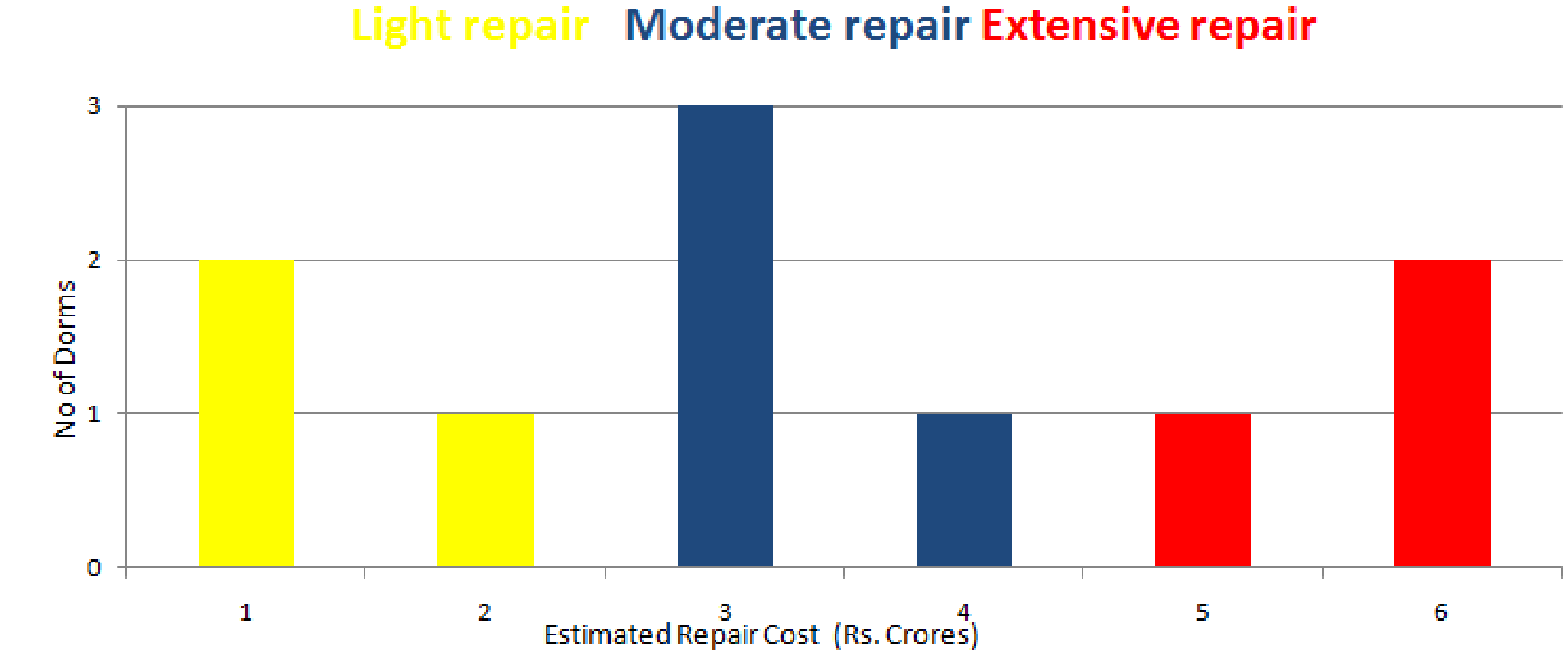
At a management school, the oldest M dorms, numbered 1 to 10, need to be repaired urgently. This following diagram represents the estimated repair costs (in Rs. Crores) for the 10 dorms. For any dorm, the estimated repair cost (in Rs. Crores) is an integer. Repairs with estimated cost Rs. 1 or 2 Crores are considered light repairs, repairs with estimated cost Rs. 3 or 4 are considered moderate repairs and repairs with estimated cost Rs. 5 or 6 Crores are considered extensive repairs. Further, the following information is known. 1. Odd-numbered dorms do not need light repair; even-numbered dorms do not need moderate repair and dorms, whose numbers are divisible by 3, do not need extensive repair. 2. Dorms 4 to 9 all need different repair costs, with Dorm 7 needing the maximum and Dorm 8 needing the minimum.

Chart for this set — reading the chart is part of the question
Q25Bar GraphsMCQ

Which of the following is NOT necessarily true?

Show solution

Correct answer: D

A bar chart gives the number of dorms at each repair cost:

Cost (Rs. Cr)123456
No. of dorms213112

Repairs are grouped as Light (1 or 2), Moderate (3 or 4) and Extensive (5 or 6).

What each dorm is allowed (from clue 1).

  • Odd dorms (1, 3, 5, 7, 9) cannot be light → they are Moderate or Extensive.
  • Even dorms (2, 4, 6, 8, 10) cannot be moderate → they are Light or Extensive.
  • Dorms divisible by 3 (3, 6, 9) cannot be extensive → they are Light or Moderate.

Combining these:

  • Dorm 3 and Dorm 9 → Moderate only (3 or 4).
  • Dorm 6 → Light only (1 or 2).
  • Dorms 1, 5, 7 → Moderate or Extensive.
  • Dorms 2, 4, 8, 10 → Light or Extensive.

Using clue 2 (dorms 4–9 all get different costs, dorm 7 the maximum, dorm 8 the minimum):

  1. Dorm 7 = 6 (max), Dorm 8 = 1 (min).
  2. Dorm 6 is light and cost 1 is taken, so Dorm 6 = 2.
  3. Dorm 4 is even (so 2 or 5) and 2 is taken, so Dorm 4 = 5.
  4. Dorms 5 and 9 are moderate, different, so they take 3 and 4 in some order.

The costs still to be placed among dorms 1, 2, 3, 10 are one more 1, two more 3s and one more 6, i.e. the set {1, 3, 3, 6}.

  1. Dorm 3 is moderate → 3.
  2. Dorm 1 is odd (can't be 1) → 3.
  3. Dorms 2 and 10 are the leftover {1, 6} in some order.

Solved table (only the two pairs stay flexible):

Dorm12345678910
Cost31 or 6353 or 42614 or 36 or 1

Within each pair the two dorms take opposite values: {Dorm 5, Dorm 9} = {3, 4}, and {Dorm 2, Dorm 10} = {1, 6}.

Now test each statement against the solved table.

  • Dorm 1 needs a moderate repair — Dorm 1 = 3, which is moderate. Always true.
  • Dorm 5 will cost no more than Rs. 4 Cr — Dorm 5 is 3 or 4, both ≤ 4. Always true.
  • Dorm 7 needs an extensive repair — Dorm 7 = 6, which is extensive. Always true.
  • Dorm 10 will cost no more than Rs. 4 Cr — Dorm 10 is 1 or 6. If it is 6, it exceeds 4. So this is not guaranteed.

The statement that need not be true is about Dorm 10.

Answer: Dorm 10 repair will cost no more than Rs. 4 Crores (Choice D)

Q26Bar GraphsTITA

What is the total cost of repairing the odd-numbered dorms (in Rs. Crores)?

Show solution

Correct answer: 19

A bar chart gives the number of dorms at each repair cost:

Cost (Rs. Cr)123456
No. of dorms213112

Repairs are grouped as Light (1 or 2), Moderate (3 or 4) and Extensive (5 or 6).

What each dorm is allowed (from clue 1).

  • Odd dorms (1, 3, 5, 7, 9) cannot be light → they are Moderate or Extensive.
  • Even dorms (2, 4, 6, 8, 10) cannot be moderate → they are Light or Extensive.
  • Dorms divisible by 3 (3, 6, 9) cannot be extensive → they are Light or Moderate.

Combining these:

  • Dorm 3 and Dorm 9 → Moderate only (3 or 4).
  • Dorm 6 → Light only (1 or 2).
  • Dorms 1, 5, 7 → Moderate or Extensive.
  • Dorms 2, 4, 8, 10 → Light or Extensive.

Using clue 2 (dorms 4–9 all get different costs, dorm 7 the maximum, dorm 8 the minimum):

  1. Dorm 7 = 6 (max), Dorm 8 = 1 (min).
  2. Dorm 6 is light and cost 1 is taken, so Dorm 6 = 2.
  3. Dorm 4 is even (so 2 or 5) and 2 is taken, so Dorm 4 = 5.
  4. Dorms 5 and 9 are moderate, different, so they take 3 and 4 in some order.

The costs still to be placed among dorms 1, 2, 3, 10 are one more 1, two more 3s and one more 6, i.e. the set {1, 3, 3, 6}.

  1. Dorm 3 is moderate → 3.
  2. Dorm 1 is odd (can't be 1) → 3.
  3. Dorms 2 and 10 are the leftover {1, 6} in some order.

Solved table (only the two pairs stay flexible):

Dorm12345678910
Cost31 or 6353 or 42614 or 36 or 1

Within each pair the two dorms take opposite values: {Dorm 5, Dorm 9} = {3, 4}, and {Dorm 2, Dorm 10} = {1, 6}.

Add up the odd-numbered dorms (1, 3, 5, 7, 9):

  • Dorm 1 = 3, Dorm 3 = 3, Dorm 7 = 6 — these are fixed.
  • Dorms 5 and 9 together are 3 and 4 (in some order), so their sum is 7 no matter which way round.

Total = 3 + 3 + 7 + 6 = 19.

💡 Teacher tip: When two unknowns are just a fixed pair in some order, you don't need to resolve the order — their sum is already locked.

Answer: 19

Q27Bar GraphsTITA

Suppose further that: 1. 4 of the 10 dorms needing repair are women's dorms and need a total of Rs. 20 Crores for repair. 2. Only one of Dorms 1 to 5 is a women's dorm. What is the cost for repairing Dorm 9 (in Rs. Crores)?

Show solution

Correct answer: 3

A bar chart gives the number of dorms at each repair cost:

Cost (Rs. Cr)123456
No. of dorms213112

Repairs are grouped as Light (1 or 2), Moderate (3 or 4) and Extensive (5 or 6).

What each dorm is allowed (from clue 1).

  • Odd dorms (1, 3, 5, 7, 9) cannot be light → they are Moderate or Extensive.
  • Even dorms (2, 4, 6, 8, 10) cannot be moderate → they are Light or Extensive.
  • Dorms divisible by 3 (3, 6, 9) cannot be extensive → they are Light or Moderate.

Combining these:

  • Dorm 3 and Dorm 9 → Moderate only (3 or 4).
  • Dorm 6 → Light only (1 or 2).
  • Dorms 1, 5, 7 → Moderate or Extensive.
  • Dorms 2, 4, 8, 10 → Light or Extensive.

Using clue 2 (dorms 4–9 all get different costs, dorm 7 the maximum, dorm 8 the minimum):

  1. Dorm 7 = 6 (max), Dorm 8 = 1 (min).
  2. Dorm 6 is light and cost 1 is taken, so Dorm 6 = 2.
  3. Dorm 4 is even (so 2 or 5) and 2 is taken, so Dorm 4 = 5.
  4. Dorms 5 and 9 are moderate, different, so they take 3 and 4 in some order.

The costs still to be placed among dorms 1, 2, 3, 10 are one more 1, two more 3s and one more 6, i.e. the set {1, 3, 3, 6}.

  1. Dorm 3 is moderate → 3.
  2. Dorm 1 is odd (can't be 1) → 3.
  3. Dorms 2 and 10 are the leftover {1, 6} in some order.

Solved table (only the two pairs stay flexible):

Dorm12345678910
Cost31 or 6353 or 42614 or 36 or 1

Within each pair the two dorms take opposite values: {Dorm 5, Dorm 9} = {3, 4}, and {Dorm 2, Dorm 10} = {1, 6}.

Bring in the new conditions: 4 dorms are women's dorms costing Rs. 20 Cr in total, and only one of Dorms 1–5 is a women's dorm.

First, the total cost of all 10 dorms is 1(2)+2(1)+3(3)+4(1)+5(1)+6(2)=34 Cr.1(2) + 2(1) + 3(3) + 4(1) + 5(1) + 6(2) = 34 \text{ Cr}.

So the four women's dorms cost 20 Cr and the six men's dorms cost 14 Cr.

We need one dorm from {1, 2, 3, 4, 5} and three dorms from {6, 7, 8, 9, 10} whose costs add to 20. Test the flexible pairs:

  • Dorms 6, 7, 8 are fixed at 2, 6, 1. Their three-dorm combinations with dorm 9 or 10 must be checked.
  • The only assignment that reaches 20 is Dorm 5 = 4, Dorm 9 = 3, Dorm 2 = 1, Dorm 10 = 6. Then the women's dorms are Dorm 4 (5), Dorm 7 (6), Dorm 9 (3), Dorm 10 (6), totalling 5 + 6 + 3 + 6 = 20, with exactly one of them (Dorm 4) from 1–5. ✓

Every other split of the pairs fails to make three dorms from {6–10} sum correctly.

Hence Dorm 9 = 3.

Answer: 3

Q28Bar GraphsMCQ

Suppose further that: 1. 4 of the 10 dorms needing repair are women's dorms and need a total of Rs. 20 Crores for repair. 2. Only one of Dorms 1 to 5 is a women's dorm. Which of the following is a women's dorm?

Show solution

Correct answer: D

A bar chart gives the number of dorms at each repair cost:

Cost (Rs. Cr)123456
No. of dorms213112

Repairs are grouped as Light (1 or 2), Moderate (3 or 4) and Extensive (5 or 6).

What each dorm is allowed (from clue 1).

  • Odd dorms (1, 3, 5, 7, 9) cannot be light → they are Moderate or Extensive.
  • Even dorms (2, 4, 6, 8, 10) cannot be moderate → they are Light or Extensive.
  • Dorms divisible by 3 (3, 6, 9) cannot be extensive → they are Light or Moderate.

Combining these:

  • Dorm 3 and Dorm 9 → Moderate only (3 or 4).
  • Dorm 6 → Light only (1 or 2).
  • Dorms 1, 5, 7 → Moderate or Extensive.
  • Dorms 2, 4, 8, 10 → Light or Extensive.

Using clue 2 (dorms 4–9 all get different costs, dorm 7 the maximum, dorm 8 the minimum):

  1. Dorm 7 = 6 (max), Dorm 8 = 1 (min).
  2. Dorm 6 is light and cost 1 is taken, so Dorm 6 = 2.
  3. Dorm 4 is even (so 2 or 5) and 2 is taken, so Dorm 4 = 5.
  4. Dorms 5 and 9 are moderate, different, so they take 3 and 4 in some order.

The costs still to be placed among dorms 1, 2, 3, 10 are one more 1, two more 3s and one more 6, i.e. the set {1, 3, 3, 6}.

  1. Dorm 3 is moderate → 3.
  2. Dorm 1 is odd (can't be 1) → 3.
  3. Dorms 2 and 10 are the leftover {1, 6} in some order.

Solved table (only the two pairs stay flexible):

Dorm12345678910
Cost31 or 6353 or 42614 or 36 or 1

Within each pair the two dorms take opposite values: {Dorm 5, Dorm 9} = {3, 4}, and {Dorm 2, Dorm 10} = {1, 6}.

Bring in the new conditions: 4 women's dorms cost Rs. 20 Cr in total, and only one of Dorms 1–5 is a women's dorm.

The total cost of all 10 dorms is 1(2)+2(1)+3(3)+4(1)+5(1)+6(2)=34 Cr,1(2) + 2(1) + 3(3) + 4(1) + 5(1) + 6(2) = 34 \text{ Cr}, so the four women's dorms must total 20 and the six men's dorms 14.

Picking one dorm from 1–5 and three from 6–10 to reach 20, the only workable choice is Dorm 5 = 4, Dorm 9 = 3, Dorm 2 = 1, Dorm 10 = 6, which makes the women's dorms {4, 7, 9, 10} with costs 5 + 6 + 3 + 6 = 20.

Check the options against this set:

  • Dorm 2 — not in the set.
  • Dorm 5 — not in the set.
  • Dorm 8 — not in the set.
  • Dorm 10 — in the set.

Answer: Dorm 10 (Choice D)

Set · Data Tables

There were seven elective courses - E1 to E7 - running in a specific term in a college. Each of the 300 students enrolled had chosen just one elective from among these seven. However, before the start of the term, E7 was withdrawn as the instructor concerned had left the college. The students who had opted for E7 were allowed to join any of the remaining electives. Also, the students who had chosen other electives were given one chance to change their choice. The table below captures the movement of the students from one elective to another during this process. Movement from one elective to the same elective simply means no movement. Some numbers in the table got accidentally erased; however, it is known that these were either 0 or 1. Further, the following are known: 1. Before the change process there were 6 more students in E1 than in E4, but after the reshuffle, the number of students in E4 was 3 more than that in E1. 2. The number of students in E2 increased by 30 after the change process. 3. Before the change process, E4 had 2 more students than E6, while E2 had 10 more students than E3.

From \ To ElectiveE1E2E3E4E5E6
E19510142
E234822
E326252
E432144
E5530
E67329
E7416305541
Q29Data TablesMCQ

How many elective courses among E1 to E6 had a decrease in their enrollments after the change process?

Show solution

Correct answer: C

How to read the table. Each row is an old elective and each column is a new one, so a cell counts students who moved from the row's elective to the column's elective. That means:

  • a row total = students in that elective before the change,
  • a column total = students in that elective after the change.

Every blank is either 0 or 1. We use the four given clues to pin them down.

  1. Row E1 has no blanks, so E1 before =9+5+10+1+4+2=31= 9+5+10+1+4+2 = 31. Clue 1 says E1 had 6 more than E4 before, so E4 before =25=25. Row E4 already shows 3+2+14+4=233+2+14+4=23, so its two blanks must add to 2 — both are 1.
  2. Clue 3 says E4 had 2 more than E6 before, so E6 before =23=23. Row E6 shows 7+3+2+9=217+3+2+9=21, so its two blanks are both 1.
  3. Column E2 has no blanks, so E2 after =5+34+6+3+5+7+16=76= 5+34+6+3+5+7+16 = 76. Clue 2 says E2 rose by 30, so E2 before =46=46. Row E2 already totals 46, so its two blanks are both 0.
  4. Clue 3 also says E2 was 10 more than E3 before, so E3 before =36=36. Row E3 shows 2+6+25+2=352+6+25+2=35, so exactly one of its blanks is 1.
  5. Using Clue 1's "after" part (E4 after == E1 after +3+3) to balance the columns fixes the last blanks: in row E3 the move to E5 is 1 (and to E4 is 0), and row E5's blanks come out as E5→E1 =1=1, E5→E3 =1=1, E5→E6 =1=1 (E5 before =38=38).

Completed movement table:

From \ ToE1E2E3E4E5E6Before
E1951014231
E2034802246
E3262501236
E4132141425
E5151030138
E617312923
E7416305541101
After187679214561300

Before vs After enrollment:

ElectiveE1E2E3E4E5E6
Before314636253823
After187679214561

The question asks how many electives lost students. Compare each column's before and after:

  • E1: 311831 \to 18 — down
  • E2: 467646 \to 76 — up
  • E3: 367936 \to 79 — up
  • E4: 252125 \to 21 — down
  • E5: 384538 \to 45 — up
  • E6: 236123 \to 61 — up

Only E1 and E4 fell, so 2 electives had a decrease.

Answer: 2 (Choice C)

Q30Data TablesMCQ

After the change process, which of the following is the correct sequence of number of students in the six electives E 1 to E6?

Show solution

Correct answer: D

How to read the table. Each row is an old elective and each column is a new one, so a cell counts students who moved from the row's elective to the column's elective. That means:

  • a row total = students in that elective before the change,
  • a column total = students in that elective after the change.

Every blank is either 0 or 1. We use the four given clues to pin them down.

  1. Row E1 has no blanks, so E1 before =9+5+10+1+4+2=31= 9+5+10+1+4+2 = 31. Clue 1 says E1 had 6 more than E4 before, so E4 before =25=25. Row E4 already shows 3+2+14+4=233+2+14+4=23, so its two blanks must add to 2 — both are 1.
  2. Clue 3 says E4 had 2 more than E6 before, so E6 before =23=23. Row E6 shows 7+3+2+9=217+3+2+9=21, so its two blanks are both 1.
  3. Column E2 has no blanks, so E2 after =5+34+6+3+5+7+16=76= 5+34+6+3+5+7+16 = 76. Clue 2 says E2 rose by 30, so E2 before =46=46. Row E2 already totals 46, so its two blanks are both 0.
  4. Clue 3 also says E2 was 10 more than E3 before, so E3 before =36=36. Row E3 shows 2+6+25+2=352+6+25+2=35, so exactly one of its blanks is 1.
  5. Using Clue 1's "after" part (E4 after == E1 after +3+3) to balance the columns fixes the last blanks: in row E3 the move to E5 is 1 (and to E4 is 0), and row E5's blanks come out as E5→E1 =1=1, E5→E3 =1=1, E5→E6 =1=1 (E5 before =38=38).

Completed movement table:

From \ ToE1E2E3E4E5E6Before
E1951014231
E2034802246
E3262501236
E4132141425
E5151030138
E617312923
E7416305541101
After187679214561300

Before vs After enrollment:

ElectiveE1E2E3E4E5E6
Before314636253823
After187679214561

The question asks for the after-change enrollments of E1 to E6. These are exactly the column totals of the completed table: 18, 76, 79, 21, 45, 61.

Answer: 18, 76, 79, 21, 45, 61 (Choice D)

Q31Data TablesMCQ

After the change process, which course among E1 to E6 had the largest change in its enrollment as a percentage of its original enrollment?

Show solution

Correct answer: D

How to read the table. Each row is an old elective and each column is a new one, so a cell counts students who moved from the row's elective to the column's elective. That means:

  • a row total = students in that elective before the change,
  • a column total = students in that elective after the change.

Every blank is either 0 or 1. We use the four given clues to pin them down.

  1. Row E1 has no blanks, so E1 before =9+5+10+1+4+2=31= 9+5+10+1+4+2 = 31. Clue 1 says E1 had 6 more than E4 before, so E4 before =25=25. Row E4 already shows 3+2+14+4=233+2+14+4=23, so its two blanks must add to 2 — both are 1.
  2. Clue 3 says E4 had 2 more than E6 before, so E6 before =23=23. Row E6 shows 7+3+2+9=217+3+2+9=21, so its two blanks are both 1.
  3. Column E2 has no blanks, so E2 after =5+34+6+3+5+7+16=76= 5+34+6+3+5+7+16 = 76. Clue 2 says E2 rose by 30, so E2 before =46=46. Row E2 already totals 46, so its two blanks are both 0.
  4. Clue 3 also says E2 was 10 more than E3 before, so E3 before =36=36. Row E3 shows 2+6+25+2=352+6+25+2=35, so exactly one of its blanks is 1.
  5. Using Clue 1's "after" part (E4 after == E1 after +3+3) to balance the columns fixes the last blanks: in row E3 the move to E5 is 1 (and to E4 is 0), and row E5's blanks come out as E5→E1 =1=1, E5→E3 =1=1, E5→E6 =1=1 (E5 before =38=38).

Completed movement table:

From \ ToE1E2E3E4E5E6Before
E1951014231
E2034802246
E3262501236
E4132141425
E5151030138
E617312923
E7416305541101
After187679214561300

Before vs After enrollment:

ElectiveE1E2E3E4E5E6
Before314636253823
After187679214561

The question asks which elective changed the most, as a percentage of its original size. Compute AfterBeforeBefore\dfrac{\text{After} - \text{Before}}{\text{Before}} for each:

ElectiveBeforeAfterChange% change
E13118−13−41.9%
E24676+30+65.2%
E33679+43+119.4%
E42521−4−16.0%
E53845+7+18.4%
E62361+38+165.2%

The biggest swing is E6 at about +165%+165\%.

Answer: E6 (Choice D)

Q32Data TablesMCQ

Later, the college imposed a condition that if after the change of electives, the enrollment in any elective (other than E7) dropped to less than 20 students, all the students who had left that course will be required to re-enroll for that elective. Which of the following is a correct sequence of electives in decreasing order of their final enrollments?

Show solution

Correct answer: A

How to read the table. Each row is an old elective and each column is a new one, so a cell counts students who moved from the row's elective to the column's elective. That means:

  • a row total = students in that elective before the change,
  • a column total = students in that elective after the change.

Every blank is either 0 or 1. We use the four given clues to pin them down.

  1. Row E1 has no blanks, so E1 before =9+5+10+1+4+2=31= 9+5+10+1+4+2 = 31. Clue 1 says E1 had 6 more than E4 before, so E4 before =25=25. Row E4 already shows 3+2+14+4=233+2+14+4=23, so its two blanks must add to 2 — both are 1.
  2. Clue 3 says E4 had 2 more than E6 before, so E6 before =23=23. Row E6 shows 7+3+2+9=217+3+2+9=21, so its two blanks are both 1.
  3. Column E2 has no blanks, so E2 after =5+34+6+3+5+7+16=76= 5+34+6+3+5+7+16 = 76. Clue 2 says E2 rose by 30, so E2 before =46=46. Row E2 already totals 46, so its two blanks are both 0.
  4. Clue 3 also says E2 was 10 more than E3 before, so E3 before =36=36. Row E3 shows 2+6+25+2=352+6+25+2=35, so exactly one of its blanks is 1.
  5. Using Clue 1's "after" part (E4 after == E1 after +3+3) to balance the columns fixes the last blanks: in row E3 the move to E5 is 1 (and to E4 is 0), and row E5's blanks come out as E5→E1 =1=1, E5→E3 =1=1, E5→E6 =1=1 (E5 before =38=38).

Completed movement table:

From \ ToE1E2E3E4E5E6Before
E1951014231
E2034802246
E3262501236
E4132141425
E5151030138
E617312923
E7416305541101
After187679214561300

Before vs After enrollment:

ElectiveE1E2E3E4E5E6
Before314636253823
After187679214561

Apply the re-enrolment rule. Any elective (except E7) that ended below 20 students forces everyone who left it to come back. Looking at the after-change row, only E1 ended below 20 (at 18).

E1 started with 31 students; 9 stayed (the E1→E1 cell), so 319=2231 - 9 = 22 had left. They now return to E1, leaving whichever elective they had switched to. From row E1, those 22 went: 5 to E2, 10 to E3, 1 to E4, 4 to E5, 2 to E6.

Subtract them back out:

ElectiveWasReturns to E1New
E118+2240
E276−571
E379−1069
E421−120
E545−441
E661−259

(E4 lands at exactly 20, so it does not trigger another round.)

In decreasing order: E2 (71) > E3 (69) > E6 (59) > E5 (41) > E1 (40) > E4 (20).

Answer: E2, E3, E6, E5, E1, E4 (Choice A)