CATLab

CAT 2019 DILR Questions — Slot 2

The actual Data Interpretation & Logical Reasoning section from CAT 2019, Slot 2 — 32 questions in original paper order, each with a full worked solution. Tap an option (or type your answer) to check yourself before reading the solution.

32 questions24 MCQ · 8 TITA60 min section0/32 attempted
Set · Mixed Charts & Caselets

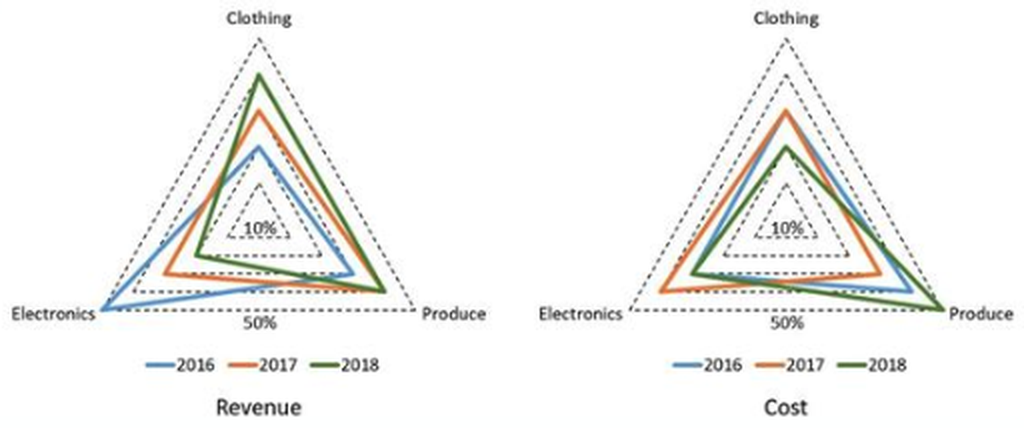
A large store has only three departments, Clothing, Produce, and Electronics. The following figure shows the percentages of revenue and cost from the three departments for the years 2016, 2017 and 2018. The dotted lines depict percentage levels. So for example, in 2016, 50% of store's revenue came from its Electronics department while 40% of its costs were incurred in the Produce department. In this setup, Profit is computed as (Revenue - Cost) and Percentage Profit as Profit/Cost × 100%. It is known that 1. The percentage profit for the store in 2016 was 100%. 2. The store’s revenue doubled from 2016 to 2017, and its cost doubled from 2016 to 2018. 3. There was no profit from the Electronics department in 2017. 4. In 2018, the revenue from the Clothing department was the same as the cost incurred in the Produce department.

Chart for this set — reading the chart is part of the question
Q1Mixed Charts & CaseletsTITA

What was the percentage profit of the store in 2018?

Show solution

Correct answer: 25

Setting up the store-wide totals

Reading the radar charts. Each chart is a triangle with one corner per department. The dotted triangles are the percentage levels, from 10% (innermost) out to 50% (the outer edge), and each year's three shares add to 100%. Revenue shares (Clothing / Produce / Electronics): 2016 = 20 / 30 / 50, 2017 = 30 / 40 / 30, 2018 = 40 / 40 / 20. Cost shares: 2016 = 30 / 40 / 30, 2017 = 30 / 30 / 40, 2018 = 20 / 50 / 30.

The radar charts give us percentage shares of revenue and cost for each department in each year. To find actual profit percentages, we first need the total revenue and total cost for each year.

Step 1 — Anchor 2016.

Let the store's total cost in 2016 be 100100. The percentage profit in 2016 was 100%100\%, and percentage profit is ProfitCost×100%\frac{\text{Profit}}{\text{Cost}}\times 100\%. So:

R2016−C2016C2016×100=100  ⟹  R2016−C2016=C2016  ⟹  R2016=200\frac{R_{2016}-C_{2016}}{C_{2016}}\times 100 = 100 \implies R_{2016}-C_{2016}=C_{2016} \implies R_{2016}=200

Step 2 — Use the doubling clues.

  • Revenue doubled from 2016 to 2017: R2017=2×200=400R_{2017}=2\times 200=400.
  • Cost doubled from 2016 to 2018: C2018=2×100=200C_{2018}=2\times 100=200.

Step 3 — Use the Electronics-in-2017 clue.

"No profit from Electronics in 2017" means Electronics revenue equals Electronics cost in 2017.

ItemValue
Electronics revenue (2017)30%×400=12030\%\times 400 = 120
Electronics cost (2017)40%×C201740\%\times C_{2017}

120=0.40×C2017  ⟹  C2017=300120 = 0.40\times C_{2017} \implies C_{2017}=300

Step 4 — Use the Clothing-revenue = Produce-cost (2018) clue.

ItemValue
Clothing revenue (2018)40%×R201840\%\times R_{2018}
Produce cost (2018)50%×200=10050\%\times 200 = 100

0.40×R2018=100  ⟹  R2018=2500.40\times R_{2018}=100 \implies R_{2018}=250

Solved totals:

YearRevenueCostProfitProfit %
2016200100100100%
201740030010033.3%
20182502005025%

Answering the question

For 2018:

Profit%2018=250−200200×100=50200×100=25%\text{Profit\%}_{2018}=\frac{250-200}{200}\times 100=\frac{50}{200}\times 100=25\%

Answer: 25

Q2Mixed Charts & CaseletsMCQ

What was the ratio of revenue generated from the Produce department in 2017 to that in 2018?

Show solution

Correct answer: D

Setting up the store-wide totals

Reading the radar charts. Each chart is a triangle with one corner per department. The dotted triangles are the percentage levels, from 10% (innermost) out to 50% (the outer edge), and each year's three shares add to 100%. Revenue shares (Clothing / Produce / Electronics): 2016 = 20 / 30 / 50, 2017 = 30 / 40 / 30, 2018 = 40 / 40 / 20. Cost shares: 2016 = 30 / 40 / 30, 2017 = 30 / 30 / 40, 2018 = 20 / 50 / 30.

The radar charts give us percentage shares of revenue and cost for each department. We need the actual totals first.

Step 1 — Anchor 2016. Let 2016 cost =100=100. Since 2016 profit percentage is 100%100\%:

R2016−C2016C2016×100=100  ⟹  R2016=200\frac{R_{2016}-C_{2016}}{C_{2016}}\times 100 = 100 \implies R_{2016}=200

Step 2 — Apply the doubling clues.

  • Revenue doubled 2016→2017: R2017=400R_{2017}=400.
  • Cost doubled 2016→2018: C2018=200C_{2018}=200.

Step 3 — Electronics in 2017 broke even (revenue = cost):

0.30×400=0.40×C2017  ⟹  120=0.40×C2017  ⟹  C2017=3000.30\times 400 = 0.40\times C_{2017} \implies 120 = 0.40\times C_{2017} \implies C_{2017}=300

Step 4 — In 2018, Clothing revenue = Produce cost:

0.40×R2018=0.50×200=100  ⟹  R2018=2500.40\times R_{2018} = 0.50\times 200 = 100 \implies R_{2018}=250

Solved totals:

YearRevenueCostProfitProfit %
2016200100100100%
201740030010033.3%
20182502005025%

Answering the question

We need the ratio of Produce-department revenue in 2017 to that in 2018.

From the revenue-share table, Produce's share is 40%40\% in both years — but the total revenue differs.

YearProduce revenue shareTotal revenueProduce revenue
201740%4000.40×400=1600.40\times 400 = 160
201840%2500.40×250=1000.40\times 250 = 100

Ratio=160:100=8:5\text{Ratio} = 160: 100 = 8: 5

💡 Teacher tip: Equal percentage shares do not mean equal amounts — always multiply the percentage by that year's total.

Answer: 8: 5 (Option D)

Q3Mixed Charts & CaseletsTITA

What percentage of the total profits for the store in 2016 was from the Electronics department?

Show solution

Correct answer: 70

Setting up the store-wide totals

Reading the radar charts. Each chart is a triangle with one corner per department. The dotted triangles are the percentage levels, from 10% (innermost) out to 50% (the outer edge), and each year's three shares add to 100%. Revenue shares (Clothing / Produce / Electronics): 2016 = 20 / 30 / 50, 2017 = 30 / 40 / 30, 2018 = 40 / 40 / 20. Cost shares: 2016 = 30 / 40 / 30, 2017 = 30 / 30 / 40, 2018 = 20 / 50 / 30.

The radar charts give percentage shares of revenue and cost by department. We determine the actual totals step by step.

Step 1 — Anchor 2016. Let 2016 cost =100=100. With a 100%100\% profit percentage:

R2016=200R_{2016}=200

Step 2 — Doubling clues.

  • R2017=2×200=400R_{2017}=2\times 200=400
  • C2018=2×100=200C_{2018}=2\times 100=200

Step 3 — Electronics broke even in 2017 (revenue = cost):

0.30×400=0.40×C2017  ⟹  C2017=3000.30\times 400 = 0.40\times C_{2017} \implies C_{2017}=300

Step 4 — In 2018, Clothing revenue = Produce cost:

0.40×R2018=0.50×200=100  ⟹  R2018=2500.40\times R_{2018}=0.50\times 200=100 \implies R_{2018}=250

Solved totals:

YearRevenueCostProfitProfit %
2016200100100100%
201740030010033.3%
20182502005025%

Answering the question

We need: what percentage of the store's 2016 total profit came from Electronics?

The store's total 2016 profit is 200−100=100200-100=100.

Now compute Electronics' own profit in 2016 using its revenue and cost shares:

ItemShareTotalAmount
Electronics revenue (2016)50%2000.50×200=1000.50\times 200=100
Electronics cost (2016)30%1000.30×100=300.30\times 100=30
Electronics profit (2016)100−30=70100-30=70

Electronics’ share of total profit=70100×100=70%\text{Electronics' share of total profit}=\frac{70}{100}\times 100=70\%

💡 Teacher tip: Department profit = (department's revenue share × total revenue) − (department's cost share × total cost). The percentages apply to different bases (revenue vs. cost), so compute each separately.

Answer: 70

Q4Mixed Charts & CaseletsMCQ

What was the approximate difference in profit percentages of the store in 2017 and 2018?

Show solution

Correct answer: C

Setting up the store-wide totals

Reading the radar charts. Each chart is a triangle with one corner per department. The dotted triangles are the percentage levels, from 10% (innermost) out to 50% (the outer edge), and each year's three shares add to 100%. Revenue shares (Clothing / Produce / Electronics): 2016 = 20 / 30 / 50, 2017 = 30 / 40 / 30, 2018 = 40 / 40 / 20. Cost shares: 2016 = 30 / 40 / 30, 2017 = 30 / 30 / 40, 2018 = 20 / 50 / 30.

The radar charts give percentage shares of revenue and cost by department. We find the actual totals using the four clues.

Step 1 — Anchor 2016. Let 2016 cost =100=100. With a 100%100\% profit percentage:

R2016−100100×100=100  ⟹  R2016=200\frac{R_{2016}-100}{100}\times 100 = 100 \implies R_{2016}=200

Step 2 — Doubling clues.

  • Revenue doubled 2016→2017: R2017=400R_{2017}=400.
  • Cost doubled 2016→2018: C2018=200C_{2018}=200.

Step 3 — Electronics broke even in 2017 (no profit ⇒ revenue = cost):

0.30×400=0.40×C2017  ⟹  120=0.40×C2017  ⟹  C2017=3000.30\times 400 = 0.40\times C_{2017} \implies 120 = 0.40\times C_{2017} \implies C_{2017}=300

Step 4 — In 2018, Clothing revenue = Produce cost:

0.40×R2018=0.50×200=100  ⟹  R2018=2500.40\times R_{2018} = 0.50\times 200 = 100 \implies R_{2018}=250

Solved totals:

YearRevenueCostProfitProfit %
2016200100100100%
201740030010033.3%
20182502005025%

Answering the question

We need the difference in the store's profit percentages for 2017 and 2018.

Profit%2017=400−300300×100=100300×100=33.3%\text{Profit\%}_{2017}=\frac{400-300}{300}\times 100=\frac{100}{300}\times 100=33.3\%

Profit%2018=250−200200×100=50200×100=25%\text{Profit\%}_{2018}=\frac{250-200}{200}\times 100=\frac{50}{200}\times 100=25\%

Difference=33.3−25=8.3\text{Difference}=33.3-25=8.3

Answer: 8.3 (Option C)

Set · Puzzles

Ten players, as listed in the table below, participated in a rifle shooting competition comprising of 10 rounds. Each round had 6 participants. Players numbered 1 through 6 participated in Round 1, players 2 through 7 in Round 2,..., players 5 through 10 in Round 5, players 6 through 10 and 1 in Round 6, players 7 through 10, 1 and 2 in Round 7 and so on. The top three performances in each round were awarded 7, 3 and 1 points respectively. There were no ties in any of the 10 rounds. The table below gives the total number of points obtained by the 10 players after Round 6 and Round 10. The following information is known about Rounds 1 through 6: 1. Gordon did not score consecutively in any two rounds. 2. Eric and Fatima both scored in a round. The following information is known about Rounds 7 through 10: 1. Only two players scored in three consecutive rounds. One of them was Chen. No other player scored in any two consecutive rounds. 2. Joshin scored in Round 7, while Amita scored in Round 10. 3. No player scored in all the four rounds.

Table — total points obtained by 10 players in a rifle shooting competition, after Round 6 and after Round 10.

Player No.Player NamePoints after Round 6Points after Round 10
1Amita818
2Bala25
3Chen36
4David66
5Eric310
6Fatima1010
7Gordon1717
8Hansa14
9Ikea217
10Joshin1417
Q5PuzzlesMCQ

What were the scores of Chen, David, and Eric respectively after Round 3?

Show solution

Correct answer: B

What were the scores of Chen, David, and Eric after Round 3?

We need to first work out who scored in each of Rounds 1–3. Let us build the full scoring table step by step.

Understanding the round structure

Each round features 6 players in a sliding window:

RoundPlayers (by number)
11–6
22–7
33–8
44–9
55–10
66–10, 1

Each round awards 7, 3, 1 points to its top three (no ties).

Key deductions for Rounds 1–6

  1. Joshin (Player 10) plays only Rounds 5 and 6 in this phase, yet has 14 points. The maximum from two rounds is 7+7=147+7=14, so Joshin took 7 in R5 and 7 in R6.

  2. Gordon (Player 7) plays Rounds 2–6 and has 17 points. The clue says Gordon never scored in two consecutive rounds. To reach 17 = 7 + 7 + 3, he needs three non-adjacent rounds from {R2, R3, R4, R5, R6}. The only such triple is R2, R4, R6. Since R6's 7 belongs to Joshin, Gordon gets 7 (R2), 7 (R4), 3 (R6).

  3. Amita (Player 1) plays R1 and R6, with 8 points = 7 + 1. Since R6's 7 is Joshin's, Amita gets 7 (R1), 1 (R6).

  4. Bala (Player 2) plays R1 and R2, with 2 points = 1 + 1, so 1 (R1), 1 (R2).

  5. All the 1-point slots in R1, R2, R6 are now taken. Hansa (Player 8) has just 1 point and plays R3–R6; the only remaining 1 is in R3, so Hansa = 1 (R3).

  6. Ikea (Player 9) has 2 points and plays R4–R6; the available 1s are in R4 and R5 (R6's 1 is Amita's), so Ikea = 1 (R4), 1 (R5).

  7. Fatima (Player 6) plays all six rounds and has 10 points. Every 7 except R3 is taken (R1→Amita, R2→Gordon, R4→Gordon, R5→Joshin, R6→Joshin), so Fatima = 7 (R3) + one 3.

  8. Eric (Player 5) has 3 points (a single 3) from Rounds 1–5. The clue says Eric and Fatima both scored in a round. Fatima scored in R3 (her 7) and in one other round (her 3). Eric and Fatima cannot both get the 3-point slot in the same round, so the only round where they can both appear among the top three is R3 — where Fatima got 7 and Eric gets 3. Thus Eric = 3 (R3).

  9. In R5, the 7 (Joshin) and 1 (Ikea) are fixed; the remaining eligible scorer for the 3 is Fatima (Eric, Gordon, Hansa are all done). So Fatima = 3 (R5).

  10. In R4, the 7 (Gordon) and 1 (Ikea) are fixed; the 3 must go to David (Eric and Fatima are done). So David = 3 (R4).

  11. David has 6 = 3 + 3, so he needs one more 3 in R1 or R2. Chen has 3 = a single 3, in the other of R1/R2. The clues leave open which of R1/R2 goes to David vs Chen — but this does not affect any question.

Solved scoring table (Rounds 1–6)

Round7 pts3 pts1 pt
1AmitaDavid or ChenBala
2GordonChen or DavidBala
3FatimaEricHansa
4GordonDavidIkea
5JoshinFatimaIkea
6JoshinGordonAmita

Answering the question

We read cumulative totals through Round 3:

  • Chen: scored a single 3 in either R1 or R2. Either way, by the end of R3 he has 3.
  • David: scored a 3 in either R1 or R2 (his second 3 is in R4, which hasn't happened yet). Through R3, David has 3.
  • Eric: scored his only 3 in R3 itself. Through R3, Eric has 3.

Chen=3,David=3,Eric=3\text{Chen} = 3,\quad \text{David} = 3,\quad \text{Eric} = 3

Answer: 3, 3, 3 (Option B)

Q6PuzzlesMCQ

Which three players were in the last three positions after Round 4?

Show solution

Correct answer: D

Which three players were in the last three positions after Round 4?

We first reconstruct the scoring for Rounds 1–4, then sum each player's points.

Building the scoring table

Each round awards 7, 3, 1 to its top three. Here is how we pin down Rounds 1–4:

  1. Joshin (Player 10) plays only R5 and R6 in the first phase but already has 14 points after Round 6 — that forces 7 (R5) and 7 (R6).
  2. Gordon (Player 7) has 17 from R2–R6, never scoring in consecutive rounds. The only way to fit 7 + 7 + 3 on non-adjacent rounds is R2, R4, R6; since R6's 7 is Joshin's, Gordon gets 7 (R2), 7 (R4), 3 (R6).
  3. Amita (Player 1) has 8 from R1 + R6 = 7 + 1; R6's 7 is taken, so 7 (R1), 1 (R6).
  4. Bala (Player 2) has 2 from R1 + R2 = 1 (R1), 1 (R2).
  5. Hansa (Player 8) has 1 point; all 1s in R1, R2, R6 are taken, so 1 (R3).
  6. Ikea (Player 9) has 2 from R4–R6; available 1s are R4 and R5, so 1 (R4), 1 (R5).
  7. Fatima (Player 6) has 10 from all six rounds; the only 7 left is R3, so 7 (R3) + one 3.
  8. Eric (Player 5) has 3 (a single 3). Since Eric and Fatima both scored in a round, and they cannot share the 3-point slot, Eric's 3 must be in R3 alongside Fatima's 7: Eric = 3 (R3).
  9. Fatima's 3 goes to R5 (the only round where she is the remaining eligible scorer after Joshin's 7 and Ikea's 1).
  10. David (Player 4) has 6 = 3 + 3. One 3 is in R4 (the only eligible scorer there after Gordon's 7 and Ikea's 1); the other is in R1 or R2.
  11. Chen (Player 3) has 3 = a single 3, in whichever of R1/R2 David did not take.

Solved scoring for Rounds 1–4

Round7 pts3 pts1 pt
1AmitaDavid or ChenBala
2GordonChen or DavidBala
3FatimaEricHansa
4GordonDavidIkea

Cumulative points through Round 4

PlayerRounds scored (through R4)Total
Gordon7 (R2) + 7 (R4)14
Amita7 (R1)7
Fatima7 (R3)7
David3 (R1 or R2) + 3 (R4)6
Chen3 (R1 or R2)3
Eric3 (R3)3
Bala1 (R1) + 1 (R2)2
Hansa1 (R3)1
Ikea1 (R4)1
Joshinhas not played yet (first round is R5)0

💡 Teacher tip: Joshin (Player 10) does not appear until Round 5, so after Round 4 he has zero points — always check which players have not yet entered the competition.

The bottom three are Joshin (0), Hansa (1), and Ikea (1).

Answer: Hansa, Ikea, Joshin (Option D)

Q7PuzzlesMCQ

Which player scored points in maximum number of rounds?

Show solution

Correct answer: D

Which player scored points in the maximum number of rounds?

To answer this, we need the complete scoring record across all 10 rounds. Let us reconstruct it.

Rounds 1–6 — key deductions

  • Joshin plays only R5, R6 in this phase; 14 points forces 7 (R5), 7 (R6).
  • Gordon (17 pts, no consecutive scoring rounds, plays R2–R6) must use non-adjacent R2, R4, R6: 7 (R2), 7 (R4), 3 (R6).
  • Amita (8 from R1, R6) = 7 (R1), 1 (R6).
  • Bala (2 from R1, R2) = 1 (R1), 1 (R2).
  • Hansa (1 pt) = 1 (R3); Ikea (2 pts) = 1 (R4), 1 (R5).
  • Fatima (10 from all six rounds) = 7 (R3) + 3 (R5).
  • Eric (3 pts) = 3 (R3) — forced because Eric and Fatima must share a scoring round, and R3 is the only one where Fatima's 7 and Eric's 3 can coexist.
  • David (6 = 3+3) = 3 (R4) + 3 in R1 or R2. Chen (3) = 3 in the other of R1/R2.

Rounds 7–10 — key deductions

Points gained in R7–10: Amita +10, Bala +3, Chen +3, Eric +7, Hansa +3, Ikea +15, Joshin +3 (David, Fatima, Gordon gain 0).

  • Eric plays only R10 in this phase; +7 means 7 (R10).
  • Ikea (+15 over R7–R9) = 7 + 7 + 1, scoring in all three — one of the two players who scored in three consecutive rounds.
  • Chen (+3 over R8–R10) = 1 (R8), 1 (R9), 1 (R10) — the other three-consecutive scorer.
  • Amita scored in R10 (given); her +10 = 7 + 3 with non-consecutive rounds → 7 (R7), 3 (R10).
  • Joshin scored in R7 (given); +3 = 3 (R7).
  • Hansa (+3, plays only R7–R8) = 3 (R8).
  • Bala (+3) = 3 (R9).

Complete scoring table

Round7 pts3 pts1 pt
1AmitaDavid/ChenBala
2GordonChen/DavidBala
3FatimaEricHansa
4GordonDavidIkea
5JoshinFatimaIkea
6JoshinGordonAmita
7AmitaJoshinIkea
8IkeaHansaChen
9IkeaBalaChen
10EricAmitaChen

Counting rounds scored per player

PlayerRounds scoredCount
IkeaR4, R5, R7, R8, R95
AmitaR1, R6, R7, R104
ChenR1 or R2, R8, R9, R104
BalaR1, R2, R93
GordonR2, R4, R63
JoshinR5, R6, R73
DavidR1 or R2, R42
EricR3, R102
FatimaR3, R52
HansaR3, R82

Ikea scored in five different rounds — more than any other player.

Answer: Ikea (Option D)

Q8PuzzlesMCQ

Which players scored points in the last round?

Show solution

Correct answer: D

Which players scored points in the last round (Round 10)?

We need to determine who received the 7, 3, and 1 points in Round 10. Let us reconstruct the Rounds 7–10 scoring.

Points gained in Rounds 7–10

Subtracting each player's Round 6 total from their Round 10 total:

PlayerAfter R6After R10Gain
Amita818+10
Bala25+3
Chen36+3
David660
Eric310+7
Fatima10100
Gordon17170
Hansa14+3
Ikea217+15
Joshin1417+3

David, Fatima, and Gordon gained nothing — they did not score in Rounds 7–10.

Round 10 participants

Round 10 features players 10, 1, 2, 3, 4, 5: Joshin, Amita, Bala, Chen, David, Eric.

Of these, David gained 0, so the three scorers are among {Joshin, Amita, Bala, Chen, Eric}.

Deductions for Rounds 7–10

  1. Eric plays only R10 in this phase and gained +7, so Eric = 7 (R10).

  2. Ikea gained +15 over R7–R9 (she does not play R10). That equals 7 + 7 + 1, so she scored in all three rounds — one of the two players who scored in three consecutive rounds.

  3. Chen is the other three-consecutive scorer (given). He gained +3 over R8–R10 = 1 (R8), 1 (R9), 1 (R10).

  4. Amita scored in R10 (given) and gained +10 = 7 + 3. Since she cannot score in consecutive rounds (only Ikea and Chen may), her 7 must be in R7 (non-adjacent to R10). So Amita = 7 (R7), 3 (R10).

  5. Joshin scored in R7 (given) and gained +3 = 3 (R7).

  6. Hansa gained +3 and plays only R7–R8; with R7's slots taken (Amita 7, Joshin 3, Ikea 1), she gets 3 (R8).

  7. Bala gained +3; the remaining 3-point slot is in R9, so Bala = 3 (R9).

Round 10 scoring

Round7 pts3 pts1 pt
10EricAmitaChen

The three players who scored in Round 10 are Eric (7), Amita (3), and Chen (1).

Answer: Amita, Chen, Eric (Option D)

Set · Puzzles

The first year students in a business school are split into six sections. In 2019 the Business Statistics course was taught in these six sections by Annie, Beti, Chetan, Dave, Esha, and Fakir. All six sections had a common midterm (MT) and a common endterm (ET) worth 100 marks each. ET contained more questions than MT. Questions for MT and ET were prepared collectively by the six faculty members. Considering MT and ET together, each faculty member prepared the same number of questions. Each of MT and ET had at least four questions that were worth 5 marks, at least three questions that were worth 10 marks, and at least two questions that were worth 15 marks. In both MT and ET, all the 5-mark questions preceded the 10-mark questions, and all the 15- mark questions followed the 10-mark questions. The following additional facts are known. i. Annie prepared the fifth question for both MT and ET. For MT, this question carried 5 marks. ii. Annie prepared one question for MT. Every other faculty member prepared more than one questions for MT. iii. All questions prepared by a faculty member appeared consecutively in MT as well as ET. iv. Chetan prepared the third question in both MT and ET; and Esha prepared the eighth question in both. v. Fakir prepared the first question of MT and the last one in ET. Dave prepared the last question of MT and the first one in ET.

Q9PuzzlesMCQ

The second question in ET was prepared by:

Show solution

Correct answer: D

Setting up the full arrangement

Before answering any specific question, we need to pin down the structure of both papers.

Step 1 — Find the marks distribution for each paper.

Each paper is worth 100 marks using questions worth 5, 10, or 15 marks. If a paper has aa questions worth 5 marks, bb worth 10, and cc worth 15, then:

5a+10b+15c=100⟹a+2b+3c=205a + 10b + 15c = 100 \quad\Longrightarrow\quad a + 2b + 3c = 20

with the constraints a≥4a \ge 4, b≥3b \ge 3, c≥2c \ge 2 (from the set-up), and all 5-mark questions come first, then 10-mark, then 15-mark.

Step 2 — Pin down MT.

Annie prepared the 5th question of MT and it carried 5 marks. Since all 5-mark questions come first, MT must have at least five 5-mark questions (a≥5a \ge 5). Also, Annie made exactly 1 MT question while every other faculty member made more than 1 (at least 2), so MT has at least 1+5×2=111 + 5 \times 2 = 11 questions.

The only valid splits (a,b,c)(a, b, c) with a≥5a \ge 5 are:

Split (a,b,c)(a,b,c)Total questions
(5,3,3)(5, 3, 3)11
(6,4,2)(6, 4, 2)12
(8,3,2)(8, 3, 2)13

Step 3 — Use the "ET has more questions" and "equal total" constraints.

ET has more questions than MT, and the maximum any paper can be is 13, so MT must be less than 13. That leaves MT = 11 or 12.

Since each of the six faculty prepared the same total number of questions across both papers, (MT + ET) must be divisible by 6:

  • MT = 11, ET = 13 → 24÷6=424 \div 6 = 4 ✓ (each faculty prepared 4 questions total)
  • MT = 11, ET = 12 → 23, not divisible by 6 ✗
  • MT = 12, ET = 13 → 25, not divisible by 6 ✗

So MT has 11 questions (split 5, 3, 3) and ET has 13 questions (split 8, 3, 2). Each faculty prepared 4 questions in total.

In MT: Annie = 1 question, each of the other five = 2 questions. In ET: Annie = 3 questions, each of the other five = 2 questions.

Step 4 — Place everyone's blocks (consecutive in each paper).

MT (11 questions): Fakir is 1st → positions 1–2; Chetan is 3rd → positions 3–4; Annie is 5th (single) → position 5; Dave is last → positions 10–11; Esha is 8th → positions 8–9; the remaining spots 6–7 go to Beti.

ET (13 questions): Dave is 1st → positions 1–2; Chetan is 3rd → positions 3–4; Annie is 5th with 3 questions → positions 5–7; Esha is 8th → positions 8–9; Fakir is last → positions 12–13; the remaining spots 10–11 go to Beti.

PosMT facultyMT marksET facultyET marks
1Fakir5Dave5
2Fakir5Dave5
3Chetan5Chetan5
4Chetan5Chetan5
5Annie5Annie5
6Beti10Annie5
7Beti10Annie5
8Esha10Esha5
9Esha15Esha10
10Dave15Beti10
11Dave15Beti10
12——Fakir15
13——Fakir15

💡 Teacher tip: The key breakthrough is realising that the marks-ordering rule (5s, then 10s, then 15s) combined with Annie's 5th question being 5 marks forces a≥5a \ge 5 for MT, which dramatically narrows the possible paper sizes.

Answering this question

We need the second question in ET. From the table, ET positions 1 and 2 both belong to Dave (he prepared the first question of ET, and since each faculty's questions are consecutive, his block covers positions 1–2).

Answer: D. Dave

Q10PuzzlesMCQ

How many 5‐mark questions were there in MT and ET combined?

Show solution

Correct answer: A

Setting up the full arrangement

Step 1 — Find the marks distribution for each paper.

Each paper is worth 100 marks using questions worth 5, 10, or 15 marks. If a paper has aa questions worth 5 marks, bb worth 10, and cc worth 15, then:

5a+10b+15c=100⟹a+2b+3c=205a + 10b + 15c = 100 \quad\Longrightarrow\quad a + 2b + 3c = 20

with a≥4a \ge 4, b≥3b \ge 3, c≥2c \ge 2, and all 5-mark questions come first, then 10-mark, then 15-mark.

Step 2 — Pin down MT.

Annie prepared the 5th question of MT and it was worth 5 marks. Since all 5-mark questions precede the 10-mark ones, MT must have at least five 5-mark questions (a≥5a \ge 5). Also, Annie made exactly 1 MT question while every other faculty member made more than 1 (at least 2), so MT has at least 1+5×2=111 + 5 \times 2 = 11 questions.

The only valid splits with a≥5a \ge 5 are: (5,3,3)=11(5,3,3)=11 questions, (6,4,2)=12(6,4,2)=12 questions, (8,3,2)=13(8,3,2)=13 questions.

Step 3 — Use the "ET has more questions" and "equal total" constraints.

ET has more questions than MT, and the maximum is 13, so MT < 13 (MT is 11 or 12). Since each of the six faculty prepared the same total number of questions, (MT + ET) must be divisible by 6:

  • MT = 11, ET = 13 → 24÷6=424 \div 6 = 4 ✓
  • MT = 11, ET = 12 → 23 ✗
  • MT = 12, ET = 13 → 25 ✗

So MT has 11 questions with split (5,3,3)(5, 3, 3) and ET has 13 questions with split (8,3,2)(8, 3, 2).

Step 4 — Place everyone's blocks.

PosMT facultyMT marksET facultyET marks
1Fakir5Dave5
2Fakir5Dave5
3Chetan5Chetan5
4Chetan5Chetan5
5Annie5Annie5
6Beti10Annie5
7Beti10Annie5
8Esha10Esha5
9Esha15Esha10
10Dave15Beti10
11Dave15Beti10
12——Fakir15
13——Fakir15

💡 Teacher tip: The marks-ordering rule means we can read off the mark value directly from the position once we know the split. For MT (split 5, 3, 3): positions 1–5 are 5 marks, 6–8 are 10 marks, 9–11 are 15 marks. For ET (split 8, 3, 2): positions 1–8 are 5 marks, 9–11 are 10 marks, 12–13 are 15 marks.

Answering this question

We need the total number of 5-mark questions across both papers.

  • MT has five 5-mark questions (positions 1–5).
  • ET has eight 5-mark questions (positions 1–8).

5+8=135 + 8 = 13

Answer: A. 13

Q11PuzzlesMCQ

Who prepared 15-mark questions for MT and ET?

Show solution

Correct answer: D

Setting up the full arrangement

Step 1 — Marks distribution.

Each paper is worth 100 marks with questions worth 5, 10, or 15 marks. With aa five-mark, bb ten-mark, and cc fifteen-mark questions:

a+2b+3c=20,a≥4,  b≥3,  c≥2a + 2b + 3c = 20, \quad a \ge 4,\; b \ge 3,\; c \ge 2

All 5-mark questions come first, then 10-mark, then 15-mark.

Step 2 — Pin down MT.

Annie's 5th MT question is worth 5 marks, so MT has at least five 5-mark questions (a≥5a \ge 5). Annie made exactly 1 MT question; everyone else made at least 2, so MT ≥1+5×2=11\ge 1 + 5 \times 2 = 11 questions.

Valid splits with a≥5a \ge 5: (5,3,3)=11(5,3,3)=11, (6,4,2)=12(6,4,2)=12, (8,3,2)=13(8,3,2)=13 questions.

Step 3 — Use the two key constraints.

ET has more questions than MT (so MT < 13), and (MT + ET) must be divisible by 6 (equal total per faculty). Testing:

  • MT = 11, ET = 13 → 24 ÷ 6 = 4 ✓
  • MT = 11, ET = 12 → 23 ✗
  • MT = 12, ET = 13 → 25 ✗

So MT = 11 (split 5, 3, 3) and ET = 13 (split 8, 3, 2).

Step 4 — Place the blocks and assign marks.

PosMT facultyMT marksET facultyET marks
1Fakir5Dave5
2Fakir5Dave5
3Chetan5Chetan5
4Chetan5Chetan5
5Annie5Annie5
6Beti10Annie5
7Beti10Annie5
8Esha10Esha5
9Esha15Esha10
10Dave15Beti10
11Dave15Beti10
12——Fakir15
13——Fakir15

💡 Teacher tip: Once you know the split, the marks for each position are fixed by the ordering rule. For MT (5, 3, 3): positions 1–5 → 5 marks, 6–8 → 10 marks, 9–11 → 15 marks. For ET (8, 3, 2): positions 1–8 → 5 marks, 9–11 → 10 marks, 12–13 → 15 marks.

Answering this question

We need to identify every faculty member who prepared at least one 15-mark question across MT and ET.

MT 15-mark questions (positions 9–11):

  • Position 9: Esha
  • Positions 10–11: Dave

ET 15-mark questions (positions 12–13):

  • Positions 12–13: Fakir

No other faculty member appears in a 15-mark position. So the 15-mark questions were prepared by Dave, Esha, and Fakir only.

Answer: D. Only Dave, Esha and Fakir

Q12PuzzlesMCQ

Which of the following questions did Beti prepare in ET?

Show solution

Correct answer: D

Setting up the full arrangement

Step 1 — Marks distribution.

Each paper is worth 100 marks with questions worth 5, 10, or 15 marks. With aa five-mark, bb ten-mark, and cc fifteen-mark questions:

a+2b+3c=20,a≥4,  b≥3,  c≥2a + 2b + 3c = 20, \quad a \ge 4,\; b \ge 3,\; c \ge 2

All 5-mark questions come first, then 10-mark, then 15-mark.

Step 2 — Pin down MT.

Annie's 5th MT question is worth 5 marks, so MT has at least five 5-mark questions (a≥5a \ge 5). Annie made exactly 1 MT question; everyone else made at least 2, so MT ≥1+5×2=11\ge 1 + 5 \times 2 = 11 questions.

Valid splits with a≥5a \ge 5: (5,3,3)=11(5,3,3)=11, (6,4,2)=12(6,4,2)=12, (8,3,2)=13(8,3,2)=13 questions.

Step 3 — Use the two key constraints.

ET has more questions than MT (so MT < 13), and (MT + ET) must be divisible by 6 (equal total per faculty). Testing:

  • MT = 11, ET = 13 → 24 ÷ 6 = 4 ✓
  • MT = 11, ET = 12 → 23 ✗
  • MT = 12, ET = 13 → 25 ✗

So MT = 11 (split 5, 3, 3) and ET = 13 (split 8, 3, 2). Each faculty prepared 4 questions total. In ET: Annie = 3, each of the other five = 2.

Step 4 — Place the blocks in ET.

Using the clues: Dave is 1st (positions 1–2), Chetan is 3rd (positions 3–4), Annie is 5th with 3 consecutive questions (positions 5–7), Esha is 8th (positions 8–9), Fakir is last (positions 12–13). The only remaining consecutive pair is positions 10–11, which must be Beti.

PosET facultyET marks
1Dave5
2Dave5
3Chetan5
4Chetan5
5Annie5
6Annie5
7Annie5
8Esha5
9Esha10
10Beti10
11Beti10
12Fakir15
13Fakir15

💡 Teacher tip: When placing consecutive blocks, work from the fixed anchors (positions given in the clues) inward. Once Dave, Chetan, Annie, Esha, and Fakir are placed, the only gap left determines Beti's position automatically.

Answering this question

From the ET table, Beti's consecutive block occupies positions 10 and 11. Among the given options — seventh, fourth, ninth, and tenth — the one that falls within Beti's block is the tenth question.

Answer: D. Tenth question

Set · Mixed Charts & Caselets

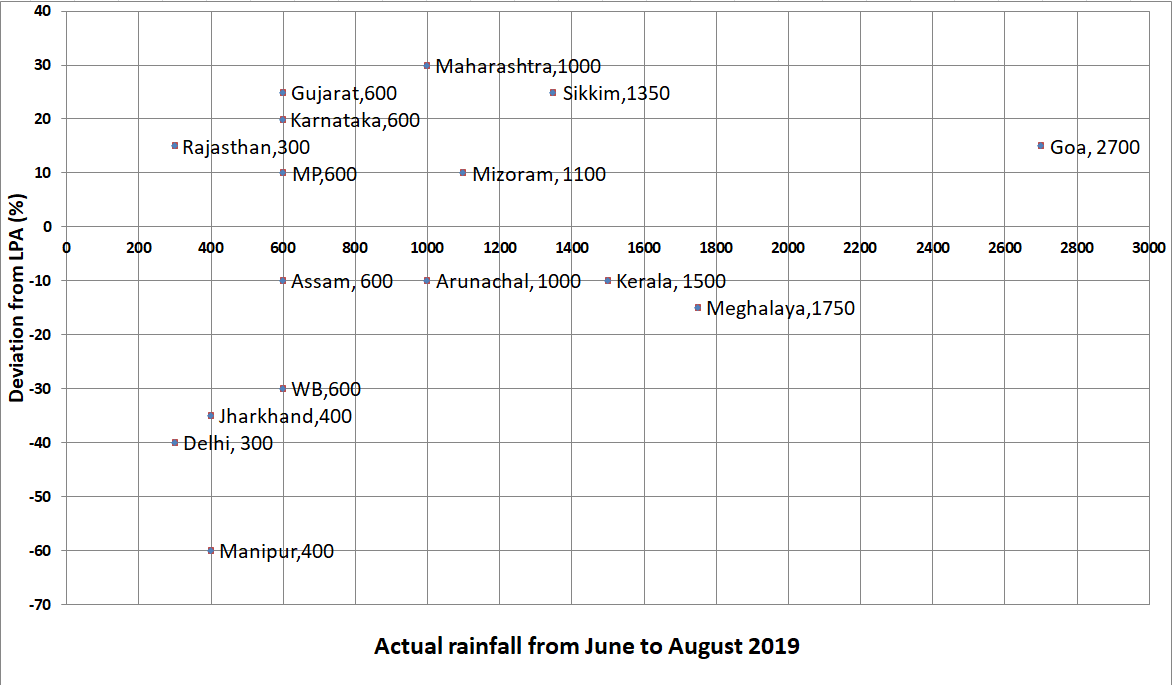
To compare the rainfall data, India Meteorological Department (IMD) calculated the Long Period Average (LPA) of rainfall during period June-August for each of the 16 states. The figure given below shows the actual rainfall (measured in mm) during June-August, 2019 and the percentage deviations from LPA of respective states in 2018. Each state along with its actual rainfall is presented in the figure.

Chart for this set — reading the chart is part of the question
Q13Mixed Charts & CaseletsMCQ

If a ‘Heavy Monsoon State’ is defined as a state with actual rainfall from June-August, 2019 of 900 mm or more, then approximately what percentage of ‘Heavy Monsoon States’ have a negative deviation from respective LPAs in 2019?

Show solution

Correct answer: A

Finding the percentage of Heavy Monsoon States with negative deviation

Step 1 — Read the scatter plot. Each state is a point whose horizontal position gives its actual June–August 2019 rainfall (mm) and whose vertical position gives its percentage deviation from LPA.

StateRainfall (mm)DeviationStateRainfall (mm)Deviation
Maharashtra1000+30%Assam600−10%
Gujarat600+25%Arunachal1000−10%
Sikkim1350+25%Kerala1500−10%
Karnataka600+20%Meghalaya1750−15%
Rajasthan300+15%West Bengal600−30%
Goa2700+15%Jharkhand400−35%
Madhya Pradesh600+10%Delhi300−40%
Mizoram1100+10%Manipur400−60%

Step 2 — Identify the Heavy Monsoon States (actual rainfall ≥ 900 mm).

StateRainfall (mm)Deviation
Maharashtra1000+30%
Mizoram1100+10%
Sikkim1350+25%
Arunachal1000−10%
Kerala1500−10%
Meghalaya1750−15%
Goa2700+15%

That is 7 Heavy Monsoon States.

Step 3 — Count how many of them have a negative deviation.

Three states — Arunachal (−10%), Kerala (−10%), Meghalaya (−15%) — have negative deviations.

Step 4 — Compute the percentage.

37×100%≈42.86%\frac{3}{7}\times 100\% \approx 42.86\%

Answer: 42.86 (Option A)

Q14Mixed Charts & CaseletsMCQ

If a ‘Low Monsoon State’ is defined as a state with actual rainfall from June-August, 2019 of 750 mm or less, then what is the median ‘deviation from LPA’ (as defined in the Y-axis of the figure) of ‘Low Monsoon States’?

Show solution

Correct answer: A

Finding the median deviation of Low Monsoon States

Step 1 — Read the scatter plot. Each state is a point whose horizontal position gives its actual June–August 2019 rainfall (mm) and whose vertical position gives its percentage deviation from LPA.

StateRainfall (mm)DeviationStateRainfall (mm)Deviation
Maharashtra1000+30%Assam600−10%
Gujarat600+25%Arunachal1000−10%
Sikkim1350+25%Kerala1500−10%
Karnataka600+20%Meghalaya1750−15%
Rajasthan300+15%West Bengal600−30%
Goa2700+15%Jharkhand400−35%
Madhya Pradesh600+10%Delhi300−40%
Mizoram1100+10%Manipur400−60%

Step 2 — Identify the Low Monsoon States (actual rainfall ≤ 750 mm) and list their deviations.

StateRainfall (mm)Deviation
Manipur400−60%
Delhi300−40%
Jharkhand400−35%
West Bengal600−30%
Assam600−10%
Madhya Pradesh600+10%
Rajasthan300+15%
Karnataka600+20%
Gujarat600+25%

That is 9 Low Monsoon States.

Step 3 — Sort the deviations and find the median.

With 9 values, the median is the 5th value when sorted from lowest to highest:

−60,  −40,  −35,  −30,  −10,  +10,  +15,  +20,  +25-60,\; -40,\; -35,\; -30,\; \boxed{-10},\; +10,\; +15,\; +20,\; +25

The 5th value is −10%.

Answer: −10% (Option A)

Q15Mixed Charts & CaseletsMCQ

What is the average rainfall of all states that have actual rainfall of 600 mm or less in 2019 and have a negative deviation from LPA?

Show solution

Correct answer: D

Finding the average rainfall of states with ≤ 600 mm rainfall and negative deviation

Step 1 — Read the scatter plot. Each state is a point whose horizontal position gives its actual June–August 2019 rainfall (mm) and whose vertical position gives its percentage deviation from LPA.

StateRainfall (mm)DeviationStateRainfall (mm)Deviation
Maharashtra1000+30%Assam600−10%
Gujarat600+25%Arunachal1000−10%
Sikkim1350+25%Kerala1500−10%
Karnataka600+20%Meghalaya1750−15%
Rajasthan300+15%West Bengal600−30%
Goa2700+15%Jharkhand400−35%
Madhya Pradesh600+10%Delhi300−40%
Mizoram1100+10%Manipur400−60%

Step 2 — Apply both filters: rainfall ≤ 600 mm and negative deviation.

First, the states with rainfall ≤ 600 mm are: Gujarat (600, +25%), Karnataka (600, +20%), Rajasthan (300, +15%), Madhya Pradesh (600, +10%), Assam (600, −10%), West Bengal (600, −30%), Jharkhand (400, −35%), Delhi (300, −40%), Manipur (400, −60%).

Now keep only those with a negative deviation:

StateRainfall (mm)Deviation
Assam600−10%
West Bengal600−30%
Jharkhand400−35%
Delhi300−40%
Manipur400−60%

💡 Teacher tip: Gujarat, Karnataka, Rajasthan, and MP all have rainfall ≤ 600 mm but positive deviations, so they are excluded by the second condition.

Step 3 — Compute the average.

Average=600+600+400+300+4005=23005=460 mm\text{Average} = \frac{600 + 600 + 400 + 300 + 400}{5} = \frac{2300}{5} = 460 \text{ mm}

Answer: 460 mm (Option D)

Q16Mixed Charts & CaseletsMCQ

The LPA of a state for a year is defined as the average rainfall in the preceding 10 years considering the period of June-August. For example, LPA in 2018 is the average rainfall during 2009-2018 and LPA in 2019 is the average rainfall during 2010-2019. It is also observed that the actual rainfall in Gujarat in 2019 is 20% more than the rainfall in 2009. The LPA of Gujarat in 2019 is closest to

Show solution

Correct answer: C

Finding the LPA of Gujarat in 2019

Step 1 — Read the scatter plot for Gujarat.

StateRainfall (mm)Deviation from LPA
Gujarat600+25%

The setup tells us the Y-axis shows the percentage deviation from LPA in 2018. So Gujarat's actual 2019 rainfall of 600 mm is 25% above its LPA for 2018.

Step 2 — Compute LPA(2018) for Gujarat.

Actual 2019=LPA(2018)×(1+0.25)\text{Actual 2019} = \text{LPA(2018)} \times (1 + 0.25)

600=LPA(2018)×1.25  ⟹  LPA(2018)=6001.25=480 mm600 = \text{LPA(2018)} \times 1.25 \implies \text{LPA(2018)} = \frac{600}{1.25} = 480 \text{ mm}

Step 3 — Use the LPA definition to find LPA(2019).

The LPA of a year is the average rainfall of the preceding 10 years:

  • LPA(2018) = average of 2009–2018
  • LPA(2019) = average of 2010–2019

The only difference between these two 10-year windows is that 2019 enters and 2009 leaves:

LPA(2019)−LPA(2018)=R2019−R200910\text{LPA(2019)} - \text{LPA(2018)} = \frac{R_{2019} - R_{2009}}{10}

Step 4 — Find R2009R_{2009} using the given clue.

We are told Gujarat's actual 2019 rainfall is 20% more than the rainfall in 2009:

R2019=1.2×R2009  ⟹  600=1.2×R2009  ⟹  R2009=500 mmR_{2019} = 1.2 \times R_{2009} \implies 600 = 1.2 \times R_{2009} \implies R_{2009} = 500 \text{ mm}

Step 5 — Compute LPA(2019).

LPA(2019)=LPA(2018)+R2019−R200910=480+600−50010=480+10=490 mm\text{LPA(2019)} = \text{LPA(2018)} + \frac{R_{2019} - R_{2009}}{10} = 480 + \frac{600 - 500}{10} = 480 + 10 = 490 \text{ mm}

💡 Teacher tip: The key insight is that two consecutive 10-year LPAs differ by exactly Rnew−Rold10\frac{R_{\text{new}} - R_{\text{old}}}{10}, because 9 of the 10 years overlap. Here the shift is only 10 mm, so LPA(2019) sits just 10 mm above LPA(2018).

Answer: 490 mm (Option C)

Set · Puzzles

In the table below the check marks indicate all languages spoken by five people: Paula, Quentin, Robert, Sally and Terence. For example, Paula speaks only Chinese and English. These five people form three teams, Team 1, Team 2 and Team 3. Each team has either 2 or 3 members. A team is said to speak a particular language if at least one of its members speak that language. The following facts are known. (1) Each team speaks exactly four languages and has the same number of members. (2) English and Chinese are spoken by all three teams, Basque and French by exactly two teams and the other languages by exactly one team. (3) None of the teams include both Quentin and Robert. (4) Paula and Sally are together in exactly two teams. (5) Robert is in Team 1 and Quentin is in Team 3.

Table — check marks (Y) indicate all languages spoken by each of the five people.

PersonArabicBasqueChineseDutchEnglishFrench
PaulaYY
QuentinYY
RobertYY
SallyYY
TerenceYY
Q17PuzzlesMCQ

Who among the following four is not a member of Team 2?

Show solution

Correct answer: C

Setting up the full arrangement

First, let us note the languages each person speaks:

PersonLanguages spoken
PaulaChinese, English
QuentinDutch, English
RobertArabic, French
SallyBasque, English
TerenceChinese, French

Step 1 — Convert language-team counts into person-team counts.

A team "speaks" a language if any member speaks it. So if a language is spoken by exactly kk teams, the only people who speak that language must be spread across exactly kk teams.

  • Arabic → 1 team: Only Robert speaks Arabic, and Robert is in Team 1 (Fact 5). So Robert is in exactly 1 team.
  • Dutch → 1 team: Only Quentin speaks Dutch, and Quentin is in Team 3 (Fact 5). So Quentin is in exactly 1 team.
  • Basque → 2 teams: Only Sally speaks Basque, so Sally is in exactly 2 teams.
  • French → 2 teams: Robert (Team 1) covers one team; Terence is the only other French speaker, so Terence must cover the second team — Terence is in at least 1 team.
  • Chinese → 3 teams: Only Paula and Terence speak Chinese, so between them they must appear in all three teams.
  • English → 3 teams: Paula, Quentin, and Sally must collectively cover all three teams.

Step 2 — Determine team size.

All three teams have the same size kk (either 2 or 3), so total memberships =3k= 3k.

We already know Q=1Q = 1, R=1R = 1, S=2S = 2. Fact 4 says Paula and Sally share exactly two teams, so Paula is in at least 2 teams.

P+Q+R+S+T=3k  ⟹  P+1+1+2+T=3k  ⟹  P+T=3k−4P + Q + R + S + T = 3k \implies P + 1 + 1 + 2 + T = 3k \implies P + T = 3k - 4

  • If k=2k = 2: P+T=2P + T = 2. With P≥2P \geq 2, we get P=2,T=0P = 2, T = 0. But T=0T = 0 means no one provides French to a second team — contradiction.
  • If k=3k = 3: P+T=5P + T = 5. With P≥2P \geq 2 and T≥1T \geq 1, the viable option (after checking all constraints) is P=3,T=2P = 3, T = 2.

So each team has 3 members, with membership counts: Paula 3, Sally 2, Terence 2, Quentin 1, Robert 1.

Step 3 — Build the teams.

Paula is in every team. Robert is only in Team 1.

  • Team 1: Paula + Robert already give Chinese, English, Arabic, French — that's exactly 4 languages. The third member must add no new language. Sally would add Basque (a 5th language), so the third member must be Terence (Chinese and French, both already covered).
  • Terence needs a second team. If it were Team 3, Sally couldn't reach her required 2 teams (she can't be in Team 1). So Terence's second team is Team 2.
  • Sally fills the remaining seats in Teams 2 and 3.
TeamMembersLanguages spoken
Team 1Paula, Robert, TerenceChinese, English, Arabic, French
Team 2Paula, Sally, TerenceChinese, English, Basque, French
Team 3Paula, Quentin, SallyChinese, English, Dutch, Basque

Verification: English & Chinese appear in all three teams ✓; Basque (T2, T3) and French (T1, T2) in exactly two ✓; Arabic (T1) and Dutch (T3) in exactly one ✓; Paula & Sally share exactly Teams 2 and 3 ✓; Quentin and Robert never share a team ✓.


Answering the question

Team 2 = {Paula, Sally, Terence}. Among the four options — Paula, Terence, Quentin, Sally — the one not in Team 2 is Quentin (he is only in Team 3).

Answer: Quentin

Q18PuzzlesMCQ

Who among the following four people is a part of exactly two teams?

Show solution

Correct answer: C

Setting up the full arrangement

First, let us note the languages each person speaks:

PersonLanguages spoken
PaulaChinese, English
QuentinDutch, English
RobertArabic, French
SallyBasque, English
TerenceChinese, French

Step 1 — Convert language-team counts into person-team counts.

A team "speaks" a language if any member speaks it. So if a language is spoken by exactly kk teams, the only people who speak that language must be spread across exactly kk teams.

  • Arabic → 1 team: Only Robert speaks Arabic, and Robert is in Team 1 (Fact 5). So Robert is in exactly 1 team.
  • Dutch → 1 team: Only Quentin speaks Dutch, and Quentin is in Team 3 (Fact 5). So Quentin is in exactly 1 team.
  • Basque → 2 teams: Only Sally speaks Basque, so Sally is in exactly 2 teams.
  • French → 2 teams: Robert (Team 1) covers one team; Terence is the only other French speaker, so Terence must cover the second team — Terence is in at least 1 team.
  • Chinese → 3 teams: Only Paula and Terence speak Chinese, so between them they must appear in all three teams.
  • English → 3 teams: Paula, Quentin, and Sally must collectively cover all three teams.

Step 2 — Determine team size.

All three teams have the same size kk (either 2 or 3), so total memberships =3k= 3k.

We already know Q=1Q = 1, R=1R = 1, S=2S = 2. Fact 4 says Paula and Sally share exactly two teams, so Paula is in at least 2 teams.

P+Q+R+S+T=3k  ⟹  P+1+1+2+T=3k  ⟹  P+T=3k−4P + Q + R + S + T = 3k \implies P + 1 + 1 + 2 + T = 3k \implies P + T = 3k - 4

  • If k=2k = 2: P+T=2P + T = 2. With P≥2P \geq 2, we get P=2,T=0P = 2, T = 0. But T=0T = 0 means no one provides French to a second team — contradiction.
  • If k=3k = 3: P+T=5P + T = 5. With P≥2P \geq 2 and T≥1T \geq 1, the viable option (after checking all constraints) is P=3,T=2P = 3, T = 2.

So each team has 3 members, with membership counts: Paula 3, Sally 2, Terence 2, Quentin 1, Robert 1.

Step 3 — Build the teams.

Paula is in every team. Robert is only in Team 1.

  • Team 1: Paula + Robert already give Chinese, English, Arabic, French — exactly 4 languages. The third member must add no new language. Sally would add Basque (a 5th language), so the third member must be Terence.
  • Terence needs a second team. If it were Team 3, Sally couldn't reach her required 2 teams. So Terence's second team is Team 2.
  • Sally fills the remaining seats in Teams 2 and 3.
TeamMembersLanguages spoken
Team 1Paula, Robert, TerenceChinese, English, Arabic, French
Team 2Paula, Sally, TerenceChinese, English, Basque, French
Team 3Paula, Quentin, SallyChinese, English, Dutch, Basque

Verification: English & Chinese in all three ✓; Basque (T2, T3) and French (T1, T2) in exactly two ✓; Arabic (T1) and Dutch (T3) in exactly one ✓; Paula & Sally share exactly Teams 2 and 3 ✓; Quentin and Robert never share a team ✓.


Answering the question

From the membership counts derived above:

PersonNumber of teams
Paula3
Sally2
Terence2
Quentin1
Robert1

Among the four options — Paula (3), Quentin (1), Sally (2), Robert (1) — the person in exactly two teams is Sally.

Answer: Sally

Q19PuzzlesMCQ

Who among the five people is a member of all teams?

Show solution

Correct answer: C

Setting up the full arrangement

First, let us note the languages each person speaks:

PersonLanguages spoken
PaulaChinese, English
QuentinDutch, English
RobertArabic, French
SallyBasque, English
TerenceChinese, French

Step 1 — Convert language-team counts into person-team counts.

A team "speaks" a language if any member speaks it. So if a language is spoken by exactly kk teams, the only people who speak that language must be spread across exactly kk teams.

  • Arabic → 1 team: Only Robert speaks Arabic, and Robert is in Team 1 (Fact 5). So Robert is in exactly 1 team.
  • Dutch → 1 team: Only Quentin speaks Dutch, and Quentin is in Team 3 (Fact 5). So Quentin is in exactly 1 team.
  • Basque → 2 teams: Only Sally speaks Basque, so Sally is in exactly 2 teams.
  • French → 2 teams: Robert (Team 1) covers one team; Terence is the only other French speaker, so Terence must cover the second team — Terence is in at least 1 team.
  • Chinese → 3 teams: Only Paula and Terence speak Chinese, so between them they must appear in all three teams.
  • English → 3 teams: Paula, Quentin, and Sally must collectively cover all three teams.

Step 2 — Determine team size.

All three teams have the same size kk (either 2 or 3), so total memberships =3k= 3k.

We already know Q=1Q = 1, R=1R = 1, S=2S = 2. Fact 4 says Paula and Sally share exactly two teams, so Paula is in at least 2 teams.

P+Q+R+S+T=3k  ⟹  P+1+1+2+T=3k  ⟹  P+T=3k−4P + Q + R + S + T = 3k \implies P + 1 + 1 + 2 + T = 3k \implies P + T = 3k - 4

  • If k=2k = 2: P+T=2P + T = 2. With P≥2P \geq 2, we get P=2,T=0P = 2, T = 0. But T=0T = 0 means no one provides French to a second team — contradiction.
  • If k=3k = 3: P+T=5P + T = 5. With P≥2P \geq 2 and T≥1T \geq 1, the viable option (after checking all constraints) is P=3,T=2P = 3, T = 2.

💡 Teacher tip: The key insight is that Chinese must be spoken by all three teams, but only Paula and Terence speak Chinese. If Paula is in only 2 teams, Terence must cover the third — but then the French constraint and the team-size equation force a contradiction. Paula must be in all three teams.

So each team has 3 members, with membership counts: Paula 3, Sally 2, Terence 2, Quentin 1, Robert 1.

Step 3 — Build the teams.

Paula is in every team. Robert is only in Team 1.

  • Team 1: Paula + Robert already give Chinese, English, Arabic, French — exactly 4 languages. The third member must add no new language. Sally would add Basque (a 5th language), so the third member must be Terence.
  • Terence needs a second team. If it were Team 3, Sally couldn't reach her required 2 teams. So Terence's second team is Team 2.
  • Sally fills the remaining seats in Teams 2 and 3.
TeamMembersLanguages spoken
Team 1Paula, Robert, TerenceChinese, English, Arabic, French
Team 2Paula, Sally, TerenceChinese, English, Basque, French
Team 3Paula, Quentin, SallyChinese, English, Dutch, Basque

Verification: English & Chinese in all three ✓; Basque (T2, T3) and French (T1, T2) in exactly two ✓; Arabic (T1) and Dutch (T3) in exactly one ✓; Paula & Sally share exactly Teams 2 and 3 ✓; Quentin and Robert never share a team ✓.


Answering the question

Looking at the solved table, Paula appears in Team 1, Team 2, and Team 3 — she is the only person in all three teams. This makes sense: she is the only person who speaks both Chinese and English, and since every team must speak both of those languages, she is needed everywhere.

Answer: Paula

Q20PuzzlesMCQ

Apart from Chinese and English, which languages are spoken by Team 1?

Show solution

Correct answer: A

Setting up the full arrangement

First, let us note the languages each person speaks:

PersonLanguages spoken
PaulaChinese, English
QuentinDutch, English
RobertArabic, French
SallyBasque, English
TerenceChinese, French

Step 1 — Convert language-team counts into person-team counts.

A team "speaks" a language if any member speaks it. So if a language is spoken by exactly kk teams, the only people who speak that language must be spread across exactly kk teams.

  • Arabic → 1 team: Only Robert speaks Arabic, and Robert is in Team 1 (Fact 5). So Robert is in exactly 1 team.
  • Dutch → 1 team: Only Quentin speaks Dutch, and Quentin is in Team 3 (Fact 5). So Quentin is in exactly 1 team.
  • Basque → 2 teams: Only Sally speaks Basque, so Sally is in exactly 2 teams.
  • French → 2 teams: Robert (Team 1) covers one team; Terence is the only other French speaker, so Terence must cover the second team — Terence is in at least 1 team.
  • Chinese → 3 teams: Only Paula and Terence speak Chinese, so between them they must appear in all three teams.
  • English → 3 teams: Paula, Quentin, and Sally must collectively cover all three teams.

Step 2 — Determine team size.

All three teams have the same size kk (either 2 or 3), so total memberships =3k= 3k.

We already know Q=1Q = 1, R=1R = 1, S=2S = 2. Fact 4 says Paula and Sally share exactly two teams, so Paula is in at least 2 teams.

P+Q+R+S+T=3k  ⟹  P+1+1+2+T=3k  ⟹  P+T=3k−4P + Q + R + S + T = 3k \implies P + 1 + 1 + 2 + T = 3k \implies P + T = 3k - 4

  • If k=2k = 2: P+T=2P + T = 2. With P≥2P \geq 2, we get P=2,T=0P = 2, T = 0. But T=0T = 0 means no one provides French to a second team — contradiction.
  • If k=3k = 3: P+T=5P + T = 5. With P≥2P \geq 2 and T≥1T \geq 1, the viable option (after checking all constraints) is P=3,T=2P = 3, T = 2.

So each team has 3 members, with membership counts: Paula 3, Sally 2, Terence 2, Quentin 1, Robert 1.

Step 3 — Build the teams.

Paula is in every team. Robert is only in Team 1.

  • Team 1: Paula + Robert already give Chinese, English, Arabic, French — exactly 4 languages. The third member must add no new language. Sally would add Basque (a 5th language), so the third member must be Terence.
  • Terence needs a second team. If it were Team 3, Sally couldn't reach her required 2 teams. So Terence's second team is Team 2.
  • Sally fills the remaining seats in Teams 2 and 3.
TeamMembersLanguages spoken
Team 1Paula, Robert, TerenceChinese, English, Arabic, French
Team 2Paula, Sally, TerenceChinese, English, Basque, French
Team 3Paula, Quentin, SallyChinese, English, Dutch, Basque

Verification: English & Chinese in all three ✓; Basque (T2, T3) and French (T1, T2) in exactly two ✓; Arabic (T1) and Dutch (T3) in exactly one ✓; Paula & Sally share exactly Teams 2 and 3 ✓; Quentin and Robert never share a team ✓.


Answering the question

Team 1 = {Paula, Robert, Terence}.

  • Paula contributes Chinese and English.
  • Robert contributes Arabic and French.
  • Terence contributes Chinese and French (both already covered).

So the four languages spoken by Team 1 are: Chinese, English, Arabic, French. Apart from Chinese and English, the remaining two are Arabic and French.

Answer: Arabic and French

Set · Mixed Charts & Caselets

Students in a college are discussing two proposals -- A: a proposal by the authorities to introduce dress code on campus, and B: a proposal by the students to allow multinational food franchises to set up outlets on college campus. A student does not necessarily support either of the two proposals. In an upcoming election for student union president, there are two candidates in fray: Sunita and Ragini. Every student prefers one of the two candidates. A survey was conducted among the students by picking a sample of 500 students. The following information was noted from this survey. 1. 250 students supported proposal A and 250 students supported proposal B. 2. Among the 200 students who preferred Sunita as student union president, 80% supported proposal A. 3. Among those who preferred Ragini, 30% supported proposal A. 4. 20% of those who supported proposal B preferred Sunita. 5. 40% of those who did not support proposal B preferred Ragini. 6. Every student who preferred Sunita and supported proposal B also supported proposal A. 7. Among those who preferred Ragini, 20% did not support any of the proposals.

Q21Mixed Charts & CaseletsTITA

Among the students surveyed who supported proposal A, what percentage preferred Sunita for student union president?

Show solution

Correct answer: 64

We need to find, among students who supported proposal A, what percentage preferred Sunita. To do that, we first build the complete survey grid from the seven clues.

Step 1 — Establish the two big totals

  • Total surveyed = 500.
  • Every student prefers exactly one of Sunita or Ragini.
  • 250 support proposal A; 250 support proposal B.

Step 2 — Split each candidate's supporters using the percentage clues

  1. 200 prefer Sunita, and 80% of them support A: 0.80×200=1600.80 \times 200 = 160 So 160 Sunita-preferrers support A.

  2. 300 prefer Ragini, and 30% of them support A: 0.30×300=900.30 \times 300 = 90 So 90 Ragini-preferrers support A.

Check: 160+90=250160 + 90 = 250, which matches the total A-supporters. ✓

  1. 20% of B-supporters prefer Sunita: 0.20×250=500.20 \times 250 = 50 So among B-supporters, 50 prefer Sunita and 200 prefer Ragini.

  2. Students who did not support B = 500−250=250500 - 250 = 250. Of these, 40% prefer Ragini: 0.40×250=1000.40 \times 250 = 100 So among non-B students, 100 prefer Ragini and 150 prefer Sunita.

  3. Every Sunita-preferrer who supports B also supports A. So the cell "Sunita, B, not-A" is 0.

  4. Among Ragini-preferrers, 20% support neither proposal: 0.20×300=600.20 \times 300 = 60 So the Ragini "not-A, not-B" cell = 60.

Step 3 — Fill the grid

A & BA & not-Bnot-A & Bnot-A & not-BTotal
Sunita50110040200
Ragini504015060300
Total100150150100500

How the Sunita row fills: She has 50 B-supporters, and all of them also support A, so A&B = 50 and not-A&B = 0. Her total A-supporters are 160, leaving 160−50=110160 - 50 = 110 in A&not-B. Her row total is 200, so the remaining not-A&not-B cell = 200−50−110−0=40200 - 50 - 110 - 0 = 40.

How the Ragini row fills: not-A&not-B = 60 (from clue 7). Her non-B total is 100, so A&not-B = 100−60=40100 - 60 = 40. Her total A-supporters are 90, so A&B = 90−40=5090 - 40 = 50. Her B-total is 200, so not-A&B = 200−50=150200 - 50 = 150.

Column totals confirm A = 100+150=250100 + 150 = 250 and B = 100+150=250100 + 150 = 250. ✓

Step 4 — Answer the question

Among A-supporters, those who prefer Sunita are in the two A-columns of Sunita's row: 50+110=16050 + 110 = 160

Total A-supporters = 250, so 160250×100=64%\frac{160}{250} \times 100 = 64\%

Answer: 64

Q22Mixed Charts & CaseletsTITA

What percentage of the students surveyed who did not support proposal A preferred Ragini as student union president?

Show solution

Correct answer: 84

We need the percentage of students who did not support proposal A and preferred Ragini. We first build the full survey grid from the clues.

Step 1 — Establish the two big totals

  • Total surveyed = 500.
  • Every student prefers exactly one of Sunita or Ragini.
  • 250 support proposal A; 250 support proposal B.

Step 2 — Split each candidate's supporters using the percentage clues

  1. 200 prefer Sunita, and 80% of them support A: 0.80×200=1600.80 \times 200 = 160 So 160 Sunita-preferrers support A.

  2. 300 prefer Ragini, and 30% of them support A: 0.30×300=900.30 \times 300 = 90 So 90 Ragini-preferrers support A.

Check: 160+90=250160 + 90 = 250, matching total A-supporters. ✓

  1. 20% of B-supporters prefer Sunita: 0.20×250=500.20 \times 250 = 50 So among B-supporters, 50 prefer Sunita and 200 prefer Ragini.

  2. Non-B students = 500−250=250500 - 250 = 250. Of these, 40% prefer Ragini: 0.40×250=1000.40 \times 250 = 100 So among non-B students, 100 prefer Ragini and 150 prefer Sunita.

  3. Every Sunita-preferrer who supports B also supports A, so the "Sunita, B, not-A" cell = 0.

  4. Among Ragini-preferrers, 20% support neither proposal: 0.20×300=600.20 \times 300 = 60 So the Ragini "not-A, not-B" cell = 60.

Step 3 — Fill the grid

A & BA & not-Bnot-A & Bnot-A & not-BTotal
Sunita50110040200
Ragini504015060300
Total100150150100500

Sunita row: 50 B-supporters all support A (A&B = 50, not-A&B = 0); A-total 160 leaves 110 in A&not-B; row total 200 leaves 40 in not-A&not-B.

Ragini row: not-A&not-B = 60; non-B total 100 leaves 40 in A&not-B; A-total 90 leaves 50 in A&B; B-total 200 leaves 150 in not-A&B.

Column totals confirm A = 250 and B = 250. ✓

Step 4 — Answer the question

Students who did not support A = 500−250=250500 - 250 = 250.

Among these non-A students, those who prefer Ragini sit in the two not-A columns of Ragini's row: 150+60=210150 + 60 = 210

So the required percentage is 210250×100=84%\frac{210}{250} \times 100 = 84\%

Answer: 84

Q23Mixed Charts & CaseletsMCQ

What percentage of the students surveyed who supported both proposals A and B preferred Sunita as student union president?

Show solution

Correct answer: D

We need the percentage of students who supported both proposals A and B and preferred Sunita. We first build the full survey grid from the clues.

Step 1 — Establish the two big totals

  • Total surveyed = 500.
  • Every student prefers exactly one of Sunita or Ragini.
  • 250 support proposal A; 250 support proposal B.

Step 2 — Split each candidate's supporters using the percentage clues

  1. 200 prefer Sunita, and 80% of them support A: 0.80×200=1600.80 \times 200 = 160 So 160 Sunita-preferrers support A.

  2. 300 prefer Ragini, and 30% of them support A: 0.30×300=900.30 \times 300 = 90 So 90 Ragini-preferrers support A.

Check: 160+90=250160 + 90 = 250, matching total A-supporters. ✓

  1. 20% of B-supporters prefer Sunita: 0.20×250=500.20 \times 250 = 50 So among B-supporters, 50 prefer Sunita and 200 prefer Ragini.

  2. Non-B students = 500−250=250500 - 250 = 250. Of these, 40% prefer Ragini: 0.40×250=1000.40 \times 250 = 100 So among non-B students, 100 prefer Ragini and 150 prefer Sunita.

  3. Every Sunita-preferrer who supports B also supports A, so the "Sunita, B, not-A" cell = 0.

  4. Among Ragini-preferrers, 20% support neither proposal: 0.20×300=600.20 \times 300 = 60 So the Ragini "not-A, not-B" cell = 60.

Step 3 — Fill the grid

A & BA & not-Bnot-A & Bnot-A & not-BTotal
Sunita50110040200
Ragini504015060300
Total100150150100500

Sunita row: 50 B-supporters all support A (A&B = 50, not-A&B = 0); A-total 160 leaves 110 in A&not-B; row total 200 leaves 40 in not-A&not-B.

Ragini row: not-A&not-B = 60; non-B total 100 leaves 40 in A&not-B; A-total 90 leaves 50 in A&B; B-total 200 leaves 150 in not-A&B.

Column totals confirm A = 250 and B = 250. ✓

Step 4 — Answer the question

Students who supported both A and B are in the "A & B" column, which totals 100.

Of these, those who prefer Sunita = 50 (the Sunita entry in the A&B column).

50100×100=50%\frac{50}{100} \times 100 = 50\%

Answer: D. 50

Q24Mixed Charts & CaseletsMCQ

How many of the students surveyed supported proposal B, did not support proposal A and preferred Ragini as student union president?

Show solution

Correct answer: A

We need the count of students who supported proposal B, did not support proposal A, and preferred Ragini. We first build the full survey grid from the clues.

Step 1 — Establish the two big totals

  • Total surveyed = 500.
  • Every student prefers exactly one of Sunita or Ragini.
  • 250 support proposal A; 250 support proposal B.

Step 2 — Split each candidate's supporters using the percentage clues

  1. 200 prefer Sunita, and 80% of them support A: 0.80×200=1600.80 \times 200 = 160 So 160 Sunita-preferrers support A.

  2. 300 prefer Ragini, and 30% of them support A: 0.30×300=900.30 \times 300 = 90 So 90 Ragini-preferrers support A.

Check: 160+90=250160 + 90 = 250, matching total A-supporters. ✓

  1. 20% of B-supporters prefer Sunita: 0.20×250=500.20 \times 250 = 50 So among B-supporters, 50 prefer Sunita and 200 prefer Ragini.

  2. Non-B students = 500−250=250500 - 250 = 250. Of these, 40% prefer Ragini: 0.40×250=1000.40 \times 250 = 100 So among non-B students, 100 prefer Ragini and 150 prefer Sunita.

  3. Every Sunita-preferrer who supports B also supports A, so the "Sunita, B, not-A" cell = 0.

  4. Among Ragini-preferrers, 20% support neither proposal: 0.20×300=600.20 \times 300 = 60 So the Ragini "not-A, not-B" cell = 60.

Step 3 — Fill the grid

A & BA & not-Bnot-A & Bnot-A & not-BTotal
Sunita50110040200
Ragini504015060300
Total100150150100500

Sunita row: 50 B-supporters all support A (A&B = 50, not-A&B = 0); A-total 160 leaves 110 in A&not-B; row total 200 leaves 40 in not-A&not-B.

Ragini row: not-A&not-B = 60; non-B total 100 leaves 40 in A&not-B; A-total 90 leaves 50 in A&B; B-total 200 leaves 150 in not-A&B.

Column totals confirm A = 250 and B = 250. ✓

Step 4 — Answer the question

We need students who are: B-supporter + not-A + prefer Ragini.

That is exactly the Ragini entry in the "not-A & B" column, which is 150.

💡 Teacher tip: When a question specifies three conditions at once (support B, not support A, prefer Ragini), it is pointing at a single cell of the grid — read it directly rather than re-deriving.

Answer: A. 150

Set · Scheduling & Sequencing

Three doctors, Dr. Ben, Dr. Kane and Dr. Wayne visit a particular clinic Monday to Saturday to see patients. Dr. Ben sees each patient for 10 minutes and charges Rs. 100/-. Dr. Kane sees each patient for 15 minutes and charges Rs. 200/-, while Dr. Wayne sees each patient for 25 minutes and charges Rs. 300/-. The clinic has three rooms numbered 1, 2 and 3 which are assigned to the three doctors as per the following table. The clinic is open from 9 a.m. to 11.30 a.m. every Monday to Saturday. On arrival each patient is handed a numbered token indicating their position in the queue, starting with token number 1 every day. As soon as any doctor becomes free, the next patient in the queue enters that emptied room for consultation. If at any time, more than one room is free then the waiting patient enters the room with the smallest number. For example, if the next two patients in the queue have token numbers 7 and 8 and if rooms numbered 1 and 3 are free, then patient with token number 7 enters room number 1 and patient with token number 8 enters room number 3.

Table — assignment of the three doctors to the three rooms across the working week.

Room No.Monday & TuesdayWednesday & ThursdayFriday & Saturday
1BenWayneKane
2KaneBenWayne
3WayneKaneBen
Q25Scheduling & SequencingMCQ

What is the maximum number of patients that the clinic can cater to on any single day?

Show solution

Correct answer: C

Finding the maximum number of patients on a single day

Key setup. The clinic operates from 9:00 a.m. to 11:30 a.m., giving a working window of 150 minutes each day. Three doctors work simultaneously in three rooms:

DoctorTime per patientFee per patient
Dr. Ben10 minRs. 100
Dr. Kane15 minRs. 200
Dr. Wayne25 minRs. 300

The room-to-doctor assignment changes by day, but every day all three doctors are present:

RoomMon & TueWed & ThuFri & Sat
1BenWayneKane
2KaneBenWayne
3WayneKaneBen

Reasoning. To maximise the number of patients seen, we assume the queue is never empty — every doctor is busy for the entire 150-minute window, seeing patients back-to-back with no idle time. The number of patients each doctor can see depends only on their consultation time, not on which room they occupy:

Ben:15010=15 patients\text{Ben}: \frac{150}{10} = 15 \text{ patients}

Kane:15015=10 patients\text{Kane}: \frac{150}{15} = 10 \text{ patients}

Wayne:15025=6 patients\text{Wayne}: \frac{150}{25} = 6 \text{ patients}

Since all three doctors work in parallel, the daily total is the sum:

15+10+6=3115 + 10 + 6 = 31

💡 Teacher tip: When the queue never empties, each doctor acts like an independent pipeline. The room number only affects which patient goes to which doctor — it does not change how many patients a doctor can see in 150 minutes.

Answer: C. 31

Q26Scheduling & SequencingMCQ

The queue is never empty on one particular Saturday. Which of the three doctors would earn the maximum amount in consultation charges on that day?

Show solution

Correct answer: B

Who earns the most on a busy Saturday?

Key setup. On Saturday the room assignments are:

RoomSaturday
1Kane
2Wayne
3Ben

The clinic window is 9:00 a.m. – 11:30 a.m. = 150 minutes. Since the queue is never empty, every doctor works the full 150 minutes without any idle time.

Step 1 — Patients seen by each doctor.

DoctorConsultation timePatients in 150 min
Ben10 min150 ÷ 10 = 15
Kane15 min150 ÷ 15 = 10
Wayne25 min150 ÷ 25 = 6

Step 2 — Earnings.

DoctorPatientsFee per patientTotal earnings
Ben15Rs. 100Rs. 1,500
Kane10Rs. 200Rs. 2,000
Wayne6Rs. 300Rs. 1,800

💡 Teacher tip: A higher fee per patient does not automatically mean higher total earnings. Kane sees fewer patients than Ben but charges double, which tips the balance in his favour. Wayne charges the most per visit but sees so few patients (only 6) that he falls short.

Dr. Kane earns Rs. 2,000 — more than both Ben (Rs. 1,500) and Wayne (Rs. 1,800).

Answer: B. Dr. Kane

Q27Scheduling & SequencingMCQ

Mr. Singh visited the clinic on Monday, Wednesday, and Friday of a particular week, arriving at 8:50 a.m. on each of the three days. His token number was 13 on all three days. On which day was he at the clinic for the maximum duration?

Show solution

Correct answer: C

On which day was Mr. Singh at the clinic the longest?

Key setup. Mr. Singh arrives at 8:50 a.m. on all three days and holds token 13 each day. Since his arrival time is identical across days, the day he leaves latest is the day with the maximum total duration.

The clinic opens at 9:00 a.m. (t = 0). Patients 1, 2, 3 immediately fill rooms 1, 2, 3 respectively. We simulate the queue forward, always assigning the next token to the lowest-numbered free room.


Monday — Rooms: Ben(1), Kane(2), Wayne(3)

Time (t)EventRooms free → assigned
0P1→R1(Ben), P2→R2(Kane), P3→R3(Wayne)—
10R1 free → P4→R1(Ben)—
15R2 free → P5→R2(Kane)—
20R1 free → P6→R1(Ben)—
25R3 free → P7→R3(Wayne)—
30R1 & R2 free → P8→R1(Ben), P9→R2(Kane)—
40R1 free → P10→R1(Ben)—
45R2 free → P11→R2(Kane)—
50R1 & R3 free → P12→R1(Ben), P13→R3(Wayne)Token 13 → Wayne

Token 13 sees Wayne (25 min): enters at t = 50 (9:50 a.m.), leaves at t = 75 (10:15 a.m.).


Wednesday — Rooms: Wayne(1), Ben(2), Kane(3)

Time (t)Event
0P1→R1(Wayne), P2→R2(Ben), P3→R3(Kane)
10R2 free → P4→R2(Ben)
15R3 free → P5→R3(Kane)
20R2 free → P6→R2(Ben)
25R1 free → P7→R1(Wayne)
30R2 & R3 free → P8→R2(Ben), P9→R3(Kane)
40R2 free → P10→R2(Ben)
45R3 free → P11→R3(Kane)
50R1 & R2 free → P12→R1(Wayne), P13→R2(Ben)

Token 13 sees Ben (10 min): enters at t = 50 (9:50 a.m.), leaves at t = 60 (10:00 a.m.).


Friday — Rooms: Kane(1), Wayne(2), Ben(3)

Time (t)Event
0P1→R1(Kane), P2→R2(Wayne), P3→R3(Ben)
10R3 free → P4→R3(Ben)
15R1 free → P5→R1(Kane)
20R3 free → P6→R3(Ben)
25R2 free → P7→R2(Wayne)
30R1 & R3 free → P8→R1(Kane), P9→R3(Ben)
40R3 free → P10→R3(Ben)
45R1 free → P11→R1(Kane)
50R2 & R3 free → P12→R2(Wayne), P13→R3(Ben)

Token 13 sees Ben (10 min): enters at t = 50 (9:50 a.m.), leaves at t = 60 (10:00 a.m.).


Summary:

DayToken 13 seesEnters atLeaves at
MondayWayne (25 min)9:50 a.m.10:15 a.m.
WednesdayBen (10 min)9:50 a.m.10:00 a.m.
FridayBen (10 min)9:50 a.m.10:00 a.m.

💡 Teacher tip: Token 13 enters at the same clock time (t = 50) on all three days, because the queue dynamics up to that point are symmetric — the same number of patients have been processed. What differs is which doctor token 13 draws, and that depends on the room assignment for that day. On Monday, token 13 lands in Wayne's room (the slowest doctor), making the visit 15 minutes longer.

Mr. Singh leaves at 10:15 a.m. on Monday versus 10:00 a.m. on the other two days, so Monday is the longest.

Answer: C. Monday

Q28Scheduling & SequencingMCQ

On a slow Thursday, only two patients are waiting at 9 a.m. After that two patients keep arriving at exact 15-minute intervals starting at 9:15 a.m. -- i.e. at 9:15 a.m., 9:30 a.m., 9:45 a.m. etc. Then the total duration in minutes when all three doctors are simultaneously free is

Show solution

Correct answer: D

Total time all three doctors are simultaneously free on a slow Thursday

Key setup. On Thursday the room assignments are:

RoomThursday
1Wayne (25 min)
2Ben (10 min)
3Kane (15 min)

At 9:00 a.m. (t = 0) only two patients are waiting, so they take rooms 1 and 2 (the two lowest-numbered rooms). Room 3 starts empty. After that, two patients arrive together every 15 minutes: at t = 15, 30, 45, 60, …

Step 1 — Simulate the first cycle (t = 0 to t = 30).

Time (t)What happensRooms busyRooms free
0P1→R1(Wayne until t=25), P2→R2(Ben until t=10). R3 empty.1, 23
10R2 frees. No patients waiting (next arrival at t=15).12, 3
15Two arrive: P3→R2(Ben until t=25), P4→R3(Kane until t=30).1, 2, 3—
25R1 and R2 both free. R3 still busy until t=30.31, 2
30R3 frees. Two arrive: P5→R1(Wayne until t=55), P6→R2(Ben until t=40).1, 23

At t = 30, all three rooms are free for an instant, but two patients arrive at that exact moment and immediately occupy rooms 1 and 2.

Step 2 — Recognise the repeating pattern.

From t = 30 onward, the same 30-minute cycle repeats:

  • Two patients take rooms 1 (Wayne, 25 min) and 2 (Ben, 10 min). Room 3 is free.
  • At t + 10: Room 2 frees → rooms 2 and 3 free, room 1 busy.
  • At t + 15: Two arrive → take rooms 2 (Ben) and 3 (Kane, 15 min). All three busy.
  • At t + 25: Rooms 1 and 2 free. Room 3 still busy.
  • At t + 30: Room 3 frees and two new patients arrive simultaneously → rooms 1 and 2 reoccupied instantly.
Time (t)Rooms freeAll three free?
0 – 103 onlyNo
10 – 152, 3No (room 1 busy)
15 – 25noneNo
25 – 301, 2No (room 3 busy)
30 (instant)1, 2, 3 → but arrivals0 min
30 – 403 onlyNo
40 – 452, 3No
45 – 55noneNo
55 – 601, 2No
60 (instant)1, 2, 3 → but arrivals0 min
…(pattern repeats)…

This cycle continues through t = 90, 120, and 150 (clinic close). At every moment when the third room would free up alongside the other two, a fresh pair of patients arrives at that exact instant.

💡 Teacher tip: The key is that Kane's 15-minute consultation time is a perfect divisor of the 15-minute arrival interval. This causes room 3 to free up exactly when the next batch arrives, so the all-free state is always instantaneous — it has zero duration.

Step 3 — Total up.

At no point during the entire clinic session do all three rooms stay empty for any positive length of time.

Total simultaneously-free time=0 minutes\text{Total simultaneously-free time} = 0 \text{ minutes}

Answer: D. 0

Set · Puzzles

Three pouches (each represented by a filled circle) are kept in each of the nine slots in a 3 × 3 grid, as shown in the figure. Every pouch has a certain number of one-rupee coins. The minimum and maximum amounts of money (in rupees) among the three pouches in each of the nine slots are given in the table. For example, we know that among the three pouches kept in the second column of the first row, the minimum amount in a pouch is Rs. 6 and the maximum amount is Rs. 8. There are nine pouches in any of the three columns, as well as in any of the three rows. It is known that the average amount of money (in rupees) kept in the nine pouches in any column or in any row is an integer. It is also known that the total amount of money kept in the three pouches in the first column of the third row is Rs. 4.

Figure — a 3x3 grid; each of the nine slots holds three pouches (filled circles). Accompanying table gives the (minimum, maximum) amount of money (in Rs.) among the three pouches in each slot.

Column 1Column 2Column 3
Row 1(2, 4)(6, 8)(1, 3)
Row 2(3, 5)(1, 1)(6, 20)
Row 3(1, 2)(1, 2)(2, 5)
Q29PuzzlesTITA

What is the total amount of money (in rupees) in the three pouches kept in the first column of the second row?

Show solution

Correct answer: 13

Setting up the grid

Each of the 9 slots holds three pouches. The table gives the minimum and maximum rupee amounts among those three pouches. If the min is mm and the max is MM, the third pouch xx satisfies m≤x≤Mm \le x \le M, so each slot's total lies in the range [2m+M,  m+2M][2m+M,\; m+2M].

The key constraint: every row of 9 pouches and every column of 9 pouches has an integer average, so each row total and each column total must be a multiple of 9.

We are also told the slot at Row 3, Column 1 totals Rs. 4.


Step 1 — Fix R3C1

For R3C1 the table gives (min⁡,max⁡)=(1,2)(\min,\max)=(1,2) and the total is 4. The three pouches are {1,1,2}\{1,1,2\} (since 1+1+2=41+1+2=4 and min=1, max=2). ✓

Step 2 — Bound each row and column, then squeeze to a multiple of 9

Computing the total range for each slot:

Slot(min, max)Slot total range
R1C1(2,4)[8, 10]
R1C2(6,8)[20, 22]
R1C3(1,3)[5, 7]
R2C1(3,5)[11, 13]
R2C2(1,1)[3, 3]
R2C3(6,20)[32, 46]
R3C1(1,2)[4, 5] → fixed at 4
R3C2(1,2)[4, 5]
R3C3(2,5)[9, 12]
  • Row 1 range: [8+20+5,  10+22+7]=[33,39][8+20+5,\; 10+22+7]=[33,39] → only multiple of 9 is 36.
  • Row 2 range: [11+3+32,  13+3+46]=[46,62][11+3+32,\; 13+3+46]=[46,62] → only multiple of 9 is 54.
  • Row 3 range (with R3C1=4): [4+4+9,  4+5+12]=[17,21][4+4+9,\; 4+5+12]=[17,21] → only multiple of 9 is 18.
  • Column 1 range (with R3C1=4): [8+11+4,  10+13+4]=[23,27][8+11+4,\; 10+13+4]=[23,27] → only multiple of 9 is 27.
  • Column 2 range: [20+3+4,  22+3+5]=[27,30][20+3+4,\; 22+3+5]=[27,30] → only multiple of 9 is 27.
  • Grand total =36+54+18=108=36+54+18=108, so Column 3 =108−27−27==108-27-27= 54.

Step 3 — Solve each slot

  • Column 1 = 27: R1C1+R2C1+4=27⇒R1C1+R2C1=23R1C1 + R2C1 + 4 = 27 \Rightarrow R1C1+R2C1=23. With R1C1≤10R1C1\le 10 and R2C1≤13R2C1\le 13, the only option is R1C1=10,  R2C1=13R1C1=10,\; R2C1=13.
  • R1C1 = 10 → pouches {2,4,4}\{2,4,4\}
  • R2C1 = 13 → pouches {3,5,5}\{3,5,5\}

The remaining slots are solved similarly, giving the complete grid:

SlotPouchesTotal
R1,C12, 4, 410
R1,C26, 6, 820
R1,C31, 2, 36
R2,C13, 5, 513
R2,C21, 1, 13
R2,C36, 12, 2038
R3,C11, 1, 24
R3,C21, 1, 24
R3,C32, 3, 510

Answering the question

The question asks for the total in the three pouches at Row 2, Column 1. From the solved grid, that slot holds {3,5,5}\{3,5,5\}, which sums to 3+5+5=133+5+5=13.

Answer: 13

Q30PuzzlesTITA

How many pouches contain exactly one coin?

Show solution

Correct answer: 8

Setting up the grid

Each of the 9 slots holds three pouches. The table gives the minimum and maximum rupee amounts among those three. If the min is mm and the max is MM, the third pouch xx satisfies m≤x≤Mm \le x \le M, so each slot's total lies in [2m+M,  m+2M][2m+M,\; m+2M].

Every row of 9 pouches and every column of 9 pouches has an integer average, so each row total and each column total is a multiple of 9. We are also told R3C1 totals Rs. 4.

Deducing the full grid

R3C1: (1,2)(1,2) with total 4 → pouches {1,1,2}\{1,1,2\}.

Row/column totals (squeezing each range to the only multiple of 9 inside it):

RangeMultiple of 9
Row 1[33, 39]36
Row 2[46, 62]54
Row 3[17, 21]18
Column 1[23, 27]27
Column 2[27, 30]27
Column 3(108 − 27 − 27)54

Solving slot by slot:

  • Col 1 = 27: R1C1+R2C1=23R1C1+R2C1=23 with maxima 10 and 13 → R1C1=10  {2,4,4}R1C1=10\;\{2,4,4\}, R2C1=13  {3,5,5}R2C1=13\;\{3,5,5\}.
  • Col 2 = 27: R1C2+R3C2=24R1C2+R3C2=24 with R3C2∈{4,5}R3C2\in\{4,5\} → R3C2=4  {1,1,2}R3C2=4\;\{1,1,2\}, R1C2=20  {6,6,8}R1C2=20\;\{6,6,8\}.
  • Row 3 = 18: R3C3=18−4−4=10  {2,3,5}R3C3=18-4-4=10\;\{2,3,5\}.
  • Row 1 = 36: R1C3=36−10−20=6  {1,2,3}R1C3=36-10-20=6\;\{1,2,3\}.
  • Col 3 = 54: R2C3=54−6−10=38  {6,12,20}R2C3=54-6-10=38\;\{6,12,20\}; R2C2={1,1,1}=3R2C2=\{1,1,1\}=3.
SlotPouchesTotal
R1,C12, 4, 410
R1,C26, 6, 820
R1,C31, 2, 36
R2,C13, 5, 513
R2,C21, 1, 13
R2,C36, 12, 2038
R3,C11, 1, 24
R3,C21, 1, 24
R3,C32, 3, 510

Answering the question

We need the number of pouches containing exactly one coin (Rs. 1). Scanning each slot for 1-rupee pouches:

SlotPouchesCount of 1s
R1,C12, 4, 40
R1,C26, 6, 80
R1,C31, 2, 31
R2,C13, 5, 50
R2,C21, 1, 13
R2,C36, 12, 200
R3,C11, 1, 22
R3,C21, 1, 22
R3,C32, 3, 50

1+3+2+2=81+3+2+2=8

Answer: 8

Q31PuzzlesTITA

What is the number of slots for which the average amount (in rupees) of its three pouches is an integer?

Show solution

Correct answer: 2

Setting up the grid

Each of the 9 slots holds three pouches. The table gives the minimum and maximum among those three. The third pouch xx satisfies min⁡≤x≤max⁡\min \le x \le \max, so each slot total lies in [2min⁡+max⁡,  min⁡+2max⁡][2\min+\max,\; \min+2\max].

Every row of 9 pouches and every column of 9 pouches has an integer average, so each row and column total is a multiple of 9. We are told R3C1 totals Rs. 4.

Deducing the full grid

R3C1: (1,2)(1,2), total 4 → {1,1,2}\{1,1,2\}.

Row and column totals (each range contains exactly one multiple of 9):

RangeTotal
Row 1[33, 39]36
Row 2[46, 62]54
Row 3[17, 21]18
Column 1[23, 27]27
Column 2[27, 30]27
Column 3108 − 27 − 2754

Solving each slot using the column/row totals and the min–max constraints:

  • Col 1 = 27: R1C1+R2C1=23R1C1+R2C1=23 → R1C1=10  {2,4,4}R1C1=10\;\{2,4,4\}, R2C1=13  {3,5,5}R2C1=13\;\{3,5,5\}.
  • Col 2 = 27: R1C2+R3C2=24R1C2+R3C2=24 → R3C2=4  {1,1,2}R3C2=4\;\{1,1,2\}, R1C2=20  {6,6,8}R1C2=20\;\{6,6,8\}.
  • Row 3 = 18: R3C3=10  {2,3,5}R3C3=10\;\{2,3,5\}.
  • Row 1 = 36: R1C3=6  {1,2,3}R1C3=6\;\{1,2,3\}.
  • Col 3 = 54: R2C3=38  {6,12,20}R2C3=38\;\{6,12,20\}; R2C2=3  {1,1,1}R2C2=3\;\{1,1,1\}.
SlotPouchesTotal
R1,C12, 4, 410
R1,C26, 6, 820
R1,C31, 2, 36
R2,C13, 5, 513
R2,C21, 1, 13
R2,C36, 12, 2038
R3,C11, 1, 24
R3,C21, 1, 24
R3,C32, 3, 510

Answering the question

A slot's average (of its three pouches) is an integer exactly when its total is divisible by 3. Checking each slot total:

SlotTotalDivisible by 3?
R1,C110No
R1,C220No
R1,C36Yes
R2,C113No
R2,C23Yes
R2,C338No
R3,C14No
R3,C24No
R3,C310No

Only R1C3 (total 6, average 2) and R2C2 (total 3, average 1) qualify — that is 2 slots.

Answer: 2

Q32PuzzlesTITA

The number of slots for which the total amount in its three pouches strictly exceeds Rs. 10 is

Show solution

Correct answer: 3

Setting up the grid

Each of the 9 slots holds three pouches. The table gives the minimum and maximum among those three. The third pouch xx satisfies min⁡≤x≤max⁡\min \le x \le \max, so each slot total lies in [2min⁡+max⁡,  min⁡+2max⁡][2\min+\max,\; \min+2\max].

Every row of 9 pouches and every column of 9 pouches has an integer average, so each row and column total is a multiple of 9. We are told R3C1 totals Rs. 4.

Deducing the full grid

R3C1: (1,2)(1,2), total 4 → {1,1,2}\{1,1,2\}.

Row and column totals (each range contains exactly one multiple of 9):

RangeTotal
Row 1[33, 39]36
Row 2[46, 62]54
Row 3[17, 21]18
Column 1[23, 27]27
Column 2[27, 30]27
Column 3108 − 27 − 2754

Solving each slot:

  • Col 1 = 27: R1C1+R2C1=23R1C1+R2C1=23 → R1C1=10  {2,4,4}R1C1=10\;\{2,4,4\}, R2C1=13  {3,5,5}R2C1=13\;\{3,5,5\}.
  • Col 2 = 27: R1C2+R3C2=24R1C2+R3C2=24 → R3C2=4  {1,1,2}R3C2=4\;\{1,1,2\}, R1C2=20  {6,6,8}R1C2=20\;\{6,6,8\}.
  • Row 3 = 18: R3C3=10  {2,3,5}R3C3=10\;\{2,3,5\}.
  • Row 1 = 36: R1C3=6  {1,2,3}R1C3=6\;\{1,2,3\}.
  • Col 3 = 54: R2C3=38  {6,12,20}R2C3=38\;\{6,12,20\}; R2C2=3  {1,1,1}R2C2=3\;\{1,1,1\}.
SlotPouchesTotal
R1,C12, 4, 410
R1,C26, 6, 820
R1,C31, 2, 36
R2,C13, 5, 513
R2,C21, 1, 13
R2,C36, 12, 2038
R3,C11, 1, 24
R3,C21, 1, 24
R3,C32, 3, 510

Answering the question

We need the number of slots whose total strictly exceeds Rs. 10 (i.e., total >10> 10, so total =10= 10 does not count). Checking each slot:

SlotTotalStrictly > 10?
R1,C110No (equals 10)
R1,C220Yes
R1,C36No
R2,C113Yes
R2,C23No
R2,C338Yes
R3,C14No
R3,C24No
R3,C310No (equals 10)

Three slots — R1C2 (20), R2C1 (13), and R2C3 (38) — have totals strictly greater than 10.

Answer: 3