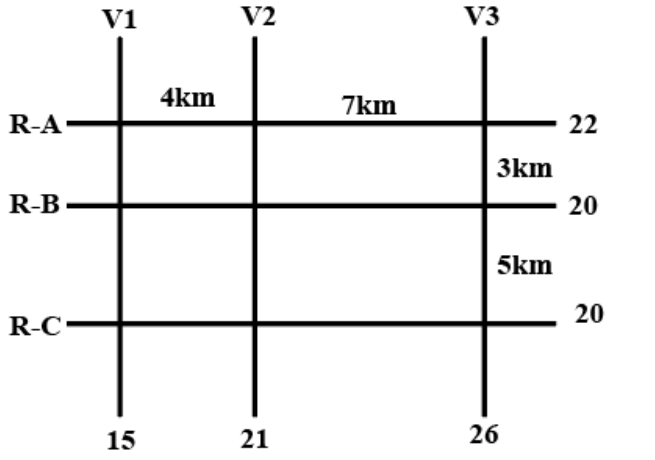
We need to determine the cash requirement at the (R-C, V2) intersection. Let's build the full arrangement from the clues.
Step 1 — Verify the grand total
Summing the horizontal road totals: 22+20+20=62.
Summing the vertical road totals: 15+21+26=62. ✓
So the six ATMs together hold Rs. 62 Lakhs.
Step 2 — Locate the minimum (7) and maximum (15)
Clue 1 says the ATMs with Rs. 7 Lakhs (minimum) and Rs. 15 Lakhs (maximum) are on the same road. Their sum is 7+15=22.
We check which road could hold exactly these two (or more) ATMs:
| Road | Total | Could 7 and 15 be on it? |
|---|
| R-A | 22 | Yes — 7 + 15 = 22 exactly, so they are the only ATMs on R-A. |
| R-B | 20 | No — 22 > 20. |
| R-C | 20 | No — 22 > 20. |
| V1 | 15 | No — 22 > 15. |
| V2 | 21 | No — 22 > 21. |
| V3 | 26 | Would need a third ATM worth 26−22=4, but 4 < 7 (the minimum). No. |
R-A = {7, 15}, exactly two ATMs.
Step 3 — Determine the remaining four cash values
The other four ATMs sum to 62−22=40 and must split into R-B (20) and R-C (20).
Four distinct integers between 8 and 14 (since 7 is the min and 15 is the max) summing to 40:
- {8, 9, 10, 13}: sum = 40, but no two pairs each total 20 (8+13 = 21, 9+10 = 19). ✗
- {8, 9, 11, 12}: sum = 40, and 8+12 = 20, 9+11 = 20. ✓
So R-B = {8, 12}, R-C = {9, 11}, and the six values are {7, 8, 9, 11, 12, 15}.
Step 4 — Place the ATMs using Clue 2
The second-highest value is 12. Clue 2 says it is 12 km from the ATM at (R-C, V3), so there is an ATM at (R-C, V3).
Since 12 belongs to R-B, we test each possible column on R-B. Recall the road distances: V1–V2 = 4 km, V2–V3 = 7 km (along any horizontal road); R-A–R-B = 3 km, R-B–R-C = 5 km (along any vertical road).
| Position of 12 | Path to (R-C, V3) | Distance |
|---|
| (R-B, V1) | V1→V2→V3 along R-B, then V3 down to R-C | 4+7+5=16 km ✗ |
| (R-B, V2) | V2→V3 along R-B, then V3 down to R-C | 7+5=12 km ✓ |
| (R-B, V3) | V3 down to R-C | 5 km ✗ |
So (R-B, V2) = 12.
Step 5 — Place R-C's two values
R-C = {9, 11} with an ATM at (R-C, V3). The V3 column totals 26.
- If (R-C, V3) = 11: remaining V3 = 26−11=15 for the R-A and R-B cells in column V3. This is achievable (see grid below).
- If (R-C, V3) = 9: remaining V3 = 26−9=17. R-A can contribute 7 or 15; R-B's remaining ATM is 8. The maximum fill is 15+8=23, but we need exactly 17. If R-B contributes 8, R-A must contribute 9 — but 9 is already used by R-C. If R-B contributes nothing, R-A must contribute 17 — impossible (max is 15). ✗
So (R-C, V3) = 11 and therefore (R-C, V2) = 9.
Step 6 — Complete the grid
Column V2 = 21 = 12 (at R-B, V2) + 9 (at R-C, V2) + (R-A, V2). So (R-A, V2) = 0 → no ATM there.
R-A's 7 and 15 must occupy V1 and V3; R-B's 8 sits at V1 or V3. Two equally valid layouts remain (cells shown a / b differ between layouts; bold = fixed in both):
| Road | V1 | V2 | V3 | Row total |
|---|
| R-A | 7 / 15 | — | 15 / 7 | 22 |
| R-B | 8 / — | 12 | — / 8 | 20 |
| R-C | — | 9 | 11 | 20 |
| Col total | 15 | 21 | 26 | 62 |
💡 Teacher tip: Even though two layouts exist, the (R-C, V2) cell is 9 in both — the V2 column must total 21, it already holds 12 and 9, and R-A contributes nothing at V2.
Answer: Choice B — the ATM at (R-C, V2) has a cash requirement of Rs. 9 Lakhs.