CATLab

CAT 2024 DILR Questions — Slot 1

The actual Data Interpretation & Logical Reasoning section from CAT 2024, Slot 1 — 22 questions in original paper order, each with a full worked solution. Tap an option (or type your answer) to check yourself before reading the solution.

22 questions12 MCQ · 10 TITA40 min section0/22 attempted
Set · Puzzles

Six web surfers M, N, O, P, X, and Y each had 30 stars which they distributed among four bloggers A, B, C, and D. The number of stars received by A and B from the six web surfers is shown in the figure below.
The following additional facts are known regarding the number of stars received by the bloggers from the surfers.

  1. The numbers of stars received by the bloggers from the surfers were all multiples of 5 (including 0).
  2. The total numbers of stars received by the bloggers were the same.
  3. Each blogger received a different number of stars from M.
  4. Two surfers gave all their stars to a single blogger.
  5. D received more stars than C from Y.

Bar chart titled 'No. of Stars received by Bloggers A and B' — stars given by the six surfers (M, N, O, P, X, Y) to blogger A (series A) and blogger B (series B).

SurferStars to AStars to B
M100
N250
O00
P525
X00
Y520
Q1PuzzlesTITA

What was the total number of stars received by D?

Show solution

Correct answer: 45

Each of the six surfers hands out exactly 30 stars (all in multiples of 5) among bloggers A, B, C and D. The chart fixes how many went to A and B; each surfer's stars to C and D together must therefore be 30−(A+B)30-(\text{A}+\text{B}).

Totals must be equal. The six surfers give 6×30=1806\times 30 = 180 stars in all, and every blogger ends with the same total, so each blogger got 180/4=45180/4 = 45. Adding the chart columns, A already has 10+25+0+5+0+5=4510+25+0+5+0+5 = 45 and B has 0+0+0+25+0+20=450+0+0+25+0+20 = 45 — so C and D must also reach 45 each.

Now pin the remaining cells:

  1. Surfer Y: Y gave 5 to A and 20 to B, leaving 5 for C and D. We're told D got more than C, so C=0, D=5C=0,\ D=5.
  2. Surfer M: the clue says M gave a different amount to each blogger. M gave 10 to A and 0 to B, and C+D must be 20 with two different values (not 0 or 10) — so they are 5 and 15.
  3. Two surfers gave everything to one blogger. Only O and X gave nothing to A or B, so they are the two who dump all 30 on a single blogger. C and D each still need 45, and O and X supply 60 between them — so one of them goes entirely to C and the other entirely to D (which one is not fixed).
  4. Balancing C: C needs 45. One of O/X supplies 30, Y supplies 0, so M and N must supply the other 15. That forces M gives C = 15 (so D = 5) and N gives C = 0 (so D = 5).

This gives the full grid (the only open point is whether O→C & X→D, or the reverse):

SurferABCDTotal
M10015530
N2500530
O0030 or 00 or 3030
P5250030
X000 or 3030 or 030
Y5200530
Total45454545180

This question — total stars received by D. Every blogger's total is the same, and 180÷4=45180 \div 4 = 45. Reading D's column confirms it: 5+5+30+0+0+5=455+5+30+0+0+5 = 45 (whichever of O/X feeds D).

Answer: 45
Q2PuzzlesMCQ

What was the number of stars received by D from Y?

Show solution

Correct answer: A

Each of the six surfers hands out exactly 30 stars (all in multiples of 5) among bloggers A, B, C and D. The chart fixes how many went to A and B; each surfer's stars to C and D together must therefore be 30−(A+B)30-(\text{A}+\text{B}).

Totals must be equal. The six surfers give 6×30=1806\times 30 = 180 stars in all, and every blogger ends with the same total, so each blogger got 180/4=45180/4 = 45. Adding the chart columns, A already has 10+25+0+5+0+5=4510+25+0+5+0+5 = 45 and B has 0+0+0+25+0+20=450+0+0+25+0+20 = 45 — so C and D must also reach 45 each.

Now pin the remaining cells:

  1. Surfer Y: Y gave 5 to A and 20 to B, leaving 5 for C and D. We're told D got more than C, so C=0, D=5C=0,\ D=5.
  2. Surfer M: the clue says M gave a different amount to each blogger. M gave 10 to A and 0 to B, and C+D must be 20 with two different values (not 0 or 10) — so they are 5 and 15.
  3. Two surfers gave everything to one blogger. Only O and X gave nothing to A or B, so they are the two who dump all 30 on a single blogger. C and D each still need 45, and O and X supply 60 between them — so one of them goes entirely to C and the other entirely to D (which one is not fixed).
  4. Balancing C: C needs 45. One of O/X supplies 30, Y supplies 0, so M and N must supply the other 15. That forces M gives C = 15 (so D = 5) and N gives C = 0 (so D = 5).

This gives the full grid (the only open point is whether O→C & X→D, or the reverse):

SurferABCDTotal
M10015530
N2500530
O0030 or 00 or 3030
P5250030
X000 or 3030 or 030
Y5200530
Total45454545180

This question — stars D got from Y. Y gave 5 to A and 20 to B, so only 30−25=530-25 = 5 stars are left for C and D together. Since D received more than C, the split must be C=0, D=5C=0,\ D=5.

Answer: 5

Q3PuzzlesTITA

How many surfers distributed their stars among exactly 2 bloggers?

Show solution

Correct answer: 2

Each of the six surfers hands out exactly 30 stars (all in multiples of 5) among bloggers A, B, C and D. The chart fixes how many went to A and B; each surfer's stars to C and D together must therefore be 30−(A+B)30-(\text{A}+\text{B}).

Totals must be equal. The six surfers give 6×30=1806\times 30 = 180 stars in all, and every blogger ends with the same total, so each blogger got 180/4=45180/4 = 45. Adding the chart columns, A already has 10+25+0+5+0+5=4510+25+0+5+0+5 = 45 and B has 0+0+0+25+0+20=450+0+0+25+0+20 = 45 — so C and D must also reach 45 each.

Now pin the remaining cells:

  1. Surfer Y: Y gave 5 to A and 20 to B, leaving 5 for C and D. We're told D got more than C, so C=0, D=5C=0,\ D=5.
  2. Surfer M: the clue says M gave a different amount to each blogger. M gave 10 to A and 0 to B, and C+D must be 20 with two different values (not 0 or 10) — so they are 5 and 15.
  3. Two surfers gave everything to one blogger. Only O and X gave nothing to A or B, so they are the two who dump all 30 on a single blogger. C and D each still need 45, and O and X supply 60 between them — so one of them goes entirely to C and the other entirely to D (which one is not fixed).
  4. Balancing C: C needs 45. One of O/X supplies 30, Y supplies 0, so M and N must supply the other 15. That forces M gives C = 15 (so D = 5) and N gives C = 0 (so D = 5).

This gives the full grid (the only open point is whether O→C & X→D, or the reverse):

SurferABCDTotal
M10015530
N2500530
O0030 or 00 or 3030
P5250030
X000 or 3030 or 030
Y5200530
Total45454545180

This question — how many surfers split their stars among exactly two bloggers. Count how many bloggers each surfer gave a non-zero number to:

SurferBloggers usedCount
MA, C, D3
NA, D2
Oone blogger only1
PA, B2
Xone blogger only1
YA, B, D3

Exactly two bloggers were used by N and P — so 2 surfers.

Answer: 2

Q4PuzzlesMCQ

Which of the following can be determined with certainty? I. The number of stars received by C from M II. The number of stars received by D from O

Show solution

Correct answer: B

Each of the six surfers hands out exactly 30 stars (all in multiples of 5) among bloggers A, B, C and D. The chart fixes how many went to A and B; each surfer's stars to C and D together must therefore be 30−(A+B)30-(\text{A}+\text{B}).

Totals must be equal. The six surfers give 6×30=1806\times 30 = 180 stars in all, and every blogger ends with the same total, so each blogger got 180/4=45180/4 = 45. Adding the chart columns, A already has 10+25+0+5+0+5=4510+25+0+5+0+5 = 45 and B has 0+0+0+25+0+20=450+0+0+25+0+20 = 45 — so C and D must also reach 45 each.

Now pin the remaining cells:

  1. Surfer Y: Y gave 5 to A and 20 to B, leaving 5 for C and D. We're told D got more than C, so C=0, D=5C=0,\ D=5.
  2. Surfer M: the clue says M gave a different amount to each blogger. M gave 10 to A and 0 to B, and C+D must be 20 with two different values (not 0 or 10) — so they are 5 and 15.
  3. Two surfers gave everything to one blogger. Only O and X gave nothing to A or B, so they are the two who dump all 30 on a single blogger. C and D each still need 45, and O and X supply 60 between them — so one of them goes entirely to C and the other entirely to D (which one is not fixed).
  4. Balancing C: C needs 45. One of O/X supplies 30, Y supplies 0, so M and N must supply the other 15. That forces M gives C = 15 (so D = 5) and N gives C = 0 (so D = 5).

This gives the full grid (the only open point is whether O→C & X→D, or the reverse):

SurferABCDTotal
M10015530
N2500530
O0030 or 00 or 3030
P5250030
X000 or 3030 or 030
Y5200530
Total45454545180

This question — which statement is certain?

  • I. Stars C got from M. M's four amounts must all differ: A = 10, B = 0, and C + D = 20 split as two distinct values. Balancing C's total to 45 forces M → C = 15. This is fixed — certain.
  • II. Stars D got from O. O gives all 30 stars to a single blogger, but that blogger could be C or D — O and X are interchangeable. So D-from-O is either 30 or 0 — not certain.

Only statement I can be determined.

Answer: Only I

Set · Puzzles

Two students, Amiya and Ramya are the only candidates in an election for the position of class representative. Students will vote based on the intensity level of Amiya's and Ramya's campaigns and the type of campaigns they run. Each campaign is said to have a level of 1 if it is a staid campaign and a level of 2 if it is a vigorous campaign. Campaigns can be of two types, they can either focus on issues, or on attacking the other candidate.
If Amiya and Ramya both run campaigns focusing on issues, then

  • The percentage of students voting in the election will be 20 times the sum of the levels of campaigning of the two students. For example, if Amiya and Ramya both run vigorous campaigns, then 20 x (2+2)%, that is, 80% of the students will vote in the election.
  • Among voting students, the percentage of votes for each candidate will be proportional to the levels of their campaigns. For example, if Amiya runs a staid (i.e., level 1) campaign while Ramya runs a vigorous (i.e., level 2) campaign, then Amiya will receive 1/3 of the votes cast, and Ramya will receive the other 2/3.
    The above-mentioned percentages change as follows if at least one of them runs a campaign attacking their opponent.
  • If Amiya runs a campaign attacking Ramya and Ramya runs a campaign focusing on issues, then 10% of the students who would have otherwise voted for Amiya will vote for Ramya, and another 10% who would have otherwise voted for Amiya, will not vote at all.
  • If Ramya runs a campaign attacking Amiya and Amiya runs a campaign focusing on issues, then 20% of the students who would have otherwise voted for Ramya will vote for Amiya, and another 5% who would have otherwise voted for Ramya, will not vote at all.
  • If both run campaigns attacking each other, then 10% of the students who would have otherwise voted for them had they run campaigns focusing on issues, will not vote at all.
Q5PuzzlesMCQ

If both of them run staid campaigns attacking the other, then what percentage of students will vote in the election?

Show solution

Correct answer: D

Setting up the key formulas

Let Amiya's campaign level be aa and Ramya's be rr, where each is either 1 (staid) or 2 (vigorous).

When both run issue-focused campaigns, the turnout is 20(a+r)%20(a+r)\% of all students, and votes split proportionally to campaign levels. This means:

Amiya’s base votes=20(a+r)%×aa+r=20a%\text{Amiya's base votes} = 20(a+r)\% \times \frac{a}{a+r} = 20a\%

Ramya’s base votes=20(a+r)%×ra+r=20r%\text{Ramya's base votes} = 20(a+r)\% \times \frac{r}{a+r} = 20r\%

So each candidate's base vote share (as a percentage of all students) is simply 20 × their own level.

When both run attacking campaigns, the rule says: 10% of each candidate's base voters (the voters they would have had under issue campaigns) will not vote at all. So each candidate keeps 90% of their base:

CandidateBase votesAfter 10% lossVotes retained
Amiya20a20a−10%-10\%20a×0.9=18a20a \times 0.9 = 18a
Ramya20r20r−10%-10\%20r×0.9=18r20r \times 0.9 = 18r

Applying to this question

Both run staid campaigns (a=1, r=1a = 1,\ r = 1) and both attack.

Amiya’s votes=18×1=18%\text{Amiya's votes} = 18 \times 1 = 18\% Ramya’s votes=18×1=18%\text{Ramya's votes} = 18 \times 1 = 18\% Total turnout=18+18=36%\text{Total turnout} = 18 + 18 = \mathbf{36\%}

Answer: D. 36%

Q6PuzzlesMCQ

What is the minimum percentage of students who will vote in the election?

Show solution

Correct answer: D

Setting up the key formulas

Let Amiya's campaign level be aa and Ramya's be rr, where each is either 1 (staid) or 2 (vigorous).

When both run issue-focused campaigns, each candidate's base vote share (as a percentage of all students) is:

Amiya’s base=20a%,Ramya’s base=20r%\text{Amiya's base} = 20a\%, \qquad \text{Ramya's base} = 20r\%

The attack rules then shift portions of these bases. Here is the complete turnout formula for every scenario:

ScenarioAmiya's votesRamya's votesTurnout
Both issues20a20a20r20r20(a+r)20(a+r)
Amiya attacks, Ramya issues16a16a20r+2a20r + 2a18a+20r18a + 20r
Ramya attacks, Amiya issues20a+4r20a + 4r15r15r20a+19r20a + 19r
Both attack18a18a18r18r18(a+r)18(a+r)

💡 Teacher tip: Turnout always increases when campaign levels (aa or rr) increase, because every formula has a positive coefficient on both aa and rr. So to minimise turnout, set both levels to their lowest value: a=1, r=1a = 1,\ r = 1.

Checking all four scenarios with a=1, r=1a = 1,\ r = 1

ScenarioTurnout calculationTurnout
Both issues20(1+1)20(1+1)40%
Amiya attacks, Ramya issues18(1)+20(1)18(1) + 20(1)38%
Ramya attacks, Amiya issues20(1)+19(1)20(1) + 19(1)39%
Both attack18(1+1)18(1+1)36%

The lowest turnout across all scenarios is 36%, which occurs when both candidates run staid campaigns and attack each other.

Answer: D. 36%

Q7PuzzlesMCQ

If Amiya runs a campaign focusing on issues, then what is the maximum percentage of votes that she can get?

Show solution

Correct answer: A

Setting up the key formulas

Let Amiya's campaign level be aa and Ramya's be rr, where each is either 1 (staid) or 2 (vigorous).

When both run issue-focused campaigns, each candidate's base vote share (as a percentage of all students) is:

Amiya’s base=20a%,Ramya’s base=20r%\text{Amiya's base} = 20a\%, \qquad \text{Ramya's base} = 20r\%

The attack rules then shift portions of these bases:

ScenarioAmiya's votesRamya's votesTurnout
Both issues20a20a20r20r20(a+r)20(a+r)
Amiya attacks, Ramya issues16a16a20r+2a20r + 2a18a+20r18a + 20r
Ramya attacks, Amiya issues20a+4r20a + 4r15r15r20a+19r20a + 19r
Both attack18a18a18r18r18(a+r)18(a+r)

Applying to this question

Amiya runs an issue-focused campaign. So the possible scenarios are:

  1. Both issues → Amiya gets 20a20a. Maximum at a=2a = 2: 20×2=40%20 \times 2 = 40\%.
  2. Ramya attacks, Amiya issues → Amiya gets 20a+4r20a + 4r (she gains 20% of Ramya's base). Maximum at a=2, r=2a = 2,\ r = 2: 40+8=48%40 + 8 = 48\%.

Between these two, the larger value is 48%.

Let's verify the calculation for the winning case (a=2, r=2a = 2,\ r = 2, Ramya attacks):

  • Amiya's base = 20×2=40%20 \times 2 = 40\%
  • Ramya's base = 20×2=40%20 \times 2 = 40\%
  • 20% of Ramya's base switches to Amiya: 0.20×40=8%0.20 \times 40 = 8\%
  • Amiya's total = 40+8=48%40 + 8 = 48\% ✓

Answer: A. 48%

Q8PuzzlesMCQ

If Ramya runs a campaign attacking Amiya, then what is the minimum percentage of votes that she is guaranteed to get?

Show solution

Correct answer: B

Setting up the key formulas

Let Amiya's campaign level be aa and Ramya's be rr, where each is either 1 (staid) or 2 (vigorous).

When both run issue-focused campaigns, each candidate's base vote share (as a percentage of all students) is:

Amiya’s base=20a%,Ramya’s base=20r%\text{Amiya's base} = 20a\%, \qquad \text{Ramya's base} = 20r\%

The attack rules then shift portions of these bases:

ScenarioAmiya's votesRamya's votesTurnout
Both issues20a20a20r20r20(a+r)20(a+r)
Amiya attacks, Ramya issues16a16a20r+2a20r + 2a18a+20r18a + 20r
Ramya attacks, Amiya issues20a+4r20a + 4r15r15r20a+19r20a + 19r
Both attack18a18a18r18r18(a+r)18(a+r)

Applying to this question

Ramya runs an attacking campaign. Two sub-cases are possible depending on what Amiya does:

Case 1: Amiya runs issues (only Ramya attacks)

From the rule: 20% of Ramya's base voters go to Amiya, and another 5% don't vote. So Ramya keeps only 75% of her base: Ramya’s votes=20r×0.75=15r\text{Ramya's votes} = 20r \times 0.75 = 15r

Case 2: Amiya also attacks (both attack)

From the rule: 10% of each candidate's base voters don't vote. Ramya keeps 90%: Ramya’s votes=20r×0.9=18r\text{Ramya's votes} = 20r \times 0.9 = 18r

Finding the minimum guaranteed

Ramya cannot control what Amiya does, so we must consider the worst case for Ramya — which is Case 1 (she gets fewer votes when Amiya stays on issues).

Ramya’s votes (worst case)=15r\text{Ramya's votes (worst case)} = 15r

To minimise this, set r=1r = 1 (staid campaign): 15×1=15%15 \times 1 = \mathbf{15\%}

💡 Teacher tip: "Guaranteed" means the minimum across all scenarios the candidate doesn't control. Ramya controls her own level and that she attacks, but she does not control Amiya's choice — so we take the worst of the two sub-cases.

Answer: B. 15%

Q9PuzzlesMCQ

What is the maximum possible voting margin with which one of the candidates can win?

Show solution

Correct answer: B

Setting up the key formulas

Let Amiya's campaign level be aa and Ramya's be rr, where each is either 1 (staid) or 2 (vigorous).

When both run issue-focused campaigns, each candidate's base vote share (as a percentage of all students) is:

Amiya’s base=20a%,Ramya’s base=20r%\text{Amiya's base} = 20a\%, \qquad \text{Ramya's base} = 20r\%

The attack rules then shift portions of these bases. Here is the complete table of vote shares:

ScenarioAmiya's votesRamya's votesMargin (Amiya − Ramya)
Both issues20a20a20r20r20(a−r)20(a - r)
Amiya attacks, Ramya issues16a16a20r+2a20r + 2a14a−20r14a - 20r
Ramya attacks, Amiya issues20a+4r20a + 4r15r15r20a−11r20a - 11r
Both attack18a18a18r18r18(a−r)18(a - r)

Finding the maximum margin

We need the largest absolute value of the margin across all scenarios and all choices of a,r∈{1,2}a, r \in \{1, 2\}.

Scenario 1 — Both issues: ∣20(a−r)∣|20(a-r)|, max = 20×1=20%20 \times 1 = 20\%.

Scenario 2 — Amiya attacks, Ramya issues: ∣14a−20r∣|14a - 20r|

  • (a=2,r=1)(a=2, r=1): ∣28−20∣=8%|28 - 20| = 8\%
  • (a=1,r=2)(a=1, r=2): ∣14−40∣=26%|14 - 40| = 26\% ← Ramya wins by 26%
  • (a=2,r=2)(a=2, r=2): ∣28−40∣=12%|28 - 40| = 12\%
  • (a=1,r=1)(a=1, r=1): ∣14−20∣=6%|14 - 20| = 6\%

Scenario 3 — Ramya attacks, Amiya issues: ∣20a−11r∣|20a - 11r|

  • (a=2,r=1)(a=2, r=1): ∣40−11∣=29%|40 - 11| = \mathbf{29\%} ← Amiya wins by 29%
  • (a=1,r=2)(a=1, r=2): ∣20−22∣=2%|20 - 22| = 2\%
  • (a=2,r=2)(a=2, r=2): ∣40−22∣=18%|40 - 22| = 18\%
  • (a=1,r=1)(a=1, r=1): ∣20−11∣=9%|20 - 11| = 9\%

Scenario 4 — Both attack: ∣18(a−r)∣|18(a-r)|, max = 18×1=18%18 \times 1 = 18\%.

Result

The largest margin across all scenarios is 29%, achieved when Amiya runs a vigorous issue-focused campaign (a=2a = 2) and Ramya runs a staid attacking campaign (r=1r = 1).

Verification:

  • Amiya's base = 20×2=40%20 \times 2 = 40\%
  • Ramya's base = 20×1=20%20 \times 1 = 20\%
  • 20% of Ramya's base switches to Amiya: 0.20×20=4%0.20 \times 20 = 4\%
  • 5% of Ramya's base doesn't vote: 0.05×20=1%0.05 \times 20 = 1\%
  • Amiya = 40+4=44%40 + 4 = 44\%, Ramya = 20×0.75=15%20 \times 0.75 = 15\%
  • Margin = 44−15=29%44 - 15 = 29\% ✓

Answer: B. 29%

Set · Bar Graphs

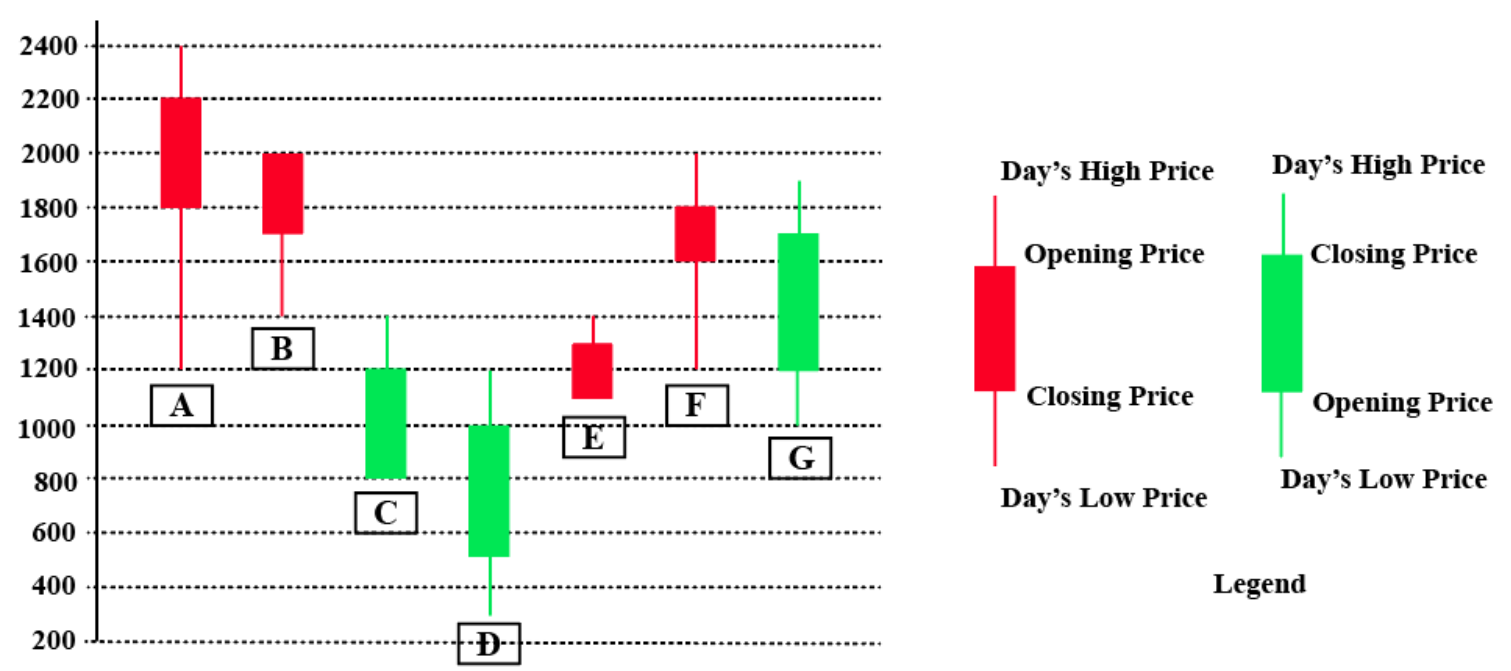
The chart below shows the price data for seven shares - A, B, C, D, E, F, and G as a candlestick plot for a particular day. The vertical axis shows the price of the share in rupees. A share whose closing price (price at the end of the day) is more than its opening price (price at the start of the day) is called a bullish share; otherwise, it is called a bearish share. All bullish and bearish shares are shown in green and red colour respectively.

Chart for this set — reading the chart is part of the question
Q10Bar GraphsMCQ

Daily Share Price Variability (SPV) is defined as (Day's high price - Day's low price) / (Average of the opening and closing prices during the day). Which among the shares A, C, D and F had the highest SPV on that day?

Show solution

Correct answer: C

Reading the candlesticks. Gridlines are Rs. 200 apart. A red (bearish) candle has its Open at the top of the box and its Close at the bottom; a green (bullish) candle is the other way round. The top of the wick is the day's High and the bottom is the day's Low — B has no upper wick (High = Open = 2000), and C and E have no lower wick (Low = 800 and 1100).

Written out as four prices per share:

ShareTypeOpenHighLowClose
ABearish2200240012001800
BBearish2000200014001700
CBullish80014008001200
DBullish50012003001000
EBearish1300140011001100
FBearish1800200012001600
GBullish1200190010001700

The Share Price Variability is SPV=High−Low12(Open+Close).\text{SPV}=\frac{\text{High}-\text{Low}}{\tfrac12(\text{Open}+\text{Close})}. We only need the four shares asked about — A, C, D and F.

  1. A: 2400−1200(2200+1800)/2=12002000=0.60\dfrac{2400-1200}{(2200+1800)/2}=\dfrac{1200}{2000}=0.60.
  2. C: 1400−800(800+1200)/2=6001000=0.60\dfrac{1400-800}{(800+1200)/2}=\dfrac{600}{1000}=0.60.
  3. D: 1200−300(500+1000)/2=900750=1.20\dfrac{1200-300}{(500+1000)/2}=\dfrac{900}{750}=1.20.
  4. F: 2000−1200(1800+1600)/2=8001700≈0.47\dfrac{2000-1200}{(1800+1600)/2}=\dfrac{800}{1700}\approx 0.47.

The largest value is D's, at 1.20.

💡 Teacher tip: D has both a wide High−Low swing (900) and the smallest average price (750), so the ratio shoots up. A big numerator over a small denominator wins.

Answer: D

Q11Bar GraphsTITA

Daily Share Price Variability (SPV) is defined as (Day's high price - Day's low price) / (Average of the opening and closing prices during the day). How many shares had an SPV greater than 0.5 on that day?

Show solution

Correct answer: 4

Reading the candlesticks. Gridlines are Rs. 200 apart. A red (bearish) candle has its Open at the top of the box and its Close at the bottom; a green (bullish) candle is the other way round. The top of the wick is the day's High and the bottom is the day's Low — B has no upper wick (High = Open = 2000), and C and E have no lower wick (Low = 800 and 1100).

Written out as four prices per share, then the Share Price Variability for every share: SPV=High−Low12(Open+Close).\text{SPV}=\frac{\text{High}-\text{Low}}{\tfrac12(\text{Open}+\text{Close})}.

ShareTypeOpenHighLowClose
ABearish2200240012001800
BBearish2000200014001700
CBullish80014008001200
DBullish50012003001000
EBearish1300140011001100
FBearish1800200012001600
GBullish1200190010001700
ShareHigh−LowAvg(Open, Close)SPVAbove 0.5?
A120020000.60Yes
B60018500.32No
C60010000.60Yes
D9007501.20Yes
E30012000.25No
F80017000.47No
G90014500.62Yes

The shares with SPV greater than 0.5 are A, C, D and G — that is 4 shares.

Answer: 4

Q12Bar GraphsMCQ

Daily loss for a share is defined as (Opening price - Closing price) / (Opening price). Which among the shares A, B, F and G had the highest daily loss on that day?

Show solution

Correct answer: C

Reading the candlesticks. Gridlines are Rs. 200 apart. A red (bearish) candle has its Open at the top of the box and its Close at the bottom; a green (bullish) candle is the other way round. The top of the wick is the day's High and the bottom is the day's Low — B has no upper wick (High = Open = 2000), and C and E have no lower wick (Low = 800 and 1100).

Daily loss is defined as Daily loss=Open−CloseOpen.\text{Daily loss}=\frac{\text{Open}-\text{Close}}{\text{Open}}.

ShareTypeOpenHighLowClose
ABearish2200240012001800
BBearish2000200014001700
CBullish80014008001200
DBullish50012003001000
EBearish1300140011001100
FBearish1800200012001600
GBullish1200190010001700

A share only makes a loss if it closed below its opening price (a bearish, red share). We are asked about A, B, F and G:

  1. A: 2200−18002200=4002200≈18.2%\dfrac{2200-1800}{2200}=\dfrac{400}{2200}\approx 18.2\%.
  2. B: 2000−17002000=3002000=15.0%\dfrac{2000-1700}{2000}=\dfrac{300}{2000}=15.0\%.
  3. F: 1800−16001800=2001800≈11.1%\dfrac{1800-1600}{1800}=\dfrac{200}{1800}\approx 11.1\%.
  4. G: G closed at 1700, above its open of 1200 — it made a gain, not a loss.

The highest daily loss is A's, at about 18.2%.

Answer: A

Q13Bar GraphsMCQ

What would have been the percentage wealth gain for a trader, who bought equal numbers of all bullish shares at opening price and sold them at their day's high?

Show solution

Correct answer: A

Reading the candlesticks. Gridlines are Rs. 200 apart. A red (bearish) candle has its Open at the top of the box and its Close at the bottom; a green (bullish) candle is the other way round. The top of the wick is the day's High and the bottom is the day's Low — B has no upper wick (High = Open = 2000), and C and E have no lower wick (Low = 800 and 1100).

Written out as four prices per share:

ShareTypeOpenHighLowClose
ABearish2200240012001800
BBearish2000200014001700
CBullish80014008001200
DBullish50012003001000
EBearish1300140011001100
FBearish1800200012001600
GBullish1200190010001700

A bullish share is one that closed above its opening price (the green shares). From the table those are C, D and G.

The trader buys one of each at the opening price and sells each at the day's high:

  1. Total cost (buy at open): 800+500+1200=2500800+500+1200 = 2500.
  2. Total received (sell at high): 1400+1200+1900=45001400+1200+1900 = 4500.
  3. Percentage gain: 4500−25002500×100=20002500×100=80%\dfrac{4500-2500}{2500}\times 100 = \dfrac{2000}{2500}\times 100 = \mathbf{80\%}.

Answer: 80%

Set · Set Theory: LR

The chart below provides complete information about the number of countries visited by Dheeraj, Samantha and Nitesh, in Asia, Europe and the rest of the world (ROW).
The following additional facts are known about the countries visited by them.

  1. 32 countries were visited by at least one of them.
  2. USA (in ROW) is the only country that was visited by all three of them.
  3. China (in Asia) is the only country that was visited by both Dheeraj and Nitesh, but not by Samantha.
  4. France (in Europe) is the only country outside Asia, which was visited by both Dheeraj and Samantha, but not by Nitesh.
  5. Half of the countries visited by both Samantha and Nitesh are in Europe.

Bar chart titled 'Number of countries visited' — countries visited by Dheeraj, Samantha and Nitesh split by region (Asia, Europe, ROW).

PersonAsiaEuropeROW
Dheeraj371
Samantha094
Nitesh1612
Q14Set Theory: LRTITA

How many countries in Asia were visited by at least one of Dheeraj, Samantha and Nitesh?

Show solution

Correct answer: 3

Finding Asian countries visited by at least one person

We first convert the chart and the five clues into a complete Venn-diagram count, broken down by region.

Step 1 — Total visits per person (from the chart).

PersonAsiaEuropeROWTotal visits
Dheeraj37111
Samantha09413
Nitesh161219

Sum of all visits =11+13+19=43= 11 + 13 + 19 = 43.

Step 2 — Use the 32 distinct countries (Fact 1).

Let e1e_1 = countries visited by exactly one person, e2e_2 = exactly two, e3e_3 = exactly three.

e1+e2+e3=32(distinct countries)e_1 + e_2 + e_3 = 32 \quad\text{(distinct countries)} e1+2e2+3e3=43(total visits)e_1 + 2e_2 + 3e_3 = 43 \quad\text{(total visits)}

Subtracting: e2+2e3=11e_2 + 2e_3 = 11.

Fact 2 says USA is the only country visited by all three, so e3=1e_3 = 1. Hence e2=9e_2 = 9 and e1=22e_1 = 22.

Step 3 — Split the 9 "exactly-two" countries.

  • D & N only = 1 (China, Fact 3).
  • D & S only = 1 (France, Fact 4 — Samantha visited 0 Asian countries, so France is the sole D&S-only country).
  • S & N only =9−1−1=7= 9 - 1 - 1 = 7.

So Samantha-and-Nitesh together (including USA) =7+1=8= 7 + 1 = 8 countries. Fact 5 says half are in Europe → 4 in Europe, the other 4 outside Europe.

Step 4 — Resolve region by region.

RegionD-onlyS-onlyN-onlyD&SD&NS&NAll 3Region total
Asia20001 (China)003
Europe6421 (France)04017
ROW0080031 (USA)12
Total8410117132

💡 Teacher tip: The key to the whole set is the inclusion–exclusion identity e2+2e3=(sum of visits)−(distinct countries)e_2 + 2e_3 = \text{(sum of visits)} - \text{(distinct countries)}. Once you know e3=1e_3 = 1 from the USA clue, everything else cascades.

Answering the question.

Samantha visited 0 Asian countries. Dheeraj's 3 Asian countries include China (shared with Nitesh), and Nitesh's single Asian country is China. So Asia contains:

  • Dheeraj-only: 2
  • China (D & N): 1

Asian countries visited by at least one=2+1=3\text{Asian countries visited by at least one} = 2 + 1 = 3

Answer: 3

Q15Set Theory: LRTITA

How many countries in Europe were visited only by Nitesh?

Show solution

Correct answer: 2

Finding European countries visited only by Nitesh

We first build the full Venn count from the chart and the five clues.

Step 1 — Total visits per person (from the chart).

PersonAsiaEuropeROWTotal visits
Dheeraj37111
Samantha09413
Nitesh161219

Sum of all visits =11+13+19=43= 11 + 13 + 19 = 43.

Step 2 — Use the 32 distinct countries (Fact 1).

Let e1e_1 = exactly one, e2e_2 = exactly two, e3e_3 = exactly three.

e1+e2+e3=32,e1+2e2+3e3=43e_1 + e_2 + e_3 = 32, \qquad e_1 + 2e_2 + 3e_3 = 43

Subtracting: e2+2e3=11e_2 + 2e_3 = 11. Fact 2 gives e3=1e_3 = 1 (USA is the only all-three country), so e2=9e_2 = 9, e1=22e_1 = 22.

Step 3 — Split the 9 "exactly-two" countries.

  • D & N only = 1 (China, Fact 3).
  • D & S only = 1 (France, Fact 4 — Samantha has no Asian country, so France is the only D&S-only).
  • S & N only =9−1−1=7= 9 - 1 - 1 = 7.

Samantha-and-Nitesh together (including USA) =7+1=8= 7 + 1 = 8. Fact 5: half in Europe → 4 in Europe.

Step 4 — Resolve region by region.

RegionD-onlyS-onlyN-onlyD&SD&NS&NAll 3Region total
Asia20001 (China)003
Europe6421 (France)04017
ROW0080031 (USA)12
Total8410117132

Answering the question.

Nitesh visited 6 European countries in total. In Europe, Nitesh shares countries only with Samantha (the 4 S&N countries); he shares nothing with Dheeraj in Europe (China, the only D&N country, is in Asia), and USA (all three) is in ROW.

Nitesh-only in Europe=6−4=2\text{Nitesh-only in Europe} = 6 - 4 = 2

Answer: 2

Q16Set Theory: LRTITA

How many countries in the ROW were visited by both Nitesh and Samantha?

Show solution

Correct answer: 4

Finding ROW countries visited by both Nitesh and Samantha

We first build the full Venn count from the chart and the five clues.

Step 1 — Total visits per person (from the chart).

PersonAsiaEuropeROWTotal visits
Dheeraj37111
Samantha09413
Nitesh161219

Sum of all visits =11+13+19=43= 11 + 13 + 19 = 43.

Step 2 — Use the 32 distinct countries (Fact 1).

Let e1e_1 = exactly one, e2e_2 = exactly two, e3e_3 = exactly three.

e1+e2+e3=32,e1+2e2+3e3=43e_1 + e_2 + e_3 = 32, \qquad e_1 + 2e_2 + 3e_3 = 43

Subtracting: e2+2e3=11e_2 + 2e_3 = 11. Fact 2 gives e3=1e_3 = 1 (USA is the only all-three country), so e2=9e_2 = 9, e1=22e_1 = 22.

Step 3 — Split the 9 "exactly-two" countries.

  • D & N only = 1 (China, Fact 3).
  • D & S only = 1 (France, Fact 4 — Samantha has no Asian country, so France is the only D&S-only).
  • S & N only =9−1−1=7= 9 - 1 - 1 = 7.

Samantha-and-Nitesh together (including USA) =7+1=8= 7 + 1 = 8 countries. Fact 5: half in Europe → 4 in Europe.

Step 4 — Resolve region by region.

RegionD-onlyS-onlyN-onlyD&SD&NS&NAll 3Region total
Asia20001 (China)003
Europe6421 (France)04017
ROW0080031 (USA)12
Total8410117132

💡 Teacher tip: "Visited by both Nitesh and Samantha" includes countries visited by all three — USA counts here. Always check whether the question says "both" (inclusive of all-three) or "exactly two."

Answering the question.

Samantha-and-Nitesh together total 8 countries. Of these, 4 are in Europe (Fact 5). Samantha visited 0 Asian countries, so none of the S&N countries are in Asia. The remaining 8−4=48 - 4 = 4 must all be in ROW.

From the ROW row of the table: S&N-only = 3, plus USA (all three) = 1, giving 3+1=43 + 1 = 4.

Answer: 4

Q17Set Theory: LRMCQ

How many countries in Europe were visited by exactly one of Dheeraj, Samantha and Nitesh?

Show solution

Correct answer: D

Finding European countries visited by exactly one person

We first build the full Venn count from the chart and the five clues.

Step 1 — Total visits per person (from the chart).

PersonAsiaEuropeROWTotal visits
Dheeraj37111
Samantha09413
Nitesh161219

Sum of all visits =11+13+19=43= 11 + 13 + 19 = 43.

Step 2 — Use the 32 distinct countries (Fact 1).

Let e1e_1 = exactly one, e2e_2 = exactly two, e3e_3 = exactly three.

e1+e2+e3=32,e1+2e2+3e3=43e_1 + e_2 + e_3 = 32, \qquad e_1 + 2e_2 + 3e_3 = 43

Subtracting: e2+2e3=11e_2 + 2e_3 = 11. Fact 2 gives e3=1e_3 = 1 (USA is the only all-three country), so e2=9e_2 = 9, e1=22e_1 = 22.

Step 3 — Split the 9 "exactly-two" countries.

  • D & N only = 1 (China, Fact 3).
  • D & S only = 1 (France, Fact 4 — Samantha has no Asian country, so France is the only D&S-only).
  • S & N only =9−1−1=7= 9 - 1 - 1 = 7.

Samantha-and-Nitesh together (including USA) =7+1=8= 7 + 1 = 8. Fact 5: half in Europe → 4 in Europe.

Step 4 — Resolve region by region.

RegionD-onlyS-onlyN-onlyD&SD&NS&NAll 3Region total
Asia20001 (China)003
Europe6421 (France)04017
ROW0080031 (USA)12
Total8410117132

Answering the question.

"Exactly one" means we read the D-only, S-only, and N-only cells of the Europe row:

  • Dheeraj-only in Europe: 6
  • Samantha-only in Europe: 4
  • Nitesh-only in Europe: 2

6+4+2=126 + 4 + 2 = 12

Answer: D. 12

Set · Games & Tournaments

The game of QUIET is played between two teams. Six teams, numbered 1, 2, 3, 4, 5, and 6, play in a QUIET tournament. These teams are divided equally into two groups. In the tournament, each team plays every other team in the same group only once, and each team in the other group exactly twice. The tournament has several rounds, each of which consists of a few games. Every team plays exactly one game in each round.
The following additional facts are known about the schedule of games in the tournament.

  1. Each team played against a team from the other group in Round 8.
  2. In Round 4 and Round 7, the match-ups, that is the pair of teams playing against each other, were identical. In Round 5 and Round 8, the match-ups were identical.
  3. Team 4 played Team 6 in both Round 1 and Round 2.
  4. Team 1 played Team 5 ONLY once and that was in Round 2.
  5. Team 3 played Team 4 in Round 3. Team 1 played Team 6 in Round 6.
  6. In Round 8, Team 3 played Team 6, while Team 2 played Team 5.
Q18Games & TournamentsTITA

How many rounds were there in the tournament?

Show solution

Correct answer: 8

How many games each team plays. Six teams are split into two groups of three. Inside a group each team meets the other two once (2 games); against the other group it meets each of the three teams twice (3×2=63\times 2 = 6 games). So every team plays 2+6=82+6 = 8 games — one per round — meaning 8 rounds of 3 games each.

Finding the two groups. Same-group pairs meet once; different-group pairs meet twice.

  1. Teams 1 and 5 meet only once (clue 4), so they are in the same group.
  2. Teams 4 and 6 meet twice — in Rounds 1 and 2 (clue 3) — so they are in different groups.
  3. Round 8 is entirely cross-group (clue 1). Its three games are 3–6 and 2–5 (clue 6) plus the leftover pair 1–4. So 1&4, 2&5 and 3&6 are each cross-group.
  4. Chaining these: 1 and 5 together; 4 opposite 1; 2 opposite 5; 6 opposite 4; 3 opposite 6. This splits the teams cleanly:

Group X={1,5,6}Group Y={2,3,4}\textbf{Group X} = \{1,5,6\} \qquad \textbf{Group Y} = \{2,3,4\}

Building the schedule. Using clue 2 (Round 4 repeats in Round 7, Round 5 repeats in Round 8) together with the fixed games — 4–6 in Rounds 1 & 2, 1–5 in Round 2, 3–4 in Round 3, 1–6 in Round 6 — the whole timetable is forced:

RoundGame 1Game 2Game 3
14–61–23–5
24–61–52–3
33–41–25–6
41–34–52–6
51–42–53–6
61–62–43–5
71–34–52–6
81–42–53–6

This question — how many rounds. Each team plays 2 games inside its group plus 6 against the other group, i.e. 8 games, and every team plays exactly one game per round. So there are 8 rounds.

Answer: 8

Q19Games & TournamentsTITA

What is the number of the team that played Team 1 in Round 5?

Show solution

Correct answer: 4

How many games each team plays. Six teams are split into two groups of three. Inside a group each team meets the other two once (2 games); against the other group it meets each of the three teams twice (3×2=63\times 2 = 6 games). So every team plays 2+6=82+6 = 8 games — one per round — meaning 8 rounds of 3 games each.

Finding the two groups. Same-group pairs meet once; different-group pairs meet twice.

  1. Teams 1 and 5 meet only once (clue 4), so they are in the same group.
  2. Teams 4 and 6 meet twice — in Rounds 1 and 2 (clue 3) — so they are in different groups.
  3. Round 8 is entirely cross-group (clue 1). Its three games are 3–6 and 2–5 (clue 6) plus the leftover pair 1–4. So 1&4, 2&5 and 3&6 are each cross-group.
  4. Chaining these: 1 and 5 together; 4 opposite 1; 2 opposite 5; 6 opposite 4; 3 opposite 6. This splits the teams cleanly:

Group X={1,5,6}Group Y={2,3,4}\textbf{Group X} = \{1,5,6\} \qquad \textbf{Group Y} = \{2,3,4\}

Building the schedule. Using clue 2 (Round 4 repeats in Round 7, Round 5 repeats in Round 8) together with the fixed games — 4–6 in Rounds 1 & 2, 1–5 in Round 2, 3–4 in Round 3, 1–6 in Round 6 — the whole timetable is forced:

RoundGame 1Game 2Game 3
14–61–23–5
24–61–52–3
33–41–25–6
41–34–52–6
51–42–53–6
61–62–43–5
71–34–52–6
81–42–53–6

This question — who played Team 1 in Round 5. Round 5's games are 1–4, 2–5 and 3–6. Team 1's opponent is Team 4.

Answer: 4

Q20Games & TournamentsMCQ

Which team among the teams numbered 2, 3, 4, and 5 was not part of the same group?

Show solution

Correct answer: A

How many games each team plays. Six teams are split into two groups of three. Inside a group each team meets the other two once (2 games); against the other group it meets each of the three teams twice (3×2=63\times 2 = 6 games). So every team plays 2+6=82+6 = 8 games — one per round — meaning 8 rounds of 3 games each.

Finding the two groups. Same-group pairs meet once; different-group pairs meet twice.

  1. Teams 1 and 5 meet only once (clue 4), so they are in the same group.
  2. Teams 4 and 6 meet twice — in Rounds 1 and 2 (clue 3) — so they are in different groups.
  3. Round 8 is entirely cross-group (clue 1). Its three games are 3–6 and 2–5 (clue 6) plus the leftover pair 1–4. So 1&4, 2&5 and 3&6 are each cross-group.
  4. Chaining these: 1 and 5 together; 4 opposite 1; 2 opposite 5; 6 opposite 4; 3 opposite 6. This splits the teams cleanly:

Group X={1,5,6}Group Y={2,3,4}\textbf{Group X} = \{1,5,6\} \qquad \textbf{Group Y} = \{2,3,4\}

Building the schedule. Using clue 2 (Round 4 repeats in Round 7, Round 5 repeats in Round 8) together with the fixed games — 4–6 in Rounds 1 & 2, 1–5 in Round 2, 3–4 in Round 3, 1–6 in Round 6 — the whole timetable is forced:

RoundGame 1Game 2Game 3
14–61–23–5
24–61–52–3
33–41–25–6
41–34–52–6
51–42–53–6
61–62–43–5
71–34–52–6
81–42–53–6

This question — which of Teams 2, 3, 4, 5 is not in the same group as the others. The groups are X = {1, 5, 6} and Y = {2, 3, 4}. Among the four listed, 2, 3 and 4 all sit in Group Y; only Team 5 belongs to Group X.

Answer: 5

Q21Games & TournamentsTITA

What is the number of the team that played Team 1 in Round 7?

Show solution

Correct answer: 3

How many games each team plays. Six teams are split into two groups of three. Inside a group each team meets the other two once (2 games); against the other group it meets each of the three teams twice (3×2=63\times 2 = 6 games). So every team plays 2+6=82+6 = 8 games — one per round — meaning 8 rounds of 3 games each.

Finding the two groups. Same-group pairs meet once; different-group pairs meet twice.

  1. Teams 1 and 5 meet only once (clue 4), so they are in the same group.
  2. Teams 4 and 6 meet twice — in Rounds 1 and 2 (clue 3) — so they are in different groups.
  3. Round 8 is entirely cross-group (clue 1). Its three games are 3–6 and 2–5 (clue 6) plus the leftover pair 1–4. So 1&4, 2&5 and 3&6 are each cross-group.
  4. Chaining these: 1 and 5 together; 4 opposite 1; 2 opposite 5; 6 opposite 4; 3 opposite 6. This splits the teams cleanly:

Group X={1,5,6}Group Y={2,3,4}\textbf{Group X} = \{1,5,6\} \qquad \textbf{Group Y} = \{2,3,4\}

Building the schedule. Using clue 2 (Round 4 repeats in Round 7, Round 5 repeats in Round 8) together with the fixed games — 4–6 in Rounds 1 & 2, 1–5 in Round 2, 3–4 in Round 3, 1–6 in Round 6 — the whole timetable is forced:

RoundGame 1Game 2Game 3
14–61–23–5
24–61–52–3
33–41–25–6
41–34–52–6
51–42–53–6
61–62–43–5
71–34–52–6
81–42–53–6

This question — who played Team 1 in Round 7. Round 7 repeats Round 4's match-ups: 1–3, 4–5 and 2–6. Team 1's opponent is Team 3.

Answer: 3

Q22Games & TournamentsTITA

What is the number of the team that played Team 6 in Round 3?

Show solution

Correct answer: 5

How many games each team plays. Six teams are split into two groups of three. Inside a group each team meets the other two once (2 games); against the other group it meets each of the three teams twice (3×2=63\times 2 = 6 games). So every team plays 2+6=82+6 = 8 games — one per round — meaning 8 rounds of 3 games each.

Finding the two groups. Same-group pairs meet once; different-group pairs meet twice.

  1. Teams 1 and 5 meet only once (clue 4), so they are in the same group.
  2. Teams 4 and 6 meet twice — in Rounds 1 and 2 (clue 3) — so they are in different groups.
  3. Round 8 is entirely cross-group (clue 1). Its three games are 3–6 and 2–5 (clue 6) plus the leftover pair 1–4. So 1&4, 2&5 and 3&6 are each cross-group.
  4. Chaining these: 1 and 5 together; 4 opposite 1; 2 opposite 5; 6 opposite 4; 3 opposite 6. This splits the teams cleanly:

Group X={1,5,6}Group Y={2,3,4}\textbf{Group X} = \{1,5,6\} \qquad \textbf{Group Y} = \{2,3,4\}

Building the schedule. Using clue 2 (Round 4 repeats in Round 7, Round 5 repeats in Round 8) together with the fixed games — 4–6 in Rounds 1 & 2, 1–5 in Round 2, 3–4 in Round 3, 1–6 in Round 6 — the whole timetable is forced:

RoundGame 1Game 2Game 3
14–61–23–5
24–61–52–3
33–41–25–6
41–34–52–6
51–42–53–6
61–62–43–5
71–34–52–6
81–42–53–6

This question — who played Team 6 in Round 3. Round 3's games are 3–4, 1–2 and 5–6. Team 6's opponent is Team 5.

Answer: 5