CATLab

CAT 2021 DILR Questions — Slot 1

The actual Data Interpretation & Logical Reasoning section from CAT 2021, Slot 1 — 20 questions in original paper order, each with a full worked solution. Tap an option (or type your answer) to check yourself before reading the solution.

20 questions15 MCQ · 5 TITA40 min section0/20 attempted
Set · Scheduling & Sequencing

A journal plans to publish 18 research papers, written by eight authors (A, B, C, D, E, F, G, and H) in four issues of the journal scheduled in January, April, July and October. Each of the research papers was written by exactly one of the eight authors. Five papers were scheduled in each of the first two issues, while four were scheduled in each of the last two issues. Every author wrote at least one paper and at most three papers. The total number of papers written by A, D, G and H was double the total number of papers written by the other four authors. Four of the authors were from India and two each were from Japan and China. Each author belonged to exactly one of the three areas — Manufacturing, Automation, and Logistics. Four of the authors were from the Logistics area and two were from the Automation area. As per the journal policy, none of the authors could have more than one paper in any issue of the journal.
The following facts are also known.

  1. F, an Indian author from the Logistics area, wrote only one paper. It was scheduled in the October issue.
  2. A was from the Automation area and did not have a paper scheduled in the October issue.
  3. None of the Indian authors were from the Manufacturing area and none of the Japanese or Chinese authors were from the Automation area.
  4. A and H were from different countries, but had their papers scheduled in exactly the same issues.
  5. C and E, both Chinese authors from different areas, had the same number of papers scheduled. Further, E had papers scheduled in consecutive issues of the journal but C did not.
  6. B, from the Logistics area, had a paper scheduled in the April issue of the journal.
  7. B and G belonged to the same country. None of their papers were scheduled in the same issue of the journal.
  8. D, a Japanese author from the Manufacturing area, did not have a paper scheduled in the July issue.
  9. C and H belonged to different areas.
Q1Scheduling & SequencingMCQ

What is the correct sequence of number of papers written by B, C, E and G, respectively?

Show solution

Correct answer: A

Let us build the complete arrangement from the clues, then read off the answer.

Step 1 — Split the 18 papers into two groups

The total papers by A, D, G, H is double the total by B, C, E, F. If the smaller group (B+C+E+F) totals xx, then the larger group (A+D+G+H) totals 2x2x, and x+2x=18x + 2x = 18, so x=6x = 6.

  • A + D + G + H = 12
  • B + C + E + F = 6

Since every author writes at most 3 papers, four authors summing to 12 must each write exactly 3: A = D = G = H = 3.

Step 2 — Assign countries

Four authors are Indian, two Japanese, two Chinese.

  • A is Automation (clue 2). Since no Japanese/Chinese author is in Automation (clue 3), A is Indian.
  • C and E are the two Chinese authors (clue 5).
  • D is Japanese (clue 8).
  • A and H are from different countries (clue 4). A is Indian, and H cannot be Chinese (C and E already are), so H is Japanese.

Thus: India = {A, B, F, G}, Japan = {D, H}, China = {C, E}.

Step 3 — Assign areas

Automation has 2 authors, Logistics has 4, so Manufacturing has 8−4−2=28 - 4 - 2 = 2.

  • Indians are never in Manufacturing; Japanese/Chinese are never in Automation (clue 3). So both Automation authors are Indian, and both Manufacturing authors are Japanese/Chinese.
  • A is Automation. Among Indians, F and B are Logistics (clues 1 and 6), so the second Automation author is G.
  • Manufacturing (2 authors, from Japan/China) contains D. C and E are in different areas (clue 5), so exactly one of them is Manufacturing. Clue 9 says C and H are in different areas; H is Logistics, so C is Manufacturing and E is Logistics.
AuthorCountryAreaPapersScheduled in
AIndiaAutomation3January, April, July
BIndiaLogistics1April
CChinaManufacturing2January, October
DJapanManufacturing3January, April, October
EChinaLogistics2April, July
FIndiaLogistics1October
GIndiaAutomation3January, July, October
HJapanLogistics3January, April, July

Step 4 — Determine the smaller-group counts

F = 1 (clue 1). So B + C + E = 5. Clue 5 says C and E wrote the same number of papers, and E's papers are in consecutive issues, so E must have at least 2. The only split of 5 with C = E and E ≥ 2 is C = E = 2, B = 1.

This question

Reading the paper counts directly from the table:

AuthorPapers
B1
C2
E2
G3

Answer: 1, 2, 2, 3 (Option A)

Q2Scheduling & SequencingTITA

How many papers were written by Indian authors?

Show solution

Correct answer: 8

Let us build the complete arrangement from the clues, then sum the Indian authors' papers.

Step 1 — Split the 18 papers into two groups

The total papers by A, D, G, H is double the total by B, C, E, F. If the smaller group totals xx, then x+2x=18x + 2x = 18, so x=6x = 6.

  • A + D + G + H = 12
  • B + C + E + F = 6

Since each author writes at most 3 papers, four authors summing to 12 forces A = D = G = H = 3.

Step 2 — Assign countries

Four authors are Indian, two Japanese, two Chinese.

  • A is Automation (clue 2). No Japanese/Chinese author is in Automation (clue 3), so A is Indian.
  • C and E are the two Chinese authors (clue 5).
  • D is Japanese (clue 8).
  • A and H are from different countries (clue 4). A is Indian and H cannot be Chinese, so H is Japanese.

Thus: India = {A, B, F, G}, Japan = {D, H}, China = {C, E}.

Step 3 — Assign areas and counts

  • Automation has 2 authors (both Indian): A and G.
  • Manufacturing has 2 authors (from Japan/China): C and D.
  • Logistics has 4 authors: B, E, F, H.

For the smaller group: F = 1 (clue 1), and B + C + E = 5 with C = E (clue 5) and E ≥ 2 (consecutive issues), giving C = E = 2, B = 1.

Complete solved table

AuthorCountryAreaPapersScheduled in
AIndiaAutomation3January, April, July
BIndiaLogistics1April
CChinaManufacturing2January, October
DJapanManufacturing3January, April, October
EChinaLogistics2April, July
FIndiaLogistics1October
GIndiaAutomation3January, July, October
HJapanLogistics3January, April, July

This question

The Indian authors are A, B, F, and G. Adding their papers:

3+1+1+3=83 + 1 + 1 + 3 = 8

Answer: 8

Q3Scheduling & SequencingMCQ

Which of the following statement(s) MUST be true? Statement A: Every issue had at least one paper by author(s) from each country. Statement B: Every issue had at most two papers by author(s) from each area.

Show solution

Correct answer: C

Let us build the complete arrangement, then test each statement against the issue-by-issue schedule.

Step 1 — Split the 18 papers into two groups

A+D+G+H is double B+C+E+F. If the smaller group totals xx, then 3x=183x = 18, so x=6x = 6. Thus A+D+G+H = 12 and B+C+E+F = 6. Since each author writes at most 3, we get A = D = G = H = 3.

Step 2 — Countries and areas

  • A is Automation → Indian (no Japanese/Chinese in Automation). C and E are Chinese (clue 5). D is Japanese (clue 8). A and H are different countries (clue 4) → H is Japanese.
  • India = {A, B, F, G}, Japan = {D, H}, China = {C, E}.
  • Automation (2, both Indian): A, G. Manufacturing (2, from Japan/China): C, D. Logistics (4): B, E, F, H.
  • F = 1; B + C + E = 5 with C = E and E ≥ 2 → C = E = 2, B = 1.

Step 3 — Assign issues

  • A skips October (clue 2), has 3 papers → Jan, Apr, Jul. H copies A (clue 4).
  • D skips July (clue 8) → Jan, Apr, Oct.
  • B is in April only (clue 6, since B = 1).
  • G (3 papers) shares no issue with B (clue 7) → Jan, Jul, Oct.
  • C and E split the remaining slots: E must be consecutive, C must not → E = Apr, Jul and C = Jan, Oct.

Complete solved tables

AuthorCountryAreaPapersScheduled in
AIndiaAutomation3January, April, July
BIndiaLogistics1April
CChinaManufacturing2January, October
DJapanManufacturing3January, April, October
EChinaLogistics2April, July
FIndiaLogistics1October
GIndiaAutomation3January, July, October
HJapanLogistics3January, April, July
IssueAuthors with a paper
JanuaryA, C, D, G, H
AprilA, B, D, E, H
JulyA, E, G, H
OctoberC, D, F, G

This question

Statement A — Every issue had at least one paper from each country (India, Japan, China).

IssueIndiaJapanChina
JanuaryA, GD, HC
AprilA, BD, HE
JulyA, GHE
OctoberF, GDC

Every issue has at least one Indian, one Japanese, and one Chinese paper. Statement A is true.

Statement B — Every issue had at most two papers from each area.

Look at April: the authors are A (Automation), B (Logistics), D (Manufacturing), E (Logistics), H (Logistics). That is three Logistics papers — B, E, and H. This exceeds two, so Statement B is false.

Answer: Only Statement A (Option C)

Q4Scheduling & SequencingMCQ

Which of the following statements is FALSE?

Show solution

Correct answer: C

Let us build the complete arrangement, then test each option against the issue-by-issue schedule.

Step 1 — Split the 18 papers into two groups

A+D+G+H is double B+C+E+F. If the smaller group totals xx, then 3x=183x = 18, so x=6x = 6. Thus A+D+G+H = 12 and B+C+E+F = 6. Since each author writes at most 3, we get A = D = G = H = 3.

Step 2 — Countries and areas

  • A is Automation → Indian. C and E are Chinese (clue 5). D is Japanese (clue 8). A and H are different countries (clue 4) → H is Japanese.
  • India = {A, B, F, G}, Japan = {D, H}, China = {C, E}.
  • Automation (2): A, G. Manufacturing (2): C, D. Logistics (4): B, E, F, H.
  • F = 1; B + C + E = 5 with C = E and E ≥ 2 → C = E = 2, B = 1.

Step 3 — Assign issues

  • A skips October → Jan, Apr, Jul. H copies A.
  • D skips July → Jan, Apr, Oct.
  • B is in April only.
  • G shares no issue with B → Jan, Jul, Oct.
  • C and E split remaining: E consecutive, C not → E = Apr, Jul, C = Jan, Oct.

Complete solved tables

AuthorCountryAreaPapersScheduled in
AIndiaAutomation3January, April, July
BIndiaLogistics1April
CChinaManufacturing2January, October
DJapanManufacturing3January, April, October
EChinaLogistics2April, July
FIndiaLogistics1October
GIndiaAutomation3January, July, October
HJapanLogistics3January, April, July
IssueAuthors with a paper
JanuaryA, C, D, G, H
AprilA, B, D, E, H
JulyA, E, G, H
OctoberC, D, F, G

This question — test each option

Option A: Every issue had at least one Automation paper. Automation authors are A (Jan, Apr, Jul) and G (Jan, Jul, Oct). Together they cover all four issues. True.

Option B: Every issue had exactly one Chinese paper. Chinese authors: C (Jan, Oct) and E (Apr, Jul) — exactly one per issue. True.

Option C: Every issue had exactly two Logistics papers. Logistics authors are B, E, F, H. Counting per issue:

  • January: only H → 1 Logistics paper.
  • April: B, E, H → 3 Logistics papers.
  • July: E, H → 2.
  • October: F → 1.

January and October each have only one Logistics paper, and April has three. So this statement is false.

Option D: Every issue had exactly two Indian papers. Indian authors: A, B, F, G.

  • January: A, G → 2.
  • April: A, B → 2.
  • July: A, G → 2.
  • October: F, G → 2.

True.

Answer: Every issue had exactly two papers by authors from Logistics area. (Option C)

Q5Scheduling & SequencingMCQ

Which of the following statements is FALSE?

Show solution

Correct answer: D

Let us build the complete arrangement, then test each option against the issue-by-issue schedule.

Step 1 — Split the 18 papers into two groups

A+D+G+H is double B+C+E+F. If the smaller group totals xx, then 3x=183x = 18, so x=6x = 6. Thus A+D+G+H = 12 and B+C+E+F = 6. Since each author writes at most 3, we get A = D = G = H = 3.

Step 2 — Countries and areas

  • A is Automation → Indian. C and E are Chinese (clue 5). D is Japanese (clue 8). A and H are different countries (clue 4) → H is Japanese.
  • India = {A, B, F, G}, Japan = {D, H}, China = {C, E}.
  • Automation (2): A, G. Manufacturing (2): C, D. Logistics (4): B, E, F, H.
  • F = 1; B + C + E = 5 with C = E and E ≥ 2 → C = E = 2, B = 1.

Step 3 — Assign issues

  • A skips October → Jan, Apr, Jul. H copies A.
  • D skips July → Jan, Apr, Oct.
  • B is in April only.
  • G shares no issue with B → Jan, Jul, Oct.
  • C and E split remaining: E consecutive, C not → E = Apr, Jul, C = Jan, Oct.

Complete solved tables

AuthorCountryAreaPapersScheduled in
AIndiaAutomation3January, April, July
BIndiaLogistics1April
CChinaManufacturing2January, October
DJapanManufacturing3January, April, October
EChinaLogistics2April, July
FIndiaLogistics1October
GIndiaAutomation3January, July, October
HJapanLogistics3January, April, July
IssueAuthors with a paper
JanuaryA, C, D, G, H
AprilA, B, D, E, H
JulyA, E, G, H
OctoberC, D, F, G

This question — test each option

The Manufacturing authors are C (Jan, Oct) and D (Jan, Apr, Oct). Counting Manufacturing papers per issue:

IssueManufacturing authorsCount
JanuaryC, D2
AprilD1
July—0
OctoberC, D2

Now check each statement:

  • Option A: Exactly two Manufacturing papers in January → C and D both appear. True.
  • Option B: Exactly one Manufacturing paper in April → only D. True.
  • Option C: Exactly one Logistics paper in October → Logistics authors in October: only F. True.
  • Option D: Exactly two Manufacturing papers in July → July has zero Manufacturing papers (neither C nor D appears). False.

Answer: There were exactly two papers by authors from Manufacturing area in the July issue. (Option D)

Q6Scheduling & SequencingMCQ

Which of the following is the correct sequence of number of papers by authors from Automation, Manufacturing and Logistics areas, respectively?

Show solution

Correct answer: A

Let us build the complete arrangement, then sum the paper counts by area.

Step 1 — Split the 18 papers into two groups

A+D+G+H is double B+C+E+F. If the smaller group totals xx, then 3x=183x = 18, so x=6x = 6. Thus A+D+G+H = 12 and B+C+E+F = 6. Since each author writes at most 3, we get A = D = G = H = 3.

Step 2 — Countries and areas

  • A is Automation → Indian. C and E are Chinese (clue 5). D is Japanese (clue 8). A and H are different countries (clue 4) → H is Japanese.
  • India = {A, B, F, G}, Japan = {D, H}, China = {C, E}.
  • Automation (2): A, G. Manufacturing (2): C, D. Logistics (4): B, E, F, H.
  • F = 1; B + C + E = 5 with C = E and E ≥ 2 → C = E = 2, B = 1.

Complete solved table

AuthorCountryAreaPapersScheduled in
AIndiaAutomation3January, April, July
BIndiaLogistics1April
CChinaManufacturing2January, October
DJapanManufacturing3January, April, October
EChinaLogistics2April, July
FIndiaLogistics1October
GIndiaAutomation3January, July, October
HJapanLogistics3January, April, July

This question — sum papers by area

AreaAuthorsCalculationTotal
AutomationA, G3+33 + 36
ManufacturingC, D2+32 + 35
LogisticsB, E, F, H1+2+1+31 + 2 + 1 + 37

Verification: 6+5+7=186 + 5 + 7 = 18 ✓

Answer: 6, 5, 7 (Option A)

Set · Bar Graphs

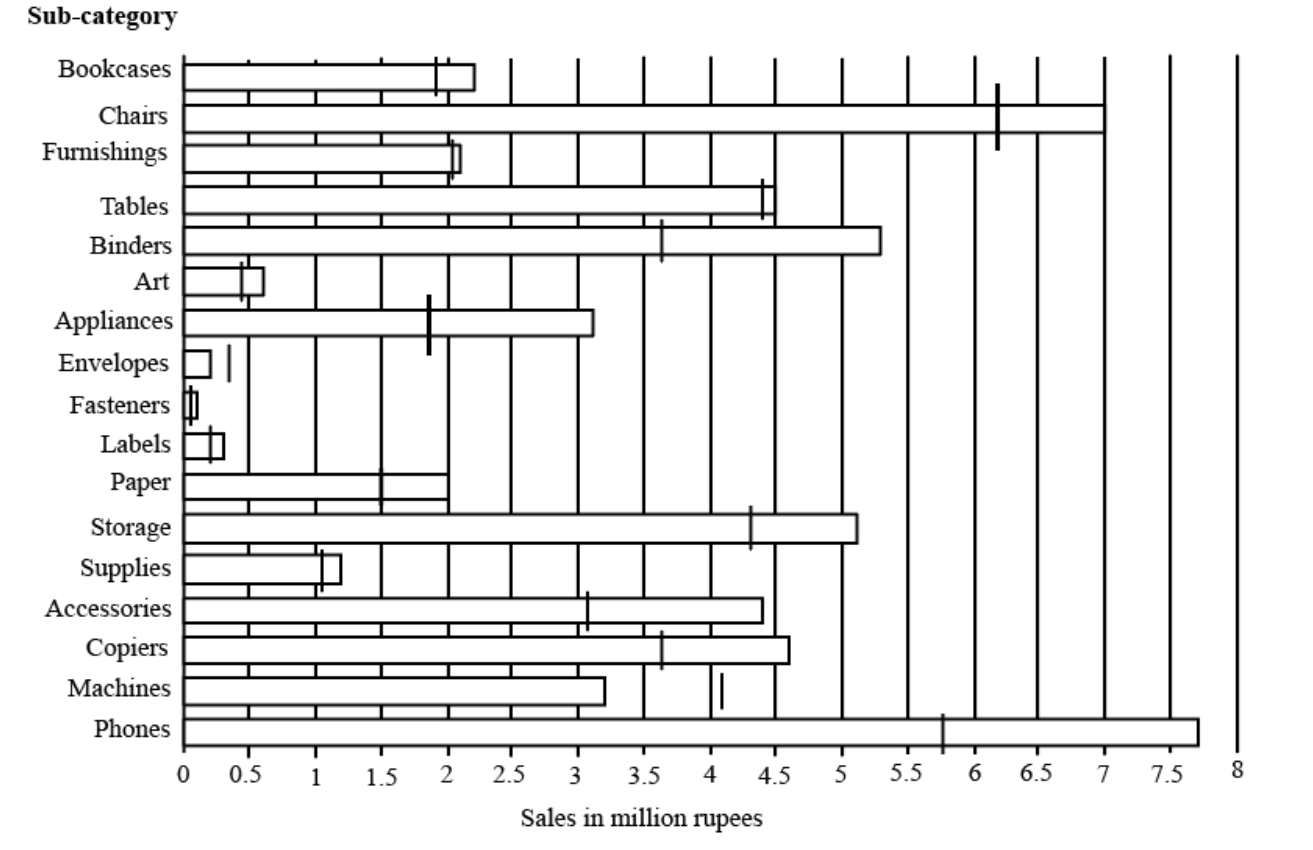
The horizontal bars in the above diagram represent 2020 aggregate sales (in ₹ million) of a company for the different subcategories of its products. The top four product subcategories (Bookcases, Chairs, Furnishings, Tables) belong to furniture product category; the bottom four product subcategories (Accessories, Copiers, Machines, Phones) belong to the technology product category while all other product subcategories belong to the office supply product category. For each of the product subcategories, there is a vertical line indicating the sales of the corresponding subcategory in 2019.

Chart for this set — reading the chart is part of the question
Q7Bar GraphsMCQ

The total sales (in ₹ million) in 2019 from products in office supplies category is closest to

Show solution

Correct answer: C

What we need

We must find the total 2019 sales across every subcategory that belongs to the office supplies category, then pick the closest option.

Office supplies is the nine middle subcategories: Binders, Art, Appliances, Envelopes, Fasteners, Labels, Paper, Storage and Supplies.

📈 Reading the chart: each bar's right-hand end gives that subcategory's 2020 sales; the short vertical tick line gives its 2019 sales. Read both against the 0.5 gridlines — to the nearest 0.05 is close enough. The margins in this set are wide, so a small reading error never changes the answer.

Step 1 — Read each 2019 office-supply value off its tick

Sub-category2019 sales (₹ million)
Binders3.60
Art0.45
Appliances1.85
Envelopes0.35
Fasteners0.05
Labels0.20
Paper1.50
Storage4.30
Supplies1.05

Step 2 — Add them up

3.60+0.45+1.85+0.35+0.05+0.20+1.50+4.30+1.05=13.353.60 + 0.45 + 1.85 + 0.35 + 0.05 + 0.20 + 1.50 + 4.30 + 1.05 = 13.35

Step 3 — Match to the options

The options are 18.0, 16.5, 13.5 and 12.5. Our total of 13.35 is closest to 13.5.

💡 Teacher tip: the nearest rival option is 12.5, a full ₹0.85 million away. Nine readings would each have to be wrong by about 0.1 in the same direction to reach it, so there is no need to fuss over the exact tick positions.

Answer: 13.5 (Option C)

Q8Bar GraphsMCQ

The percentage increase in sales in Furniture category from 2019 to 2020 is closest to

Show solution

Correct answer: B

What we need

We need the percentage increase in total Furniture sales from 2019 to 2020, to the closest option.

Furniture is the top four subcategories: Bookcases, Chairs, Furnishings and Tables.

📈 Reading the chart: each bar's right-hand end gives that subcategory's 2020 sales; the short vertical tick line gives its 2019 sales. Read both against the 0.5 gridlines — to the nearest 0.05 is close enough.

Step 1 — Read the four Furniture bars and their ticks

Sub-category20192020
Bookcases1.902.20
Chairs6.207.00
Furnishings2.052.10
Tables4.404.50
Furniture total14.5515.80

Step 2 — Compute the increase

15.80−14.55=1.25 ₹ million15.80 - 14.55 = 1.25 \text{ ₹ million}

Step 3 — Percentage increase

1.2514.55×100≈8.6%\frac{1.25}{14.55} \times 100 \approx 8.6\%

💡 Teacher tip: you can see this without arithmetic. Three of the four bars barely move past their ticks; only Chairs and Bookcases grow visibly, and neither grows by anything like a quarter of its own length. A single-digit answer is the only plausible one.

Step 4 — Match to the options

The options are 20%, 8%, 25% and 1%. About 8.6% is closest to 8%, and the nearest rival (20%) is far away, so the reading tolerance is irrelevant here.

Answer: 8% (Option B)

Q9Bar GraphsTITA

How many subcategories had sales of ₹ 4 million or more in 2019 and registered an increase in sales in excess of 25% in 2020?

Show solution

Correct answer: 1

What we need

We must count the subcategories that satisfy both conditions:

  1. 2019 sales of ₹4 million or more, and
  2. a 2020 increase of more than 25% over 2019.

📈 Reading the chart: each bar's right-hand end gives that subcategory's 2020 sales; the short vertical tick line gives its 2019 sales. Read both against the 0.5 gridlines.

Step 1 — Which 2019 ticks sit at or past ₹4 million?

Run your eye down the 4.0 mark. Only five ticks reach it:

Sub-category2019 sales (₹ million)
Chairs6.20
Phones5.75
Tables4.40
Storage4.30
Machines4.05

Machines is the only close call — its tick sits just to the right of the 4.0 gridline, so it is in. As Step 2 shows, it makes no difference either way.

Step 2 — Check the 2020 growth for each

Sub-category2019 → 2020% change> 25%?
Chairs6.20 → 7.000.806.20×100≈12.9%\frac{0.80}{6.20}\times100 \approx 12.9\%No
Phones5.75 → 7.701.955.75×100≈33.9%\frac{1.95}{5.75}\times100 \approx 33.9\%Yes
Tables4.40 → 4.500.104.40×100≈2.3%\frac{0.10}{4.40}\times100 \approx 2.3\%No
Storage4.30 → 5.100.804.30×100≈18.6%\frac{0.80}{4.30}\times100 \approx 18.6\%No
Machines4.05 → 3.20fell (negative)No

💡 Teacher tip: Machines is the trap. Its 2019 tick clears ₹4 million, but the tick sits to the right of the end of its bar — sales fell — so it cannot possibly satisfy a growth condition. Spot that visually and you never compute it.

Storage is the only other borderline case: 0.80 on a base of 4.30 needs the base to be under 3.2 to reach 25%, and the tick is nowhere near there.

Step 3 — Count

Only Phones satisfies both conditions.

Answer: 1

Q10Bar GraphsMCQ

The improvement index for a category is the maximum percentage increase in sales from 2019 to 2020 among any of its subcategories. The correct order of categories in increasing order of this improvement index is

Show solution

Correct answer: A

What we need

The improvement index of a category is the largest percentage increase in sales (2019 → 2020) among any of its subcategories. We must order the three categories by this index, smallest first.

📈 Reading the chart: each bar's right-hand end gives that subcategory's 2020 sales; the short vertical tick line gives its 2019 sales. Because this question is about percentage growth, what matters visually is how far a bar extends beyond its own tick relative to the tick's position — a short bar that doubles beats a long bar that creeps forward.

Step 1 — Find the best-growing subcategory in each category

Furniture

Sub-category2019 → 2020% change
Bookcases1.90 → 2.20≈15.8%\approx 15.8\%
Chairs6.20 → 7.00≈12.9%\approx 12.9\%
Furnishings2.05 → 2.10≈2.4%\approx 2.4\%
Tables4.40 → 4.50≈2.3%\approx 2.3\%

Best = Bookcases ≈ 16%.

Technology

Sub-category2019 → 2020% change
Accessories3.05 → 4.40≈44.3%\approx 44.3\%
Copiers3.60 → 4.60≈27.8%\approx 27.8\%
Machines4.05 → 3.20fell
Phones5.75 → 7.70≈33.9%\approx 33.9\%

Best = Accessories ≈ 44%.

Office supply

Sub-category2019 → 2020% change
Binders3.60 → 5.30≈47.2%\approx 47.2\%
Art0.45 → 0.60≈33%\approx 33\%
Appliances1.85 → 3.10≈67.6%\approx 67.6\%
Envelopes0.35 → 0.20fell
Fasteners0.05 → 0.10≈100%\approx 100\%
Labels0.20 → 0.30≈50%\approx 50\%
Paper1.50 → 2.00≈33%\approx 33\%
Storage4.30 → 5.10≈18.6%\approx 18.6\%
Supplies1.05 → 1.20≈14%\approx 14\%

Best = Fasteners ≈ 100%.

⚠️ Fasteners is the one bar you cannot read precisely — both its 2019 tick and its 2020 bar sit inside the first half-gridline. You do not need it. Appliances alone (1.85 → 3.10, about 68%) already beats Technology's best of 44%, so office supply finishes top whatever Fasteners turns out to be.

Step 2 — Compare the three indices

CategoryImprovement index
Furniture≈ 16%
Technology≈ 44%
Office supply≥ 68%

💡 Teacher tip: a tiny base can turn a barely visible absolute increase into a huge percentage, which is why this index always favours whichever category owns the smallest bar.

Step 3 — Write in increasing order

Furniture < Technology < Office supply.

Answer: furniture, technology, office supply (Option A)

Set · Puzzles

Amudha, Bharatan, Chandran, Dhinesh, Ezhil, Fani and Gowtham are seven people in a town. Any pair of them could either be strangers, acquaintances, or friends. All relationships are mutual. For example, if Amudha is a friend of Bharatan, then Bharatan is also a friend of Amudha. Similarly, if Amudha is a stranger to Bharatan, then Bharatan is also a stranger to Amudha.
Partial information about the number of friends, acquaintances, and strangers of each of these people among them is given in the table below.
The following additional facts are also known.

  1. Amudha, Bharatan, and Chandran are mutual strangers.
  2. Amudha, Dhinesh, and Fani are Ezil's friends.
  3. Chandran and Gowtham are friends.
  4. Every friend of Amudha is an acquaintance of Bharatan, and every acquaintance of Bharatan is a friend of Amudha.
  5. Every friend of Bharatan is an acquaintance of Amudha, and every acquaintance of Amudha is a friend of Bharatan.

Partial table of relationships (blank = not given):

PersonNo. of FriendsNo. of AcquaintancesNo. of Strangers
Amudha(blank)14
Bharatan(blank)(blank)(blank)
Chandran(blank)1(blank)
Dhinesh(blank)(blank)2
Ezhil(blank)(blank)(blank)
Fani1(blank)(blank)
Gowtham(blank)32
Q11PuzzlesMCQ

Who are Gowtham’s acquaintances?

Show solution

Correct answer: A

Finding Gowtham's acquaintances

We need to build the full relationship grid first, then read off Gowtham's acquaintances.

Step 1 — Fill the blanks using the row-sum rule.

Each person has exactly 6 relationships (one with each of the other six people), so Friends + Acquaintances + Strangers = 6.

  • Amudha: Friends =6−1−4=1= 6 - 1 - 4 = 1
  • Gowtham: Friends =6−3−2=1= 6 - 3 - 2 = 1

Step 2 — Identify each person's single friend.

Clue 2 tells us Amudha, Dhinesh, and Fani are Ezhil's friends. Since Amudha has exactly 1 friend, that friend must be Ezhil. Since Fani has exactly 1 friend, that friend must also be Ezhil. Clue 3 tells us Chandran and Gowtham are friends; since Gowtham has exactly 1 friend, it is Chandran.

Step 3 — Use the Amudha–Bharatan linkage (clues 4 and 5).

Clue 4 says Amudha's friends = Bharatan's acquaintances. Amudha's only friend is Ezhil, so Bharatan's only acquaintance is Ezhil.

Clue 5 says Bharatan's friends = Amudha's acquaintances. Amudha has exactly 1 acquaintance, so Bharatan has exactly 1 friend — the same person.

That person is an acquaintance of Amudha and a friend of Bharatan. It cannot be Ezhil (already Amudha's friend), Chandran (stranger to Amudha by clue 1), Fani (whose only friend is Ezhil), or Gowtham (whose only friend is Chandran). So it is Dhinesh.

Step 4 — Pin down Gowtham's relationships.

Amudha's 4 strangers are Bharatan, Chandran, Fani, and Gowtham (her only non-strangers are Ezhil and Dhinesh). So Amudha–Gowtham = stranger. Similarly, Bharatan's 4 strangers are Amudha, Chandran, Fani, and Gowtham, so Bharatan–Gowtham = stranger.

Gowtham has exactly 2 strangers (Amudha and Bharatan) and 1 friend (Chandran). His remaining 3 relationships — with Dhinesh, Ezhil, and Fani — must all be acquaintances.

The complete relationship grid (F = friend, A = acquaintance, S = stranger):

AmuBhaChaDhiEzhFanGow
Amudha–SSAFSS
BharatanS–SFASS
ChandranSS–SSAF
DhineshAFS–FSA
EzhilFASF–FA
FaniSSASF–A
GowthamSSFAAA–

Reading Gowtham's row: friend = Chandran, strangers = Amudha & Bharatan, acquaintances = Dhinesh, Ezhil, and Fani.

Answer: A. Dhinesh, Ezhil and Fani

Q12PuzzlesMCQ

Which of these pairs share the same type of relationship?

Show solution

Correct answer: D

Which pair of pairs shares the same relationship type?

We use the fully solved relationship grid (F = friend, A = acquaintance, S = stranger):

AmuBhaChaDhiEzhFanGow
Amudha–SSAFSS
BharatanS–SFASS
ChandranSS–SSAF
DhineshAFS–FSA
EzhilFASF–FA
FaniSSASF–A
GowthamSSFAAA–

Now check each option by reading the two relationships off the grid:

  • Option A: (Amudha, Gowtham) = stranger; (Ezhil, Fani) = friend → different.
  • Option B: (Bharatan, Chandran) = stranger; (Dhinesh, Ezhil) = friend → different.
  • Option C: (Chandran, Ezhil) = stranger; (Dhinesh, Gowtham) = acquaintance → different.
  • Option D: (Bharatan, Ezhil) = acquaintance; (Fani, Gowtham) = acquaintance → same!

Answer: D. (Bharatan, Ezhil) and (Fani, Gowtham)

Q13PuzzlesMCQ

Who is an acquaintance of Amudha?

Show solution

Correct answer: A

Who is an acquaintance of Amudha?

From the given table, Amudha has exactly 1 acquaintance and 4 strangers, so she also has 6−1−4=16 - 1 - 4 = 1 friend.

Identifying Amudha's friend: Clue 2 says Amudha, Dhinesh, and Fani are Ezhil's friends. Since Amudha has exactly one friend, that friend is Ezhil.

Using the Amudha–Bharatan linkage:

Clue 5 states: every acquaintance of Amudha is a friend of Bharatan, and every friend of Bharatan is an acquaintance of Amudha. This means Amudha's acquaintances and Bharatan's friends are the same set of people.

So we need to find Bharatan's single friend. Clue 4 tells us Bharatan's acquaintances = Amudha's friends = {Ezhil}, so Bharatan's only acquaintance is Ezhil. Since Amudha has exactly 1 acquaintance, Bharatan has exactly 1 friend.

Who is Bharatan's friend? It must be someone who is an acquaintance of Amudha. It cannot be:

  • Ezhil (already Amudha's friend, not acquaintance)
  • Chandran (stranger to Amudha by clue 1)
  • Fani (whose only friend is Ezhil)
  • Gowtham (whose only friend is Chandran)

That leaves Dhinesh — he is an acquaintance of Amudha and a friend of Bharatan.

💡 Teacher tip: Clues 4 and 5 create a two-way mirror between Amudha and Bharatan: her friends ↔ his acquaintances, and her acquaintances ↔ his friends. Once you know one person's counts, you immediately know the other's.

Answer: A. Dhinesh

Q14PuzzlesMCQ

Who is an acquaintance of Chandran?

Show solution

Correct answer: B

Who is an acquaintance of Chandran?

From the given table, Chandran has exactly 1 acquaintance. Let us determine who it is by elimination.

What we already know about Chandran's relationships:

  1. Clue 1: Amudha, Bharatan, and Chandran are mutual strangers → Chandran is a stranger to Amudha and Bharatan.
  2. Clue 3: Chandran and Gowtham are friends → Gowtham is Chandran's friend.
  3. Dhinesh has 2 strangers. From the grid, Dhinesh's friends are Bharatan and Ezhil, and his acquaintances are Amudha and Gowtham. That accounts for 4 of his 6 relationships; the remaining 2 (Chandran and Fani) must be his strangers. So Chandran–Dhinesh = stranger.

So Chandran is a stranger to Amudha, Bharatan, and Dhinesh, and a friend of Gowtham. That uses 4 of his 6 relationships. His remaining two are with Ezhil and Fani — one is his acquaintance, the other is a stranger.

Resolving Ezhil vs Fani:

Ezhil's friends are exactly Amudha, Dhinesh, and Fani (clue 2). So Ezhil is not a friend of Chandran. We also know Ezhil's acquaintances are Bharatan and Gowtham (from the full grid). That leaves Chandran as Ezhil's one stranger. So Chandran–Ezhil = stranger.

By elimination, Chandran–Fani = acquaintance.

The relevant portion of the solved grid:

AmuBhaChaDhiEzhFanGow
ChandranSS–SSAF

Answer: B. Fani

Q15PuzzlesTITA

How many friends does Ezhil have?

Show solution

Correct answer: 3

How many friends does Ezhil have?

This one follows directly from the clues.

Clue 2 explicitly states: Amudha, Dhinesh, and Fani are Ezhil's friends.

Since all relationships are mutual, Ezhil is a friend of Amudha, Dhinesh, and Fani — giving Ezhil at least 3 friends.

Now we confirm Ezhil has exactly 3 friends by checking the full grid:

AmuBhaChaDhiEzhFanGow
EzhilFASF–FA

Reading Ezhil's row: friends = Amudha, Dhinesh, Fani (3); acquaintances = Bharatan, Gowtham (2); stranger = Chandran (1). The total is 3+2+1=63 + 2 + 1 = 6 ✓.

No additional friends are possible — every other relationship is accounted for as an acquaintance or stranger.

Answer: 3

Q16PuzzlesTITA

How many people are either a friend or a friend-of-a-friend of Ezhil?

Show solution

Correct answer: 4

How many people are either a friend or a friend-of-a-friend of Ezhil?

We need to find everyone who is either a direct friend of Ezhil, or a friend of one of Ezhil's friends (excluding Ezhil herself).

Step 1 — Identify Ezhil's direct friends.

From the solved grid:

AmuBhaChaDhiEzhFanGow
EzhilFASF–FA

Ezhil's friends are: Amudha, Dhinesh, Fani (3 people).

Step 2 — Find the friends of each of Ezhil's friends.

PersonTheir friends
AmudhaEzhil
DhineshBharatan, Ezhil
FaniEzhil

Reading each row from the full grid:

  • Amudha's only friend is Ezhil (already counted).
  • Dhinesh's friends are Bharatan and Ezhil. Bharatan is new.
  • Fani's only friend is Ezhil (already counted).

Step 3 — Combine the sets.

  • Direct friends of Ezhil: {Amudha, Dhinesh, Fani}
  • Friends-of-friends (new): {Bharatan}

Total = {Amudha, Dhinesh, Fani, Bharatan} = 4 people.

💡 Teacher tip: "Friend-of-a-friend" means a person reachable by following exactly two friend-edges in the friendship network. Draw the friendship links as a graph and count everyone within distance 2 of Ezhil (excluding Ezhil herself).

Answer: 4

Set · Puzzles

Ganga, Kaveri, and Narmada are three women who buy four raw materials (Mango, Apple, Banana and Milk) and sell five finished products (Mango smoothie, Apple smoothie, Banana smoothie, Mixed fruit smoothie and Fruit salad). Table-1 gives information about the raw materials required to produce the five finished products. One unit of a finished product requires one unit of each of the raw materials mentioned in the second column of the table.
One unit of milk, mango, apple, and banana cost ₹5, ₹3, ₹2, and ₹1 respectively. Each unit of a finished product is sold for a profit equal to two times the number of raw materials used to make that product. For example, apple smoothie is made with two raw materials (apple and milk) and will be sold for a profit of ₹4 per unit. Leftover raw materials are sold during the last business hour of the day for a loss of ₹1 per unit.
The amount, in rupees, received from sales (revenue) for each woman in each of the four business hours of the day is given in Table-2.
The following additional facts are known.

  1. No one except possibly Ganga sold any Mango smoothie.
  2. Each woman sold either zero or one unit of any single finished product in any hour.
  3. Each woman had exactly one unit each of two different raw materials as leftovers.
  4. No one had any banana leftover.
Finished productRaw materials required
Mango smoothieMango, Milk
Apple smoothieApple, Milk
Banana smoothieBanana, Milk
Mixed fruit smoothieMango, Apple, Banana, Milk
Fruit saladMango, Apple, Banana

Table-2 revenue (Rs.) per business hour:

Business HourGangaKaveriNarmada
Hour 1231931
Hour 2212221
Hour 3293023
Hour 4 (last)302722
Q17PuzzlesMCQ

What BEST can be concluded about the number of units of fruit salad sold in the first hour?

Show solution

Correct answer: A

Setting up the selling prices

First, we work out the selling price (revenue) of each finished product. The selling price equals the cost of raw materials + profit, where profit = 2 × (number of raw materials used).

ProductMaterialsCostProfit (2 × #materials)Sale price
Mango smoothieMango, Milk3+5 = 82×2 = 412
Apple smoothieApple, Milk2+5 = 72×2 = 411
Banana smoothieBanana, Milk1+5 = 62×2 = 410
Mixed fruit smoothieMango, Apple, Banana, Milk3+2+1+5 = 112×4 = 819
Fruit saladMango, Apple, Banana3+2+1 = 62×3 = 612

Leftover raw materials are sold in the last hour at a ₹1 loss per unit: milk → ₹4, mango → ₹2, apple → ₹1 (banana leftovers are not allowed by Fact 4).

Decoding Hour 1 revenues

In Hours 1–3, revenue comes only from finished products (Fact 2: at most one unit of any product per person per hour). Also, only Ganga may sell a Mango smoothie (Fact 1).

Ganga — Hour 1 = ₹23: We need two product prices that sum to 23. The only pair is 12 + 11 = 23, i.e., Apple smoothie (₹11) plus a ₹12 item. The ₹12 item could be Fruit salad or Mango smoothie (only Ganga can sell the latter). So Ganga sells 0 or 1 Fruit salad in Hour 1.

Kaveri — Hour 1 = ₹19: No two-product combination sums to 19 (10+11=21, 10+12=22, 11+12=23, 19+anything > 19). But a single Mixed fruit smoothie = ₹19. So Kaveri sells 0 Fruit salad in Hour 1.

Narmada — Hour 1 = ₹31: We need two products summing to 31: 19 + 12 = 31. The ₹19 item is Mixed fruit smoothie; the ₹12 item must be Fruit salad (Narmada cannot sell Mango smoothie). So Narmada sells 1 Fruit salad in Hour 1.

Counting Fruit salads in Hour 1

WomanFruit salad in Hour 1?
Ganga0 or 1 (depends on whether her ₹12 item is Fruit salad or Mango smoothie)
Kaveri0 (only sold Mixed fruit smoothie)
Narmada1 (certainly sold Fruit salad)

Total = 1 + (0 or 1) = 1 or 2.

Answer: Either 1 or 2.

Q18PuzzlesMCQ

Which of the following is NECESSARILY true?

Show solution

Correct answer: B

Selling prices (quick reference)

ProductSale price
Mango smoothie12
Apple smoothie11
Banana smoothie10
Mixed fruit smoothie19
Fruit salad12

Leftover sale prices (₹1 loss per unit): milk → ₹4, mango → ₹2, apple → ₹1. No banana leftovers (Fact 4). Each woman has exactly two different leftover materials (Fact 3), so the possible leftover pairs and their values are:

Leftover pairTotal leftover revenue
Milk + Mango4 + 2 = 6
Milk + Apple4 + 1 = 5
Mango + Apple2 + 1 = 3

Decoding Hour 4 (the last hour)

Hour 4 revenue = finished products sold + leftover sales. We subtract each possible leftover total from each woman's Hour 4 revenue and check if the remainder can be formed from product prices.

Ganga — Hour 4 = ₹30:

  • Leftover ₹6 → finished = 24 = 12 + 12 = Mango smoothie + Fruit salad ✓
  • Leftover ₹5 → finished = 25 → no combination of product prices gives 25 ✗
  • Leftover ₹3 → finished = 27 → no combination gives 27 ✗

So Ganga's leftovers are milk + mango (₹6).

Narmada — Hour 4 = ₹22:

  • Leftover ₹6 → finished = 16 → impossible ✗
  • Leftover ₹5 → finished = 17 → impossible ✗
  • Leftover ₹3 → finished = 19 = Mixed fruit smoothie ✓

So Narmada's leftovers are mango + apple (₹3).

Kaveri — Hour 4 = ₹27:

  • Leftover ₹6 → finished = 21 = 11 + 10 = Apple smoothie + Banana smoothie ✓
  • Leftover ₹5 → finished = 22 = 12 + 10 = Fruit salad + Banana smoothie ✓
  • Leftover ₹3 → finished = 24 = 12 + 12, but both ₹12 items would need to be Fruit salad (Kaveri can't sell Mango smoothie), and selling the same product twice in one hour is not allowed ✗

So Kaveri's leftovers are milk + mango or milk + apple — not uniquely determined.

Summary of leftovers

WomanLeftover materials
GangaMilk + Mango (certain)
KaveriMilk + Mango or Milk + Apple (uncertain)
NarmadaMango + Apple (certain)

Checking each option

  • A. Ganga did not sell any leftover mangoes → Ganga's leftovers include mango → False.
  • B. Ganga did not sell any leftover apples → Ganga's leftovers are milk + mango, with no apple → Necessarily true ✓
  • C. Narmada sold one unit of leftover milk → Narmada's leftovers are mango + apple, no milk → False.
  • D. Kaveri sold one unit of leftover mangoes → Kaveri might have milk + apple instead → Not necessarily true.

Answer: Ganga did not sell any leftover apples.

Q19PuzzlesMCQ

What BEST can be concluded about the total number of units of milk the three women had in the beginning?

Show solution

Correct answer: B

Selling prices (quick reference)

ProductSale priceUses milk?
Mango smoothie12Yes
Apple smoothie11Yes
Banana smoothie10Yes
Mixed fruit smoothie19Yes
Fruit salad12No

Leftover sale prices: milk → ₹4, mango → ₹2, apple → ₹1. Possible leftover pairs: milk+mango (₹6), milk+apple (₹5), mango+apple (₹3).

Full decoded schedule

Using the same decoding process (matching each hour's revenue to product-price combinations, with only Ganga allowed to sell Mango smoothie), the full schedule is:

Hour 1Hour 2Hour 3Hour 4 (finished + leftovers)
Ganga (23, 21, 29, 30)Apple sm + (Fruit salad or Mango sm)Apple sm + Banana smBanana sm + Mixed smMango sm + Fruit salad; leftovers milk + mango
Kaveri (19, 22, 30, 27)Mixed smBanana sm + Fruit saladApple sm + Mixed smCase 1: Apple sm + Banana sm; leftovers milk+mango or Case 2: Banana sm + Fruit salad; leftovers milk+apple
Narmada (31, 21, 23, 22)Fruit salad + Mixed smApple sm + Banana smApple sm + Fruit saladMixed sm; leftovers mango + apple

Counting milk units

Milk used = (units of every smoothie sold, since all smoothies use milk) + (milk leftover, if any). Fruit salad does not use milk.

Narmada:

  • Smoothies: Mixed(H1) + Apple+Banana(H2) + Apple(H3) + Mixed(H4) = 1 + 2 + 1 + 1 = 5 milk used
  • Leftover: mango + apple → 0 milk leftover
  • Total milk = 5

Ganga:

  • Smoothies: Apple(H1) + possibly Mango(H1) + Apple+Banana(H2) + Banana+Mixed(H3) + Mango(H4) = 1 + (0 or 1) + 2 + 2 + 1 = 6 or 7 milk used
  • Leftover: milk + mango → 1 milk leftover
  • Total milk = 7 or 8

Kaveri:

  • Smoothies: Mixed(H1) + Banana(H2) + Apple+Mixed(H3) + H4(2 smoothies in Case 1, or 1 smoothie in Case 2) = 1 + 1 + 2 + (2 or 1) = 6 or 5 milk used
  • Leftover: milk + mango or milk + apple → 1 milk leftover (both cases)
  • Total milk = 7 or 6

Combining all three

Total milk=5+(7 or 8)+(6 or 7)\text{Total milk} = 5 + (7 \text{ or } 8) + (6 \text{ or } 7)

The possible values are:

  • 5 + 7 + 6 = 18
  • 5 + 8 + 6 = 19
  • 5 + 7 + 7 = 19
  • 5 + 8 + 7 = 20

So the total ranges over 18, 19, or 20.

Answer: Either 18 or 19 or 20 units.

Q20PuzzlesTITA

If it is known that three leftover units of mangoes were sold during the last business hour of the day, how many apple smoothies were sold during the day?

Show solution

Correct answer: 6

Selling prices (quick reference)

ProductSale price
Mango smoothie12
Apple smoothie11
Banana smoothie10
Mixed fruit smoothie19
Fruit salad12

Leftover sale prices: milk → ₹4, mango → ₹2, apple → ₹1. Possible leftover pairs: milk+mango (₹6), milk+apple (₹5), mango+apple (₹3).

Full decoded schedule

Hour 1Hour 2Hour 3Hour 4 (finished + leftovers)
Ganga (23, 21, 29, 30)Apple sm + (Fruit salad or Mango sm)Apple sm + Banana smBanana sm + Mixed smMango sm + Fruit salad; leftovers milk + mango
Kaveri (19, 22, 30, 27)Mixed smBanana sm + Fruit saladApple sm + Mixed smCase 1: Apple sm + Banana sm; leftovers milk+mango or Case 2: Banana sm + Fruit salad; leftovers milk+apple
Narmada (31, 21, 23, 22)Fruit salad + Mixed smApple sm + Banana smApple sm + Fruit saladMixed sm; leftovers mango + apple

Using the new condition: 3 leftover mangoes

From the decoded schedule, the leftover mangoes come from:

WomanLeftover materialsMango leftover?
GangaMilk + Mango1 mango (certain)
NarmadaMango + Apple1 mango (certain)
KaveriMilk + Mango (Case 1) or Milk + Apple (Case 2)1 or 0 mango

Ganga and Narmada together contribute 2 leftover mangoes. For the total to be 3, Kaveri must also have a mango leftover — this forces Case 1 for Kaveri.

So Kaveri's Hour 4 = Apple smoothie + Banana smoothie (with leftovers milk + mango).

Counting apple smoothies sold during the day

With Kaveri in Case 1, let us count apple smoothies for each woman across all four hours:

WomanApple smoothies soldHours
Ganga2Hour 1 (Apple sm) + Hour 2 (Apple sm)
Kaveri2Hour 3 (Apple sm) + Hour 4 (Apple sm, Case 1)
Narmada2Hour 2 (Apple sm) + Hour 3 (Apple sm)

Total apple smoothies=2+2+2=6\text{Total apple smoothies} = 2 + 2 + 2 = 6

Answer: 6