CATLab

CAT 2021 DILR Questions — Slot 3

The actual Data Interpretation & Logical Reasoning section from CAT 2021, Slot 3 — 20 questions in original paper order, each with a full worked solution. Tap an option (or type your answer) to check yourself before reading the solution.

20 questions15 MCQ · 5 TITA40 min section0/20 attempted
Set · Bar Graphs

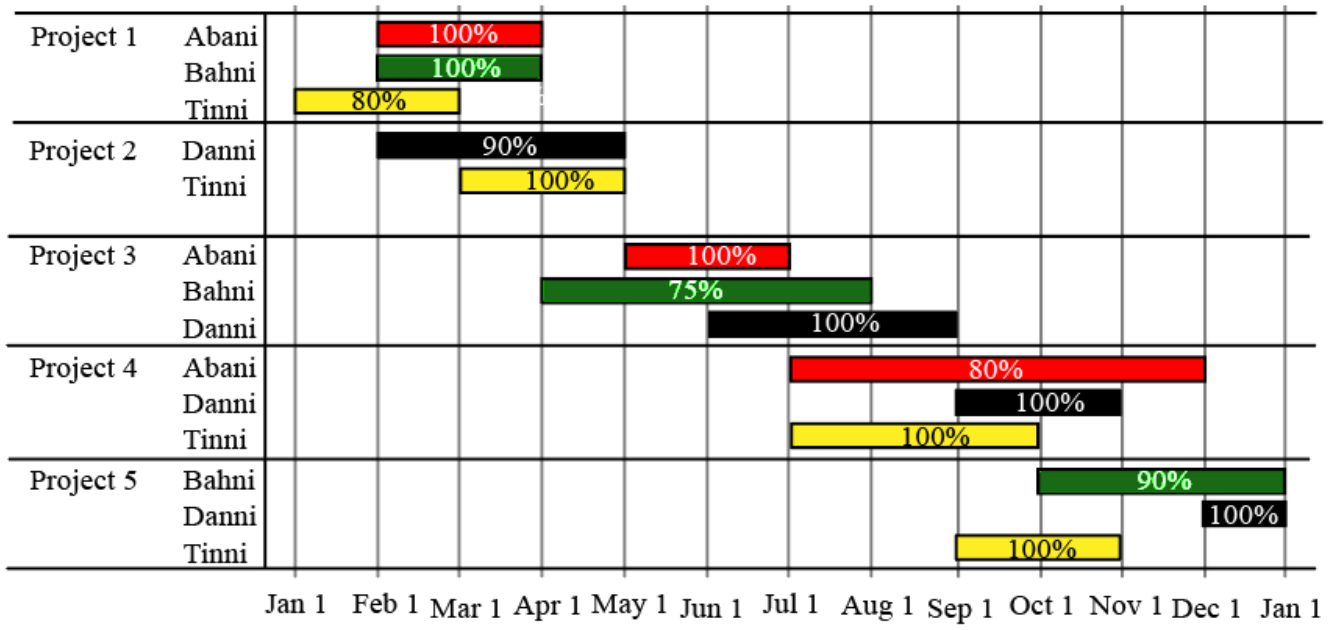
The figure above shows the schedule of four employees - Abani, Bahni, Danni, and Tinni - whom Dhoni supervised in 2020. Altogether there were five projects which started and concluded in 2020 in which they were involved. For each of these projects and for each employee, the starting day was at the beginning of a month and the concluding day was the end of a month, and these are indicated by the left and right end points of the corresponding horizontal bars. The number within each bar indicates the percentage of assigned work completed by the employee for that project, as assessed by Dhoni. For each employee, his/her total project-month (in 2020) is the sum of the number of months (s)he worked across the five projects, while his/her annual completion index is the weightage average of the completion percentage assigned from the different projects, with the weights being the corresponding number of months (s)he worked in these projects. For each project, the total employee-month is the sum of the number of months four employees worked in this project, while its completion index is the weightage average of the completion percentage assigned for the employees who worked in this project, with the weights being the corresponding number of months they worked in this project.

Chart for this set — reading the chart is part of the question
Q1Bar GraphsMCQ

Which of the following statements is/are true? I: The total project-month was the same for the four employees. II: The total employee-month was the same for the five projects.

Show solution

Correct answer: D

Reading the schedule. Each bar is one person on one project; the number inside is the % of work they completed, and the bar's length is how many months they worked. Reading all the bars gives two master tables.

Per employee — total months worked, and the month-weighted average completion (the "annual completion index"):

EmployeeProjects (months, %)Total monthsWeighted sumIndex
AbaniP1 (2, 100), P3 (2, 100), P4 (5, 80)9200 + 200 + 400 = 800800/9 = 88.89
BahniP1 (2, 100), P3 (4, 75), P5 (3, 90)9200 + 300 + 270 = 770770/9 = 85.56
DanniP2 (3, 90), P3 (3, 100), P4 (2, 100), P5 (1, 100)9270 + 300 + 200 + 100 = 870870/9 = 96.67
TinniP1 (2, 80), P2 (2, 100), P4 (3, 100), P5 (2, 100)9160 + 200 + 300 + 200 = 860860/9 = 95.56

Per project — total employee-months, and the calendar span (start of earliest bar to end of latest):

ProjectPeople (months)Employee-monthsSpanDuration
P1Abani 2, Bahni 2, Tinni 26Jan–Mar3
P2Danni 3, Tinni 25Feb–Apr3
P3Abani 2, Bahni 4, Danni 39Apr–Aug5
P4Abani 5, Danni 2, Tinni 310Jul–Nov5
P5Bahni 3, Danni 1, Tinni 26Sep–Dec4

This question. Check the two statements against the tables.

  • Statement I — total project-months the same for all four employees. From the top table: Abani 9, Bahni 9, Danni 9, Tinni 9. All equal → I is true.
  • Statement II — total employee-months the same for all five projects. From the bottom table: 6, 5, 9, 10, 6. Clearly not equal → II is false.

Only I holds.

Answer: Only I

Q2Bar GraphsMCQ

Which employees did not work in multiple projects for any of the months in 2020?

Show solution

Correct answer: A

Reading the schedule. Each bar is one person on one project; the number inside is the % of work they completed, and the bar's length is how many months they worked. Reading all the bars gives two master tables.

Per employee — total months worked, and the month-weighted average completion (the "annual completion index"):

EmployeeProjects (months, %)Total monthsWeighted sumIndex
AbaniP1 (2, 100), P3 (2, 100), P4 (5, 80)9200 + 200 + 400 = 800800/9 = 88.89
BahniP1 (2, 100), P3 (4, 75), P5 (3, 90)9200 + 300 + 270 = 770770/9 = 85.56
DanniP2 (3, 90), P3 (3, 100), P4 (2, 100), P5 (1, 100)9270 + 300 + 200 + 100 = 870870/9 = 96.67
TinniP1 (2, 80), P2 (2, 100), P4 (3, 100), P5 (2, 100)9160 + 200 + 300 + 200 = 860860/9 = 95.56

Per project — total employee-months, and the calendar span (start of earliest bar to end of latest):

ProjectPeople (months)Employee-monthsSpanDuration
P1Abani 2, Bahni 2, Tinni 26Jan–Mar3
P2Danni 3, Tinni 25Feb–Apr3
P3Abani 2, Bahni 4, Danni 39Apr–Aug5
P4Abani 5, Danni 2, Tinni 310Jul–Nov5
P5Bahni 3, Danni 1, Tinni 26Sep–Dec4

This question. "Did not work on multiple projects in any month" means the person's bars never overlap on the calendar. Lay each person's months side by side:

  • Abani: Feb–Mar, then May–Jun, then Jul–Nov. No overlap.
  • Bahni: Feb–Mar, then Apr–Jul, then Oct–Dec. No overlap.
  • Danni: Feb–Apr, then Jun–Aug, then Sep–Oct, then Dec. No overlap.
  • Tinni: Jan–Feb, Mar–Apr, then Jul–Sep and Sep–Oct — both include September, so Tinni is on two projects at once that month.

So everyone except Tinni stayed on one project per month.

Answer: Only Abani, Bahni and Danni

Q3Bar GraphsMCQ

The project duration, measured in terms of the number of months, is the time during which at least one employee worked in the project. Which of the following pairs of the projects had the same duration?

Show solution

Correct answer: D

Reading the schedule. Each bar is one person on one project; the number inside is the % of work they completed, and the bar's length is how many months they worked. Reading all the bars gives two master tables.

Per employee — total months worked, and the month-weighted average completion (the "annual completion index"):

EmployeeProjects (months, %)Total monthsWeighted sumIndex
AbaniP1 (2, 100), P3 (2, 100), P4 (5, 80)9200 + 200 + 400 = 800800/9 = 88.89
BahniP1 (2, 100), P3 (4, 75), P5 (3, 90)9200 + 300 + 270 = 770770/9 = 85.56
DanniP2 (3, 90), P3 (3, 100), P4 (2, 100), P5 (1, 100)9270 + 300 + 200 + 100 = 870870/9 = 96.67
TinniP1 (2, 80), P2 (2, 100), P4 (3, 100), P5 (2, 100)9160 + 200 + 300 + 200 = 860860/9 = 95.56

Per project — total employee-months, and the calendar span (start of earliest bar to end of latest):

ProjectPeople (months)Employee-monthsSpanDuration
P1Abani 2, Bahni 2, Tinni 26Jan–Mar3
P2Danni 3, Tinni 25Feb–Apr3
P3Abani 2, Bahni 4, Danni 39Apr–Aug5
P4Abani 5, Danni 2, Tinni 310Jul–Nov5
P5Bahni 3, Danni 1, Tinni 26Sep–Dec4

This question. A project's duration is the number of months from its first start to its last finish. From the project table:

P1 = 3, P2 = 3, P3 = 5, P4 = 5, P5 = 4.

The equal pairs are P1 & P2 (both 3) and P3 & P4 (both 5). Only P3 & P4 appears among the options.

Answer: Project 3, Project 4

Q4Bar GraphsMCQ

The list of employees in decreasing order of annual completion index is:

Show solution

Correct answer: C

Reading the schedule. Each bar is one person on one project; the number inside is the % of work they completed, and the bar's length is how many months they worked. Reading all the bars gives two master tables.

Per employee — total months worked, and the month-weighted average completion (the "annual completion index"):

EmployeeProjects (months, %)Total monthsWeighted sumIndex
AbaniP1 (2, 100), P3 (2, 100), P4 (5, 80)9200 + 200 + 400 = 800800/9 = 88.89
BahniP1 (2, 100), P3 (4, 75), P5 (3, 90)9200 + 300 + 270 = 770770/9 = 85.56
DanniP2 (3, 90), P3 (3, 100), P4 (2, 100), P5 (1, 100)9270 + 300 + 200 + 100 = 870870/9 = 96.67
TinniP1 (2, 80), P2 (2, 100), P4 (3, 100), P5 (2, 100)9160 + 200 + 300 + 200 = 860860/9 = 95.56

Per project — total employee-months, and the calendar span (start of earliest bar to end of latest):

ProjectPeople (months)Employee-monthsSpanDuration
P1Abani 2, Bahni 2, Tinni 26Jan–Mar3
P2Danni 3, Tinni 25Feb–Apr3
P3Abani 2, Bahni 4, Danni 39Apr–Aug5
P4Abani 5, Danni 2, Tinni 310Jul–Nov5
P5Bahni 3, Danni 1, Tinni 26Sep–Dec4

This question. The annual completion index is the month-weighted average already computed in the top table:

EmployeeIndex
Danni96.67
Tinni95.56
Abani88.89
Bahni85.56

Largest to smallest: Danni, Tinni, Abani, Bahni.

Answer: Danni, Tinni, Abani, Bahni

Set · Puzzles

Each of the bottles mentioned in this question contains 50 ml of liquid. The liquid in any bottle can be 100% pure content (P) or can have certain amount of impurity (I). Visually it is not possible to distinguish between P and I. There is a testing device which detects impurity, as long as the percentage of impurity in the content tested is 10% or more. For example, suppose bottle 1 contains only P, and bottle 2 contains 80% P and 20% I. If content from bottle 1 is tested, it will be found out that it contains only P. If content of bottle 2 is tested, the test will reveal that it contains some amount of I. If 10 ml of content from bottle 1 is mixed with 20 ml content from bottle 2, the test will show that the mixture has impurity, and hence we can conclude that at least one of the two bottles has I. However, if 10 ml of content from bottle 1 is mixed with 5 ml of content from bottle 2. the test will not detect any impurity in the resultant mixture.

Q5PuzzlesMCQ

5 ml of content from bottle A is mixed with 5 ml of content from bottle B. The resultant mixture, when tested, detects the presence of I. If it is known that bottle A contains only P, what BEST can be concluded about the volume of I in bottle B?

Show solution

Correct answer: D

The one rule that matters. The device says "impurity present" exactly when the impurity in the tested sample is 10% or more. If you mix v1v_1 ml that is a fraction f1f_1 impure with v2v_2 ml that is a fraction f2f_2 impure, the mixture's impurity fraction is

v1f1+v2f2v1+v2.\frac{v_1 f_1 + v_2 f_2}{v_1 + v_2}.

Every bottle holds 50 ml.

This question. We take 5 ml from A (pure, so fA=0f_A = 0) and 5 ml from B (impurity fraction fBf_B). The mixture's impurity fraction is

5⋅0+5⋅fB5+5=fB2.\frac{5\cdot 0 + 5\cdot f_B}{5 + 5} = \frac{f_B}{2}.

The device did detect impurity, so

fB2≥0.10  ⇒  fB≥0.20.\frac{f_B}{2} \ge 0.10 \;\Rightarrow\; f_B \ge 0.20.

Bottle B holds 50 ml, so the amount of impurity in it is 50×fB≥50×0.20=1050 \times f_B \ge 50 \times 0.20 = 10 ml. That is only a floor — B could hold much more. So all we can safely conclude is 10 ml or more.

Answer: 10 ml or more

Q6PuzzlesTITA

There are four bottles. Each bottle is known to contain only P or only I. They will be considered to be “collectively ready for despatch” if all of them contain only P. In minimum how many tests, is it possible to ascertain whether these four bottles are “collectively ready for despatch”?

Show solution

Correct answer: 1

The one rule that matters. The device says "impurity present" exactly when the impurity in the tested sample is 10% or more. If you mix v1v_1 ml that is a fraction f1f_1 impure with v2v_2 ml that is a fraction f2f_2 impure, the mixture's impurity fraction is

v1f1+v2f2v1+v2.\frac{v_1 f_1 + v_2 f_2}{v_1 + v_2}.

Every bottle holds 50 ml.

This question. Four bottles, each entirely pure or entirely impure. We only need a yes/no: are all four pure?

Do it in a single test: take equal amounts from all four and mix them together.

  • If all four are pure, the mix is 0% impure → nothing detected → they are ready.
  • If even one bottle is fully impure, that bottle alone makes the mix at least 14=25%\tfrac14 = 25\% impure — well past the 10% line → detected → not ready.

The two situations give opposite readings, so one test settles it.

Answer: 1

Q7PuzzlesTITA

There are four bottles. It is known that three of these bottles contain only P, while the remaining one contains 80% P and 20% I. What is the minimum number of tests required to definitely identify the bottle containing some amount of I?

Show solution

Correct answer: 2

The one rule that matters. The device says "impurity present" exactly when the impurity in the tested sample is 10% or more. If you mix v1v_1 ml that is a fraction f1f_1 impure with v2v_2 ml that is a fraction f2f_2 impure, the mixture's impurity fraction is

v1f1+v2f2v1+v2.\frac{v_1 f_1 + v_2 f_2}{v_1 + v_2}.

Every bottle holds 50 ml.

This question. Four bottles: exactly one is 80% pure / 20% impure, the other three are pure. We must say which bottle is the impure one.

Test 1 — split into two pairs. Mix equal amounts from bottles 1 and 2.

  • If the impure bottle is 1 or 2, the mix is 0.20×12=10%0.20 \times \tfrac12 = 10\% impure → detected.
  • If the impure bottle is 3 or 4, the mix is pure → nothing detected.

Either way we now know which pair holds the impure bottle.

Test 2 — check one bottle from that pair alone. A lone impure bottle reads 20% (detected); a pure one reads 0%. That single reading names the culprit.

Why not one test? A single test only gives a yes/no, which can separate at most two cases — but here there are four possible culprits. So 2 is the fewest possible, and the plan above achieves it.

Answer: 2

Q8PuzzlesMCQ

There are four bottles. It is known that either one or two of these bottles contain(s) only P, while the remaining ones contain 85% P and 15% I. What is the minimum number of tests required to ascertain the exact number of bottles containing only P?

Show solution

Correct answer: D

The one rule that matters. The device says "impurity present" exactly when the impurity in the tested sample is 10% or more. If you mix v1v_1 ml that is a fraction f1f_1 impure with v2v_2 ml that is a fraction f2f_2 impure, the mixture's impurity fraction is

v1f1+v2f2v1+v2.\frac{v_1 f_1 + v_2 f_2}{v_1 + v_2}.

Every bottle holds 50 ml.

This question. Four bottles: either 1 or 2 of them are pure and the rest are 85% pure / 15% impure. We must find the exact number of pure bottles — equivalently, whether 2 or 3 bottles are impure.

Do it in one test: mix equal amounts from all four. If kk bottles are impure, the mixture's impurity is k×0.154\dfrac{k \times 0.15}{4}.

Pure bottlesImpure (kk)Mixture impurityDetected?
133×0.154=11.25%\frac{3 \times 0.15}{4} = 11.25\%Yes (≥ 10%)
222×0.154=7.5%\frac{2 \times 0.15}{4} = 7.5\%No (< 10%)

The two cases land on opposite sides of the 10% line, so a single combined test tells us the exact count.

Answer: 1

Set · Games & Tournaments

10 players - P1, P2, … , P10 - competed in an international javelin throw event. The number (after P) of a player reflects his rank at the beginning of the event, with rank 1 going to the topmost player. There were two phases in the event with the first phase consisting of rounds 1, 2, and 3, and the second phase consisting of rounds 4, 5, and 6. A throw is measured in terms of the distance it covers (in meters, up to one decimal point accuracy), only if the throw is a ‘valid’ one. For an invalid throw, the distance is taken as zero. A player’s score at the end of a round is the maximum distance of all his throws up to that round. Players are re-ranked after every round based on their current scores. In case of a tie in scores, the player with a prevailing higher rank retains the higher rank. This ranking determines the order in which the players go for their throws in the next round. In each of the rounds in the first phase, the players throw in increasing order of their latest rank, i.e. the player ranked 1 at that point throws first, followed by the player ranked 2 at that point and so on. The top six players at the end of the first phase qualify for the second phase. In each of the rounds in the second phase, the players throw in decreasing order of their latest rank i.e. the player ranked 6 at that point throws first, followed by the player ranked 5 at that point and so on. The players ranked 1, 2, and 3 at the end of the sixth round receive gold, silver, and bronze medals respectively. All the valid throws of the event were of distinct distances (as per stated measurement accuracy). The tables below show distances (in meters) covered by all valid throws in the first and the third round in the event. Distances covered by all the valid throws in the first round Distances covered by all the valid throws in the third round The following facts are also known. i. Among the throws in the second round, only the last two were valid. Both the throws enabled these players to qualify for the second phase, with one of them qualifying with the least score. None of these players won any medal. ii. If a player throws first in a round AND he was also the last (among the players in the current round) to throw in the previous round, then the player is said to get a double. Two players got a double. iii. In each round of the second phase, exactly one player improved his score. Each of these improvements was by the same amount. iv. The gold and bronze medalists improved their scores in the fifth and the sixth rounds respectively. One medal winner improved his score in the fourth round. v. The difference between the final scores of the gold medalist and the silver medalist, as well as the difference between the final scores of the silver medalist and the bronze medalist was 1.0 m.

Distances covered by all the valid throws in the first round

PlayerDistance (in m)
P182.9
P381.5
P586.4
P682.5
P787.2
P984.1

Distances covered by all the valid throws in the third round

PlayerDistance (in m)
P188.6
P379.0
P981.4
Q9Games & TournamentsMCQ

Which two players got the double?

Show solution

Correct answer: C

How scoring and order work. A player's score after any round is the longest valid throw he has made so far (an invalid throw counts as 0). After every round players are re-ranked by score, ties broken in favour of the previously higher rank. Throwing order: in (rounds 1–3) the current rank-1 throws first, then rank-2, and so on; in (rounds 4–6) the order reverses — current rank-6 throws first, up to rank-1 last. The top six after round 3 go through to.

Building the whole event once.

Given throws. Round 1: P1 82.9, P3 81.5, P5 86.4, P6 82.5, P7 87.2, P9 84.1 (everyone else invalid → 0). Round 3: P1 88.6, P3 79.0, P9 81.4.

After round 1 the ranking by score is P7 (87.2), P5 (86.4), P9 (84.1), P1 (82.9), P6 (82.5), P3 (81.5), then P2, P4, P8, P10 (all 0). So in round 2 the throwing order runs P7 first … P10 last.

Round 2. Only the last two throws were valid — those belong to the last two throwers, P8 and P10. Call their distances d8d_8 and d10d_{10}. Both qualify for, and neither wins a medal.

After round 3, P1 improves to 88.6; P3 and P9 do not beat their earlier bests. The six qualifiers must be P1, P7, P5, P9, P8, P10 — which means d8d_8 and d10d_{10} are both above P6's 82.5.

The two "doubles" (a player who throws first in a round and was last to throw in the previous round):

  • P10: to throw first in round 3 it must be rank 1 after round 2, so d10d_{10} is above 87.2. Since P10 threw last in round 2, it gets a double in round 3. This puts d10d_{10} between 87.2 and 87.6.
  • P8: it is the weakest qualifier, so it ends round 3 ranked 6 and throws first in round 4; among the six qualifiers it threw last in round 3, so it gets a double in round 4. This forces d8d_8 between 82.5 and 82.9.

Ranking going into:

Rank123456
PlayerP1P10P7P5P9P8
Score88.6d10d_{10}87.286.484.1d8d_8

. Exactly one player improves in each of rounds 4, 5, 6, always by the same amount. The gold medallist improves in round 5, the bronze in round 6, and one medallist in round 4. The final gaps are Gold − Silver = Silver − Bronze = 1.0 m. Working the arithmetic:

  • Bronze = P5: 86.4 → improves once in round 6 by 1.2 → 87.6.
  • Silver = P1: never improves → stays 88.6.
  • Gold = P7: 87.2 → improves in round 4 (→ 88.4) and round 5 (→ 89.6) → 89.6.

Check: 89.6 − 88.6 = 1.0 and 88.6 − 87.6 = 1.0. The common step is 1.2 m.

Final standings: Gold P7 (89.6), Silver P1 (88.6), Bronze P5 (87.6). P10, P9, P8 do not improve; P8 finishes on d8d_8 (somewhere between 82.5 and 82.9).

This question — the two doubles. From the build:

  • P10 throws first in round 3 (rank 1 after round 2) and had thrown last in round 2 → double.
  • P8 throws first in round 4 (rank 6 after round 3) and had thrown last among the qualifiers in round 3 → double.

Answer: P8, P10

Q10Games & TournamentsMCQ

Who won the silver medal?

Show solution

Correct answer: D

How scoring and order work. A player's score after any round is the longest valid throw he has made so far (an invalid throw counts as 0). After every round players are re-ranked by score, ties broken in favour of the previously higher rank. Throwing order: in (rounds 1–3) the current rank-1 throws first, then rank-2, and so on; in (rounds 4–6) the order reverses — current rank-6 throws first, up to rank-1 last. The top six after round 3 go through to.

Building the whole event once.

Given throws. Round 1: P1 82.9, P3 81.5, P5 86.4, P6 82.5, P7 87.2, P9 84.1 (everyone else invalid → 0). Round 3: P1 88.6, P3 79.0, P9 81.4.

After round 1 the ranking by score is P7 (87.2), P5 (86.4), P9 (84.1), P1 (82.9), P6 (82.5), P3 (81.5), then P2, P4, P8, P10 (all 0). So in round 2 the throwing order runs P7 first … P10 last.

Round 2. Only the last two throws were valid — those belong to the last two throwers, P8 and P10. Call their distances d8d_8 and d10d_{10}. Both qualify for, and neither wins a medal.

After round 3, P1 improves to 88.6; P3 and P9 do not beat their earlier bests. The six qualifiers must be P1, P7, P5, P9, P8, P10 — which means d8d_8 and d10d_{10} are both above P6's 82.5.

The two "doubles" (a player who throws first in a round and was last to throw in the previous round):

  • P10: to throw first in round 3 it must be rank 1 after round 2, so d10d_{10} is above 87.2. Since P10 threw last in round 2, it gets a double in round 3. This puts d10d_{10} between 87.2 and 87.6.
  • P8: it is the weakest qualifier, so it ends round 3 ranked 6 and throws first in round 4; among the six qualifiers it threw last in round 3, so it gets a double in round 4. This forces d8d_8 between 82.5 and 82.9.

Ranking going into:

Rank123456
PlayerP1P10P7P5P9P8
Score88.6d10d_{10}87.286.484.1d8d_8

. Exactly one player improves in each of rounds 4, 5, 6, always by the same amount. The gold medallist improves in round 5, the bronze in round 6, and one medallist in round 4. The final gaps are Gold − Silver = Silver − Bronze = 1.0 m. Working the arithmetic:

  • Bronze = P5: 86.4 → improves once in round 6 by 1.2 → 87.6.
  • Silver = P1: never improves → stays 88.6.
  • Gold = P7: 87.2 → improves in round 4 (→ 88.4) and round 5 (→ 89.6) → 89.6.

Check: 89.6 − 88.6 = 1.0 and 88.6 − 87.6 = 1.0. The common step is 1.2 m.

Final standings: Gold P7 (89.6), Silver P1 (88.6), Bronze P5 (87.6). P10, P9, P8 do not improve; P8 finishes on d8d_8 (somewhere between 82.5 and 82.9).

This question — the silver medallist. The final standings give rank 2 (silver) to P1, at 88.6 m.

Answer: P1

Q11Games & TournamentsMCQ

Who threw the last javelin in the event?

Show solution

Correct answer: A

How scoring and order work. A player's score after any round is the longest valid throw he has made so far (an invalid throw counts as 0). After every round players are re-ranked by score, ties broken in favour of the previously higher rank. Throwing order: in (rounds 1–3) the current rank-1 throws first, then rank-2, and so on; in (rounds 4–6) the order reverses — current rank-6 throws first, up to rank-1 last. The top six after round 3 go through to.

Building the whole event once.

Given throws. Round 1: P1 82.9, P3 81.5, P5 86.4, P6 82.5, P7 87.2, P9 84.1 (everyone else invalid → 0). Round 3: P1 88.6, P3 79.0, P9 81.4.

After round 1 the ranking by score is P7 (87.2), P5 (86.4), P9 (84.1), P1 (82.9), P6 (82.5), P3 (81.5), then P2, P4, P8, P10 (all 0). So in round 2 the throwing order runs P7 first … P10 last.

Round 2. Only the last two throws were valid — those belong to the last two throwers, P8 and P10. Call their distances d8d_8 and d10d_{10}. Both qualify for, and neither wins a medal.

After round 3, P1 improves to 88.6; P3 and P9 do not beat their earlier bests. The six qualifiers must be P1, P7, P5, P9, P8, P10 — which means d8d_8 and d10d_{10} are both above P6's 82.5.

The two "doubles" (a player who throws first in a round and was last to throw in the previous round):

  • P10: to throw first in round 3 it must be rank 1 after round 2, so d10d_{10} is above 87.2. Since P10 threw last in round 2, it gets a double in round 3. This puts d10d_{10} between 87.2 and 87.6.
  • P8: it is the weakest qualifier, so it ends round 3 ranked 6 and throws first in round 4; among the six qualifiers it threw last in round 3, so it gets a double in round 4. This forces d8d_8 between 82.5 and 82.9.

Ranking going into:

Rank123456
PlayerP1P10P7P5P9P8
Score88.6d10d_{10}87.286.484.1d8d_8

. Exactly one player improves in each of rounds 4, 5, 6, always by the same amount. The gold medallist improves in round 5, the bronze in round 6, and one medallist in round 4. The final gaps are Gold − Silver = Silver − Bronze = 1.0 m. Working the arithmetic:

  • Bronze = P5: 86.4 → improves once in round 6 by 1.2 → 87.6.
  • Silver = P1: never improves → stays 88.6.
  • Gold = P7: 87.2 → improves in round 4 (→ 88.4) and round 5 (→ 89.6) → 89.6.

Check: 89.6 − 88.6 = 1.0 and 88.6 − 87.6 = 1.0. The common step is 1.2 m.

Final standings: Gold P7 (89.6), Silver P1 (88.6), Bronze P5 (87.6). P10, P9, P8 do not improve; P8 finishes on d8d_8 (somewhere between 82.5 and 82.9).

This question — the last throw of the event. In round 6 the order is rank 6 first up to rank 1 last, so the very last throw is by whoever is rank 1 after round 5. After round 5, P7 has just jumped to 89.6 and stands first. So P7 throws the last javelin.

Answer: P7

Q12Games & TournamentsMCQ

What was the final score (in m) of the silver-medalist?

Show solution

Correct answer: C

How scoring and order work. A player's score after any round is the longest valid throw he has made so far (an invalid throw counts as 0). After every round players are re-ranked by score, ties broken in favour of the previously higher rank. Throwing order: in (rounds 1–3) the current rank-1 throws first, then rank-2, and so on; in (rounds 4–6) the order reverses — current rank-6 throws first, up to rank-1 last. The top six after round 3 go through to.

Building the whole event once.

Given throws. Round 1: P1 82.9, P3 81.5, P5 86.4, P6 82.5, P7 87.2, P9 84.1 (everyone else invalid → 0). Round 3: P1 88.6, P3 79.0, P9 81.4.

After round 1 the ranking by score is P7 (87.2), P5 (86.4), P9 (84.1), P1 (82.9), P6 (82.5), P3 (81.5), then P2, P4, P8, P10 (all 0). So in round 2 the throwing order runs P7 first … P10 last.

Round 2. Only the last two throws were valid — those belong to the last two throwers, P8 and P10. Call their distances d8d_8 and d10d_{10}. Both qualify for, and neither wins a medal.

After round 3, P1 improves to 88.6; P3 and P9 do not beat their earlier bests. The six qualifiers must be P1, P7, P5, P9, P8, P10 — which means d8d_8 and d10d_{10} are both above P6's 82.5.

The two "doubles" (a player who throws first in a round and was last to throw in the previous round):

  • P10: to throw first in round 3 it must be rank 1 after round 2, so d10d_{10} is above 87.2. Since P10 threw last in round 2, it gets a double in round 3. This puts d10d_{10} between 87.2 and 87.6.
  • P8: it is the weakest qualifier, so it ends round 3 ranked 6 and throws first in round 4; among the six qualifiers it threw last in round 3, so it gets a double in round 4. This forces d8d_8 between 82.5 and 82.9.

Ranking going into:

Rank123456
PlayerP1P10P7P5P9P8
Score88.6d10d_{10}87.286.484.1d8d_8

. Exactly one player improves in each of rounds 4, 5, 6, always by the same amount. The gold medallist improves in round 5, the bronze in round 6, and one medallist in round 4. The final gaps are Gold − Silver = Silver − Bronze = 1.0 m. Working the arithmetic:

  • Bronze = P5: 86.4 → improves once in round 6 by 1.2 → 87.6.
  • Silver = P1: never improves → stays 88.6.
  • Gold = P7: 87.2 → improves in round 4 (→ 88.4) and round 5 (→ 89.6) → 89.6.

Check: 89.6 − 88.6 = 1.0 and 88.6 − 87.6 = 1.0. The common step is 1.2 m.

Final standings: Gold P7 (89.6), Silver P1 (88.6), Bronze P5 (87.6). P10, P9, P8 do not improve; P8 finishes on d8d_8 (somewhere between 82.5 and 82.9).

This question — the silver medallist's final score. Silver is P1, who never improves in, so his score stays at his round-3 best of 88.6 m.

Answer: 88.6

Q13Games & TournamentsMCQ

Which of the following can be the final score (in m) of P8?

Show solution

Correct answer: C

How scoring and order work. A player's score after any round is the longest valid throw he has made so far (an invalid throw counts as 0). After every round players are re-ranked by score, ties broken in favour of the previously higher rank. Throwing order: in (rounds 1–3) the current rank-1 throws first, then rank-2, and so on; in (rounds 4–6) the order reverses — current rank-6 throws first, up to rank-1 last. The top six after round 3 go through to.

Building the whole event once.

Given throws. Round 1: P1 82.9, P3 81.5, P5 86.4, P6 82.5, P7 87.2, P9 84.1 (everyone else invalid → 0). Round 3: P1 88.6, P3 79.0, P9 81.4.

After round 1 the ranking by score is P7 (87.2), P5 (86.4), P9 (84.1), P1 (82.9), P6 (82.5), P3 (81.5), then P2, P4, P8, P10 (all 0). So in round 2 the throwing order runs P7 first … P10 last.

Round 2. Only the last two throws were valid — those belong to the last two throwers, P8 and P10. Call their distances d8d_8 and d10d_{10}. Both qualify for, and neither wins a medal.

After round 3, P1 improves to 88.6; P3 and P9 do not beat their earlier bests. The six qualifiers must be P1, P7, P5, P9, P8, P10 — which means d8d_8 and d10d_{10} are both above P6's 82.5.

The two "doubles" (a player who throws first in a round and was last to throw in the previous round):

  • P10: to throw first in round 3 it must be rank 1 after round 2, so d10d_{10} is above 87.2. Since P10 threw last in round 2, it gets a double in round 3. This puts d10d_{10} between 87.2 and 87.6.
  • P8: it is the weakest qualifier, so it ends round 3 ranked 6 and throws first in round 4; among the six qualifiers it threw last in round 3, so it gets a double in round 4. This forces d8d_8 between 82.5 and 82.9.

Ranking going into:

Rank123456
PlayerP1P10P7P5P9P8
Score88.6d10d_{10}87.286.484.1d8d_8

. Exactly one player improves in each of rounds 4, 5, 6, always by the same amount. The gold medallist improves in round 5, the bronze in round 6, and one medallist in round 4. The final gaps are Gold − Silver = Silver − Bronze = 1.0 m. Working the arithmetic:

  • Bronze = P5: 86.4 → improves once in round 6 by 1.2 → 87.6.
  • Silver = P1: never improves → stays 88.6.
  • Gold = P7: 87.2 → improves in round 4 (→ 88.4) and round 5 (→ 89.6) → 89.6.

Check: 89.6 − 88.6 = 1.0 and 88.6 − 87.6 = 1.0. The common step is 1.2 m.

Final standings: Gold P7 (89.6), Silver P1 (88.6), Bronze P5 (87.6). P10, P9, P8 do not improve; P8 finishes on d8d_8 (somewhere between 82.5 and 82.9).

This question — a possible final score for P8. P8 does not improve in, so its final score is just d8d_8, its single valid round-2 throw. Two conditions pin down the range: d8d_8 must beat P6's 82.5 (so P8 qualifies) yet stay below P1's 82.9 (so P8 is the lowest-ranked qualifier, which is what makes its round-4 double happen). So 82.5<d8<82.982.5 < d_8 < 82.9.

Among the choices only 82.7 lies in that window. (81.9 is too low to qualify, 85.1 is too high and breaks the double, and 0 would mean no valid throw at all.)

Answer: 82.7

Q14Games & TournamentsMCQ

By how much did the gold medalist improve his score (in m) in the second phase?

Show solution

Correct answer: C

How scoring and order work. A player's score after any round is the longest valid throw he has made so far (an invalid throw counts as 0). After every round players are re-ranked by score, ties broken in favour of the previously higher rank. Throwing order: in (rounds 1–3) the current rank-1 throws first, then rank-2, and so on; in (rounds 4–6) the order reverses — current rank-6 throws first, up to rank-1 last. The top six after round 3 go through to.

Building the whole event once.

Given throws. Round 1: P1 82.9, P3 81.5, P5 86.4, P6 82.5, P7 87.2, P9 84.1 (everyone else invalid → 0). Round 3: P1 88.6, P3 79.0, P9 81.4.

After round 1 the ranking by score is P7 (87.2), P5 (86.4), P9 (84.1), P1 (82.9), P6 (82.5), P3 (81.5), then P2, P4, P8, P10 (all 0). So in round 2 the throwing order runs P7 first … P10 last.

Round 2. Only the last two throws were valid — those belong to the last two throwers, P8 and P10. Call their distances d8d_8 and d10d_{10}. Both qualify for, and neither wins a medal.

After round 3, P1 improves to 88.6; P3 and P9 do not beat their earlier bests. The six qualifiers must be P1, P7, P5, P9, P8, P10 — which means d8d_8 and d10d_{10} are both above P6's 82.5.

The two "doubles" (a player who throws first in a round and was last to throw in the previous round):

  • P10: to throw first in round 3 it must be rank 1 after round 2, so d10d_{10} is above 87.2. Since P10 threw last in round 2, it gets a double in round 3. This puts d10d_{10} between 87.2 and 87.6.
  • P8: it is the weakest qualifier, so it ends round 3 ranked 6 and throws first in round 4; among the six qualifiers it threw last in round 3, so it gets a double in round 4. This forces d8d_8 between 82.5 and 82.9.

Ranking going into:

Rank123456
PlayerP1P10P7P5P9P8
Score88.6d10d_{10}87.286.484.1d8d_8

. Exactly one player improves in each of rounds 4, 5, 6, always by the same amount. The gold medallist improves in round 5, the bronze in round 6, and one medallist in round 4. The final gaps are Gold − Silver = Silver − Bronze = 1.0 m. Working the arithmetic:

  • Bronze = P5: 86.4 → improves once in round 6 by 1.2 → 87.6.
  • Silver = P1: never improves → stays 88.6.
  • Gold = P7: 87.2 → improves in round 4 (→ 88.4) and round 5 (→ 89.6) → 89.6.

Check: 89.6 − 88.6 = 1.0 and 88.6 − 87.6 = 1.0. The common step is 1.2 m.

Final standings: Gold P7 (89.6), Silver P1 (88.6), Bronze P5 (87.6). P10, P9, P8 do not improve; P8 finishes on d8d_8 (somewhere between 82.5 and 82.9).

This question — the gold medallist's phase-2 improvement. Gold is P7, who went from 87.2 (end of) to 89.6 (final), improving in round 4 and again in round 5 by 1.2 m each time. Total gain:

89.6−87.2=2.4 m.89.6 - 87.2 = 2.4 \text{ m}.

Answer: 2.4

Set · Binary Logic

Three reviewers Amal, Bimal, and Komal are tasked with selecting questions from a pool of 13 questions (Q01 to Q13). Questions can be created by external “subject matter experts” (SMEs) or by one of the three reviewers. Each of the reviewers either approves or disapproves a question that is shown to them. Their decisions lead to eventual acceptance or rejection of the question in the manner described below. If a question is created by an SME, it is reviewed first by Amal, and then by Bimal. If both of them approve the question, then the question is accepted and is not reviewed by Komal. If both disapprove the question, it is rejected and is not reviewed by Komal. If one of them approves the question and the other disapproves it, then the question is reviewed by Komal. Then the question is accepted only if she approves it. A question created by one of the reviewers is decided upon by the other two. If a question is created by Amal, then it is first reviewed by Bimal. If Bimal approves the question, then it is accepted. Otherwise, it is reviewed by Komal. The question is then accepted only if Komal approves it. A similar process is followed for questions created by Bimal, whose questions are first reviewed by Komal, and then by Amal only if Komal disapproves it. Questions created by Komal are first reviewed by Amal, and then, if required, by Bimal. The following facts are known about the review process after its completion. 1. Q02, Q06, Q09, Q11, and Q12 were rejected and the other questions were accepted. 2. Amal reviewed only Q02, Q03, Q04, Q06, Q08, Q10, Q11, and Q13. 3. Bimal reviewed only Q02, Q04, Q06 through Q09, Q12, and Q13. 4. Komal reviewed only Q01 through Q05, Q07, Q08, Q09, Q11, and Q12.

Q15Binary LogicTITA

How many questions were DEFINITELY created by Amal?

Show solution

Correct answer: 3

Setting up the whole set once. Every question is created either by an outside expert (an SME) or by one of the three reviewers — Amal, Bimal, Komal. A reviewer never reviews a question they themselves created. Who reviews a question, and in what order, depends on who created it:

Created byFirst reviewerNext reviewer (only if needed)Accepted when
Expert (SME)Amal, then Bimal (both always)Komal — only if Amal and Bimal disagreeboth approve → accepted; both disapprove → rejected; if they split, Komal decides
AmalBimalKomal (if Bimal disapproves)Bimal approves, else Komal approves
BimalKomalAmal (if Komal disapproves)Komal approves, else Amal approves
KomalAmalBimal (if Amal disapproves)Amal approves, else Bimal approves

What we are told after all reviews are finished:

  • Rejected: Q02, Q06, Q09, Q11, Q12. Accepted: Q01, Q03, Q04, Q05, Q07, Q08, Q10, Q13.
  • Amal reviewed: Q02, Q03, Q04, Q06, Q08, Q10, Q11, Q13.
  • Bimal reviewed: Q02, Q04, Q06, Q07, Q08, Q09, Q12, Q13.
  • Komal reviewed: Q01, Q02, Q03, Q04, Q05, Q07, Q08, Q09, Q11, Q12.

Reading off each question's creator. For each question, write down exactly which reviewers touched it, then match that to the only creation route that could produce that set of reviewers. The tell-tale signs: a question reviewed by both Amal and Bimal is the expert signature (Komal joins only on a split); a question reviewed by just one person means that first reviewer already settled it.

QReviewersResultCreator
Q01KomalacceptedBimal (Komal approved)
Q02Amal, Bimal, KomalrejectedExpert (split → Komal disapproved)
Q03Amal, KomalacceptedBimal (Komal disapproved → Amal approved)
Q04Amal, Bimal, KomalacceptedExpert (split → Komal approved)
Q05KomalacceptedBimal (Komal approved)
Q06Amal, BimalrejectedExpert or Komal (both disapproved either way)
Q07Bimal, KomalacceptedAmal (Bimal disapproved → Komal approved)
Q08Amal, Bimal, KomalacceptedExpert (split → Komal approved)
Q09Bimal, KomalrejectedAmal (Bimal disapproved → Komal disapproved)
Q10AmalacceptedKomal (Amal approved)
Q11Amal, KomalrejectedBimal (Komal disapproved → Amal disapproved)
Q12Bimal, KomalrejectedAmal (Bimal disapproved → Komal disapproved)
Q13Amal, BimalacceptedExpert or Komal

Definite creators: Amal → Q07, Q09, Q12 (3). Bimal → Q01, Q03, Q05, Q11 (4). Komal → Q10 (1). Expert → Q02, Q04, Q08 (3). Only Q06 and Q13 stay ambiguous — each is either an expert's or Komal's, so they are not definitely anyone's.

This question — how many were DEFINITELY created by Amal? A question is definitely Amal's only if no other creator could produce its reviewer set. From the table those are the ones reviewed by Bimal-then-Komal: Q07, Q09, Q12. Q06 and Q13 are the only other questions Amal could relate to, and both are ambiguous, so they don't count.

Answer: 3

Q16Binary LogicTITA

How many questions were DEFINITELY created by Komal?

Show solution

Correct answer: 1

Setting up the whole set once. Every question is created either by an outside expert (an SME) or by one of the three reviewers — Amal, Bimal, Komal. A reviewer never reviews a question they themselves created. Who reviews a question, and in what order, depends on who created it:

Created byFirst reviewerNext reviewer (only if needed)Accepted when
Expert (SME)Amal, then Bimal (both always)Komal — only if Amal and Bimal disagreeboth approve → accepted; both disapprove → rejected; if they split, Komal decides
AmalBimalKomal (if Bimal disapproves)Bimal approves, else Komal approves
BimalKomalAmal (if Komal disapproves)Komal approves, else Amal approves
KomalAmalBimal (if Amal disapproves)Amal approves, else Bimal approves

What we are told after all reviews are finished:

  • Rejected: Q02, Q06, Q09, Q11, Q12. Accepted: Q01, Q03, Q04, Q05, Q07, Q08, Q10, Q13.
  • Amal reviewed: Q02, Q03, Q04, Q06, Q08, Q10, Q11, Q13.
  • Bimal reviewed: Q02, Q04, Q06, Q07, Q08, Q09, Q12, Q13.
  • Komal reviewed: Q01, Q02, Q03, Q04, Q05, Q07, Q08, Q09, Q11, Q12.

Reading off each question's creator. For each question, write down exactly which reviewers touched it, then match that to the only creation route that could produce that set of reviewers. The tell-tale signs: a question reviewed by both Amal and Bimal is the expert signature (Komal joins only on a split); a question reviewed by just one person means that first reviewer already settled it.

QReviewersResultCreator
Q01KomalacceptedBimal (Komal approved)
Q02Amal, Bimal, KomalrejectedExpert (split → Komal disapproved)
Q03Amal, KomalacceptedBimal (Komal disapproved → Amal approved)
Q04Amal, Bimal, KomalacceptedExpert (split → Komal approved)
Q05KomalacceptedBimal (Komal approved)
Q06Amal, BimalrejectedExpert or Komal (both disapproved either way)
Q07Bimal, KomalacceptedAmal (Bimal disapproved → Komal approved)
Q08Amal, Bimal, KomalacceptedExpert (split → Komal approved)
Q09Bimal, KomalrejectedAmal (Bimal disapproved → Komal disapproved)
Q10AmalacceptedKomal (Amal approved)
Q11Amal, KomalrejectedBimal (Komal disapproved → Amal disapproved)
Q12Bimal, KomalrejectedAmal (Bimal disapproved → Komal disapproved)
Q13Amal, BimalacceptedExpert or Komal

Definite creators: Amal → Q07, Q09, Q12 (3). Bimal → Q01, Q03, Q05, Q11 (4). Komal → Q10 (1). Expert → Q02, Q04, Q08 (3). Only Q06 and Q13 stay ambiguous — each is either an expert's or Komal's, so they are not definitely anyone's.

This question — how many were DEFINITELY created by Komal? A Komal-created question is reviewed first by Amal alone (and by Bimal only if Amal disapproves). The only question reviewed by Amal alone is Q10 — Amal approved, so it was accepted. Q06 and Q13 (reviewed by Amal and Bimal) could be Komal's, but they could equally be an expert's, so they are not definite.

Answer: 1

Q17Binary LogicTITA

How many questions were DEFINITELY created by the SMEs?

Show solution

Correct answer: 3

Setting up the whole set once. Every question is created either by an outside expert (an SME) or by one of the three reviewers — Amal, Bimal, Komal. A reviewer never reviews a question they themselves created. Who reviews a question, and in what order, depends on who created it:

Created byFirst reviewerNext reviewer (only if needed)Accepted when
Expert (SME)Amal, then Bimal (both always)Komal — only if Amal and Bimal disagreeboth approve → accepted; both disapprove → rejected; if they split, Komal decides
AmalBimalKomal (if Bimal disapproves)Bimal approves, else Komal approves
BimalKomalAmal (if Komal disapproves)Komal approves, else Amal approves
KomalAmalBimal (if Amal disapproves)Amal approves, else Bimal approves

What we are told after all reviews are finished:

  • Rejected: Q02, Q06, Q09, Q11, Q12. Accepted: Q01, Q03, Q04, Q05, Q07, Q08, Q10, Q13.
  • Amal reviewed: Q02, Q03, Q04, Q06, Q08, Q10, Q11, Q13.
  • Bimal reviewed: Q02, Q04, Q06, Q07, Q08, Q09, Q12, Q13.
  • Komal reviewed: Q01, Q02, Q03, Q04, Q05, Q07, Q08, Q09, Q11, Q12.

Reading off each question's creator. For each question, write down exactly which reviewers touched it, then match that to the only creation route that could produce that set of reviewers. The tell-tale signs: a question reviewed by both Amal and Bimal is the expert signature (Komal joins only on a split); a question reviewed by just one person means that first reviewer already settled it.

QReviewersResultCreator
Q01KomalacceptedBimal (Komal approved)
Q02Amal, Bimal, KomalrejectedExpert (split → Komal disapproved)
Q03Amal, KomalacceptedBimal (Komal disapproved → Amal approved)
Q04Amal, Bimal, KomalacceptedExpert (split → Komal approved)
Q05KomalacceptedBimal (Komal approved)
Q06Amal, BimalrejectedExpert or Komal (both disapproved either way)
Q07Bimal, KomalacceptedAmal (Bimal disapproved → Komal approved)
Q08Amal, Bimal, KomalacceptedExpert (split → Komal approved)
Q09Bimal, KomalrejectedAmal (Bimal disapproved → Komal disapproved)
Q10AmalacceptedKomal (Amal approved)
Q11Amal, KomalrejectedBimal (Komal disapproved → Amal disapproved)
Q12Bimal, KomalrejectedAmal (Bimal disapproved → Komal disapproved)
Q13Amal, BimalacceptedExpert or Komal

Definite creators: Amal → Q07, Q09, Q12 (3). Bimal → Q01, Q03, Q05, Q11 (4). Komal → Q10 (1). Expert → Q02, Q04, Q08 (3). Only Q06 and Q13 stay ambiguous — each is either an expert's or Komal's, so they are not definitely anyone's.

This question — how many were DEFINITELY created by the experts (SMEs)? The expert signature is a question reviewed by both Amal and Bimal. Three such questions are unambiguous — Q02, Q04, Q08 — because Komal also stepped in (the split that only an expert-created question can force). Q06 and Q13 show the Amal-and-Bimal pattern too, but with no Komal step they could instead be Komal-created, so they are excluded from "definitely".

Answer: 3

Q18Binary LogicMCQ

How many questions were DEFINITELY disapproved by Bimal?

Show solution

Correct answer: B

Setting up the whole set once. Every question is created either by an outside expert (an SME) or by one of the three reviewers — Amal, Bimal, Komal. A reviewer never reviews a question they themselves created. Who reviews a question, and in what order, depends on who created it:

Created byFirst reviewerNext reviewer (only if needed)Accepted when
Expert (SME)Amal, then Bimal (both always)Komal — only if Amal and Bimal disagreeboth approve → accepted; both disapprove → rejected; if they split, Komal decides
AmalBimalKomal (if Bimal disapproves)Bimal approves, else Komal approves
BimalKomalAmal (if Komal disapproves)Komal approves, else Amal approves
KomalAmalBimal (if Amal disapproves)Amal approves, else Bimal approves

What we are told after all reviews are finished:

  • Rejected: Q02, Q06, Q09, Q11, Q12. Accepted: Q01, Q03, Q04, Q05, Q07, Q08, Q10, Q13.
  • Amal reviewed: Q02, Q03, Q04, Q06, Q08, Q10, Q11, Q13.
  • Bimal reviewed: Q02, Q04, Q06, Q07, Q08, Q09, Q12, Q13.
  • Komal reviewed: Q01, Q02, Q03, Q04, Q05, Q07, Q08, Q09, Q11, Q12.

Reading off each question's creator. For each question, write down exactly which reviewers touched it, then match that to the only creation route that could produce that set of reviewers. The tell-tale signs: a question reviewed by both Amal and Bimal is the expert signature (Komal joins only on a split); a question reviewed by just one person means that first reviewer already settled it.

QReviewersResultCreator
Q01KomalacceptedBimal (Komal approved)
Q02Amal, Bimal, KomalrejectedExpert (split → Komal disapproved)
Q03Amal, KomalacceptedBimal (Komal disapproved → Amal approved)
Q04Amal, Bimal, KomalacceptedExpert (split → Komal approved)
Q05KomalacceptedBimal (Komal approved)
Q06Amal, BimalrejectedExpert or Komal (both disapproved either way)
Q07Bimal, KomalacceptedAmal (Bimal disapproved → Komal approved)
Q08Amal, Bimal, KomalacceptedExpert (split → Komal approved)
Q09Bimal, KomalrejectedAmal (Bimal disapproved → Komal disapproved)
Q10AmalacceptedKomal (Amal approved)
Q11Amal, KomalrejectedBimal (Komal disapproved → Amal disapproved)
Q12Bimal, KomalrejectedAmal (Bimal disapproved → Komal disapproved)
Q13Amal, BimalacceptedExpert or Komal

Definite creators: Amal → Q07, Q09, Q12 (3). Bimal → Q01, Q03, Q05, Q11 (4). Komal → Q10 (1). Expert → Q02, Q04, Q08 (3). Only Q06 and Q13 stay ambiguous — each is either an expert's or Komal's, so they are not definitely anyone's.

This question — how many were DEFINITELY disapproved by Bimal? Bimal reviewed Q02, Q04, Q06, Q07, Q08, Q09, Q12, Q13. Decide his verdict on each:

QBimal's verdictDefinite?
Q02 (expert, split)part of a split — could be approve or disapproveno
Q04 (expert, split)part of a splitno
Q06both reviewers disapproved (rejected either way)disapproved
Q07 (Amal-made)Bimal disapproved (sent it to Komal)disapproved
Q08 (expert, split)uncertainno
Q09 (Amal-made)Bimal disapproved (sent it to Komal)disapproved
Q12 (Amal-made)Bimal disapproved (sent it to Komal)disapproved
Q13approved (accepted with him)approved

Definitely disapproved by Bimal: Q06, Q07, Q09, Q12 → 4.

Answer: 4

Q19Binary LogicMCQ

The approval ratio of a reviewer is the ratio of the number of questions (s)he approved to the number of questions (s)he reviewed. Which option best describes Amal’s approval ratio?

Show solution

Correct answer: D

Setting up the whole set once. Every question is created either by an outside expert (an SME) or by one of the three reviewers — Amal, Bimal, Komal. A reviewer never reviews a question they themselves created. Who reviews a question, and in what order, depends on who created it:

Created byFirst reviewerNext reviewer (only if needed)Accepted when
Expert (SME)Amal, then Bimal (both always)Komal — only if Amal and Bimal disagreeboth approve → accepted; both disapprove → rejected; if they split, Komal decides
AmalBimalKomal (if Bimal disapproves)Bimal approves, else Komal approves
BimalKomalAmal (if Komal disapproves)Komal approves, else Amal approves
KomalAmalBimal (if Amal disapproves)Amal approves, else Bimal approves

What we are told after all reviews are finished:

  • Rejected: Q02, Q06, Q09, Q11, Q12. Accepted: Q01, Q03, Q04, Q05, Q07, Q08, Q10, Q13.
  • Amal reviewed: Q02, Q03, Q04, Q06, Q08, Q10, Q11, Q13.
  • Bimal reviewed: Q02, Q04, Q06, Q07, Q08, Q09, Q12, Q13.
  • Komal reviewed: Q01, Q02, Q03, Q04, Q05, Q07, Q08, Q09, Q11, Q12.

Reading off each question's creator. For each question, write down exactly which reviewers touched it, then match that to the only creation route that could produce that set of reviewers. The tell-tale signs: a question reviewed by both Amal and Bimal is the expert signature (Komal joins only on a split); a question reviewed by just one person means that first reviewer already settled it.

QReviewersResultCreator
Q01KomalacceptedBimal (Komal approved)
Q02Amal, Bimal, KomalrejectedExpert (split → Komal disapproved)
Q03Amal, KomalacceptedBimal (Komal disapproved → Amal approved)
Q04Amal, Bimal, KomalacceptedExpert (split → Komal approved)
Q05KomalacceptedBimal (Komal approved)
Q06Amal, BimalrejectedExpert or Komal (both disapproved either way)
Q07Bimal, KomalacceptedAmal (Bimal disapproved → Komal approved)
Q08Amal, Bimal, KomalacceptedExpert (split → Komal approved)
Q09Bimal, KomalrejectedAmal (Bimal disapproved → Komal disapproved)
Q10AmalacceptedKomal (Amal approved)
Q11Amal, KomalrejectedBimal (Komal disapproved → Amal disapproved)
Q12Bimal, KomalrejectedAmal (Bimal disapproved → Komal disapproved)
Q13Amal, BimalacceptedExpert or Komal

Definite creators: Amal → Q07, Q09, Q12 (3). Bimal → Q01, Q03, Q05, Q11 (4). Komal → Q10 (1). Expert → Q02, Q04, Q08 (3). Only Q06 and Q13 stay ambiguous — each is either an expert's or Komal's, so they are not definitely anyone's.

This question — Amal's approval ratio (approvals ÷ questions he reviewed). Amal reviewed 8 questions. Pin down what we can:

QAmal's verdictDefinite?
Q03 (Bimal-made)approved (accepted after Komal's disapproval)approve
Q10 (Komal-made)approved (accepted)approve
Q06disapproved (rejected)disapprove
Q11 (Bimal-made)disapproved (rejected after Komal's disapproval)disapprove
Q02, Q04, Q08 (expert splits)each could be the approver or the disapproveruncertain
Q13approve or disapprove depending on creatoruncertain

So Amal has 2 certain approvals and 4 uncertain questions.

  • Fewest approvals = 2 → ratio 2/8=0.252/8 = 0.25.
  • Most approvals = 6 → ratio 6/8=0.756/8 = 0.75.

Everything in between is possible, so his ratio lies between 0.25 and 0.75.

Answer: lies between 0.25 and 0.75

Q20Binary LogicMCQ

How many questions created by Amal or Bimal were disapproved by at least one of the other reviewers?

Show solution

Correct answer: C

Setting up the whole set once. Every question is created either by an outside expert (an SME) or by one of the three reviewers — Amal, Bimal, Komal. A reviewer never reviews a question they themselves created. Who reviews a question, and in what order, depends on who created it:

Created byFirst reviewerNext reviewer (only if needed)Accepted when
Expert (SME)Amal, then Bimal (both always)Komal — only if Amal and Bimal disagreeboth approve → accepted; both disapprove → rejected; if they split, Komal decides
AmalBimalKomal (if Bimal disapproves)Bimal approves, else Komal approves
BimalKomalAmal (if Komal disapproves)Komal approves, else Amal approves
KomalAmalBimal (if Amal disapproves)Amal approves, else Bimal approves

What we are told after all reviews are finished:

  • Rejected: Q02, Q06, Q09, Q11, Q12. Accepted: Q01, Q03, Q04, Q05, Q07, Q08, Q10, Q13.
  • Amal reviewed: Q02, Q03, Q04, Q06, Q08, Q10, Q11, Q13.
  • Bimal reviewed: Q02, Q04, Q06, Q07, Q08, Q09, Q12, Q13.
  • Komal reviewed: Q01, Q02, Q03, Q04, Q05, Q07, Q08, Q09, Q11, Q12.

Reading off each question's creator. For each question, write down exactly which reviewers touched it, then match that to the only creation route that could produce that set of reviewers. The tell-tale signs: a question reviewed by both Amal and Bimal is the expert signature (Komal joins only on a split); a question reviewed by just one person means that first reviewer already settled it.

QReviewersResultCreator
Q01KomalacceptedBimal (Komal approved)
Q02Amal, Bimal, KomalrejectedExpert (split → Komal disapproved)
Q03Amal, KomalacceptedBimal (Komal disapproved → Amal approved)
Q04Amal, Bimal, KomalacceptedExpert (split → Komal approved)
Q05KomalacceptedBimal (Komal approved)
Q06Amal, BimalrejectedExpert or Komal (both disapproved either way)
Q07Bimal, KomalacceptedAmal (Bimal disapproved → Komal approved)
Q08Amal, Bimal, KomalacceptedExpert (split → Komal approved)
Q09Bimal, KomalrejectedAmal (Bimal disapproved → Komal disapproved)
Q10AmalacceptedKomal (Amal approved)
Q11Amal, KomalrejectedBimal (Komal disapproved → Amal disapproved)
Q12Bimal, KomalrejectedAmal (Bimal disapproved → Komal disapproved)
Q13Amal, BimalacceptedExpert or Komal

Definite creators: Amal → Q07, Q09, Q12 (3). Bimal → Q01, Q03, Q05, Q11 (4). Komal → Q10 (1). Expert → Q02, Q04, Q08 (3). Only Q06 and Q13 stay ambiguous — each is either an expert's or Komal's, so they are not definitely anyone's.

This question — of the questions created by Amal or Bimal, how many were disapproved by at least one of the other reviewers? The questions definitely created by Amal or Bimal are Q01, Q03, Q05 (Bimal), Q07, Q09, Q12 (Amal) and Q11 (Bimal). For each, check whether any reviewer other than its creator disapproved it:

QCreatorOther reviewersDisapproved by someone?
Q01BimalKomal approvedNo
Q03BimalKomal disapproved, then Amal approvedYes
Q05BimalKomal approvedNo
Q07AmalBimal disapproved, then Komal approvedYes
Q09AmalBimal and Komal disapprovedYes
Q11BimalKomal and Amal disapprovedYes
Q12AmalBimal and Komal disapprovedYes

Count of "Yes": Q03, Q07, Q09, Q11, Q12 → 5.

Answer: 5