CATLab

CAT 2022 DILR Questions — Slot 1

The actual Data Interpretation & Logical Reasoning section from CAT 2022, Slot 1 — 20 questions in original paper order, each with a full worked solution. Tap an option (or type your answer) to check yourself before reading the solution.

20 questions14 MCQ · 6 TITA40 min section0/20 attempted
Set · Puzzles

The following facts are known about the goals scored by these four players only. All the questions refer only to the goals scored by these four players. The management of a university hockey team was evaluating performance of four women players - Amla, Bimla, Harita and Sarita for their possible selection in the university team for next year. For this purpose, the management was looking at the number of goals scored by them in the past 8 matches, numbered 1 through 8. The four players together had scored a total of 12 goals in these matches. In the 8 matches, each of them had scored at least one goal. No two players had scored the same total number of goals. 1. Only one goal was scored in every even numbered match. 2. Harita scored more goals than Bimla. 3. The highest goal scorer scored goals in exactly 3 matches including Match 4 and Match 8. 4. Bimla scored a goal in Match 1 and one each in three other consecutive matches. 5. An equal number of goals were scored in Match 3 and Match 7, which was different from the number of goals scored in either Match 1 or Match 5. 6. The match in which the highest number of goals was scored was unique and it was not Match 5.

Q1PuzzlesMCQ

How many goals were scored in Match 7?

Show solution

Correct answer: C

Solving the whole set once. Four players score 12 goals across 8 matches; each scores at least one, and all four totals are different. Every even-numbered match (2, 4, 6, 8) has exactly one goal, so those four matches hold 4 goals and the four odd matches share the remaining 12−4=812-4=8.

  1. Let the odd-match goal counts be M1,M3,M5,M7M_1, M_3, M_5, M_7 with M1+M3+M5+M7=8M_1+M_3+M_5+M_7 = 8.
  2. We're told M3=M7M_3 = M_7, and this shared value differs from both M1M_1 and M5M_5.
  3. The single highest-scoring match is unique and is not Match 5. Two equal matches (M3,M7M_3, M_7) can't be the unique top, and each even match has only 1 goal — so the top match is Match 1.
  4. Put M3=M7=xM_3 = M_7 = x, giving M1+2x+M5=8M_1 + 2x + M_5 = 8 with M1M_1 strictly largest. The smallest repeat x=1x=1 leaves M1+M5=6M_1 + M_5 = 6 with M1>M5M_1 > M_5 and M5≠1M_5 \neq 1, forcing M5=2M_5 = 2, M1=4M_1 = 4. (Any x≥2x \ge 2 leaves no room for a strictly larger unique M1M_1.)

Goals per match:

Match12345678
Goals41112111

Player totals. Bimla scores in Match 1 plus one each in three other consecutive matches — 4 goals. The four distinct totals sum to 12 with Harita > Bimla, so Harita = 5, Bimla = 4, and the remaining two totals are 1 and 2. Harita (top scorer) plays exactly 3 matches including Match 4 and Match 8 (one goal each), so her other 3 goals land in the only large match, Match 1. Bimla takes one of Match 1's goals, then three consecutive matches that avoid Match 4 and Match 8 — only M5, M6, M7 fit. Amla and Sarita (totals 1 and 2) supply the leftovers: Match 2, Match 3, and the second goal of Match 5.

Solved grid:

Match12345678Total
Harita3––1–––15
Bimla1–––111–4
Amla / Sarita–●●–●–––1 & 2
Goals4111211112

The three ● goals (Match 2, Match 3, and the extra goal in Match 5) are shared between Amla and Sarita — one of them takes two of these, the other takes one.

This question — goals in Match 7. Straight from the per-match row, M7=1M_7 = 1.

Answer: 1

Q2PuzzlesMCQ

Which of the following is the correct sequence of goals scored in matches 1, 3, 5 and 7?

Show solution

Correct answer: D

Solving the whole set once. Four players score 12 goals across 8 matches; each scores at least one, and all four totals are different. Every even-numbered match (2, 4, 6, 8) has exactly one goal, so those four matches hold 4 goals and the four odd matches share the remaining 12−4=812-4=8.

  1. Let the odd-match goal counts be M1,M3,M5,M7M_1, M_3, M_5, M_7 with M1+M3+M5+M7=8M_1+M_3+M_5+M_7 = 8.
  2. We're told M3=M7M_3 = M_7, and this shared value differs from both M1M_1 and M5M_5.
  3. The single highest-scoring match is unique and is not Match 5. Two equal matches (M3,M7M_3, M_7) can't be the unique top, and each even match has only 1 goal — so the top match is Match 1.
  4. Put M3=M7=xM_3 = M_7 = x, giving M1+2x+M5=8M_1 + 2x + M_5 = 8 with M1M_1 strictly largest. The smallest repeat x=1x=1 leaves M1+M5=6M_1 + M_5 = 6 with M1>M5M_1 > M_5 and M5≠1M_5 \neq 1, forcing M5=2M_5 = 2, M1=4M_1 = 4. (Any x≥2x \ge 2 leaves no room for a strictly larger unique M1M_1.)

Goals per match:

Match12345678
Goals41112111

Player totals. Bimla scores in Match 1 plus one each in three other consecutive matches — 4 goals. The four distinct totals sum to 12 with Harita > Bimla, so Harita = 5, Bimla = 4, and the remaining two totals are 1 and 2. Harita (top scorer) plays exactly 3 matches including Match 4 and Match 8 (one goal each), so her other 3 goals land in the only large match, Match 1. Bimla takes one of Match 1's goals, then three consecutive matches that avoid Match 4 and Match 8 — only M5, M6, M7 fit. Amla and Sarita (totals 1 and 2) supply the leftovers: Match 2, Match 3, and the second goal of Match 5.

Solved grid:

Match12345678Total
Harita3––1–––15
Bimla1–––111–4
Amla / Sarita–●●–●–––1 & 2
Goals4111211112

The three ● goals (Match 2, Match 3, and the extra goal in Match 5) are shared between Amla and Sarita — one of them takes two of these, the other takes one.

This question — the sequence of goals in Matches 1, 3, 5, 7. Reading the per-match row: M1=4M_1 = 4, M3=1M_3 = 1, M5=2M_5 = 2, M7=1M_7 = 1.

Answer: 4, 1, 2, 1

Q3PuzzlesMCQ

Which of the following statement(s) is/are true? Statement-1: Amla and Sarita never scored goals in the same match. Statement-2: Harita and Sarita never scored goals in the same match.

Show solution

Correct answer: C

Solving the whole set once. Four players score 12 goals across 8 matches; each scores at least one, and all four totals are different. Every even-numbered match (2, 4, 6, 8) has exactly one goal, so those four matches hold 4 goals and the four odd matches share the remaining 12−4=812-4=8.

  1. Let the odd-match goal counts be M1,M3,M5,M7M_1, M_3, M_5, M_7 with M1+M3+M5+M7=8M_1+M_3+M_5+M_7 = 8.
  2. We're told M3=M7M_3 = M_7, and this shared value differs from both M1M_1 and M5M_5.
  3. The single highest-scoring match is unique and is not Match 5. Two equal matches (M3,M7M_3, M_7) can't be the unique top, and each even match has only 1 goal — so the top match is Match 1.
  4. Put M3=M7=xM_3 = M_7 = x, giving M1+2x+M5=8M_1 + 2x + M_5 = 8 with M1M_1 strictly largest. The smallest repeat x=1x=1 leaves M1+M5=6M_1 + M_5 = 6 with M1>M5M_1 > M_5 and M5≠1M_5 \neq 1, forcing M5=2M_5 = 2, M1=4M_1 = 4. (Any x≥2x \ge 2 leaves no room for a strictly larger unique M1M_1.)

Goals per match:

Match12345678
Goals41112111

Player totals. Bimla scores in Match 1 plus one each in three other consecutive matches — 4 goals. The four distinct totals sum to 12 with Harita > Bimla, so Harita = 5, Bimla = 4, and the remaining two totals are 1 and 2. Harita (top scorer) plays exactly 3 matches including Match 4 and Match 8 (one goal each), so her other 3 goals land in the only large match, Match 1. Bimla takes one of Match 1's goals, then three consecutive matches that avoid Match 4 and Match 8 — only M5, M6, M7 fit. Amla and Sarita (totals 1 and 2) supply the leftovers: Match 2, Match 3, and the second goal of Match 5.

Solved grid:

Match12345678Total
Harita3––1–––15
Bimla1–––111–4
Amla / Sarita–●●–●–––1 & 2
Goals4111211112

The three ● goals (Match 2, Match 3, and the extra goal in Match 5) are shared between Amla and Sarita — one of them takes two of these, the other takes one.

This question — which statement(s) is/are true?

  • Statement 1 (Amla and Sarita never scored in the same match): their goals live only in Match 2, Match 3 and the extra goal of Match 5. Each of these is a single goal in its match, so at most one of the two is present — they never share a match. True.
  • Statement 2 (Harita and Sarita never scored in the same match): Harita scores only in Matches 1, 4, 8; Sarita only among Matches 2, 3, 5. No overlap. True.

Answer: Both the statements

Q4PuzzlesMCQ

Which of the following statement(s) is/are false? Statement-1: In every match at least one player scored a goal. Statement-2: No two players scored goals in the same number of matches.

Show solution

Correct answer: A

Solving the whole set once. Four players score 12 goals across 8 matches; each scores at least one, and all four totals are different. Every even-numbered match (2, 4, 6, 8) has exactly one goal, so those four matches hold 4 goals and the four odd matches share the remaining 12−4=812-4=8.

  1. Let the odd-match goal counts be M1,M3,M5,M7M_1, M_3, M_5, M_7 with M1+M3+M5+M7=8M_1+M_3+M_5+M_7 = 8.
  2. We're told M3=M7M_3 = M_7, and this shared value differs from both M1M_1 and M5M_5.
  3. The single highest-scoring match is unique and is not Match 5. Two equal matches (M3,M7M_3, M_7) can't be the unique top, and each even match has only 1 goal — so the top match is Match 1.
  4. Put M3=M7=xM_3 = M_7 = x, giving M1+2x+M5=8M_1 + 2x + M_5 = 8 with M1M_1 strictly largest. The smallest repeat x=1x=1 leaves M1+M5=6M_1 + M_5 = 6 with M1>M5M_1 > M_5 and M5≠1M_5 \neq 1, forcing M5=2M_5 = 2, M1=4M_1 = 4. (Any x≥2x \ge 2 leaves no room for a strictly larger unique M1M_1.)

Goals per match:

Match12345678
Goals41112111

Player totals. Bimla scores in Match 1 plus one each in three other consecutive matches — 4 goals. The four distinct totals sum to 12 with Harita > Bimla, so Harita = 5, Bimla = 4, and the remaining two totals are 1 and 2. Harita (top scorer) plays exactly 3 matches including Match 4 and Match 8 (one goal each), so her other 3 goals land in the only large match, Match 1. Bimla takes one of Match 1's goals, then three consecutive matches that avoid Match 4 and Match 8 — only M5, M6, M7 fit. Amla and Sarita (totals 1 and 2) supply the leftovers: Match 2, Match 3, and the second goal of Match 5.

Solved grid:

Match12345678Total
Harita3––1–––15
Bimla1–––111–4
Amla / Sarita–●●–●–––1 & 2
Goals4111211112

The three ● goals (Match 2, Match 3, and the extra goal in Match 5) are shared between Amla and Sarita — one of them takes two of these, the other takes one.

This question — which statement(s) is/are false?

  • Statement 1 (every match had at least one goal): the per-match totals are 4, 1, 1, 1, 2, 1, 1, 1 — all at least 1. True, so not false.
  • Statement 2 (no two players scored in the same number of matches): Harita scored in 3 matches, Bimla in 4; Amla and Sarita, with totals 1 and 2, scored in 1 and 2 matches. The counts 3, 4, 1, 2 are all different. True, so not false.

Neither statement is false.

Answer: None of the statements

Q5PuzzlesMCQ

If Harita scored goals in one more match as compared to Sarita, which of the following statement(s) is/are necessarily true? Statement-1: Amla scored goals in consecutive matches. Statement-2: Sarita scored goals in consecutive matches.

Show solution

Correct answer: B

Solving the whole set once. Four players score 12 goals across 8 matches; each scores at least one, and all four totals are different. Every even-numbered match (2, 4, 6, 8) has exactly one goal, so those four matches hold 4 goals and the four odd matches share the remaining 12−4=812-4=8.

  1. Let the odd-match goal counts be M1,M3,M5,M7M_1, M_3, M_5, M_7 with M1+M3+M5+M7=8M_1+M_3+M_5+M_7 = 8.
  2. We're told M3=M7M_3 = M_7, and this shared value differs from both M1M_1 and M5M_5.
  3. The single highest-scoring match is unique and is not Match 5. Two equal matches (M3,M7M_3, M_7) can't be the unique top, and each even match has only 1 goal — so the top match is Match 1.
  4. Put M3=M7=xM_3 = M_7 = x, giving M1+2x+M5=8M_1 + 2x + M_5 = 8 with M1M_1 strictly largest. The smallest repeat x=1x=1 leaves M1+M5=6M_1 + M_5 = 6 with M1>M5M_1 > M_5 and M5≠1M_5 \neq 1, forcing M5=2M_5 = 2, M1=4M_1 = 4. (Any x≥2x \ge 2 leaves no room for a strictly larger unique M1M_1.)

Goals per match:

Match12345678
Goals41112111

Player totals. Bimla scores in Match 1 plus one each in three other consecutive matches — 4 goals. The four distinct totals sum to 12 with Harita > Bimla, so Harita = 5, Bimla = 4, and the remaining two totals are 1 and 2. Harita (top scorer) plays exactly 3 matches including Match 4 and Match 8 (one goal each), so her other 3 goals land in the only large match, Match 1. Bimla takes one of Match 1's goals, then three consecutive matches that avoid Match 4 and Match 8 — only M5, M6, M7 fit. Amla and Sarita (totals 1 and 2) supply the leftovers: Match 2, Match 3, and the second goal of Match 5.

Solved grid:

Match12345678Total
Harita3––1–––15
Bimla1–––111–4
Amla / Sarita–●●–●–––1 & 2
Goals4111211112

The three ● goals (Match 2, Match 3, and the extra goal in Match 5) are shared between Amla and Sarita — one of them takes two of these, the other takes one.

This question — the extra condition: Harita scored in one more match than Sarita. Harita scored in 3 matches, so Sarita scored in 2 (making Sarita's total 2 and Amla's 1). Sarita then fills two of the three ● slots {Match 2, Match 3, extra goal of Match 5}, and Amla the remaining one.

  • Statement 1 (Amla scored in consecutive matches): Amla scores in only one match, so "consecutive matches" cannot hold. Not necessarily true.
  • Statement 2 (Sarita scored in consecutive matches): Sarita's two matches are two of {2, 3, 5}. That could be {2, 3} (consecutive) or {2, 5} / {3, 5} (not consecutive). Not necessarily true.

Neither is necessarily true.

Answer: None of the statements

Set · Networks & Routes

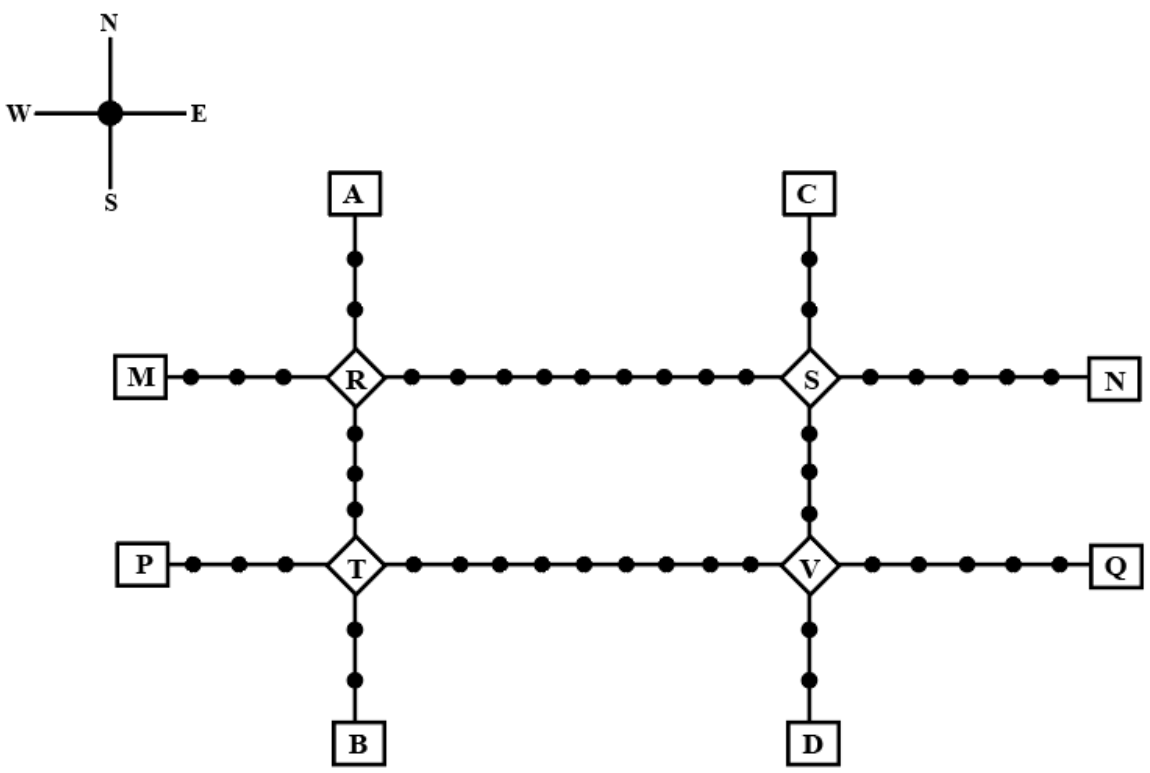
Given above is the schematic map of the metro lines in a city with rectangles denoting terminal stations (e.g. A), diamonds denoting junction stations (e.g. R) and small filled-up circles denoting other stations. Each train runs either in east-west or north-south direction, but not both. All trains stop for 2 minutes at each of the junction stations on the way and for 1 minute at each of the other stations. It takes 2 minutes to reach the next station for trains going in east-west direction and 3 minutes to reach the next station for trains going in northsouth direction. From each terminal station, the first train starts at 6 am; the last trains leave the terminal stations at midnight. Otherwise, during the service hours, there are metro service every 15 minutes in the north-south lines and every 10 minutes in the east-west lines. A train must rest for at least 15 minutes after completing a trip at the terminal station, before it can undertake the next trip in the reverse direction. (All questions are related to this metro service only. Assume that if someone reaches a station exactly at the time a train is supposed to leave, (s)he can catch that train.)

Chart for this set — reading the chart is part of the question
Q6Networks & RoutesMCQ

If Hari is ready to board a train at 8:05 am from station M, then when is the earliest that he can reach station N?

Show solution

Correct answer: A

Building the timing toolkit once. A train halts 2 min at a junction (R, S, T, V) and 1 min at any ordinary station. A hop between neighbouring stations takes 2 min east–west and 3 min north–south. The first train leaves every terminal at 6:00 am; north–south trains run every 15 min, east–west every 10 min; after a full trip a train rests at least 15 min before returning.

Counting off the map. The dots between stations are: M–R 3, R–S 9, S–N 5 on the northern east–west line, and the same on P–T–V–Q; A–R 2, R–T 3, T–B 2 on the western north–south line, and the same on C–S–V–D. So each east–west line has 17 ordinary stations, 2 junctions and 20 hops; each north–south line has 7 ordinary stations, 2 junctions and 10 hops.

One-way run times (travel + all halts in between):

LineDirectionHopsOrdinary haltsJunction haltsOne-way
M–Neast–west20×2=4020\times2 = 4017×1=1717\times1 = 172×2=42\times2 = 461 min
A–Bnorth–south10×3=3010\times3 = 307×1=77\times1 = 72×2=42\times2 = 441 min

C–D mirrors A–B (41 min); P–Q mirrors M–N (61 min).

Handy partial times (you don't count the halt at your starting station):

  • M→R=11M \to R = 11 min; R→SR \to S (or S→RS \to R) =29= 29 min.
  • B→TB \to T (north) =11= 11 min; T→RT \to R (north) =15= 15 min.
  • A→RA \to R (south) =11= 11 min; R→BR \to B (south) =28= 28 min.

This question — M to N, ready to board at 8:05 am. Trains leave M every 10 minutes from 6:00 (…, 7:50, 8:00, 8:10, …). At 8:05 the next one is 8:10. The full M→N journey is 61 minutes, so he arrives at 8:10+61=8{:}10 + 61 = 9:11 am.

Answer: 9:11 am

Q7Networks & RoutesMCQ

If Priya is ready to board a train at 10:25 am from station T, then when is the earliest that she can reach station S?

Show solution

Correct answer: A

Building the timing toolkit once. A train halts 2 min at a junction (R, S, T, V) and 1 min at any ordinary station. A hop between neighbouring stations takes 2 min east–west and 3 min north–south. The first train leaves every terminal at 6:00 am; north–south trains run every 15 min, east–west every 10 min; after a full trip a train rests at least 15 min before returning.

Counting off the map. The dots between stations are: M–R 3, R–S 9, S–N 5 on the northern east–west line, and the same on P–T–V–Q; A–R 2, R–T 3, T–B 2 on the western north–south line, and the same on C–S–V–D. So each east–west line has 17 ordinary stations, 2 junctions and 20 hops; each north–south line has 7 ordinary stations, 2 junctions and 10 hops.

One-way run times (travel + all halts in between):

LineDirectionHopsOrdinary haltsJunction haltsOne-way
M–Neast–west20×2=4020\times2 = 4017×1=1717\times1 = 172×2=42\times2 = 461 min
A–Bnorth–south10×3=3010\times3 = 307×1=77\times1 = 72×2=42\times2 = 441 min

C–D mirrors A–B (41 min); P–Q mirrors M–N (61 min).

Handy partial times (you don't count the halt at your starting station):

  • M→R=11M \to R = 11 min; R→SR \to S (or S→RS \to R) =29= 29 min.
  • B→TB \to T (north) =11= 11 min; T→RT \to R (north) =15= 15 min.
  • A→RA \to R (south) =11= 11 min; R→BR \to B (south) =28= 28 min.

This question — T to S, ready to board at 10:25 am. The route is T → R (north on the A–B line), then R → S (east on the M–N line).

  1. Northbound A–B trains reach T at …, 10:11, 10:26, … and leave 2 minutes later. At 10:25 she catches the one leaving T at 10:28.
  2. T→RT \to R takes 15 min → she reaches R at 10:43.
  3. Eastbound M–N trains leave R at …, 10:33, 10:43, 10:53, … (they arrive at:41 and leave at:43 after the junction halt). Arriving exactly at 10:43, she just catches the 10:43 departure.
  4. R→SR \to S takes 29 min → arrival 10:43+29=10{:}43 + 29 = 11:12 am.

💡 Teacher tip: "Arrives exactly as it leaves" counts as catching it — that single minute is what makes 11:12 possible instead of the next train's 11:22.

Answer: 11:12 am

Q8Networks & RoutesMCQ

Haripriya is expected to reach station S late. What is the latest time by which she must be ready to board at station S if she must reach station B before 1 am via station R?

Show solution

Correct answer: A

Building the timing toolkit once. A train halts 2 min at a junction (R, S, T, V) and 1 min at any ordinary station. A hop between neighbouring stations takes 2 min east–west and 3 min north–south. The first train leaves every terminal at 6:00 am; north–south trains run every 15 min, east–west every 10 min; after a full trip a train rests at least 15 min before returning.

Counting off the map. The dots between stations are: M–R 3, R–S 9, S–N 5 on the northern east–west line, and the same on P–T–V–Q; A–R 2, R–T 3, T–B 2 on the western north–south line, and the same on C–S–V–D. So each east–west line has 17 ordinary stations, 2 junctions and 20 hops; each north–south line has 7 ordinary stations, 2 junctions and 10 hops.

One-way run times (travel + all halts in between):

LineDirectionHopsOrdinary haltsJunction haltsOne-way
M–Neast–west20×2=4020\times2 = 4017×1=1717\times1 = 172×2=42\times2 = 461 min
A–Bnorth–south10×3=3010\times3 = 307×1=77\times1 = 72×2=42\times2 = 441 min

C–D mirrors A–B (41 min); P–Q mirrors M–N (61 min).

Handy partial times (you don't count the halt at your starting station):

  • M→R=11M \to R = 11 min; R→SR \to S (or S→RS \to R) =29= 29 min.
  • B→TB \to T (north) =11= 11 min; T→RT \to R (north) =15= 15 min.
  • A→RA \to R (south) =11= 11 min; R→BR \to B (south) =28= 28 min.

This question — the latest she can be ready at S to reach B before 1 am, going via R. Route: S → R (west on M–N), then R → B (south on A–B). Work backwards from B.

  1. The last southbound A–B train leaves terminal A at midnight. A→RA \to R is 11 min, so it reaches R at 00:11 and, after the halt, leaves R at 00:13 — the last train through R. From there R→BR \to B is 28 min, reaching B at 00:41 (before 1 am ✓). So she must be at R by 00:13.
  2. Westbound S→RS \to R takes 29 min, so she must leave S no later than 00:13−29=23:4400{:}13 - 29 = 23{:}44.
  3. Westbound M–N trains leave S at …, 23:39, 23:49, … (arriving at:37, leaving at:39). The latest departure that is 23:44 or earlier is 23:39; it reaches R at 00:08, in time for the 00:13 southbound. The 23:49 train would reach R at 00:18 — too late.

So she must be ready to board at S by 11:39 pm.

Answer: 11:39 pm

Q9Networks & RoutesTITA

What is the minimum number of trains that are required to provide the service on the AB line (considering both north and south directions)?

Show solution

Correct answer: 8

Building the timing toolkit once. A train halts 2 min at a junction (R, S, T, V) and 1 min at any ordinary station. A hop between neighbouring stations takes 2 min east–west and 3 min north–south. The first train leaves every terminal at 6:00 am; north–south trains run every 15 min, east–west every 10 min; after a full trip a train rests at least 15 min before returning.

Counting off the map. The dots between stations are: M–R 3, R–S 9, S–N 5 on the northern east–west line, and the same on P–T–V–Q; A–R 2, R–T 3, T–B 2 on the western north–south line, and the same on C–S–V–D. So each east–west line has 17 ordinary stations, 2 junctions and 20 hops; each north–south line has 7 ordinary stations, 2 junctions and 10 hops.

One-way run times (travel + all halts in between):

LineDirectionHopsOrdinary haltsJunction haltsOne-way
M–Neast–west20×2=4020\times2 = 4017×1=1717\times1 = 172×2=42\times2 = 461 min
A–Bnorth–south10×3=3010\times3 = 307×1=77\times1 = 72×2=42\times2 = 441 min

C–D mirrors A–B (41 min); P–Q mirrors M–N (61 min).

Handy partial times (you don't count the halt at your starting station):

  • M→R=11M \to R = 11 min; R→SR \to S (or S→RS \to R) =29= 29 min.
  • B→TB \to T (north) =11= 11 min; T→RT \to R (north) =15= 15 min.
  • A→RA \to R (south) =11= 11 min; R→BR \to B (south) =28= 28 min.

This question — minimum trains to run the A–B line (both directions). One way A→B takes 41 min, a train must rest at least 15 min at a terminal, and a departure is needed every 15 min.

Follow one train from A at 6:00: it reaches B at 6:41, rests at least to 6:56, and must leave B at a scheduled slot (:00,:15,:30,:45) → 7:00. Back to A at 7:41, rest to ≥ 7:56, next A slot → 8:00. So it returns to "leaving A" after 8:00−6:00=1208{:}00 - 6{:}00 = 120 minutes.

With a train needed to depart every 15 minutes, the number required is 120÷15=120 \div 15 = 8.

Answer: 8

Q10Networks & RoutesTITA

What is the minimum number of trains that are required to provide the service in this city?

Show solution

Correct answer: 48

Building the timing toolkit once. A train halts 2 min at a junction (R, S, T, V) and 1 min at any ordinary station. A hop between neighbouring stations takes 2 min east–west and 3 min north–south. The first train leaves every terminal at 6:00 am; north–south trains run every 15 min, east–west every 10 min; after a full trip a train rests at least 15 min before returning.

Counting off the map. The dots between stations are: M–R 3, R–S 9, S–N 5 on the northern east–west line, and the same on P–T–V–Q; A–R 2, R–T 3, T–B 2 on the western north–south line, and the same on C–S–V–D. So each east–west line has 17 ordinary stations, 2 junctions and 20 hops; each north–south line has 7 ordinary stations, 2 junctions and 10 hops.

One-way run times (travel + all halts in between):

LineDirectionHopsOrdinary haltsJunction haltsOne-way
M–Neast–west20×2=4020\times2 = 4017×1=1717\times1 = 172×2=42\times2 = 461 min
A–Bnorth–south10×3=3010\times3 = 307×1=77\times1 = 72×2=42\times2 = 441 min

C–D mirrors A–B (41 min); P–Q mirrors M–N (61 min).

Handy partial times (you don't count the halt at your starting station):

  • M→R=11M \to R = 11 min; R→SR \to S (or S→RS \to R) =29= 29 min.
  • B→TB \to T (north) =11= 11 min; T→RT \to R (north) =15= 15 min.
  • A→RA \to R (south) =11= 11 min; R→BR \to B (south) =28= 28 min.

This question — minimum trains for the whole city. Find each line's full cycle (round trip + the two rests, rounded up to the next scheduled departure) and divide by that line's gap between trains.

  • A–B and C–D (north–south, 41 min each way, trains every 15 min): the cycle works out to 120 min → 120÷15=8120 \div 15 = 8 trains each.
  • M–N and P–Q (east–west, 61 min each way, trains every 10 min): leave M 6:00 → N 7:01, rest to 7:16, next 10-min slot 7:20 → M 8:21, rest to 8:36, next slot 8:40. Cycle = 160 min → 160÷10=16160 \div 10 = 16 trains each.

Total =8+8+16+16== 8 + 8 + 16 + 16 = 48 trains.

Answer: 48

Set · Puzzles

Adhara, Bithi, Chhaya, Dhanavi, Esther, and Fathima are the interviewers in a process that awards funding for new initiatives. Every interviewer individually interviews each of the candidates individually and awards a token only if she recommends funding. A token has a face value of 2, 3, 5, 7, 11, or 13. Each interviewer awards tokens of a single face value only. Once all six interviews are over for a candidate, the candidate receives a funding that is Rs.1000 times the product of the face values of all the tokens. For example, if a candidate has tokens with face values 2, 5, and 7, then they get a funding of Rs.1000 × (2 × 5 × 7) = Rs.70,000. Pragnyaa, Qahira, Rasheeda, Smera, and Tantra were five candidates who received funding. The funds they received, in descending order, were Rs.390,000, Rs.210,000, Rs.165,000, Rs.77,000, and Rs.66,000. The following additional facts are known: 1. Fathima awarded tokens to everyone except Qahira, while Adhara awarded tokens to no one except Pragnyaa. 2. Rashida received the highest number of tokens that anyone received, but she did not receive one from Esther. 3. Bithi awarded a token to Smera but not to Qahira, while Dhanavi awarded a token to Qahira but not to Smera.

Q11PuzzlesTITA

How many tokens did Qahira receive?

Show solution

Correct answer: 2

Solving the whole set once. Each interviewer always awards the same face value from {2,3,5,7,11,13}\{2,3,5,7,11,13\}, and a candidate's funding ÷1000\div 1000 equals the product of the face values she received. Factor the five fundings:

Funding÷ 1000Prime (face-value) factors# tokens
390,0003902⋅3⋅5⋅132\cdot3\cdot5\cdot134
210,0002102⋅3⋅5⋅72\cdot3\cdot5\cdot74
165,0001653⋅5⋅113\cdot5\cdot113
77,000777⋅117\cdot112
66,000662⋅3⋅112\cdot3\cdot113

Every value 2–13 appears somewhere, so each interviewer matches exactly one face value.

  1. Fathima gives to everyone except Qahira — 4 of the 5 candidates. Only the value 3 appears in exactly 4 products (all but 77). So Fathima = 3 and Qahira = 77 = {7, 11} (2 tokens).
  2. Adhara gives only to Pragnyaa, so her value sits in just one product. Only 13 is unique (to 390). So Adhara = 13 and Pragnyaa = 390 = {2, 3, 5, 13}.
  3. Rasheeda got the most tokens (the maximum is 4); of the rest only 210 has 4 factors, so Rasheeda = 210 = {2, 3, 5, 7}. She got nothing from Esther, whose value is therefore not 2, 3, 5 or 7 → Esther = 11.
  4. Qahira = {7, 11}: Esther (11) supplies one; Dhanavi gives to Qahira, so Dhanavi = 7.
  5. That leaves {2, 5} for Bithi and Chhaya. Bithi gives to Smera, and the last two candidates, Smera and Tantra, hold 165 and 66 in some order.

Solved grid (✓ = a token was awarded):

Interviewer (value)Pragnyaa (390)Rasheeda (210)Qahira (77)SmeraTantra
Adhara (13)✓
Fathima (3)✓✓✓✓
Esther (11)✓✓✓
Dhanavi (7)✓✓
Bithi (2 or 5)✓✓✓
Chhaya (5 or 2)✓✓✓

Smera and Tantra hold 165 and 66 in some order; Bithi and Chhaya split {2, 5} so that Bithi's value lies in Smera's product. Everything else is fixed.

This question — how many tokens did Qahira receive? Her funding of 77,000 means a product of 77=7×1177 = 7 \times 11 — two face values, from Dhanavi and Esther. So 2 tokens.

Answer: 2

Q12PuzzlesMCQ

Who among the following definitely received a token from Bithi but not from Dhanavi?

Show solution

Correct answer: A

Solving the whole set once. Each interviewer always awards the same face value from {2,3,5,7,11,13}\{2,3,5,7,11,13\}, and a candidate's funding ÷1000\div 1000 equals the product of the face values she received. Factor the five fundings:

Funding÷ 1000Prime (face-value) factors# tokens
390,0003902⋅3⋅5⋅132\cdot3\cdot5\cdot134
210,0002102⋅3⋅5⋅72\cdot3\cdot5\cdot74
165,0001653⋅5⋅113\cdot5\cdot113
77,000777⋅117\cdot112
66,000662⋅3⋅112\cdot3\cdot113

Every value 2–13 appears somewhere, so each interviewer matches exactly one face value.

  1. Fathima gives to everyone except Qahira — 4 of the 5 candidates. Only the value 3 appears in exactly 4 products (all but 77). So Fathima = 3 and Qahira = 77 = {7, 11} (2 tokens).
  2. Adhara gives only to Pragnyaa, so her value sits in just one product. Only 13 is unique (to 390). So Adhara = 13 and Pragnyaa = 390 = {2, 3, 5, 13}.
  3. Rasheeda got the most tokens (the maximum is 4); of the rest only 210 has 4 factors, so Rasheeda = 210 = {2, 3, 5, 7}. She got nothing from Esther, whose value is therefore not 2, 3, 5 or 7 → Esther = 11.
  4. Qahira = {7, 11}: Esther (11) supplies one; Dhanavi gives to Qahira, so Dhanavi = 7.
  5. That leaves {2, 5} for Bithi and Chhaya. Bithi gives to Smera, and the last two candidates, Smera and Tantra, hold 165 and 66 in some order.

Solved grid (✓ = a token was awarded):

Interviewer (value)Pragnyaa (390)Rasheeda (210)Qahira (77)SmeraTantra
Adhara (13)✓
Fathima (3)✓✓✓✓
Esther (11)✓✓✓
Dhanavi (7)✓✓
Bithi (2 or 5)✓✓✓
Chhaya (5 or 2)✓✓✓

Smera and Tantra hold 165 and 66 in some order; Bithi and Chhaya split {2, 5} so that Bithi's value lies in Smera's product. Everything else is fixed.

This question — who definitely got a token from Bithi but not from Dhanavi? Dhanavi (value 7) gives to the candidates whose product contains 7: Rasheeda (210) and Qahira (77). Bithi (value 2 or 5) gives to Pragnyaa and Rasheeda (both 2 and 5 divide 390 and 210) and to Smera (Bithi's value lies in Smera's product).

Check the options: Rasheeda and Qahira both got Dhanavi (excluded); Tantra never gets Bithi (Tantra's product lacks Bithi's value either way). Pragnyaa gets a Bithi token in every case and, with no 7 in 390, never a Dhanavi token.

Answer: Pragnyaa

Q13PuzzlesTITA

How many tokens did Chhaya award?

Show solution

Correct answer: 3

Solving the whole set once. Each interviewer always awards the same face value from {2,3,5,7,11,13}\{2,3,5,7,11,13\}, and a candidate's funding ÷1000\div 1000 equals the product of the face values she received. Factor the five fundings:

Funding÷ 1000Prime (face-value) factors# tokens
390,0003902⋅3⋅5⋅132\cdot3\cdot5\cdot134
210,0002102⋅3⋅5⋅72\cdot3\cdot5\cdot74
165,0001653⋅5⋅113\cdot5\cdot113
77,000777⋅117\cdot112
66,000662⋅3⋅112\cdot3\cdot113

Every value 2–13 appears somewhere, so each interviewer matches exactly one face value.

  1. Fathima gives to everyone except Qahira — 4 of the 5 candidates. Only the value 3 appears in exactly 4 products (all but 77). So Fathima = 3 and Qahira = 77 = {7, 11} (2 tokens).
  2. Adhara gives only to Pragnyaa, so her value sits in just one product. Only 13 is unique (to 390). So Adhara = 13 and Pragnyaa = 390 = {2, 3, 5, 13}.
  3. Rasheeda got the most tokens (the maximum is 4); of the rest only 210 has 4 factors, so Rasheeda = 210 = {2, 3, 5, 7}. She got nothing from Esther, whose value is therefore not 2, 3, 5 or 7 → Esther = 11.
  4. Qahira = {7, 11}: Esther (11) supplies one; Dhanavi gives to Qahira, so Dhanavi = 7.
  5. That leaves {2, 5} for Bithi and Chhaya. Bithi gives to Smera, and the last two candidates, Smera and Tantra, hold 165 and 66 in some order.

Solved grid (✓ = a token was awarded):

Interviewer (value)Pragnyaa (390)Rasheeda (210)Qahira (77)SmeraTantra
Adhara (13)✓
Fathima (3)✓✓✓✓
Esther (11)✓✓✓
Dhanavi (7)✓✓
Bithi (2 or 5)✓✓✓
Chhaya (5 or 2)✓✓✓

Smera and Tantra hold 165 and 66 in some order; Bithi and Chhaya split {2, 5} so that Bithi's value lies in Smera's product. Everything else is fixed.

This question — how many tokens did Chhaya award? Chhaya's value is 2 or 5. Value 2 appears in 390, 210, 66; value 5 appears in 390, 210, 165. Either way, her value sits in exactly three candidates' products (Pragnyaa, Rasheeda, and whichever of Smera/Tantra holds the matching product). So Chhaya awards 3 tokens.

Answer: 3

Q14PuzzlesTITA

How many tokens did Smera receive?

Show solution

Correct answer: 3

Solving the whole set once. Each interviewer always awards the same face value from {2,3,5,7,11,13}\{2,3,5,7,11,13\}, and a candidate's funding ÷1000\div 1000 equals the product of the face values she received. Factor the five fundings:

Funding÷ 1000Prime (face-value) factors# tokens
390,0003902⋅3⋅5⋅132\cdot3\cdot5\cdot134
210,0002102⋅3⋅5⋅72\cdot3\cdot5\cdot74
165,0001653⋅5⋅113\cdot5\cdot113
77,000777⋅117\cdot112
66,000662⋅3⋅112\cdot3\cdot113

Every value 2–13 appears somewhere, so each interviewer matches exactly one face value.

  1. Fathima gives to everyone except Qahira — 4 of the 5 candidates. Only the value 3 appears in exactly 4 products (all but 77). So Fathima = 3 and Qahira = 77 = {7, 11} (2 tokens).
  2. Adhara gives only to Pragnyaa, so her value sits in just one product. Only 13 is unique (to 390). So Adhara = 13 and Pragnyaa = 390 = {2, 3, 5, 13}.
  3. Rasheeda got the most tokens (the maximum is 4); of the rest only 210 has 4 factors, so Rasheeda = 210 = {2, 3, 5, 7}. She got nothing from Esther, whose value is therefore not 2, 3, 5 or 7 → Esther = 11.
  4. Qahira = {7, 11}: Esther (11) supplies one; Dhanavi gives to Qahira, so Dhanavi = 7.
  5. That leaves {2, 5} for Bithi and Chhaya. Bithi gives to Smera, and the last two candidates, Smera and Tantra, hold 165 and 66 in some order.

Solved grid (✓ = a token was awarded):

Interviewer (value)Pragnyaa (390)Rasheeda (210)Qahira (77)SmeraTantra
Adhara (13)✓
Fathima (3)✓✓✓✓
Esther (11)✓✓✓
Dhanavi (7)✓✓
Bithi (2 or 5)✓✓✓
Chhaya (5 or 2)✓✓✓

Smera and Tantra hold 165 and 66 in some order; Bithi and Chhaya split {2, 5} so that Bithi's value lies in Smera's product. Everything else is fixed.

This question — how many tokens did Smera receive? Smera holds either 165=3⋅5⋅11165 = 3\cdot5\cdot11 or 66=2⋅3⋅1166 = 2\cdot3\cdot11; both are products of three face values. So Smera received 3 tokens, whichever of the two funding amounts is hers.

Answer: 3

Q15PuzzlesMCQ

Which of the following could be the amount of funding that Tantra received? (a) Rs. 66,000 (b) Rs. 165,000

Show solution

Correct answer: D

Solving the whole set once. Each interviewer always awards the same face value from {2,3,5,7,11,13}\{2,3,5,7,11,13\}, and a candidate's funding ÷1000\div 1000 equals the product of the face values she received. Factor the five fundings:

Funding÷ 1000Prime (face-value) factors# tokens
390,0003902⋅3⋅5⋅132\cdot3\cdot5\cdot134
210,0002102⋅3⋅5⋅72\cdot3\cdot5\cdot74
165,0001653⋅5⋅113\cdot5\cdot113
77,000777⋅117\cdot112
66,000662⋅3⋅112\cdot3\cdot113

Every value 2–13 appears somewhere, so each interviewer matches exactly one face value.

  1. Fathima gives to everyone except Qahira — 4 of the 5 candidates. Only the value 3 appears in exactly 4 products (all but 77). So Fathima = 3 and Qahira = 77 = {7, 11} (2 tokens).
  2. Adhara gives only to Pragnyaa, so her value sits in just one product. Only 13 is unique (to 390). So Adhara = 13 and Pragnyaa = 390 = {2, 3, 5, 13}.
  3. Rasheeda got the most tokens (the maximum is 4); of the rest only 210 has 4 factors, so Rasheeda = 210 = {2, 3, 5, 7}. She got nothing from Esther, whose value is therefore not 2, 3, 5 or 7 → Esther = 11.
  4. Qahira = {7, 11}: Esther (11) supplies one; Dhanavi gives to Qahira, so Dhanavi = 7.
  5. That leaves {2, 5} for Bithi and Chhaya. Bithi gives to Smera, and the last two candidates, Smera and Tantra, hold 165 and 66 in some order.

Solved grid (✓ = a token was awarded):

Interviewer (value)Pragnyaa (390)Rasheeda (210)Qahira (77)SmeraTantra
Adhara (13)✓
Fathima (3)✓✓✓✓
Esther (11)✓✓✓
Dhanavi (7)✓✓
Bithi (2 or 5)✓✓✓
Chhaya (5 or 2)✓✓✓

Smera and Tantra hold 165 and 66 in some order; Bithi and Chhaya split {2, 5} so that Bithi's value lies in Smera's product. Everything else is fixed.

This question — which amount could Tantra have received? Every candidate except Smera and Tantra is fixed: Pragnyaa 390,000, Rasheeda 210,000, Qahira 77,000. That leaves 165,000 and 66,000 for Smera and Tantra in some order, and the clues allow either assignment (Bithi's value simply follows whichever product Smera holds). So Tantra could have received either Rs. 66,000 or Rs. 165,000.

Answer: Both (a) and (b)

Set · Puzzles

There are 15 girls and some boys among the graduating students in a class. They are planning a get-together, which can be either a 1-day event, or a 2-day event, or a 3-day event. There are 6 singers in the class, 4 of them are boys. There are 10 dancers in the class, 4 of them are girls. No dancer in the class is a singer. Some students are not interested in attending the get-together. Those students who are interested in attending a 3-day event are also interested in attending a 2-day event; those who are interested in attending a 2-day event are also interested in attending a 1-day event. The following facts are also known: 1. All the girls and 80% of the boys are interested in attending a 1-day event. 60% of the boys are interested in attending a 2-day event. 2. Some of the girls are interested in attending a 1-day event, but not a 2-day event; some of the other girls are interested in attending both. 3. 70% of the boys who are interested in attending a 2-day event are neither singers nor dancers. 60% of the girls who are interested in attending a 2-day event are neither singers nor dancers. 4. No girl is interested in attending a 3-day event. All male singers and 2 of the dancers are interested in attending a 3-day event. 5. The number of singers interested in attending a 2-day event is one more than the number of dancers interested in attending a 2-day event.

Q16PuzzlesTITA

How many boys are there in the class?

Show solution

Correct answer: 50

Solving the whole set once. There are 15 girls and nn boys. Interest is nested: anyone up for 3 days is up for 2 days, and anyone up for 2 days is up for 1 day. Singers: 6 total, 4 boys → 2 girl singers. Dancers: 10 total, 4 girls → 6 boy dancers. Nobody is both a singer and a dancer.

Finding the number of boys.

  • 60% of boys are up for a 2-day event: 0.6n0.6n boys.
  • Of those, 70% are neither singer nor dancer, so the other 30% — that is 0.3×0.6n=0.18n0.3 \times 0.6n = 0.18n boys — are singers or dancers.
  • All 4 male singers are up for the 3-day event, hence for the 2-day event too. So 0.18n=4+(male dancers in the 2-day event)0.18n = 4 + (\text{male dancers in the 2-day event}).

0.18n=9n500.18n = \frac{9n}{50} is a whole number only when nn is a multiple of 50. Take n=50n = 50: then 0.18n=90.18n = 9, so male dancers in the 2-day event =9−4=5= 9 - 4 = 5 (fine — there are 6 male dancers). n=100n = 100 would need 14 male dancers, impossible. So n=50n = 50 boys, class size 50+15=6550 + 15 = 65.

Filling in the rest.

  • Boys: 80% of 50 = 40 up for 1 day; 60% = 30 up for 2 days; 6 up for 3 days (4 male singers + 2 dancers, all boys since no girl does 3 days).
  • The 30 two-day boys = 4 singers + 5 dancers + 21 neither.
  • Girls: "singers in the 2-day event = dancers in the 2-day event + 1", with 4 male singers and 5 male dancers, forces 2 girl singers and 0 girl dancers in the 2-day event; the 60%-are-neither rule then makes girls in the 2-day event = 5 (2 singers + 3 neither). All 15 girls do 1 day; none do 3.

Solved counts:

Group1-day2-day3-day
Boys (50)40306
Girls (15)1550
Total (65)55356

Two-day breakdown — boys (30): 4 singers + 5 dancers + 21 neither. Girls (5): 2 singers + 0 dancers + 3 neither.

This question — how many boys are in the class? The key step is that the count of "singers-or-dancers among the two-day boys", 0.18n0.18n, must be a whole number. That forces nn to be a multiple of 50, and only n=50n = 50 survives the check on the number of male dancers.

Answer: 50

Q17PuzzlesMCQ

Which of the following can be determined from the given information? I. The number of boys who are interested in attending a 1-day event and are neither dancers nor singers. II. The number of female dancers who are interested in attending a 1-day event.

Show solution

Correct answer: C

Solving the whole set once. There are 15 girls and nn boys. Interest is nested: anyone up for 3 days is up for 2 days, and anyone up for 2 days is up for 1 day. Singers: 6 total, 4 boys → 2 girl singers. Dancers: 10 total, 4 girls → 6 boy dancers. Nobody is both a singer and a dancer.

Finding the number of boys.

  • 60% of boys are up for a 2-day event: 0.6n0.6n boys.
  • Of those, 70% are neither singer nor dancer, so the other 30% — that is 0.3×0.6n=0.18n0.3 \times 0.6n = 0.18n boys — are singers or dancers.
  • All 4 male singers are up for the 3-day event, hence for the 2-day event too. So 0.18n=4+(male dancers in the 2-day event)0.18n = 4 + (\text{male dancers in the 2-day event}).

0.18n=9n500.18n = \frac{9n}{50} is a whole number only when nn is a multiple of 50. Take n=50n = 50: then 0.18n=90.18n = 9, so male dancers in the 2-day event =9−4=5= 9 - 4 = 5 (fine — there are 6 male dancers). n=100n = 100 would need 14 male dancers, impossible. So n=50n = 50 boys, class size 50+15=6550 + 15 = 65.

Filling in the rest.

  • Boys: 80% of 50 = 40 up for 1 day; 60% = 30 up for 2 days; 6 up for 3 days (4 male singers + 2 dancers, all boys since no girl does 3 days).
  • The 30 two-day boys = 4 singers + 5 dancers + 21 neither.
  • Girls: "singers in the 2-day event = dancers in the 2-day event + 1", with 4 male singers and 5 male dancers, forces 2 girl singers and 0 girl dancers in the 2-day event; the 60%-are-neither rule then makes girls in the 2-day event = 5 (2 singers + 3 neither). All 15 girls do 1 day; none do 3.

Solved counts:

Group1-day2-day3-day
Boys (50)40306
Girls (15)1550
Total (65)55356

Two-day breakdown — boys (30): 4 singers + 5 dancers + 21 neither. Girls (5): 2 singers + 0 dancers + 3 neither.

This question — which quantity can be determined?

  • I. Boys up for a 1-day event who are neither dancers nor singers. There are 40 one-day boys. The 4 male singers are surely among them, but the number of male dancers among the one-day boys is 5 or 6 (five are certain via the 2-day event; the sixth may or may not attend anything). So the "neither" count is 31 or 30 — not determined.
  • II. Female dancers up for a 1-day event. There are 4 female dancers and all girls are up for a 1-day event, so this is exactly 4 — determined.

Only II can be determined.

Answer: Only II

Q18PuzzlesMCQ

What fraction of the class are interested in attending a 2-day event?

Show solution

Correct answer: B

Solving the whole set once. There are 15 girls and nn boys. Interest is nested: anyone up for 3 days is up for 2 days, and anyone up for 2 days is up for 1 day. Singers: 6 total, 4 boys → 2 girl singers. Dancers: 10 total, 4 girls → 6 boy dancers. Nobody is both a singer and a dancer.

Finding the number of boys.

  • 60% of boys are up for a 2-day event: 0.6n0.6n boys.
  • Of those, 70% are neither singer nor dancer, so the other 30% — that is 0.3×0.6n=0.18n0.3 \times 0.6n = 0.18n boys — are singers or dancers.
  • All 4 male singers are up for the 3-day event, hence for the 2-day event too. So 0.18n=4+(male dancers in the 2-day event)0.18n = 4 + (\text{male dancers in the 2-day event}).

0.18n=9n500.18n = \frac{9n}{50} is a whole number only when nn is a multiple of 50. Take n=50n = 50: then 0.18n=90.18n = 9, so male dancers in the 2-day event =9−4=5= 9 - 4 = 5 (fine — there are 6 male dancers). n=100n = 100 would need 14 male dancers, impossible. So n=50n = 50 boys, class size 50+15=6550 + 15 = 65.

Filling in the rest.

  • Boys: 80% of 50 = 40 up for 1 day; 60% = 30 up for 2 days; 6 up for 3 days (4 male singers + 2 dancers, all boys since no girl does 3 days).
  • The 30 two-day boys = 4 singers + 5 dancers + 21 neither.
  • Girls: "singers in the 2-day event = dancers in the 2-day event + 1", with 4 male singers and 5 male dancers, forces 2 girl singers and 0 girl dancers in the 2-day event; the 60%-are-neither rule then makes girls in the 2-day event = 5 (2 singers + 3 neither). All 15 girls do 1 day; none do 3.

Solved counts:

Group1-day2-day3-day
Boys (50)40306
Girls (15)1550
Total (65)55356

Two-day breakdown — boys (30): 4 singers + 5 dancers + 21 neither. Girls (5): 2 singers + 0 dancers + 3 neither.

This question — fraction of the class up for a 2-day event. From the table, two-day attendance is 30+5=3530 + 5 = 35 out of a class of 6565:

3565=713.\frac{35}{65} = \frac{7}{13}.

Answer: 7/13

Q19PuzzlesMCQ

What BEST can be concluded about the number of male dancers who are interested in attending a 1-day event?

Show solution

Correct answer: A

Solving the whole set once. There are 15 girls and nn boys. Interest is nested: anyone up for 3 days is up for 2 days, and anyone up for 2 days is up for 1 day. Singers: 6 total, 4 boys → 2 girl singers. Dancers: 10 total, 4 girls → 6 boy dancers. Nobody is both a singer and a dancer.

Finding the number of boys.

  • 60% of boys are up for a 2-day event: 0.6n0.6n boys.
  • Of those, 70% are neither singer nor dancer, so the other 30% — that is 0.3×0.6n=0.18n0.3 \times 0.6n = 0.18n boys — are singers or dancers.
  • All 4 male singers are up for the 3-day event, hence for the 2-day event too. So 0.18n=4+(male dancers in the 2-day event)0.18n = 4 + (\text{male dancers in the 2-day event}).

0.18n=9n500.18n = \frac{9n}{50} is a whole number only when nn is a multiple of 50. Take n=50n = 50: then 0.18n=90.18n = 9, so male dancers in the 2-day event =9−4=5= 9 - 4 = 5 (fine — there are 6 male dancers). n=100n = 100 would need 14 male dancers, impossible. So n=50n = 50 boys, class size 50+15=6550 + 15 = 65.

Filling in the rest.

  • Boys: 80% of 50 = 40 up for 1 day; 60% = 30 up for 2 days; 6 up for 3 days (4 male singers + 2 dancers, all boys since no girl does 3 days).
  • The 30 two-day boys = 4 singers + 5 dancers + 21 neither.
  • Girls: "singers in the 2-day event = dancers in the 2-day event + 1", with 4 male singers and 5 male dancers, forces 2 girl singers and 0 girl dancers in the 2-day event; the 60%-are-neither rule then makes girls in the 2-day event = 5 (2 singers + 3 neither). All 15 girls do 1 day; none do 3.

Solved counts:

Group1-day2-day3-day
Boys (50)40306
Girls (15)1550
Total (65)55356

Two-day breakdown — boys (30): 4 singers + 5 dancers + 21 neither. Girls (5): 2 singers + 0 dancers + 3 neither.

This question — male dancers up for a 1-day event. There are 6 male dancers. Five of them are in the 2-day event, so they are certainly up for the 1-day event. The 6th is not in the 2-day event; since only 40 of the 50 boys attend the 1-day event (10 attend nothing), that 6th dancer may or may not be among the 40. So the count is 5 or 6.

Answer: 5 or 6

Q20PuzzlesMCQ

How many female dancers are interested in attending a 2-day event?

Show solution

Correct answer: C

Solving the whole set once. There are 15 girls and nn boys. Interest is nested: anyone up for 3 days is up for 2 days, and anyone up for 2 days is up for 1 day. Singers: 6 total, 4 boys → 2 girl singers. Dancers: 10 total, 4 girls → 6 boy dancers. Nobody is both a singer and a dancer.

Finding the number of boys.

  • 60% of boys are up for a 2-day event: 0.6n0.6n boys.
  • Of those, 70% are neither singer nor dancer, so the other 30% — that is 0.3×0.6n=0.18n0.3 \times 0.6n = 0.18n boys — are singers or dancers.
  • All 4 male singers are up for the 3-day event, hence for the 2-day event too. So 0.18n=4+(male dancers in the 2-day event)0.18n = 4 + (\text{male dancers in the 2-day event}).

0.18n=9n500.18n = \frac{9n}{50} is a whole number only when nn is a multiple of 50. Take n=50n = 50: then 0.18n=90.18n = 9, so male dancers in the 2-day event =9−4=5= 9 - 4 = 5 (fine — there are 6 male dancers). n=100n = 100 would need 14 male dancers, impossible. So n=50n = 50 boys, class size 50+15=6550 + 15 = 65.

Filling in the rest.

  • Boys: 80% of 50 = 40 up for 1 day; 60% = 30 up for 2 days; 6 up for 3 days (4 male singers + 2 dancers, all boys since no girl does 3 days).
  • The 30 two-day boys = 4 singers + 5 dancers + 21 neither.
  • Girls: "singers in the 2-day event = dancers in the 2-day event + 1", with 4 male singers and 5 male dancers, forces 2 girl singers and 0 girl dancers in the 2-day event; the 60%-are-neither rule then makes girls in the 2-day event = 5 (2 singers + 3 neither). All 15 girls do 1 day; none do 3.

Solved counts:

Group1-day2-day3-day
Boys (50)40306
Girls (15)1550
Total (65)55356

Two-day breakdown — boys (30): 4 singers + 5 dancers + 21 neither. Girls (5): 2 singers + 0 dancers + 3 neither.

This question — female dancers up for a 2-day event. The rule "girl singers in the 2-day event = girl dancers in the 2-day event + 1", together with the boys' figures, gave girl singers = 2 and girl dancers = 0. No female dancer is up for a 2-day event.

Answer: 0