CATLab

CAT 2025 DILR Questions — Slot 2

The actual Data Interpretation & Logical Reasoning section from CAT 2025, Slot 2 — 22 questions in original paper order, each with a full worked solution. Tap an option (or type your answer) to check yourself before reading the solution.

22 questions11 MCQ · 11 TITA40 min section0/22 attempted
Set · Scheduling & Sequencing

Ananya Raga, Bhaskar Tala, Charu Veena, and Devendra Sur are four musicians. Each of them started and completed their training as students under each of three Gurus — Pandit Meghnath, Ustad Samiran, and Acharya Raghunath between 2013 and 2024, including both the years. Each Guru trains any student for consecutive years only, for a span of 2, 3, or 4 years, with each Guru having a different span. During some of these years, a student may not have trained under these Gurus; however, they never trained under multiple Gurus in the same year. In none of these years, any of these Gurus trained more than two of these students at the same time. When two students train under the same Guru at the same time, they are referred to as Gurubhai, irrespective of their gender. The following additional facts are known. 1. Ustad Samiran never trained more than one of these students in the same year. 2. Acharya Raghunath did not train any of these students during 2015-2018, as well as during 2021-24. 3. Ananya and Devendra were never Gurubhai; neither were Bhaskar and Charu. All other pairs of musicians were Gurubhai for exactly 2 years. 4. In 2013, Ananya and Bhaskar started their trainings under Pandit Meghnath and under Ustad Samiran, respectively.

Q1Scheduling & SequencingMCQ

In which of the following years were Ananya and Bhaskar Gurubhai?

Show solution

Correct answer: A

Setting up the full Guru schedule

Let us abbreviate the musicians as A (Ananya), B (Bhaskar), C (Charu), D (Devendra), and the Gurus as M (Pandit Meghnath), S (Ustad Samiran), R (Acharya Raghunath).

Step 1 — Fix Raghunath's span

Clue 2 says Raghunath trained nobody during 2015–2018 or 2021–2024, so his only active years are {2013,2014,2019,2020}\{2013, 2014, 2019, 2020\}. The longest consecutive run inside these years is 2, and each Guru's span is a single value from {2,3,4}\{2,3,4\} (all different). Therefore Raghunath's span is 2, and every student's block under Raghunath is either 2013–14 or 2019–20. This leaves Meghnath and Samiran with spans {3,4}\{3,4\}.

Step 2 — Place students under Raghunath

Clue 4 tells us Ananya started under Meghnath in 2013 and Bhaskar started under Samiran in 2013. Since a student cannot train under two Gurus in the same year, neither Ananya nor Bhaskar can have Raghunath in 2013–14. Therefore Ananya and Bhaskar both train under Raghunath in 2019–20, which forces Charu and Devendra to train under Raghunath in 2013–14.

So the Raghunath-Gurubhai pairs are: A–B (2019–20) and C–D (2013–14).

Step 3 — Determine Meghnath's span and place the remaining Gurubhai pairs

From Clue 3, the pairs that must be Gurubhai for exactly 2 years are A–C and B–D (since A–D and B–C are explicitly never Gurubhai, and A–B / C–D are already covered by Raghunath). Clue 1 says Samiran never trains more than one student at a time, so Samiran creates no Gurubhai pairs. Hence A–C and B–D must overlap under Meghnath.

If Meghnath's span were 3, Ananya's block (starting 2013) would be 2013–15, and Charu would need a 2-year overlap — but any 3-year block overlapping Ananya's by 2 years would collide with Charu's Raghunath block (2013–14). So Meghnath's span is 4 and Samiran's span is 3.

  • Ananya under Meghnath: 2013–2016.
  • Charu under Meghnath: 2015–2018 (overlaps Ananya in 2015–16 = 2 years, avoids her Raghunath block).
  • Bhaskar under Meghnath: 2021–2024 (his only free 4-year run after S = 2013–15 and R = 2019–20).
  • Devendra under Meghnath: 2019–2022 (overlaps Bhaskar in 2021–22 = 2 years).

Step 4 — Place Samiran blocks (span 3, one student at a time)

  • Bhaskar under Samiran: 2013–2015 (started 2013 per Clue 4).
  • Devendra under Samiran: 2016–2018 (only 3-year run avoiding R = 2013–14 and M = 2019–22).
  • Charu under Samiran: 2019–2021 (only 3-year run avoiding R = 2013–14 and M = 2015–18).
  • Ananya under Samiran: 2022–2024 (only 3-year run avoiding M = 2013–16 and R = 2019–20).

The complete schedule

YearAnanyaBhaskarCharuDevendra
2013MSRR
2014MSRR
2015MSM
2016MMS
2017MS
2018MS
2019RRSM
2020RRM
2021MSM
2022SMM
2023SM
2024SM

Answering this question

Ananya and Bhaskar are Gurubhai only under Raghunath, in 2019 and 2020. Among the given options — 2020, 2018, 2021, 2014 — only 2020 appears.

Answer: 2020 (Choice A)
Q2Scheduling & SequencingMCQ

In which year did Charu begin her training under Pandit Meghnath?

Show solution

Correct answer: B

Recalling the solved schedule

Through the deductions for this set (Raghunath's span is 2, Meghnath's span is 4, Samiran's span is 3), the complete Guru schedule is:

YearAnanyaBhaskarCharuDevendra
2013MSRR
2014MSRR
2015MSM
2016MMS
2017MS
2018MS
2019RRSM
2020RRM
2021MSM
2022SMM
2023SM
2024SM

Why Charu starts Meghnath in 2015

Meghnath's span is 4 (Raghunath's span of 2 forces {M-span,S-span}={3,4}\{\text{M-span}, \text{S-span}\} = \{3,4\}, and span 3 is ruled out because Charu's required 2-year overlap with Ananya under Meghnath would collide with Charu's Raghunath block of 2013–14).

  • Ananya's Meghnath block is 2013–2016 (she started in 2013 per Clue 4).
  • Charu's Raghunath block is 2013–2014, so her Meghnath block must avoid those years yet overlap Ananya's block for exactly 2 years.
  • The only 4-year consecutive block satisfying both conditions is 2015–2018 (overlap with Ananya = 2015, 2016).

Therefore Charu began her training under Pandit Meghnath in 2015.

Answer: 2015 (Choice B)

Q3Scheduling & SequencingMCQ

In which of the following years were Bhaskar and Devendra Gurubhai?

Show solution

Correct answer: A

Recalling the solved schedule

The complete Guru schedule derived from the clues is:

YearAnanyaBhaskarCharuDevendra
2013MSRR
2014MSRR
2015MSM
2016MMS
2017MS
2018MS
2019RRSM
2020RRM
2021MSM
2022SMM
2023SM
2024SM

Reasoning for Bhaskar and Devendra

From Clue 3, Bhaskar and Devendra must be Gurubhai for exactly 2 years. Let us check which Guru can create this overlap:

  • Raghunath: Bhaskar's R-block is 2019–20; Devendra's R-block is 2013–14. No overlap.
  • Samiran: Clue 1 says Samiran never trains more than one student at a time, so no Gurubhai pair can come from Samiran.
  • Meghnath: This is the only possibility.

Bhaskar's Meghnath block is 2021–2024 (his other blocks — Samiran 2013–15 and Raghunath 2019–20 — leave only 2021–24 as a free 4-year run). Devendra's Meghnath block is 2019–2022. They share Meghnath in 2021 and 2022.

Among the options — 2022, 2015, 2020, 2018 — only 2022 is listed.

Answer: 2022 (Choice A)

Q4Scheduling & SequencingMCQ

Which of the following statements is TRUE?

Show solution

Correct answer: D

Recalling the solved schedule

The complete Guru schedule is:

YearAnanyaBhaskarCharuDevendra
2013MSRR
2014MSRR
2015MSM
2016MMS
2017MS
2018MS
2019RRSM
2020RRSM
2021MSM
2022SMM
2023SM
2024SM

Checking each option

  • A: Charu under Samiran in 2018 — In 2018, Charu is under Meghnath, not Samiran. ✗
  • B: Ananya under Samiran in 2015 — In 2015, Ananya is under Meghnath, not Samiran. ✗
  • C: Ananya under Samiran in 2018 — In 2018, Ananya is not training under any Guru (her Meghnath block ended in 2016 and her Raghunath block starts in 2019). ✗
  • D: Charu under Samiran in 2019 — Charu's Samiran block is 2019–2021, so she is indeed under Samiran in 2019. ✓

💡 Teacher tip: Charu's Samiran block (2019–21) is forced because her Raghunath (2013–14) and Meghnath (2015–18) blocks are already placed, and Samiran's three single-student slots must be packed without overlap into the remaining years alongside the other students' Samiran blocks.

Answer: Charu was training under Ustad Samiran in 2019 (Choice D)

Q5Scheduling & SequencingTITA

In how many of the years between 2013-24, were only two of these four musicians training under these three Gurus?

Show solution

Correct answer: 4

Recalling the solved schedule with counts

The complete Guru schedule, with the number of musicians training each year, is:

YearAnanyaBhaskarCharuDevendra# training
2013MSRR4
2014MSRR4
2015MSM3
2016MMS3
2017MS2
2018MS2
2019RRSM4
2020RRM3
2021MSM3
2022SMM3
2023SM2
2024SM2

Counting the years with exactly two musicians training

Reading the last column, exactly two of the four musicians are training in:

  1. 2017 — Charu (M) and Devendra (S)
  2. 2018 — Charu (M) and Devendra (S)
  3. 2023 — Ananya (S) and Bhaskar (M)
  4. 2024 — Ananya (S) and Bhaskar (M)

That gives 4 years.

Answer: 4

Set · Ordering & Ranking

There are six spherical balls, B1, B2, B3, B4, B5, and B6, and four circular hoops H1, H2, H3, and H4. Each ball was tested on each hoop once, by attempting to pass the ball through the hoop. If the diameter of a ball is not larger than the diameter of the hoop, the ball passes through the hoop and makes a “ping”. Any ball having a diameter larger than that of the hoop gets stuck on that hoop and does not make a ping. The following additional information is known: 1. B1 and B6 each made a ping on H4, but B5 did not. 2. B4 made a ping on H3, but B1 did not. 3. All balls, except B3, made pings on H1. 4. None of the balls, except B2, made a ping on H2.

Q6Ordering & RankingTITA

What was the total number of pings made by B1, B2, and B3?

Show solution

Correct answer: 6

Setting up the size logic

A ball pings on a hoop exactly when the ball's diameter is not larger than the hoop's diameter — i.e. ball-size \le hoop-size. So pings tell us about relative sizes.

Let us decode each clue:

  1. H1 (clue 3): Every ball except B3 pings on H1. Since a ball fails only when it is too big for the hoop, B3 is the largest ball, and H1 is big enough for every other ball — so H1 is the largest hoop.
  2. H2 (clue 4): Only B2 pings on H2. So B2 is the smallest ball, and H2 is the smallest hoop (every other ball is too big for it).
  3. H4 (clue 1): B1 and B6 ping on H4, but B5 does not. So H4 is at least as big as B1 and B6, but smaller than B5: B1H4<B5B1 \le H4 < B5 and B6H4<B5B6 \le H4 < B5.
  4. H3 (clue 2): B4 pings on H3, but B1 does not. So H3 is at least as big as B4 but smaller than B1: B4H3<B1B4 \le H3 < B1.

Putting the ball sizes together: B2<B4<B1<B5<B3B2 < B4 < B1 < B5 < B3 (B6 sits somewhere between B2 and B5; its exact spot is not fixed.)

Ping table

A ✓ means the ball fits through that hoop.

Ball \ HoopH1H2H3H4Pings
B12
B24
B30
B43
B51
B6?2 or 3

Answering this question

We need the total pings made by B1, B2, and B3:

  • B1 pings on H1 and H4 → 2
  • B2 (the smallest ball) pings on all four hoops → 4
  • B3 (the largest ball) pings on none → 0

Total =2+4+0=6= 2 + 4 + 0 = 6.

Answer: 6

Q7Ordering & RankingMCQ

Which of the following statements about the relative sizes of the balls is NOT NECESSARILY true?

Show solution

Correct answer: C

What we already know about ball sizes

From the four clues (a ball pings on a hoop iff ball-size \le hoop-size):

  • B3 is the largest ball (only B3 fails to ping on H1, the biggest hoop).
  • B2 is the smallest ball (only B2 pings on H2, the smallest hoop).
  • From H4: B1 and B6 ping but B5 does not → B1H4<B5B1 \le H4 < B5 and B6H4<B5B6 \le H4 < B5, so B1 < B5 and B6 < B5.
  • From H3: B4 pings but B1 does not → B4H3<B1B4 \le H3 < B1, so B4 < B1.

So the fixed chain is: B2<B4<B1<B5<B3B2 < B4 < B1 < B5 < B3

The only ball whose exact position is not pinned down is B6. We only know B2<B6<B5B2 < B6 < B5; B6 could be smaller than B4, between B4 and B1, between B1 and B5 — the data does not say.

Testing each option

  • A. B4<B5<B3B4 < B5 < B3 — follows from B4<B1<B5B4 < B1 < B5 and B5<B3B5 < B3. Necessarily true.
  • B. B2<B1<B5B2 < B1 < B5 — B2 is the smallest ball, and B1<B5B1 < B5. Necessarily true.
  • C. B1<B6<B3B1 < B6 < B3 — this requires B1<B6B1 < B6. But B6 only has to be bigger than B2 and smaller than B5; it could well be smaller than B1. Not necessarily true.
  • D. B1<B5<B3B1 < B5 < B3 — directly from the fixed chain. Necessarily true.

💡 Teacher tip: Whenever a ball's position is only loosely bounded (here B6 is merely "between B2 and B5"), any statement claiming a specific neighbour for it is suspect.

The statement that is not necessarily true is B1<B6<B3B1 < B6 < B3.

Answer: B1 < B6 < B3 (Choice C)

Q8Ordering & RankingMCQ

Which of the following statements about the relative sizes of the hoops is true?

Show solution

Correct answer: A

Reading hoop sizes from the pings

A ball pings on a hoop iff ball-size \le hoop-size. So each clue places a hoop relative to the balls that do and do not fit through it.

  1. H1 (clue 3): Every ball except B3 pings on H1. So H1 is big enough for all balls except the largest (B3), meaning H1 is the largest hoop.
  2. H2 (clue 4): Only B2 pings on H2. So H2 is big enough only for the smallest ball, meaning H2 is the smallest hoop.
  3. H3 (clue 2): B4 pings on H3 but B1 does not. So H3 sits between B4 and B1: B4H3<B1B4 \le H3 < B1.
  4. H4 (clue 1): B1 (and B6) ping on H4 but B5 does not. So H4 sits between B1 and B5: B1H4<B5B1 \le H4 < B5.

Ordering the hoops

From the ball chain B2<B4<B1<B5<B3B2 < B4 < B1 < B5 < B3, the hoops slot in as: H2<B4H3<B1H4<B5H1<B3H2 < B4 \le H3 < B1 \le H4 < B5 \le H1 < B3

Stripping out the balls, the hoop order is: H2<H3<H4<H1H2 < H3 < H4 < H1

Matching against the options, this is Choice A.

Answer: H2 < H3 < H4 < H1 (Choice A)

Q9Ordering & RankingMCQ

What BEST can be said about the total number of pings from all the tests undertaken?

Show solution

Correct answer: A

Solved sizes

From the clues (a ball pings on a hoop iff ball-size \le hoop-size):

  • Ball chain: B2<B4<B1<B5<B3B2 < B4 < B1 < B5 < B3, with B6 somewhere between B2 and B5.
  • Hoop chain: H2<H3<H4<H1H2 < H3 < H4 < H1.

A ball's ping count equals the number of hoops at least as big as it.

Ping table

BallPings onCount
B1H4, H12
B2H2, H3, H4, H14
B3(none)0
B4H3, H4, H13
B5H11
B6H4, H1, and H3 only if B6H3B6 \le H32 or 3

Why B6 is the only uncertain one

  • B6 definitely pings on H1 (clue 3: all except B3 ping on H1) and on H4 (clue 1).
  • B6 definitely does not ping on H2 (clue 4: only B2 pings on H2).
  • On H3, it depends on whether B6 is small enough to fit: the data does not fix B6's size relative to H3. So B6 contributes 2 or 3 pings.

Total

Total=(2+4+0+3+1)+(2 or 3)=10+(2 or 3)=12 or 13.\text{Total} = (2+4+0+3+1) + (2\text{ or }3) = 10 + (2\text{ or }3) = 12\text{ or }13.

💡 Teacher tip: Only B6's H3 result is undetermined, so the total can swing by exactly 1 — giving a two-value answer, not a wide range.

Answer: 12 or 13 (Choice A)

Set · Puzzles

The two most populous cities and the non-urban region (NUR) of each of three states, Whimshire, Fogglia, and Humbleset, are assigned Pollution Measures (PMs). These nine PMs are all distinct multiples of 10, ranging from 10 to 90. The six cities in increasing order of their PMs are: Blusterburg, Noodleton, Splutterville, Quackford, Mumpypore, Zingaloo. The Pollution Index (PI) of a state is a weighted average of the PMs of its NUR and cities, with a weight of 50% for the NUR, and 25% each for its two cities. There is only one pair of an NUR and a city (considering all cities and all NURs) where the PM of the NUR is greater than that of the city. That NUR and the city both belong to Humbleset. The PIs of all three states are distinct integers, with Humbleset and Fogglia having the highest and the lowest PI respectively.

Q10PuzzlesTITA

What is the PI of Whimshire?

Show solution

Correct answer: 45

Setting up the full assignment

We have nine PMs — the distinct multiples of 10 from 10 to 90 — split into 3 NURs and 6 cities. The six cities appear in the fixed increasing order:

Blusterburg < Noodleton < Splutterville < Quackford < Mumpypore < Zingaloo

The PI formula is:

PI=0.5×NUR+0.25×(city1+city2)\text{PI} = 0.5 \times \text{NUR} + 0.25 \times (\text{city}_1 + \text{city}_2)


Step 1 — Use the "only one NUR > city" clue to pin down the NURs

The clue says: across all NURs and all cities, there is exactly one pair where the NUR's PM exceeds the city's PM, and both belong to Humbleset.

Let the six city PMs in increasing order be c1<c2<c3<c4<c5<c6c_1 < c_2 < c_3 < c_4 < c_5 < c_6. For exactly one NUR-to-city comparison to have NUR > city:

  • Two NURs must be smaller than every city, i.e. smaller than c1c_1.
  • Humbleset's NUR must be larger than exactly one city (c1c_1) and smaller than c2c_2.

So we need four distinct PMs arranged as:

NURsmall,  NURsmall,  c1,  NURHall below c2\text{NUR}_\text{small},\; \text{NUR}_\text{small},\; c_1,\; \text{NUR}_H \quad \text{all below } c_2

That means at least four PMs are below c2c_2, so c250c_2 \geq 50.

  • If c2=50c_2 = 50: the four PMs below 50 are exactly {10,20,30,40}\{10, 20, 30, 40\}. We need c1<NURH<50c_1 < \text{NUR}_H < 50, and two NURs below c1c_1. The only fit is c1=30c_1 = 30, NURH=40\text{NUR}_H = 40, and the two small NURs are {10,20}\{10, 20\}.
  • If c260c_2 \geq 60: there would be 5+ PMs below c2c_2, but only 3 NURs and 1 city (c1c_1) to fill those slots — too many leftover PMs. Impossible.

So the NURs are {10,20,40}\{10, 20, 40\} and the cities are {30,50,60,70,80,90}\{30, 50, 60, 70, 80, 90\}:

CityBlusterburgNoodletonSpluttervilleQuackfordMumpyporeZingaloo
PM305060708090

Humbleset has NUR = 40 (the only NUR that exceeds a city — 40 > 30).


Step 2 — Parity constraint on city pairs

For a state's PI to be an integer, 0.25×(city1+city2)0.25 \times (\text{city}_1 + \text{city}_2) must be an integer. Since each city PM is a multiple of 10, this means city1/10+city2/10\text{city}_1/10 + \text{city}_2/10 must be even — the two cities must share the same parity (both even or both odd when divided by 10).

  • Even (÷10): 60, 80 → Splutterville, Mumpypore
  • Odd (÷10): 30, 50, 70, 90 → Blusterburg, Noodleton, Quackford, Zingaloo

The two even-valued cities (60, 80) must be paired together. The four odd-valued cities form two pairs.


Step 3 — Humbleset must contain Blusterburg (30)

Since Humbleset's NUR (40) exceeds only Blusterburg (30), Humbleset must contain Blusterburg. So Humbleset's city pair includes 30. The possible pairs with 30 are: (30, 50), (30, 70), or (30, 90).


Step 4 — Test each case

Humbleset's NUR = 40, so PIH=20+0.25×(30+city2)\text{PI}_H = 20 + 0.25 \times (30 + \text{city}_2).

Humbleset pairPI_HRemaining odd pairRemaining cities
(30, 50)40(70, 90)60, 80
(30, 70)45(50, 90)60, 80
(30, 90)50(50, 70)60, 80

The even pair (60, 80) always goes to one of the other two states, with NUR ∈ {10, 20}.

  • (30, 50), PI_H = 40: The (60, 80) pair gives PI = 5+35 = 40 or 10+35 = 45. The (70, 90) pair gives PI = 5+40 = 45 or 10+40 = 45. Either way, we get a duplicate (40 or 45). ✗

  • (30, 70), PI_H = 45: The (60, 80) pair gives PI = 40 or 45. The (50, 90) pair gives PI = 5+35 = 40 or 10+35 = 45. Always a duplicate with Humbleset's 45. ✗

  • (30, 90), PI_H = 50: The (60, 80) pair gives PI = 40 (NUR=10) or 45 (NUR=20). The (50, 70) pair gives PI = 35 (NUR=10) or 40 (NUR=20). For distinct PIs we need NUR=20 with (60, 80) → PI = 45, and NUR=10 with (50, 70) → PI = 35. This gives PIs 35, 45, 50 — all distinct! ✓

Since Fogglia is lowest (35) and Humbleset is highest (50):

StateNURCitiesPI
Whimshire20Splutterville (60), Mumpypore (80)45
Fogglia10Noodleton (50), Quackford (70)35
Humbleset40Blusterburg (30), Zingaloo (90)50

Answering the question

Whimshire's PI:

PIW=0.5×20+0.25×(60+80)=10+35=45\text{PI}_W = 0.5 \times 20 + 0.25 \times (60 + 80) = 10 + 35 = 45

Answer: 45

Q11PuzzlesTITA

What is the PI of Fogglia?

Show solution

Correct answer: 35

Recalling the solved assignment

Working through the clues (as detailed in the set's full solution), the unique assignment is:

StateNURCitiesPI
Whimshire20Splutterville (60), Mumpypore (80)45
Fogglia10Noodleton (50), Quackford (70)35
Humbleset40Blusterburg (30), Zingaloo (90)50

How we got here (key steps):

  1. The "only one NUR > city" clue forces the NURs to be {10,20,40}\{10, 20, 40\} and the cities to be {30,50,60,70,80,90}\{30, 50, 60, 70, 80, 90\} (with Blusterburg = 30 being the only city exceeded by an NUR — Humbleset's 40).
  2. Integer-PI requirements force same-parity city pairs, so 60 and 80 must share a state.
  3. Testing all valid pairings, only one arrangement yields three distinct integer PIs with Humbleset highest and Fogglia lowest.

Computing Fogglia's PI

Fogglia has NUR = 10 and cities Noodleton (50) and Quackford (70):

PIF=0.5×10+0.25×(50+70)=5+30=35\text{PI}_F = 0.5 \times 10 + 0.25 \times (50 + 70) = 5 + 30 = 35

This is indeed the lowest PI among the three states (35 < 45 < 50), matching the clue.

Answer: 35

Q12PuzzlesTITA

What is the PI of Humbleset?

Show solution

Correct answer: 50

Recalling the solved assignment

Working through all the clues, the unique assignment of PMs to states is:

StateNURCitiesPI
Whimshire20Splutterville (60), Mumpypore (80)45
Fogglia10Noodleton (50), Quackford (70)35
Humbleset40Blusterburg (30), Zingaloo (90)50

Key deductions that fix this arrangement:

  1. The "only one NUR > city" clue forces NURs = {10,20,40}\{10, 20, 40\} and cities = {30,50,60,70,80,90}\{30, 50, 60, 70, 80, 90\}. Humbleset's NUR (40) is the only NUR exceeding a city (40 > 30 = Blusterburg), so Humbleset must contain Blusterburg.
  2. Integer-PI requirements force same-parity city pairs: 60 and 80 must be together; the odd-valued cities pair up from {30, 50, 70, 90}.
  3. Testing all pairings, only Humbleset = (30, 90) with NUR = 40 yields three distinct PIs (35, 45, 50) with the correct ranking.

Computing Humbleset's PI

Humbleset has NUR = 40 and cities Blusterburg (30) and Zingaloo (90):

PIH=0.5×40+0.25×(30+90)=20+30=50\text{PI}_H = 0.5 \times 40 + 0.25 \times (30 + 90) = 20 + 30 = 50

This is the highest PI (50 > 45 > 35), exactly as the clue requires. Note also that Humbleset is the state where the NUR (40) exceeds one of its cities (Blusterburg = 30) — the unique such pair across all states.

Answer: 50

Q13PuzzlesMCQ

Which pair of cities definitely belong to the same state?

Show solution

Correct answer: D

Recalling the solved assignment

After working through all clues, the complete city-to-state assignment is:

StateNURCities
Whimshire20Splutterville (60), Mumpypore (80)
Fogglia10Noodleton (50), Quackford (70)
Humbleset40Blusterburg (30), Zingaloo (90)

The city PMs in increasing order are: Blusterburg (30) < Noodleton (50) < Splutterville (60) < Quackford (70) < Mumpypore (80) < Zingaloo (90).


Checking each option

OptionCitiesStatesSame state?
AMumpypore, ZingalooWhimshire, Humbleset
BSplutterville, QuackfordWhimshire, Fogglia
CBlusterburg, MumpyporeHumbleset, Whimshire
DNoodleton, QuackfordFogglia, Fogglia

Only Noodleton and Quackford are both in Fogglia.

Answer: Noodleton, Quackford (Choice D)

Q14PuzzlesTITA

For how many of the cities and NURs is it possible to identify their PM and the state they belong to?

Show solution

Correct answer: 9

Recalling the fully solved assignment

Every clue in the set converges to a single unique arrangement. Here is the complete identification of all nine entities:

EntityPMState
Blusterburg30Humbleset
Noodleton50Fogglia
Splutterville60Whimshire
Quackford70Fogglia
Mumpypore80Whimshire
Zingaloo90Humbleset
NUR (Whimshire)20Whimshire
NUR (Fogglia)10Fogglia
NUR (Humbleset)40Humbleset

Why every entity is identifiable

  1. NUR values are fixed by the "only one NUR > city" clue: the NURs must be {10,20,40}\{10, 20, 40\} (two NURs below the smallest city, one between the smallest and second-smallest city).
  2. City values are fixed by the increasing-order clue: once the NURs are known, the remaining six PMs {30,50,60,70,80,90}\{30, 50, 60, 70, 80, 90\} map to the six cities in order.
  3. City pairings are fixed by the integer-PI parity rule: 60 and 80 must share a state; the odd-valued cities pair up, and only one pairing yields distinct PIs.
  4. State assignments are fixed by the PI ranking (Humbleset highest, Fogglia lowest) and the NUR > city clue (Humbleset must contain Blusterburg).

Since the entire arrangement is forced, all 6+3=96 + 3 = 9 entities can be identified.

Answer: 9

Set · Mixed Charts & Caselets

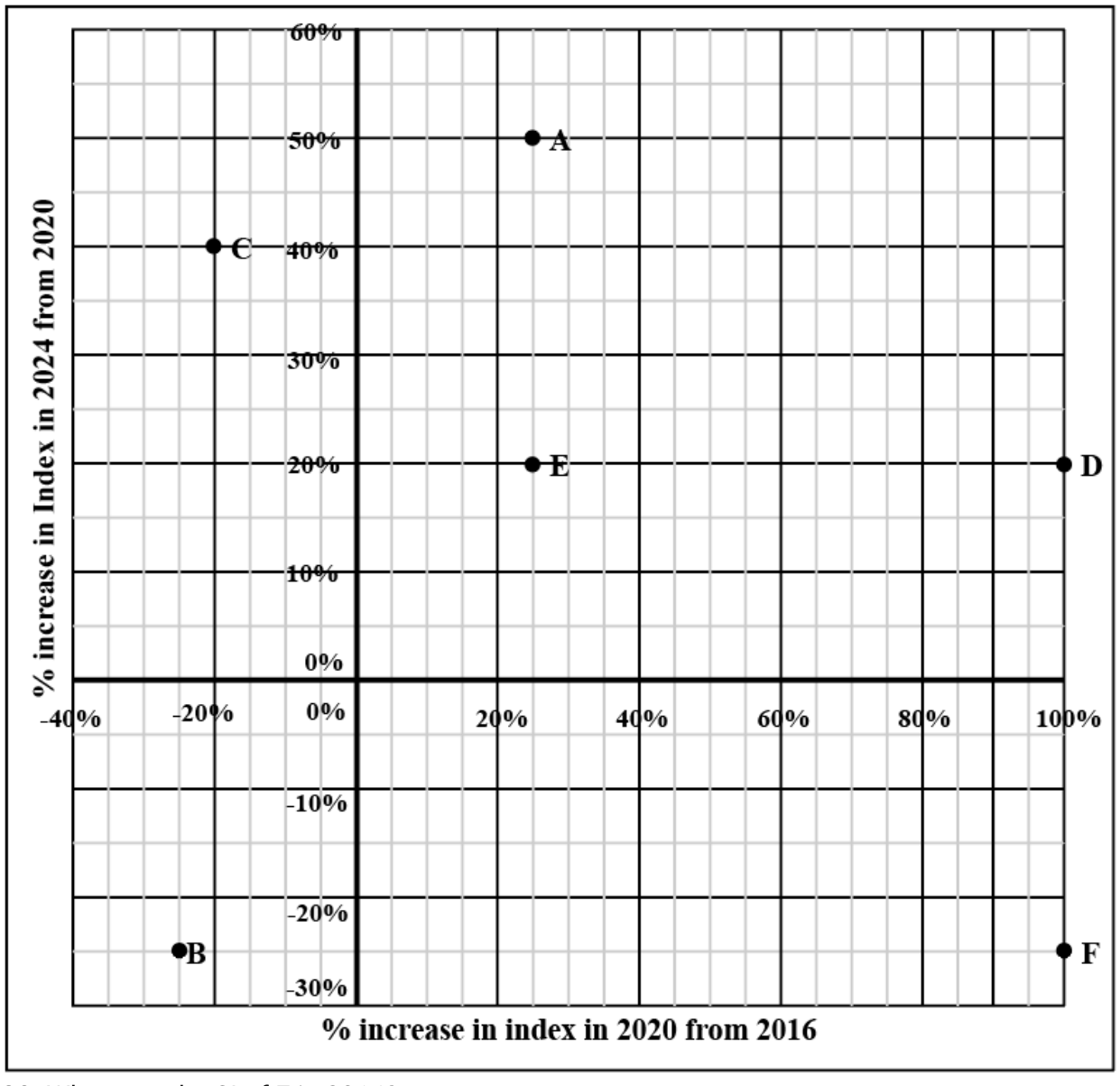
The Sustainability Index (SI) of a country at a point in time is an integer between 1 and 100. This question is related to SI of six countries - A, B, C, D, E, and F - at three different points in time - 2016, 2020, and 2024. The plot represents the exact changes in their SI, with X-coordinate representing % increase in 2020 from 2016, i.e., (SI in 2020 minus SI in 2016) / (SI in 2016), and Y-coordinate representing % increase in 2024 from 2020. At any point in time, the country with highest SI is ranked 1, while the country with the lowest SI is ranked 6. The following additional facts are known. 1. In 2016, B, C, E, and A had ranks 1, 2, 3, and 4 respectively. 2. F had lower SI than any other country in 2016, 2020, and 2024. 3. In 2024, E was the only country with SI of 90. 4. The range of SI of the six countries was 60 in 2016 as well as in 2024.

Chart for this set — reading the chart is part of the question
Q15Mixed Charts & CaseletsTITA

What was the SI of E in 2016?

Show solution

Correct answer: 60

Setting up the relationship from the plot

The plot gives each country two percentage changes:

  • X-axis: % increase in SI from 2016 to 2020, i.e. X=SI2020SI2016SI2016X = \frac{\text{SI}_{2020} - \text{SI}_{2016}}{\text{SI}_{2016}}
  • Y-axis: % increase in SI from 2020 to 2024, i.e. Y=SI2024SI2020SI2020Y = \frac{\text{SI}_{2024} - \text{SI}_{2020}}{\text{SI}_{2020}}

So if a country's 2016 SI is ss: SI2020=s(1+X),SI2024=s(1+X)(1+Y)\text{SI}_{2020} = s(1+X), \qquad \text{SI}_{2024} = s(1+X)(1+Y)

Pinning E's 2016 value directly

E's plotted point is (25%, 20%):

  • E2020=1.25×sE\text{E}_{2020} = 1.25 \times s_E
  • E2024=1.25×1.20×sE=1.50×sE\text{E}_{2024} = 1.25 \times 1.20 \times s_E = 1.50 \times s_E

Clue 3 says E was the only country with SI = 90 in 2024, so: 1.50×sE=90    sE=601.50 \times s_E = 90 \implies s_E = 60

That already answers the question, but let us verify the full table is consistent.

Deriving the complete SI table

2016 rank order (Clues 1 & 2): B(1) > C(2) > E(3) > A(4) > D(5) > F(6), since F is lowest in every year.

2016 range = 60 (Clue 4): B is highest, F is lowest, so sBsF=60s_B - s_F = 60.

Since sE=60s_E = 60, we need sC>60s_C > 60 and sB>sCs_B > s_C.

Integrality constraints (all SI values are integers):

  • C at (−20%, 40%): C2020=0.8sC=45sC\text{C}_{2020} = 0.8\,s_C = \frac{4}{5}s_C and C2024=1.12sC=2825sC\text{C}_{2024} = 1.12\,s_C = \frac{28}{25}s_C, so sCs_C must be divisible by 25. With sC>60s_C > 60 and sC<sB100s_C < s_B \le 100, the only option is sC=75s_C = 75.
  • B at (−25%, −25%): B2020=0.75sB=34sB\text{B}_{2020} = 0.75\,s_B = \frac{3}{4}s_B and B2024=0.5625sB=916sB\text{B}_{2024} = 0.5625\,s_B = \frac{9}{16}s_B, so sBs_B must be divisible by 16. With sB>75s_B > 75 and sB100s_B \le 100, we get sB{80,96}s_B \in \{80, 96\}.
  • A at (25%, 50%): A2020=1.25sA=54sA\text{A}_{2020} = 1.25\,s_A = \frac{5}{4}s_A and A2024=1.875sA=158sA\text{A}_{2024} = 1.875\,s_A = \frac{15}{8}s_A, so sAs_A must be divisible by 8.

Testing sB=96s_B = 96 (so sF=36s_F = 36): Then F2020=2×36=72\text{F}_{2020} = 2 \times 36 = 72. For A to stay above F in 2020: 1.25sA>72sA>57.61.25\,s_A > 72 \Rightarrow s_A > 57.6. But sA<sE=60s_A < s_E = 60 and sAs_A divisible by 8 gives sA{40,48,56}s_A \in \{40, 48, 56\} — none exceeds 57.6. Impossible.

So sB=80s_B = 80, sF=20s_F = 20. Then F2020=40\text{F}_{2020} = 40, and we need A2020=1.25sA>40sA>32\text{A}_{2020} = 1.25\,s_A > 40 \Rightarrow s_A > 32, giving sA{40,48,56}s_A \in \{40, 48, 56\}.

Clue 3 (only E has SI 90 in 2024): A2024=1.875sA\text{A}_{2024} = 1.875\,s_A. If sA=48s_A = 48, then A2024=90\text{A}_{2024} = 90, conflicting with E being the only country at 90. If sA=56s_A = 56, then A2024=105>100\text{A}_{2024} = 105 > 100, invalid. So sA=40s_A = 40.

D at (100%, 20%): D2024=2.4sD=125sD\text{D}_{2024} = 2.4\,s_D = \frac{12}{5}s_D, so sDs_D divisible by 5. With 20<sD<4020 < s_D < 40: sD{25,30,35}s_D \in \{25, 30, 35\} (not uniquely determined, but irrelevant for this question).

2024 range check: Max = E2024=90\text{E}_{2024} = 90, Min = F2024=30\text{F}_{2024} = 30, range =60= 60

Complete solved table

Country201620202024
A405075
B806045
C756084
D25/30/3550/60/7060/72/84
E607590
F204030

💡 Teacher tip: Clue 3 alone — combined with E's plotted coordinates — is enough to pin E's 2016 SI. The rest of the table is derived to confirm consistency.

Answer: 60

Q16Mixed Charts & CaseletsTITA

What was the SI of F in 2020?

Show solution

Correct answer: 40

Recap: how the plot translates to SI values

For a country with 2016 SI =s= s and plotted point (X,Y)(X, Y): SI2020=s(1+X),SI2024=s(1+X)(1+Y)\text{SI}_{2020} = s(1+X), \qquad \text{SI}_{2024} = s(1+X)(1+Y)

F's coordinates and formulas

F's plotted point is (100%, −25%):

  • F2020=sF×2.00=2sF\text{F}_{2020} = s_F \times 2.00 = 2\,s_F
  • F2024=2sF×0.75=1.5sF\text{F}_{2024} = 2\,s_F \times 0.75 = 1.5\,s_F

Pinning sFs_F using the clues

Clue 2 says F has the lowest SI in 2016, 2020, and 2024.

Clue 4 says the 2016 range is 60. From Clue 1, B is ranked 1 (highest) in 2016, and from Clue 2, F is lowest, so: sBsF=60s_B - s_F = 60

Clue 3 gives E2024=90\text{E}_{2024} = 90, and E's point (25%, 20%) yields E2024=1.5sE=90\text{E}_{2024} = 1.5\,s_E = 90, so sE=60s_E = 60.

The 2016 rank order is sB>sC>sE=60>sA>sD>sFs_B > s_C > s_E = 60 > s_A > s_D > s_F, so sC>60s_C > 60 and sB>sCs_B > s_C.

Integrality forces:

  • C at (−20%, 40%): sCs_C divisible by 25 → sC=75s_C = 75 (only value between 60 and 100 that keeps sB100s_B \le 100).
  • B at (−25%, −25%): sBs_B divisible by 16 → sB{80,96}s_B \in \{80, 96\}.

Testing sB=96s_B = 96 (sF=36s_F = 36): F2020=72\text{F}_{2020} = 72. Then A (at 25%, 50%) needs A2020=1.25sA>72\text{A}_{2020} = 1.25\,s_A > 72, i.e. sA>57.6s_A > 57.6. But sA<60s_A < 60 and sAs_A divisible by 8 gives sA56s_A \le 56. Contradiction — F would not stay lowest in 2020.

Therefore sB=80s_B = 80 and sF=20s_F = 20.

Computing F's 2020 SI

F2020=2×sF=2×20=40\text{F}_{2020} = 2 \times s_F = 2 \times 20 = 40

Complete solved table (for reference)

Country201620202024
A405075
B806045
C756084
D25/30/3550/60/7060/72/84
E607590
F204030

💡 Teacher tip: The key is that F must remain the lowest in 2020. Since F doubles from 2016 to 2020 (100% increase), a large sFs_F would push F's 2020 value too high to stay below A. The integrality + range constraint together force sF=20s_F = 20.

Answer: 40

Q17Mixed Charts & CaseletsTITA

What was the SI of C in 2024?

Show solution

Correct answer: 84

Recap: how the plot translates to SI values

For a country with 2016 SI =s= s and plotted point (X,Y)(X, Y): SI2020=s(1+X),SI2024=s(1+X)(1+Y)\text{SI}_{2020} = s(1+X), \qquad \text{SI}_{2024} = s(1+X)(1+Y)

C's coordinates and formulas

C's plotted point is (−20%, 40%):

  • C2020=0.80×sC=45sC\text{C}_{2020} = 0.80 \times s_C = \frac{4}{5}\,s_C
  • C2024=0.80×1.40×sC=1.12sC=2825sC\text{C}_{2024} = 0.80 \times 1.40 \times s_C = 1.12\,s_C = \frac{28}{25}\,s_C

Determining sCs_C

From Clue 1, the 2016 rank order is B(1) > C(2) > E(3) > A(4) > D(5) > F(6) (F is lowest by Clue 2).

From Clue 3 and E's point (25%, 20%): E2024=1.5sE=90sE=60\text{E}_{2024} = 1.5\,s_E = 90 \Rightarrow s_E = 60.

So sC>sE=60s_C > s_E = 60, and sC<sB100s_C < s_B \le 100.

Integrality: Since C2020=45sC\text{C}_{2020} = \frac{4}{5}s_C and C2024=2825sC\text{C}_{2024} = \frac{28}{25}s_C must both be integers, sCs_C must be divisible by 25.

The only multiple of 25 strictly between 60 and 100 is 75, so sC=75s_C = 75.

(This is confirmed by the range constraint: sBsF=60s_B - s_F = 60 with sBs_B divisible by 16 and sB>75s_B > 75 gives sB=80s_B = 80, sF=20s_F = 20.)

Computing C's 2024 SI

C2024=1.12×sC=1.12×75=84\text{C}_{2024} = 1.12 \times s_C = 1.12 \times 75 = 84

Complete solved table (for reference)

Country201620202024
A405075
B806045
C756084
D25/30/3550/60/7060/72/84
E607590
F204030

💡 Teacher tip: C's 2024 value depends on 2825sC\frac{28}{25}s_C being an integer, which forces sCs_C to be a multiple of 25. Combined with the rank constraint 60<sC<10060 < s_C < 100, only sC=75s_C = 75 works.

Answer: 84

Q18Mixed Charts & CaseletsMCQ

What was the SI of B in 2024?

Show solution

Correct answer: D

Recap: how the plot translates to SI values

For a country with 2016 SI =s= s and plotted point (X,Y)(X, Y): SI2020=s(1+X),SI2024=s(1+X)(1+Y)\text{SI}_{2020} = s(1+X), \qquad \text{SI}_{2024} = s(1+X)(1+Y)

B's coordinates and formulas

B's plotted point is (−25%, −25%):

  • B2020=0.75×sB=34sB\text{B}_{2020} = 0.75 \times s_B = \frac{3}{4}\,s_B
  • B2024=0.75×0.75×sB=0.5625sB=916sB\text{B}_{2024} = 0.75 \times 0.75 \times s_B = 0.5625\,s_B = \frac{9}{16}\,s_B

Determining sBs_B

From Clue 1, B is ranked 1 (highest SI) in 2016. From Clue 2, F is lowest in 2016. From Clue 4, the 2016 range is 60: sBsF=60s_B - s_F = 60

From Clue 3 and E's point (25%, 20%): E2024=1.5sE=90sE=60\text{E}_{2024} = 1.5\,s_E = 90 \Rightarrow s_E = 60.

The 2016 rank order is sB>sC>60>sA>sD>sFs_B > s_C > 60 > s_A > s_D > s_F.

Integrality for C (at −20%, 40%): sCs_C divisible by 25, with 60<sC<sB10060 < s_C < s_B \le 100sC=75s_C = 75.

Integrality for B: 34sB\frac{3}{4}s_B and 916sB\frac{9}{16}s_B must be integers, so sBs_B divisible by 16. With sB>75s_B > 75 and sB100s_B \le 100: sB{80,96}s_B \in \{80, 96\}.

Testing sB=96s_B = 96 (sF=36s_F = 36): F's 2020 SI =2×36=72= 2 \times 36 = 72. A (at 25%, 50%) would need A2020=1.25sA>72\text{A}_{2020} = 1.25\,s_A > 72, i.e. sA>57.6s_A > 57.6. But sA<60s_A < 60 and sAs_A divisible by 8 gives sA56s_A \le 56. F would not remain lowest in 2020 — contradiction.

Therefore sB=80s_B = 80 (and sF=20s_F = 20).

Computing B's 2024 SI

B2024=0.5625×sB=0.5625×80=916×80=45\text{B}_{2024} = 0.5625 \times s_B = 0.5625 \times 80 = \frac{9}{16} \times 80 = 45

Complete solved table (for reference)

Country201620202024
A405075
B806045
C756084
D25/30/3550/60/7060/72/84
E607590
F204030

Among the given options (A. 60, B. 54, C. 80, D. 45), the answer is 45.

💡 Teacher tip: B declines by 25% twice — a compounding effect. The factor 0.75×0.75=0.5625=9160.75 \times 0.75 = 0.5625 = \frac{9}{16}, and since sB=80=5×16s_B = 80 = 5 \times 16, the arithmetic works out cleanly to 45.

Answer: 45 (Choice D)

Set · Puzzles

The following charts depict details of research papers written by four authors, Arman, Brajen, Chintan, and Devon. The papers were of four types, single-author, two-author, three-author, and four-author, that is, written by one, two, three, or all four of these authors, respectively. No other authors were involved in writing these papers. The following additional facts are known. 1. Each of the authors wrote at least one of each of the four types of papers. 2. The four authors wrote different numbers of single-author papers. 3. Both Chintan and Devon wrote more three-author papers than Brajen. 4. The number of single-author and two-author papers written by Brajen were the same.

Chart 1 — Number of papers by each author:

AuthorNumber of papers
Arman5
Brajen8
Chintan12
Devon10

Chart 2 — Number of papers by type:

TypeNumber of papers
Single-author10
Two-author4
Three-author3
Four-author2
Q19PuzzlesTITA

What was the total number of two-author and three-author papers written by Brajen?

Show solution

Correct answer: 4

We need to build the author × paper-type matrix from the two charts and the four clues, then read off Brajen's two-author and three-author counts.

Step 1 — Set up the matrix. Let each cell be the number of papers of a given type that an author is part of. The four-author papers (there are 2) contain all four authors, so every author has 2 four-author papers.

Step 2 — Column sums (counting author-slots).

TypePapersAuthors per paperAuthor-slots
Single-author10110
Two-author428
Three-author339
Four-author248

Total author-slots = 10+8+9+8=3510+8+9+8 = 35.

Step 3 — Row sums (papers per author). 5+8+12+10=355+8+12+10 = 35 ✓ — this matches, so the matrix is consistent.

Step 4 — Subtract the four-author papers (2 each) from every row.

AuthorTotal− Four-authorLeft for Single+Two+Three
Arman523
Brajen826
Chintan12210
Devon1028

Each author wrote at least one of each type (fact 1), so every remaining cell is 1\ge 1.

Step 5 — Fix Arman. Arman has only 3 left across three categories, each 1\ge 1, so Arman = (Single 1, Two 1, Three 1).

Step 6 — Fix Brajen. Brajen has 6 left, and his single-count equals his two-count (fact 4). Let Single = Two = bb; then Three = 62b6-2b. With each 1\ge 1 we get b=1b=1 or b=2b=2.

But the four authors wrote different numbers of single-author papers (fact 2), and Arman already has 1. So Brajen cannot also have 1; hence b=2b=2.

Brajen: Single 2, Two 2, Three 2.

💡 Teacher tip: The equality clue (fact 4) plus the distinctness clue (fact 2) together pin Brajen down uniquely — the equality gives two candidates, and distinctness kills the b=1b=1 one.

Step 7 — The matrix so far.

AuthorSingleTwoThreeFourTotal
Arman11125
Brajen22228
Chintan3 or 44 or 33212
Devon4 or 31 or 23210

(The remaining ambiguity between Chintan and Devon does not affect this question.)

Brajen wrote 22 two-author papers and 22 three-author papers, so the total is 2+2=42+2=4.

Answer: 4

Q20PuzzlesMCQ

Which of the following statements is/are NECESSARILY true? i. Chintan wrote exactly three two-author papers. ii. Chintan wrote more single-author papers than Devon.

Show solution

Correct answer: A

We need to determine whether each statement is forced by the data, so we first complete the matrix as far as the clues allow and check whether anything is left open.

Building the matrix (key steps).

  1. Four-author papers = 2, all four authors each → every author has 2 four-author papers.
  2. Column author-slots: Single 10, Two 4×2=84\times2=8, Three 3×3=93\times3=9, Four 2×4=82\times4=8; total 35 = row total 5+8+12+105+8+12+10 ✓.
  3. Subtract 2 (four-author) from each row: Arman has 3, Brajen 6, Chintan 10, Devon 8 left for Single+Two+Three, each cell 1\ge 1.
  4. Arman = (1, 1, 1) — only way to split 3 into three positive parts.
  5. Brajen: Single = Two = bb (fact 4), Three = 62b6-2b. Single-counts must be distinct (fact 2); Arman already has 1, so b1b\neq 1, giving b=2b=2. Brajen = (2, 2, 2).
  6. Three-author column: Arman 1 + Brajen 2 = 3 used; column total is 9, so Chintan + Devon = 6. Fact 3 says both Chintan and Devon wrote more three-author papers than Brajen (2), so each 3\ge 3. Hence Chintan = 3, Devon = 3.
  7. Single-author column: total 10; Arman 1 + Brajen 2 = 3 used, so Chintan + Devon = 7. Distinct and 1\ge 1, different from 1 and 2 → {3, 4} in some order.
  8. Two-author column: total 8; Arman 1 + Brajen 2 = 3 used, so Chintan + Devon = 5. Each author's row total then locks the pairing:
  • Chintan's row: Single + Two = 1232=712-3-2=7. If Single = 3 then Two = 4; if Single = 4 then Two = 3.
  • Devon's row: Single + Two = 1032=510-3-2=5. If Single = 4 then Two = 1; if Single = 3 then Two = 2.

The two equally valid completions:

AuthorSingleTwoThreeFour
Arman1112
Brajen2222
Chintan3 or 44 or 332
Devon4 or 31 or 232

Checking the statements.

  • i. Chintan wrote exactly three two-author papers. In one valid completion Chintan's two-count is 4 (when his single-count is 3). So this is not necessarily true.
  • ii. Chintan wrote more single-author papers than Devon. Chintan could have 3 single-author papers while Devon has 4. So this is not necessarily true either.

Neither statement is forced by the clues.

Answer: Neither i nor ii (Choice A)

Q21PuzzlesMCQ

Which of the following statements is/are NECESSARILY true? i. Arman wrote three-author papers only with Chintan and Devon. ii. Brajen wrote three-author papers only with Chintan and Devon.

Show solution

Correct answer: B

Both statements are about who co-authored the three-author papers, so we focus on that column and reconstruct the actual papers.

The three-author column (fully determined).

There are 3 three-author papers, giving 3×3=93\times3=9 author-slots. From the matrix:

AuthorThree-author count
Arman1
Brajen2
Chintan3
Devon3

(How we get here: Arman has only 3 slots total across Single/Two/Three with each 1\ge1, so Arman = 1 in every column. Brajen's Single = Two = 2 by the equality clue and distinctness, leaving Three = 2. The three-author column sums to 9; Arman + Brajen = 3, so Chintan + Devon = 6, and fact 3 forces each of them above Brajen's 2, i.e. each = 3.)

Reconstructing the three papers.

There are exactly 3 three-author papers.

  • Chintan's count is 3 → Chintan appears in all 3 three-author papers.
  • Devon's count is 3 → Devon appears in all 3 three-author papers.

So every three-author paper already contains both Chintan and Devon, occupying 2 of the 3 seats. The third seat across the 3 papers is filled by Arman once and Brajen twice (1+2=31+2=3). The three papers are therefore:

  1. {Arman, Chintan, Devon}
  2. {Brajen, Chintan, Devon}
  3. {Brajen, Chintan, Devon}

💡 Teacher tip: When an author's count in a column equals the total number of papers of that type, that author is in every such paper. Here both Chintan and Devon hit 3 out of 3, which immediately forces them into every three-author paper.

Checking the statements.

  • i. Arman wrote three-author papers only with Chintan and Devon. Arman's lone three-author paper is {Arman, Chintan, Devon} — his co-authors are exactly Chintan and Devon. Necessarily true.
  • ii. Brajen wrote three-author papers only with Chintan and Devon. Both of Brajen's three-author papers are {Brajen, Chintan, Devon} — his co-authors are exactly Chintan and Devon. Necessarily true.

Both statements are forced.

Answer: Both i and ii (Choice B)

Q22PuzzlesTITA

If Devon wrote more than one two-author papers, then how many two-author papers did Chintan write?

Show solution

Correct answer: 3

We use the solved matrix and the added condition to pick the correct completion.

The matrix with its one remaining ambiguity.

After fixing Arman, Brajen, and the three-author column, the single- and two-author counts of Chintan and Devon can go two ways (each author's row total locks the pairing):

AuthorSingleTwoThreeFourTotal
Arman11125
Brajen22228
Chintan3 or 44 or 33212
Devon4 or 31 or 23210

The two valid completions are:

  • Completion 1: Chintan Single = 3, Two = 4; Devon Single = 4, Two = 1.
  • Completion 2: Chintan Single = 4, Two = 3; Devon Single = 3, Two = 2.

(Consistency check: in both, the two-author column sums to 1+2+4+1=81+2+4+1=8 or 1+2+3+2=81+2+3+2=8 ✓, and the single-author column sums to 10 ✓.)

Applying the condition. The condition says Devon wrote more than one two-author paper, i.e. Devon's two-count >1>1.

  • In Completion 1, Devon's two-count = 1 — rejected.
  • In Completion 2, Devon's two-count = 2 — accepted.

So Completion 2 holds, and in it Chintan's two-author count is 3.

Answer: 3