CATLab

CAT 2025 DILR Questions — Slot 1

The actual Data Interpretation & Logical Reasoning section from CAT 2025, Slot 1 — 22 questions in original paper order, each with a full worked solution. Tap an option (or type your answer) to check yourself before reading the solution.

22 questions11 MCQ · 11 TITA40 min section0/22 attempted
Set · Puzzles

Alia, Badal, Clive, Dilshan, and Ehsaan played a game in which each asks a unique question to all the others and they respond by tapping their feet, either once or twice or thrice. One tap means “Yes”, two taps mean “No”, and three taps mean “Maybe”. A total of 40 taps were heard across the five questions. Each question received at least one “Yes”, one “No”, and one “Maybe.” The following information is known. 1. Alia tapped a total of 6 times and received 9 taps to her question. She responded “Yes” to the questions asked by both Clive and Dilshan. 2. Dilshan and Ehsaan tapped a total of 11 and 9 times respectively. Dilshan responded “No” to Badal. 3. Badal, Dilshan, and Ehsaan received equal number of taps to their respective questions. 4. No one responded “Yes” more than twice. 5. No one’s answer to Alia’s question matched the answer that Alia gave to that person’s question. This was also true for Ehsaan. 6. Clive tapped more times in total than Badal.

Q1PuzzlesTITA

How many taps did Clive receive for his question?

Show solution

Correct answer: 7

Here is the fully solved grid. Rows are the person whose question is being answered, columns are the responder, and each entry is the tap-answer: 1 = Yes, 2 = No, 3 = Maybe. The last column is how many taps that question received; the bottom row is how many taps each person made.

Question by ↓ \ Answer from →AliaBadalCliveDilshanEhsaanReceived
Alia—12339
Badal2—1238
Clive12—317
Dilshan123—28
Ehsaan2123—8
Taps made66811940

How the grid is built (do this once, then read off every answer):

  1. Every person asks one question, so each of the other four gives an answer worth 1, 2 or 3 taps. That is 5×4=205 \times 4 = 20 answers totalling 40 taps, and every question must contain at least one Yes, one No and one Maybe.
  2. Alia made 6 taps. She said Yes (1) to Clive and Yes (1) to Dilshan — that is 2 taps used. The remaining two answers (to Badal and Ehsaan) must add to 4. She has already used her two allowed Yeses, so each of these is 2 or 3; the only way to make 4 is 2+22 + 2. So Alia said No to Badal and No to Ehsaan.
  3. Dilshan made 11 taps in four answers, each at most 3: that forces three 3's and one 2. He said No (2) to Badal, so his other three answers — to Alia, Clive, Ehsaan — are all Maybe (3).
  4. Alia's question received 9 taps. No one's answer to Alia may equal the answer Alia gave them. Alia said No to Badal, Yes to Clive, Yes to Dilshan, No to Ehsaan — so Badal≠2, Clive≠1, Ehsaan≠2 here. The question still needs a No, and only Clive is allowed to give it, so Clive = 2. The remaining two answers add to 9−3−2=49 - 3 - 2 = 4, splitting as Badal = 1, Ehsaan = 3.
  5. The leftover totals (Ehsaan made 9; Badal, Dilshan and Ehsaan each received 8; Clive made more taps than Badal; every question needs Yes/No/Maybe) fill the rest with exactly one consistent grid, shown below.

This question

Clive's question is the Clive row. The four answers are 1, 2, 3, 1 (from Alia, Badal, Dilshan, Ehsaan):

1+2+3+1=7 taps1 + 2 + 3 + 1 = 7 \text{ taps}

Answer: 7

Q2PuzzlesMCQ

Which two people tapped an equal number of times in total?

Show solution

Correct answer: D

Here is the fully solved grid. Rows are the person whose question is being answered, columns are the responder, and each entry is the tap-answer: 1 = Yes, 2 = No, 3 = Maybe. The last column is how many taps that question received; the bottom row is how many taps each person made.

Question by ↓ \ Answer from →AliaBadalCliveDilshanEhsaanReceived
Alia—12339
Badal2—1238
Clive12—317
Dilshan123—28
Ehsaan2123—8
Taps made66811940

How the grid is built (do this once, then read off every answer):

  1. Every person asks one question, so each of the other four gives an answer worth 1, 2 or 3 taps. That is 5×4=205 \times 4 = 20 answers totalling 40 taps, and every question must contain at least one Yes, one No and one Maybe.
  2. Alia made 6 taps. She said Yes (1) to Clive and Yes (1) to Dilshan — that is 2 taps used. The remaining two answers (to Badal and Ehsaan) must add to 4. She has already used her two allowed Yeses, so each of these is 2 or 3; the only way to make 4 is 2+22 + 2. So Alia said No to Badal and No to Ehsaan.
  3. Dilshan made 11 taps in four answers, each at most 3: that forces three 3's and one 2. He said No (2) to Badal, so his other three answers — to Alia, Clive, Ehsaan — are all Maybe (3).
  4. Alia's question received 9 taps. No one's answer to Alia may equal the answer Alia gave them. Alia said No to Badal, Yes to Clive, Yes to Dilshan, No to Ehsaan — so Badal≠2, Clive≠1, Ehsaan≠2 here. The question still needs a No, and only Clive is allowed to give it, so Clive = 2. The remaining two answers add to 9−3−2=49 - 3 - 2 = 4, splitting as Badal = 1, Ehsaan = 3.
  5. The leftover totals (Ehsaan made 9; Badal, Dilshan and Ehsaan each received 8; Clive made more taps than Badal; every question needs Yes/No/Maybe) fill the rest with exactly one consistent grid, shown below.

This question

The "taps made" totals (bottom row) are: Alia 6, Badal 6, Clive 8, Dilshan 11, Ehsaan 9. The only pair that matches is Alia and Badal, both at 6.

Answer: Alia and Badal

Q3PuzzlesMCQ

What was Clive’s response to Ehsaan’s question?

Show solution

Correct answer: A

Here is the fully solved grid. Rows are the person whose question is being answered, columns are the responder, and each entry is the tap-answer: 1 = Yes, 2 = No, 3 = Maybe. The last column is how many taps that question received; the bottom row is how many taps each person made.

Question by ↓ \ Answer from →AliaBadalCliveDilshanEhsaanReceived
Alia—12339
Badal2—1238
Clive12—317
Dilshan123—28
Ehsaan2123—8
Taps made66811940

How the grid is built (do this once, then read off every answer):

  1. Every person asks one question, so each of the other four gives an answer worth 1, 2 or 3 taps. That is 5×4=205 \times 4 = 20 answers totalling 40 taps, and every question must contain at least one Yes, one No and one Maybe.
  2. Alia made 6 taps. She said Yes (1) to Clive and Yes (1) to Dilshan — that is 2 taps used. The remaining two answers (to Badal and Ehsaan) must add to 4. She has already used her two allowed Yeses, so each of these is 2 or 3; the only way to make 4 is 2+22 + 2. So Alia said No to Badal and No to Ehsaan.
  3. Dilshan made 11 taps in four answers, each at most 3: that forces three 3's and one 2. He said No (2) to Badal, so his other three answers — to Alia, Clive, Ehsaan — are all Maybe (3).
  4. Alia's question received 9 taps. No one's answer to Alia may equal the answer Alia gave them. Alia said No to Badal, Yes to Clive, Yes to Dilshan, No to Ehsaan — so Badal≠2, Clive≠1, Ehsaan≠2 here. The question still needs a No, and only Clive is allowed to give it, so Clive = 2. The remaining two answers add to 9−3−2=49 - 3 - 2 = 4, splitting as Badal = 1, Ehsaan = 3.
  5. The leftover totals (Ehsaan made 9; Badal, Dilshan and Ehsaan each received 8; Clive made more taps than Badal; every question needs Yes/No/Maybe) fill the rest with exactly one consistent grid, shown below.

This question

Clive's response to Ehsaan's question sits in the Ehsaan row, Clive column. That entry is 2, which means No.

Answer: No

Q4PuzzlesTITA

How many “Yes” responses were received across all the questions?

Show solution

Correct answer: 6

Here is the fully solved grid. Rows are the person whose question is being answered, columns are the responder, and each entry is the tap-answer: 1 = Yes, 2 = No, 3 = Maybe. The last column is how many taps that question received; the bottom row is how many taps each person made.

Question by ↓ \ Answer from →AliaBadalCliveDilshanEhsaanReceived
Alia—12339
Badal2—1238
Clive12—317
Dilshan123—28
Ehsaan2123—8
Taps made66811940

How the grid is built (do this once, then read off every answer):

  1. Every person asks one question, so each of the other four gives an answer worth 1, 2 or 3 taps. That is 5×4=205 \times 4 = 20 answers totalling 40 taps, and every question must contain at least one Yes, one No and one Maybe.
  2. Alia made 6 taps. She said Yes (1) to Clive and Yes (1) to Dilshan — that is 2 taps used. The remaining two answers (to Badal and Ehsaan) must add to 4. She has already used her two allowed Yeses, so each of these is 2 or 3; the only way to make 4 is 2+22 + 2. So Alia said No to Badal and No to Ehsaan.
  3. Dilshan made 11 taps in four answers, each at most 3: that forces three 3's and one 2. He said No (2) to Badal, so his other three answers — to Alia, Clive, Ehsaan — are all Maybe (3).
  4. Alia's question received 9 taps. No one's answer to Alia may equal the answer Alia gave them. Alia said No to Badal, Yes to Clive, Yes to Dilshan, No to Ehsaan — so Badal≠2, Clive≠1, Ehsaan≠2 here. The question still needs a No, and only Clive is allowed to give it, so Clive = 2. The remaining two answers add to 9−3−2=49 - 3 - 2 = 4, splitting as Badal = 1, Ehsaan = 3.
  5. The leftover totals (Ehsaan made 9; Badal, Dilshan and Ehsaan each received 8; Clive made more taps than Badal; every question needs Yes/No/Maybe) fill the rest with exactly one consistent grid, shown below.

This question

Count every entry equal to 1 (a "Yes") in the grid:

  • Alia's question: Badal → 1
  • Badal's question: Clive → 1
  • Clive's question: Alia → 1 and Ehsaan → 1
  • Dilshan's question: Alia → 1
  • Ehsaan's question: Badal → 1

1+1+2+1+1=6 Yes responses1 + 1 + 2 + 1 + 1 = 6 \text{ Yes responses}

Answer: 6

Set · Mixed Charts & Caselets

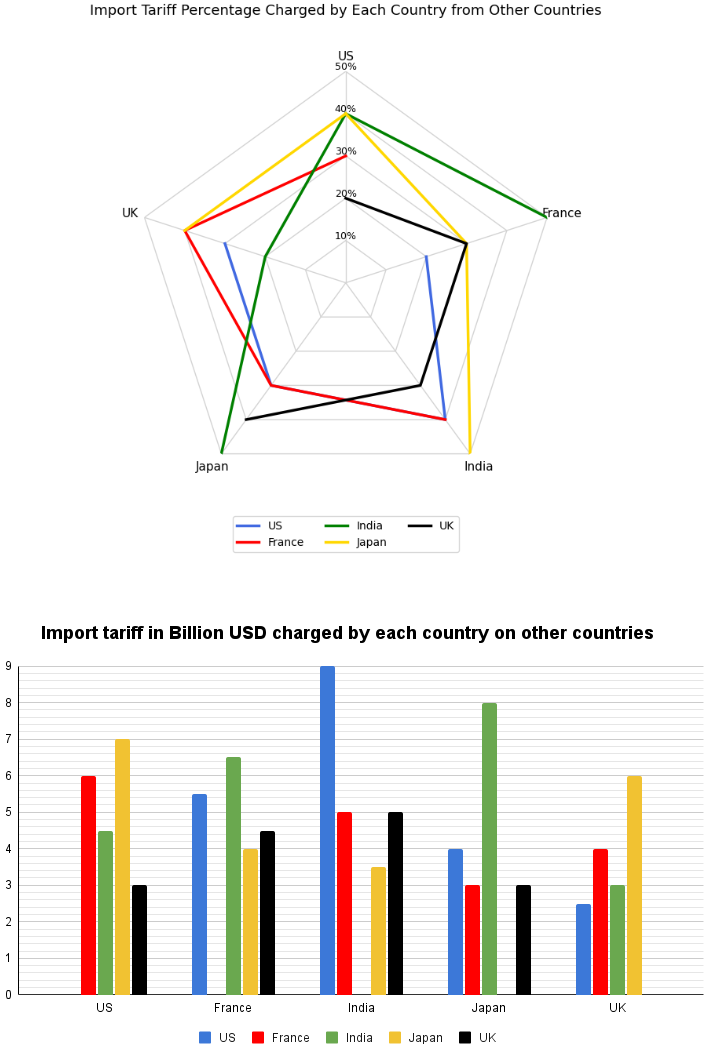
Five countries engage in trade with each other. Each country levies import tariffs on the other countries. The import tariff levied by Country X on Country Y is calculated by multiplying the corresponding tariff percentage with the total imports of Country X from Country Y. The radar chart depicts different import tariff percentages charged by each of the five countries on the others. For example, US (the blue line in the chart) charges 20%, 40%, 30%, and 30% import tariff percentages on imports from France, India, Japan, and UK, respectively. The bar chart depicts the import tariffs levied by each country on other countries. For example, US charged import tariff of 3 billion USD on UK. Assume that imports from one country to another equals the exports from the latter to the former. The trade surplus of Country X with Country Y is defined as follows. Trade surplus = Exports from Country X to Country Y - Imports to Country X from Country Y. A negative trade surplus is called trade deficit.

Chart for this set — reading the chart is part of the question
Q5Mixed Charts & CaseletsMCQ

How much is Japan's export to India worth?

Show solution

Correct answer: C

Setting up the key relationship

The problem tells us that the import tariff amount (in billion USD) is calculated as:

Tariff amount=Tariff %×Imports\text{Tariff amount} = \text{Tariff \%} \times \text{Imports}

This means we can recover the underlying import value by rearranging:

Imports of X from Y=Tariff amount X charges on YTariff % X charges on Y\text{Imports of } X \text{ from } Y = \frac{\text{Tariff amount } X \text{ charges on } Y}{\text{Tariff \% } X \text{ charges on } Y}

We are also told that imports of X from Y = exports of Y to X. So if we need Japan's export to India, that is the same as India's import from Japan.

Identifying the right data

We need two numbers:

  1. Tariff amount India charges on Japan — from the bar chart, India's bar for Japan = 3.5 billion USD.
  2. Tariff percentage India charges on Japan — from the radar chart, India charges 50% on Japan.

Computing

India’s imports from Japan=3.50.50=7.0 billion USD\text{India's imports from Japan} = \frac{3.5}{0.50} = 7.0 \text{ billion USD}

Since Japan's export to India equals India's import from Japan, the answer is 7.0 billion USD.

Answer: C. 7.0 Billion USD

Q6Mixed Charts & CaseletsMCQ

Which among the following is the highest?

Show solution

Correct answer: B

The core formula

The tariff amount and tariff percentage together let us recover the underlying trade flow:

Imports of X from Y=Tariff amount X charges on YTariff % X charges on Y\text{Imports of } X \text{ from } Y = \frac{\text{Tariff amount } X \text{ charges on } Y}{\text{Tariff \% } X \text{ charges on } Y}

Also, imports of X from Y = exports of Y to X, so we can translate any "exports by Y to X" into "imports of X from Y".

Reading the two charts

On the radar the rings are 10 percentage points apart — innermost 10%, outer edge 50% — and a country's own line skips its own axis. Three readings are easy to miss: India charges 50% on France (the green line runs right out to the France corner), France charges 30% on Japan (red meets blue on the 30% ring), and UK charges 40% on Japan (black stops on the 40% ring). On the bar chart each group is the charging country and each coloured bar is the country charged; heights read to the nearest 0.5.

Building the full trade matrix

Dividing every cell of the bar chart by the matching cell of the radar chart gives the complete import matrix (billion USD). The row is the importing country; the column is the source country:

Imports of ↓ from →USFranceIndiaJapanUK
US—30.0011.2523.3310.00
France18.33—16.2513.3311.25
India22.5010.00—7.0025.00
Japan10.0010.0016.00—7.50
UK12.5013.3310.0015.00—

Evaluating each option

  • A. Exports by Japan to UK = UK's imports from Japan = 6.00.40=15.0\frac{6.0}{0.40} = 15.0
  • B. Imports by US from France = 6.00.20=30.0\frac{6.0}{0.20} = 30.0
  • C. Exports by France to Japan = Japan's imports from France = 3.00.30=10.0\frac{3.0}{0.30} = 10.0
  • D. Imports by France from India = 6.50.40=16.25\frac{6.5}{0.40} = 16.25

Comparing: 30.0>16.25>15.0>10.030.0 > 16.25 > 15.0 > 10.0.

The highest is Imports by US from France = 30.0 billion USD.

Answer: B. Imports by US from France

Q7Mixed Charts & CaseletsMCQ

What is the trade surplus/trade deficit of India with UK?

Show solution

Correct answer: B

The core formula

The tariff amount and tariff percentage together let us recover the underlying trade flow:

Imports of X from Y=Tariff amount X charges on YTariff % X charges on Y\text{Imports of } X \text{ from } Y = \frac{\text{Tariff amount } X \text{ charges on } Y}{\text{Tariff \% } X \text{ charges on } Y}

Also, imports of X from Y = exports of Y to X.

Reading the two charts

On the radar the rings are 10 percentage points apart — innermost 10%, outer edge 50% — and a country's own line skips its own axis. Three readings are easy to miss: India charges 50% on France (the green line runs right out to the France corner), France charges 30% on Japan (red meets blue on the 30% ring), and UK charges 40% on Japan (black stops on the 40% ring). On the bar chart each group is the charging country and each coloured bar is the country charged; heights read to the nearest 0.5.

Building the full trade matrix

Dividing every cell of the bar chart by the matching cell of the radar chart gives the complete import matrix (billion USD):

Imports of ↓ from →USFranceIndiaJapanUK
US—30.0011.2523.3310.00
France18.33—16.2513.3311.25
India22.5010.00—7.0025.00
Japan10.0010.0016.00—7.50
UK12.5013.3310.0015.00—

Applying the trade surplus definition

The trade surplus of India with UK is:

Surplus=(Exports India→UK)−(Imports India←UK)\text{Surplus} = (\text{Exports India} \to \text{UK}) - (\text{Imports India} \leftarrow \text{UK})

Step 1 — Exports India → UK: This equals UK's imports from India. UK’s tariff on IndiaUK’s tariff % on India=3.00.30=10.0 billion USD\frac{\text{UK's tariff on India}}{\text{UK's tariff \% on India}} = \frac{3.0}{0.30} = 10.0 \text{ billion USD}

Step 2 — Imports India ← UK: This is India's imports from UK. India’s tariff on UKIndia’s tariff % on UK=5.00.20=25.0 billion USD\frac{\text{India's tariff on UK}}{\text{India's tariff \% on UK}} = \frac{5.0}{0.20} = 25.0 \text{ billion USD}

Step 3 — Surplus: 10.0−25.0=−15.0 billion USD10.0 - 25.0 = -15.0 \text{ billion USD}

A negative surplus is a trade deficit, so India has a deficit of 15.0 billion USD with the UK.

Answer: B. Deficit of 15.0 Billion USD

Q8Mixed Charts & CaseletsMCQ

Among France and UK, who has/have trade surplus(es) with US?

Show solution

Correct answer: D

The core formula

The tariff amount and tariff percentage together let us recover the underlying trade flow:

Imports of X from Y=Tariff amount X charges on YTariff % X charges on Y\text{Imports of } X \text{ from } Y = \frac{\text{Tariff amount } X \text{ charges on } Y}{\text{Tariff \% } X \text{ charges on } Y}

Also, imports of X from Y = exports of Y to X.

Reading the two charts

On the radar the rings are 10 percentage points apart — innermost 10%, outer edge 50% — and a country's own line skips its own axis. Three readings are easy to miss: India charges 50% on France (the green line runs right out to the France corner), France charges 30% on Japan (red meets blue on the 30% ring), and UK charges 40% on Japan (black stops on the 40% ring). On the bar chart each group is the charging country and each coloured bar is the country charged; heights read to the nearest 0.5.

Building the full trade matrix

Dividing every cell of the bar chart by the matching cell of the radar chart gives the complete import matrix (billion USD):

Imports of ↓ from →USFranceIndiaJapanUK
US—30.0011.2523.3310.00
France18.33—16.2513.3311.25
India22.5010.00—7.0025.00
Japan10.0010.0016.00—7.50
UK12.5013.3310.0015.00—

Checking each country's balance with the US

The trade surplus of a country with the US is:

Surplus=(Exports to US)−(Imports from US)\text{Surplus} = (\text{Exports to US}) - (\text{Imports from US})

France with US:

  • Exports France → US = US imports from France = 6.00.20=30.0\frac{6.0}{0.20} = 30.0
  • Imports France ← US = France imports from US = 5.50.30≈18.33\frac{5.5}{0.30} \approx 18.33
  • Surplus = 30.0−18.33≈+11.6730.0 - 18.33 \approx +11.67 → surplus ✅

UK with US:

  • Exports UK → US = US imports from UK = 3.00.30=10.0\frac{3.0}{0.30} = 10.0
  • Imports UK ← US = UK imports from US = 2.50.20=12.5\frac{2.5}{0.20} = 12.5
  • Surplus = 10.0−12.5=−2.510.0 - 12.5 = -2.5 → deficit ❌

💡 Teacher tip: Remember that "exports of X to Y" is the same cell as "imports of Y from X" — you just read the matrix from the other country's row. Getting this direction right is the most common slip in trade-balance problems.

Only France runs a trade surplus with the US.

Answer: D. Only France

Set · Puzzles

A train travels from Station A to Station E, passing through stations B, C, and D, in that order. The train has a seating capacity of 200. A ticket may be booked from any station to any other station ahead on the route, but not to any earlier station. A ticket from one station to another reserves one seat on every intermediate segment of the route. For example, a ticket from B to E reserves a seat in the intermediate segments B - C, C - D, and D - E. The occupancy factor for a segment is the total number of seats reserved in the segment as a percentage of the seating capacity. The total number of seats reserved for any segment cannot exceed 200. The following information is known. 1. Segment C - D had an occupancy factor of 95%. Only segment B - C had a higher occupancy factor. 2. Exactly 40 tickets were booked from B to C and 30 tickets were booked from B to E. 3. Among the seats reserved on segment D - E, exactly four-sevenths were from stations before C. 4. The number of tickets booked from A to C was equal to that booked from A to E, and it was higher than that from B to E. 5. No tickets were booked from A to B, from B to D and from D to E. 6. The number of tickets booked for any segment was a multiple of 10.

Q9PuzzlesMCQ

What was the occupancy factor for segment D - E?

Show solution

Correct answer: B

Setting up the whole puzzle

The route is A – B – C – D – E, giving four segments: A–B, B–C, C–D, D–E. A ticket reserves a seat on every segment it spans, so each segment's load is the sum of all tickets that cover it.

Clue 5 eliminates three ticket types: no A→B, no B→D, no D→E. The surviving ticket types are:

A→C, A→D, A→E, B→C, B→E, C→D, C→E

The load on each segment is therefore:

SegmentTickets spanning it
A–BA→C + A→D + A→E
B–CA→C + A→D + A→E + B→C + B→E
C–DA→D + A→E + B→E + C→D + C→E
D–EA→E + B→E + C→E

Step 1 — Fix the two busiest segments

Clue 1 says C–D had 95% occupancy, and only B–C was higher. Since capacity is 200:

  • C–D = 95% × 200 = 190 seats.
  • B–C is the only segment higher than 95%, so it must be at 100% → 200 seats.

Step 2 — Use the B–C load

From Clue 2: B→C = 40 and B→E = 30.

B–C=(A→C)+(A→D)+(A→E)+40+30=200\text{B–C} = (A{\to}C) + (A{\to}D) + (A{\to}E) + 40 + 30 = 200

⇒(A→C)+(A→D)+(A→E)=130\Rightarrow (A{\to}C) + (A{\to}D) + (A{\to}E) = 130

Step 3 — Apply Clue 4 (A→C = A→E)

Clue 4 says A→C = A→E, and this common value exceeds B→E = 30. Since every count is a multiple of 10 (Clue 6), the common value is at least 40. Let A→C = A→E = x:

2x+(A→D)=1302x + (A{\to}D) = 130

Step 4 — Apply Clue 3 (the 4/7 condition on D–E)

On segment D–E, the seats originating from stations before C (i.e. from A and B) are A→E + B→E = x + 30. These make up 4/7 of the total D–E load:

x+30x+30+(C→E)=47\frac{x + 30}{x + 30 + (C{\to}E)} = \frac{4}{7}

⇒(C→E)=3(x+30)4\Rightarrow (C{\to}E) = \frac{3(x+30)}{4}

Since C→E must be a multiple of 10, test x ≥ 40 (multiples of 10):

xC→E = 3(x+30)/4Multiple of 10?
4052.5No
5060Yes
6067.5No

So A→C = A→E = 50, C→E = 60, and A→D = 130 − 100 = 30.

Step 5 — Find C→D from the C–D load

30+50+30+(C→D)+60=190⇒C→D=2030 + 50 + 30 + (C{\to}D) + 60 = 190 \Rightarrow C{\to}D = 20

Complete booking table

From \ ToCDE
A503050
B40030
C—2060

Segment occupancy

SegmentSeatsOccupancy
A–B50+30+50 = 13065%
B–C130+40+30 = 200100%
C–D30+50+30+20+60 = 19095%
D–E50+30+60 = 14070%

Answering this question

Segment D–E carries A→E + B→E + C→E = 50 + 30 + 60 = 140 seats out of 200:

140200=70%\frac{140}{200} = 70\%

Answer: B. 70%

Q10PuzzlesTITA

How many tickets were booked from Station A to Station E?

Show solution

Correct answer: 50

Setting up the whole puzzle

The route is A – B – C – D – E, giving four segments: A–B, B–C, C–D, D–E. A ticket reserves a seat on every segment it spans.

Clue 5 eliminates three ticket types: no A→B, no B→D, no D→E. The surviving ticket types are:

A→C, A→D, A→E, B→C, B→E, C→D, C→E

SegmentTickets spanning it
A–BA→C + A→D + A→E
B–CA→C + A→D + A→E + B→C + B→E
C–DA→D + A→E + B→E + C→D + C→E
D–EA→E + B→E + C→E

Step 1 — Fix the two busiest segments

Clue 1: C–D = 95% × 200 = 190 seats. Only B–C is higher, so B–C = 100% × 200 = 200 seats.

Step 2 — Use the B–C load

B→C = 40, B→E = 30 (Clue 2).

(A→C)+(A→D)+(A→E)+40+30=200⇒(A→C)+(A→D)+(A→E)=130(A{\to}C) + (A{\to}D) + (A{\to}E) + 40 + 30 = 200 \Rightarrow (A{\to}C) + (A{\to}D) + (A{\to}E) = 130

Step 3 — Apply Clue 4

A→C = A→E, and this value exceeds B→E = 30, so it is at least 40 (multiple of 10). Let A→C = A→E = x:

2x+(A→D)=1302x + (A{\to}D) = 130

Step 4 — Apply Clue 3 (the 4/7 condition on D–E)

Seats on D–E from stations before C = A→E + B→E = x + 30. These are 4/7 of total D–E:

x+30x+30+(C→E)=47⇒(C→E)=3(x+30)4\frac{x+30}{x+30+(C{\to}E)} = \frac{4}{7} \Rightarrow (C{\to}E) = \frac{3(x+30)}{4}

Testing multiples of 10 with x ≥ 40:

xC→EMultiple of 10?
4052.5No
5060Yes
6067.5No

So A→C = A→E = 50, C→E = 60, A→D = 130 − 100 = 30.

Step 5 — Find C→D

30+50+30+(C→D)+60=190⇒C→D=2030 + 50 + 30 + (C{\to}D) + 60 = 190 \Rightarrow C{\to}D = 20

Complete booking table

From \ ToCDE
A503050
B40030
C—2060

Answering this question

The question asks for tickets from Station A to Station E. Reading directly from the table:

A→E=50A{\to}E = 50

Answer: 50

Q11PuzzlesTITA

How many tickets were booked from Station C?

Show solution

Correct answer: 80

Setting up the whole puzzle

The route is A – B – C – D – E, giving four segments: A–B, B–C, C–D, D–E. A ticket reserves a seat on every segment it spans.

Clue 5 eliminates three ticket types: no A→B, no B→D, no D→E. The surviving ticket types are:

A→C, A→D, A→E, B→C, B→E, C→D, C→E

SegmentTickets spanning it
A–BA→C + A→D + A→E
B–CA→C + A→D + A→E + B→C + B→E
C–DA→D + A→E + B→E + C→D + C→E
D–EA→E + B→E + C→E

Step 1 — Fix the two busiest segments

Clue 1: C–D = 95% × 200 = 190 seats. Only B–C is higher, so B–C = 100% × 200 = 200 seats.

Step 2 — Use the B–C load

B→C = 40, B→E = 30 (Clue 2).

(A→C)+(A→D)+(A→E)+40+30=200⇒(A→C)+(A→D)+(A→E)=130(A{\to}C) + (A{\to}D) + (A{\to}E) + 40 + 30 = 200 \Rightarrow (A{\to}C) + (A{\to}D) + (A{\to}E) = 130

Step 3 — Apply Clue 4

A→C = A→E, exceeding B→E = 30, so at least 40 (multiple of 10). Let A→C = A→E = x:

2x+(A→D)=1302x + (A{\to}D) = 130

Step 4 — Apply Clue 3 (the 4/7 condition on D–E)

Seats on D–E from before C = A→E + B→E = x + 30, which is 4/7 of total D–E:

x+30x+30+(C→E)=47⇒(C→E)=3(x+30)4\frac{x+30}{x+30+(C{\to}E)} = \frac{4}{7} \Rightarrow (C{\to}E) = \frac{3(x+30)}{4}

Testing multiples of 10 with x ≥ 40:

xC→EMultiple of 10?
4052.5No
5060Yes
6067.5No

So A→C = A→E = 50, C→E = 60, A→D = 130 − 100 = 30.

Step 5 — Find C→D

30+50+30+(C→D)+60=190⇒C→D=2030 + 50 + 30 + (C{\to}D) + 60 = 190 \Rightarrow C{\to}D = 20

Complete booking table

From \ ToCDE
A503050
B40030
C—2060

Answering this question

💡 Teacher tip: "Tickets booked from Station C" means tickets whose origin is C — not tickets passing through C. Since the only valid destinations ahead of C are D and E, we need C→D and C→E.

From the table:

C→D+C→E=20+60=80C{\to}D + C{\to}E = 20 + 60 = 80

Answer: 80

Q12PuzzlesTITA

What is the difference between the number of tickets booked to Station C and the number of tickets booked to Station D?

Show solution

Correct answer: 40

Setting up the whole puzzle

The route is A – B – C – D – E, giving four segments: A–B, B–C, C–D, D–E. A ticket reserves a seat on every segment it spans.

Clue 5 eliminates three ticket types: no A→B, no B→D, no D→E. The surviving ticket types are:

A→C, A→D, A→E, B→C, B→E, C→D, C→E

SegmentTickets spanning it
A–BA→C + A→D + A→E
B–CA→C + A→D + A→E + B→C + B→E
C–DA→D + A→E + B→E + C→D + C→E
D–EA→E + B→E + C→E

Step 1 — Fix the two busiest segments

Clue 1: C–D = 95% × 200 = 190 seats. Only B–C is higher, so B–C = 100% × 200 = 200 seats.

Step 2 — Use the B–C load

B→C = 40, B→E = 30 (Clue 2).

(A→C)+(A→D)+(A→E)+40+30=200⇒(A→C)+(A→D)+(A→E)=130(A{\to}C) + (A{\to}D) + (A{\to}E) + 40 + 30 = 200 \Rightarrow (A{\to}C) + (A{\to}D) + (A{\to}E) = 130

Step 3 — Apply Clue 4

A→C = A→E, exceeding B→E = 30, so at least 40 (multiple of 10). Let A→C = A→E = x:

2x+(A→D)=1302x + (A{\to}D) = 130

Step 4 — Apply Clue 3 (the 4/7 condition on D–E)

Seats on D–E from before C = A→E + B→E = x + 30, which is 4/7 of total D–E:

x+30x+30+(C→E)=47⇒(C→E)=3(x+30)4\frac{x+30}{x+30+(C{\to}E)} = \frac{4}{7} \Rightarrow (C{\to}E) = \frac{3(x+30)}{4}

Testing multiples of 10 with x ≥ 40:

xC→EMultiple of 10?
4052.5No
5060Yes
6067.5No

So A→C = A→E = 50, C→E = 60, A→D = 130 − 100 = 30.

Step 5 — Find C→D

30+50+30+(C→D)+60=190⇒C→D=2030 + 50 + 30 + (C{\to}D) + 60 = 190 \Rightarrow C{\to}D = 20

Complete booking table

From \ ToCDE
A503050
B40030
C—2060

Answering this question

We need tickets whose destination is C versus those whose destination is D.

Tickets to Station C (column C): A→C + B→C = 50 + 40 = 90.

Tickets to Station D (column D): A→D + C→D = 30 + 20 = 50. (There is no B→D, per Clue 5.)

Difference=90−50=40\text{Difference} = 90 - 50 = 40

Answer: 40

Q13PuzzlesTITA

How many tickets were booked to travel in exactly one segment?

Show solution

Correct answer: 60

Setting up the whole puzzle

The route is A – B – C – D – E, giving four segments: A–B, B–C, C–D, D–E. A ticket reserves a seat on every segment it spans.

Clue 5 eliminates three ticket types: no A→B, no B→D, no D→E. The surviving ticket types are:

A→C, A→D, A→E, B→C, B→E, C→D, C→E

SegmentTickets spanning it
A–BA→C + A→D + A→E
B–CA→C + A→D + A→E + B→C + B→E
C–DA→D + A→E + B→E + C→D + C→E
D–EA→E + B→E + C→E

Step 1 — Fix the two busiest segments

Clue 1: C–D = 95% × 200 = 190 seats. Only B–C is higher, so B–C = 100% × 200 = 200 seats.

Step 2 — Use the B–C load

B→C = 40, B→E = 30 (Clue 2).

(A→C)+(A→D)+(A→E)+40+30=200⇒(A→C)+(A→D)+(A→E)=130(A{\to}C) + (A{\to}D) + (A{\to}E) + 40 + 30 = 200 \Rightarrow (A{\to}C) + (A{\to}D) + (A{\to}E) = 130

Step 3 — Apply Clue 4

A→C = A→E, exceeding B→E = 30, so at least 40 (multiple of 10). Let A→C = A→E = x:

2x+(A→D)=1302x + (A{\to}D) = 130

Step 4 — Apply Clue 3 (the 4/7 condition on D–E)

Seats on D–E from before C = A→E + B→E = x + 30, which is 4/7 of total D–E:

x+30x+30+(C→E)=47⇒(C→E)=3(x+30)4\frac{x+30}{x+30+(C{\to}E)} = \frac{4}{7} \Rightarrow (C{\to}E) = \frac{3(x+30)}{4}

Testing multiples of 10 with x ≥ 40:

xC→EMultiple of 10?
4052.5No
5060Yes
6067.5No

So A→C = A→E = 50, C→E = 60, A→D = 130 − 100 = 30.

Step 5 — Find C→D

30+50+30+(C→D)+60=190⇒C→D=2030 + 50 + 30 + (C{\to}D) + 60 = 190 \Rightarrow C{\to}D = 20

Complete booking table

From \ ToCDE
A503050
B40030
C—2060

Answering this question

💡 Teacher tip: A ticket travels in exactly one segment only when its origin and destination are adjacent stations. Any ticket spanning two or more segments (like A→C, which covers A–B and B–C) does not qualify.

The adjacent-station ticket types and their counts are:

TicketSpansCount
A→BA–B0 (Clue 5)
B→CB–C40
C→DC–D20
D→ED–E0 (Clue 5)

0+40+20+0=600 + 40 + 20 + 0 = 60

Answer: 60

Set · Circular Arrangements

A round table has seven chairs around it. The chairs are numbered 1 through 7 in a clockwise direction. Four friends, Aslam, Bashir, Chhavi, and Davies, sit on four of the chairs. In the starting position, Aslam and Chhavi are sitting next to each other, while for Bashir as well as Davies, there are empty chairs on either side of the chairs that are sitting on. The friends take turns moving either clockwise or counterclockwise from their chair. The friend who has to move in a turn occupies the first empty chair in whichever direction (s)he chooses to move. Aslam moves first (Turn 1), followed by Bashir, Chhavi, and Davies (Turns 2, 3, and 4, respectively). Then Aslam moves again followed by Bashir, and Chhavi (Turns 5, 6, and 7, respectively). The following information is known: 1. The four friends occupy adjacent chairs only at the end of Turn 2 and Turn 6. 2. Davies occupies Chair 2 after Turn 1 and Chair 4 after Turn 5, and Chhavi occupies Chair 7 after Turn 2.

Q14Circular ArrangementsTITA

What is the number of the chair initially occupied by Bashir?

Show solution

Correct answer: 4

Finding Bashir's starting chair

We can pin down all four starting seats before tracking any moves.

Step 1 — Davies's starting chair.

We are told Davies is on Chair 2 after Turn 1. Davies does not move until Turn 4, so he has not moved by Turn 1. Therefore Davies starts on Chair 2.

Step 2 — Chhavi's starting chair.

We are told Chhavi is on Chair 7 after Turn 2. Chhavi's first move is Turn 3, so she has not moved by Turn 2. Therefore Chhavi starts on Chair 7.

Step 3 — Chairs around Davies must be empty.

Davies (Chair 2) must have empty chairs on both sides, so Chairs 1 and 3 are empty at the start.

Step 4 — Aslam's starting chair.

Aslam sits next to Chhavi (Chair 7), so Aslam must be on Chair 6 or Chair 1. But Chair 1 must be empty (it neighbours Davies). Therefore Aslam starts on Chair 6.

Step 5 — Bashir's starting chair.

Bashir also needs empty chairs on both sides. The only remaining free chairs are 4 and 5. Chair 5 is adjacent to Aslam's Chair 6, so if Bashir sat there he would have an occupied neighbour. Chair 4 has neighbours 3 and 5, both empty. Therefore Bashir starts on Chair 4.

Chair1234567
Who–Davies–Bashir–AslamChhavi

Answer: 4

Q15Circular ArrangementsMCQ

Who sits on the chair numbered 4 at the end of Turn 3?

Show solution

Correct answer: D

Who is on Chair 4 after Turn 3?

First, let us establish the starting arrangement and play out the first three turns.

Starting seats (deduced from the clues):

  • Davies is on Chair 2 after Turn 1 and doesn't move until Turn 4, so Davies starts on Chair 2.
  • Chhavi is on Chair 7 after Turn 2 and doesn't move until Turn 3, so Chhavi starts on Chair 7.
  • Davies (Chair 2) needs empty neighbours, so Chairs 1 and 3 are empty.
  • Aslam sits next to Chhavi (Chair 7); Chair 1 is taken by the empty-neighbour rule, so Aslam starts on Chair 6.
  • Bashir needs empty neighbours; the only viable chair left is Chair 4 (neighbours 3 and 5, both empty).
Chair1234567
Who–Davies–Bashir–AslamChhavi

Turn 1 — Aslam moves (from Chair 6).

Clockwise, the first empty chair is 1 (Chair 7 is taken). Counter-clockwise, it is 5. Clue 1 says the four friends must occupy four consecutive chairs after Turn 2. If Aslam goes to 5, the occupied set is {2, 4, 5, 7} and there is no way Bashir can form a block on the next turn. So Aslam moves to Chair 1. Occupied: {1, 2, 4, 7}.

Turn 2 — Bashir moves (from Chair 4).

Clockwise → 5 gives {1, 2, 5, 7} — not consecutive. Counter-clockwise → 3 gives {1, 2, 3, 7} = chairs 7-1-2-3, which are four in a row. So Bashir moves to Chair 3. ✓

Turn 3 — Chhavi moves (from Chair 7).

The block must break now (clue 1 says consecutive only after Turn 2 and Turn 6). Clockwise → 4 gives {1, 2, 3, 4}, still a block — not allowed. Counter-clockwise → 6 gives {1, 2, 3, 6}. So Chhavi moves to Chair 6.

AfterAslamBashirChhaviDaviesChairs occupied
Start64722, 4, 6, 7
Turn 114721, 2, 4, 7
Turn 213721, 2, 3, 7
Turn 313621, 2, 3, 6

After Turn 3, the occupied chairs are 1, 2, 3, and 6. Chair 4 is empty — Davies does not reach Chair 4 until Turn 4.

Answer: D. No one

Q16Circular ArrangementsMCQ

Which of the chairs are occupied at the end of Turn 6?

Show solution

Correct answer: A

Which chairs are occupied after Turn 6?

Let us build the full movement table step by step.

Starting arrangement (deduced from the clues):

Chair1234567
Who–Davies–Bashir–AslamChhavi

Key rules: On each turn, the mover goes to the first empty chair in their chosen direction. The four friends occupy four consecutive chairs only after Turn 2 and after Turn 6 (clue 1).

Turn 1 (Aslam, from 6): Clockwise → 1 (since 7 is taken); counter-clockwise → 5. Only going to 1 allows a block after Turn 2. Aslam → Chair 1. Occupied: {1, 2, 4, 7}.

Turn 2 (Bashir, from 4): Clockwise → 5 gives {1, 2, 5, 7} (not consecutive). Counter-clockwise → 3 gives {1, 2, 3, 7} = chairs 7-1-2-3 (consecutive ✓). Bashir → Chair 3.

Turn 3 (Chhavi, from 7): Block must break. Clockwise → 4 gives {1, 2, 3, 4} (still a block — not allowed). Counter-clockwise → 6 gives {1, 2, 3, 6}. Chhavi → Chair 6.

Turn 4 (Davies, from 2): Davies must be on Chair 4 after Turn 5 (clue 2) and doesn't move at Turn 5, so he must reach Chair 4 now. Clockwise from 2, the first empty chair is 4. Davies → Chair 4. Occupied: {1, 3, 4, 6}.

Turn 5 (Aslam, from 1): No block allowed yet. Clockwise → 2 gives {2, 3, 4, 6}; counter-clockwise → 7 gives {3, 4, 6, 7}. From {2, 3, 4, 6} Bashir cannot form a block next turn, but from {3, 4, 6, 7} he can. Aslam → Chair 7. Occupied: {3, 4, 6, 7}.

Turn 6 (Bashir, from 3): Clockwise → 5 gives {4, 5, 6, 7} — four consecutive ✓. Bashir → Chair 5.

AfterAslamBashirChhaviDaviesChairs occupied
Start64722, 4, 6, 7
Turn 114721, 2, 4, 7
Turn 213721, 2, 3, 7
Turn 313621, 2, 3, 6
Turn 413641, 3, 4, 6
Turn 573643, 4, 6, 7
Turn 675644, 5, 6, 7

After Turn 6: Aslam is on 7, Bashir on 5, Chhavi on 6, Davies on 4. The occupied chairs are 4, 5, 6, and 7 — exactly the consecutive block that clue 1 promised.

Answer: A. Chairs numbered 4, 5, 6, and 7

Q17Circular ArrangementsMCQ

Which of the following BEST describes the friends sitting on chairs adjacent to the one occupied by Bashir at the end of Turn 7?

Show solution

Correct answer: B

Who sits next to Bashir after Turn 7?

We need the full movement table through Turn 7. Let us trace every turn.

Starting arrangement (deduced from the clues):

Chair1234567
Who–Davies–Bashir–AslamChhavi

Turn 1 (Aslam, from 6): Must allow a block after Turn 2. Clockwise → 1 works; counter-clockwise → 5 does not. Aslam → Chair 1.

Turn 2 (Bashir, from 4): Counter-clockwise → 3 gives {1, 2, 3, 7} = consecutive block ✓. Bashir → Chair 3.

Turn 3 (Chhavi, from 7): Block must break. Clockwise → 4 keeps a block (not allowed); counter-clockwise → 6 breaks it. Chhavi → Chair 6.

Turn 4 (Davies, from 2): Must reach Chair 4 by Turn 5 (clue 2) and doesn't move at Turn 5. Clockwise from 2, first empty is 4. Davies → Chair 4.

Turn 5 (Aslam, from 1): Must set up a block for Turn 6. Counter-clockwise → 7 gives {3, 4, 6, 7}, from which Bashir can form a block. Aslam → Chair 7.

Turn 6 (Bashir, from 3): Clockwise → 5 gives {4, 5, 6, 7} = consecutive block ✓. Bashir → Chair 5.

Turn 7 (Chhavi, from 6): Block must break. Clockwise → 1 gives {1, 4, 5, 7}; counter-clockwise → 3 gives {3, 4, 5, 7}. Both are non-blocks, so Chhavi ends on Chair 1 or Chair 3.

AfterAslamBashirChhaviDaviesChairs occupied
Start64722, 4, 6, 7
Turn 114721, 2, 4, 7
Turn 213721, 2, 3, 7
Turn 313621, 2, 3, 6
Turn 413641, 3, 4, 6
Turn 573643, 4, 6, 7
Turn 675644, 5, 6, 7
Turn 7751 or 344, 5, 7, and (1 or 3)

After Turn 7, Bashir is on Chair 5. Its two neighbours on the circular table are Chair 4 and Chair 6.

  • Chair 4 → occupied by Davies.
  • Chair 6 → empty (Chhavi moved away from it at Turn 7, and no one else moved there).

💡 Teacher tip: Even though Chhavi's exact final chair (1 or 3) is not pinned down, it does not matter here — neither Chair 1 nor Chair 3 is adjacent to Bashir's Chair 5.

So the only friend seated next to Bashir is Davies.

Answer: B. Davies only

Set · Scheduling & Sequencing

At InnovateX, six employees, Asha, Bunty, Chintu, Dolly, Eklavya, and Falguni, were split into two groups of three each: Elite led by Manager Kuku, and Novice led by Manager Lalu. At the end of each quarter, Kuku and Lalu handed out ratings to all members in their respective groups. In each group, each employee received a distinct integer rating from 1 to 3. The score for an employee at the end of a quarter is defined as their cumulative rating from the beginning of the year. At the end of each quarter the employee in Novice with the highest score was promoted to Elite, and the employee in Elite with the minimum score was demoted to Novice. If there was a tie in scores, the employee with a higher rating in the latest quarter was ranked higher. 1. Asha, Bunty, and Chintu were in Elite at the beginning of Quarter 1. All of them were in Novice at the beginning of Quarter 4. 2. Dolly and Falguni were the only employees who got the same rating across all the quarters. 3. The following is known about ratings given by Lalu: Bunty received a rating of 1 in Quarter 2. Asha and Dolly received ratings of 1 and 2, respectively, in Quarter 3.

Q18Scheduling & SequencingTITA

What was Eklavya’s score at the end of Quarter 2?

Show solution

Correct answer: 4

Setting up the whole puzzle

We have six employees split into two groups of three: Elite (rated by Kuku) and Novice (rated by Lalu). Each quarter, every member of a group gets a distinct rating of 1, 2, or 3. An employee's score is the running total of their ratings. At each quarter-end, the top-scoring Novice is promoted and the lowest-scoring Elite is demoted (ties broken by the higher rating in the latest quarter).

Initial groups (start of Quarter 1):

  • Elite: Asha, Bunty, Chintu
  • Novice: Dolly, Eklavya, Falguni

Step 1 — Who moves, and when

Clue 1 says Asha, Bunty, and Chintu all start in Elite but are all in Novice by the start of Quarter 4. Since only one Elite member is demoted each quarter-end, and there are exactly three quarter-ends before Quarter 4 (end of Q1, Q2, Q3), each of Asha, Bunty, and Chintu is demoted exactly once — one per quarter — and none returns.

Clue 3 fixes the order:

  • Bunty received a rating from Lalu (Novice manager) in Quarter 2, so Bunty must have fallen to Novice at the end of Quarter 1.
  • Asha received a rating from Lalu in Quarter 3, so Asha was still in Elite during Quarter 2 and fell at the end of Quarter 2.
  • That leaves Chintu demoted at the end of Quarter 3.

Step 2 — The constant-ratings pair

Clue 2 says only Dolly and Falguni kept the same rating every quarter. Clue 3 gives Dolly's Quarter-3 rating as 2, so Dolly = 2 in every quarter. In Quarter 1, the Novice ratings 1, 2, 3 split as Dolly = 2 and {Eklavya, Falguni} = {1, 3}.

Step 3 — Filling in Quarter 1 and Quarter 2 ratings

  • End of Q1: Novice scores equal the Q1 ratings. The rating-3 person is promoted. Taking Falguni = 3 (constant) makes Falguni the top Novice scorer → promoted; so Eklavya = 1. On the Elite side, Bunty is demoted, so Bunty's Q1 rating = 1 (lowest in Elite).
  • End of Q2: Novice = Dolly (2), Bunty (1, from clue 3), so Eklavya = 3. Scores: Dolly 2+2=42+2=4, Eklavya 1+3=41+3=4, Bunty 1+1=21+1=2. Dolly and Eklavya tie at 4; the tie-break (higher latest rating) favours Eklavya (3>23 > 2) → Eklavya promoted.

The solved ratings table

EmployeeQ1Q2Q3
Asha2 or 311
Bunty113
Chintu3 or 221
Dolly222
Eklavya132
Falguni333

Answering this question

Eklavya was in Novice for Quarters 1 and 2, receiving ratings of 1 then 3.

Score at end of Q2=1+3=4\text{Score at end of Q2} = 1 + 3 = 4

Answer: 4

Q19Scheduling & SequencingTITA

How many employees changed groups more than once up to the beginning of Quarter 4?

Show solution

Correct answer: 0

Setting up the whole puzzle

We have six employees split into two groups of three: Elite (rated by Kuku) and Novice (rated by Lalu). Each quarter, every member of a group gets a distinct rating of 1, 2, or 3. An employee's score is the running total of their ratings. At each quarter-end, the top-scoring Novice is promoted and the lowest-scoring Elite is demoted (ties broken by the higher rating in the latest quarter).

Initial groups (start of Quarter 1):

  • Elite: Asha, Bunty, Chintu
  • Novice: Dolly, Eklavya, Falguni

Step 1 — Who moves, and when

Clue 1 says Asha, Bunty, and Chintu all start in Elite but are all in Novice by the start of Quarter 4. Since only one Elite member is demoted each quarter-end, and there are three quarter-ends before Quarter 4, each of Asha, Bunty, and Chintu is demoted exactly once — one per quarter — and none returns.

Clue 3 fixes the order:

  • Bunty was rated by Lalu in Quarter 2 → demoted at end of Q1.
  • Asha was rated by Lalu in Quarter 3 → demoted at end of Q2.
  • Chintu → demoted at end of Q3.

Step 2 — The constant-ratings pair and promotions

Dolly = 2 every quarter (from clue 2 + clue 3). Falguni = 3 every quarter (the other constant). Working through each quarter-end:

  • End of Q1: Falguni (rating 3) is top Novice → promoted to Elite.
  • End of Q2: Eklavya wins the tie-break over Dolly → promoted to Elite.
  • End of Q3: Dolly has the highest Novice score → promoted to Elite.

Step 3 — Group membership across all four quarter-starts

EmployeeStart Q1Start Q2Start Q3Start Q4
AshaEliteEliteNoviceNovice
BuntyEliteNoviceNoviceNovice
ChintuEliteEliteEliteNovice
DollyNoviceNoviceNoviceElite
EklavyaNoviceNoviceEliteElite
FalguniNoviceEliteEliteElite

Answering this question

We count group changes for each employee across the four quarter-starts:

  • Asha: Elite → Elite → Novice → Novice = 1 change
  • Bunty: Elite → Novice → Novice → Novice = 1 change
  • Chintu: Elite → Elite → Elite → Novice = 1 change
  • Dolly: Novice → Novice → Novice → Elite = 1 change
  • Eklavya: Novice → Novice → Elite → Elite = 1 change
  • Falguni: Novice → Elite → Elite → Elite = 1 change

Every employee changed groups exactly once. No one changed groups more than once.

Answer: 0

Q20Scheduling & SequencingTITA

What was Bunty’s score at the end of Quarter 3?

Show solution

Correct answer: 5

Setting up the whole puzzle

We have six employees split into two groups of three: Elite (rated by Kuku) and Novice (rated by Lalu). Each quarter, every member of a group gets a distinct rating of 1, 2, or 3. An employee's score is the running total of their ratings. At each quarter-end, the top-scoring Novice is promoted and the lowest-scoring Elite is demoted (ties broken by the higher rating in the latest quarter).

Initial groups (start of Quarter 1):

  • Elite: Asha, Bunty, Chintu
  • Novice: Dolly, Eklavya, Falguni

Step 1 — Who moves, and when

Clue 1 says Asha, Bunty, and Chintu all start in Elite but are all in Novice by the start of Quarter 4. Since only one Elite member is demoted each quarter-end, each of the three is demoted exactly once.

Clue 3 fixes the order:

  • Bunty was rated by Lalu in Quarter 2 → demoted at end of Q1.
  • Asha was rated by Lalu in Quarter 3 → demoted at end of Q2.
  • Chintu → demoted at end of Q3.

Step 2 — Determining Bunty's ratings

  • Quarter 1: Bunty is in Elite. Since Bunty is the one demoted at the end of Q1, Bunty must have the lowest Q1 score in Elite, so Bunty's Q1 rating = 1.
  • Quarter 2: Bunty is now in Novice. Clue 3 directly states Bunty received a rating of 1 in Quarter 2.
  • Quarter 3: Bunty is still in Novice. The Novice group in Q3 is Dolly, Bunty, Asha. Clue 3 gives Asha = 1 and Dolly = 2 in Q3, so by elimination Bunty = 3 in Quarter 3.

The solved ratings table

EmployeeQ1Q2Q3
Asha2 or 311
Bunty113
Chintu3 or 221
Dolly222
Eklavya132
Falguni333

Answering this question

Bunty's ratings across the three quarters are 1, 1, and 3.

Bunty’s score at end of Q3=1+1+3=5\text{Bunty's score at end of Q3} = 1 + 1 + 3 = 5

Answer: 5

Q21Scheduling & SequencingTITA

For how many employees can the scores at the end of Quarter 3 be determined with certainty?

Show solution

Correct answer: 4

Setting up the whole puzzle

We have six employees split into two groups of three: Elite (rated by Kuku) and Novice (rated by Lalu). Each quarter, every member of a group gets a distinct rating of 1, 2, or 3. An employee's score is the running total of their ratings. At each quarter-end, the top-scoring Novice is promoted and the lowest-scoring Elite is demoted (ties broken by the higher rating in the latest quarter).

Initial groups (start of Quarter 1):

  • Elite: Asha, Bunty, Chintu
  • Novice: Dolly, Eklavya, Falguni

Step 1 — Who moves, and when

Clue 1 says Asha, Bunty, and Chintu all start in Elite but are all in Novice by the start of Quarter 4. Each is demoted exactly once:

  • Bunty demoted at end of Q1 (rated by Lalu in Q2).
  • Asha demoted at end of Q2 (rated by Lalu in Q3).
  • Chintu demoted at end of Q3.

Step 2 — The constant-ratings pair

Dolly = 2 every quarter; Falguni = 3 every quarter (the only two with constant ratings, per clue 2).

Step 3 — Filling in all ratings quarter by quarter

  • End of Q1: Falguni (3) promoted from Novice; Bunty (1) demoted from Elite. Asha and Chintu take {2, 3} in Q1 — but which is which is not fixed.
  • End of Q2: Eklavya (3) promoted from Novice (wins tie-break over Dolly). Asha demoted from Elite, so Asha = 1, Chintu = 2 in Q2.
  • End of Q3: Dolly promoted from Novice. Chintu demoted from Elite, so Chintu = 1, Eklavya = 2 in Q3.

The solved ratings and cumulative scores

EmployeeQ1Q2Q3End Q1End Q2End Q3
Asha2 or 3112 or 33 or 44 or 5
Bunty113125
Chintu3 or 2213 or 256 or 5
Dolly222246
Eklavya132146
Falguni333369

Answering this question

We look at the End Q3 column and check which values are fixed regardless of the Asha/Chintu Q1 split:

  • Bunty = 5 ✓ (certain)
  • Dolly = 6 ✓ (certain)
  • Eklavya = 6 ✓ (certain)
  • Falguni = 9 ✓ (certain)

The remaining two depend on the unresolved Q1 split:

  • If Asha's Q1 rating is 2: Asha = 4, Chintu = 6.
  • If Asha's Q1 rating is 3: Asha = 5, Chintu = 5.

So Asha's and Chintu's end-of-Q3 scores are not certain, but the other four are.

Answer: 4

Q22Scheduling & SequencingMCQ

Which of the following statements is/are NECESSARILY true? I. Asha received a rating of 2 in Quarter 1. II. Asha received a rating of 1 in Quarter 2.

Show solution

Correct answer: D

Setting up the whole puzzle

We have six employees split into two groups of three: Elite (rated by Kuku) and Novice (rated by Lalu). Each quarter, every member of a group gets a distinct rating of 1, 2, or 3. An employee's score is the running total of their ratings. At each quarter-end, the top-scoring Novice is promoted and the lowest-scoring Elite is demoted (ties broken by the higher rating in the latest quarter).

Initial groups (start of Quarter 1):

  • Elite: Asha, Bunty, Chintu
  • Novice: Dolly, Eklavya, Falguni

Step 1 — Who moves, and when

Clue 1 says Asha, Bunty, and Chintu all start in Elite but are all in Novice by the start of Quarter 4. Each is demoted exactly once:

  • Bunty demoted at end of Q1 (rated by Lalu in Q2).
  • Asha demoted at end of Q2 (rated by Lalu in Q3).
  • Chintu demoted at end of Q3.

Step 2 — The constant-ratings pair

Dolly = 2 every quarter; Falguni = 3 every quarter (the only two with constant ratings, per clue 2).

Step 3 — Filling in all ratings quarter by quarter

  • End of Q1: Falguni (3) promoted from Novice; Bunty (1) demoted from Elite. Asha and Chintu take {2, 3} in Q1 — but which is which is not fixed.
  • End of Q2: Novice = Dolly (2), Bunty (1), Eklavya (3). Eklavya promoted (wins tie-break over Dolly). On the Elite side, the group is Asha, Chintu, Falguni with Falguni = 3. Since Asha is the one demoted, she must have the lowest Q2 rating among the three, forcing Asha = 1 and Chintu = 2.
  • End of Q3: Dolly promoted from Novice; Chintu demoted from Elite (Chintu = 1, Eklavya = 2).

The solved ratings table

EmployeeQ1Q2Q3
Asha2 or 311
Bunty113
Chintu3 or 221
Dolly222
Eklavya132
Falguni333

Answering this question

Statement I — Asha received a rating of 2 in Quarter 1.

Asha's Quarter-1 rating is either 2 or 3 — the only unresolved detail in the entire puzzle is whether Asha got 2 and Chintu got 3, or vice versa. So Statement I is not necessarily true.

Statement II — Asha received a rating of 1 in Quarter 2.

In Quarter 2, the Elite group is Asha, Chintu, Falguni, with Falguni = 3. For Asha to be the one demoted at the end of Q2, she must have the lowest score in Elite. Since Falguni already holds the 3, Asha and Chintu split {1, 2}, and Asha must take the lower value. This forces Asha = 1 in Quarter 2 — always true.

💡 Teacher tip: The key insight is that the demotion mechanism forces the demoted employee to have the lowest rating that quarter, which pins down Asha's Q2 rating even though her Q1 rating stays free.

Only Statement II must hold.

Answer: Only II