CATLab

CAT 2025 DILR Questions — Slot 3

The actual Data Interpretation & Logical Reasoning section from CAT 2025, Slot 3 — 22 questions in original paper order, each with a full worked solution. Tap an option (or type your answer) to check yourself before reading the solution.

22 questions11 MCQ · 11 TITA40 min section0/22 attempted
Set · Puzzles

Aurevia, Brelosia, Cyrenia and Zerathania are four countries with their currencies being Aurels, Brins, Crowns, and Zentars, respectively. The currencies have different exchange values. Crown's currency exchange rate with Zentars = 0.5, i.e., 1 Crown is worth 0.5 Zentars. Three travelers, Jano, Kira, and Lian set out from Zerathania visiting exactly two of the countries. Each country is visited by exactly two travelers. Each traveler has a unique Flight Cost, which represents the total cost of airfare in traveling to both the countries and back to Zerathania. The Flight Cost of Jano was 4000 Zentars, while that of the other two travelers were 5000 and 6000 Zentars, not necessarily in that order. When visiting a country, a traveler spent either 1000, 2000 or 3000 in the country's local currency. Each traveler had different spends (in the country's local currency) in the two countries he/she visited. Across all the visits, there were exactly two spends of 1000 and exactly one spend of 3000 (in the country's local currency). The total “Travel Cost” for a traveler is the sum of his/her Flight Cost and the money spent in the countries visited. The citizens of the four countries with knowledge of these travels made a few observations, with spends measured in their respective local currencies: i. Aurevia citizen: Jano and Kira visited our country, and their Travel Costs were 3500 and 8000, respectively. ii. Brelosia citizen: Kira and Lian visited our country, spending 2000 and 3000, respectively. Kira's Travel Cost was 4000. iii. Cyrenia citizen: Lian visited our country and her Travel Cost was 36000.

Q1PuzzlesTITA

What is the sum of Travel Costs for all travelers in Zentars?

Show solution

Correct answer: 41000

Setting up the full arrangement

This is a multi-layer puzzle: we must figure out who visited which country, how much each traveler spent (in local currency), and the exchange rates — all from the citizens' observations. Let's build it step by step.

Step 1 — Who visited where

Each traveler visits exactly 2 of the 3 foreign countries (Aurevia, Brelosia, Cyrenia), and each country is visited by exactly 2 travelers. The citizens tell us directly:

  • Aurevia: visited by Jano and Kira
  • Brelosia: visited by Kira and Lian
  • Cyrenia: visited by Lian and …?

Kira already has 2 countries (Aurevia + Brelosia), so she cannot visit Cyrenia. Lian already has 2 countries (Brelosia + Cyrenia). Cyrenia still needs a second visitor — that must be Jano.

TravelerCountries visitedSkips
JanoAurevia, CyreniaBrelosia
KiraAurevia, BrelosiaCyrenia
LianBrelosia, CyreniaAurevia

Step 2 — Spends in local currency

There are 6 spends total (3 travelers × 2 countries). The constraints say: exactly two spends of 1000, exactly one spend of 3000, and the remaining three are 2000. Also, each traveler's two spends must differ.

The Brelosia citizen tells us: Kira spent 2000 Brins and Lian spent 3000 Brins in Brelosia. That 3000 is the only 3000 across all visits.

  • Kira's two spends must differ. She already spent 2000 in Brelosia, so her Aurevia spend cannot be 2000. It also can't be 3000 (the only 3000 is used). So Kira spent 1000 in Aurevia.

Used so far: one 1000 (Kira–Aurevia), one 3000 (Lian–Brelosia), one 2000 (Kira–Brelosia). Remaining: one 1000 and two 2000s, to be distributed among Jano's two spends and Lian's Cyrenia spend.

  • Lian already has 3000, so her Cyrenia spend must differ → it is 2000.
  • That leaves {1000, 2000} for Jano's two spends (Aurevia and Cyrenia), which do differ. ✓

Step 3 — Exchange rates

Let 1 Aurel =a= a Zentars, 1 Brin =b= b Zentars, and 1 Crown =0.5= 0.5 Zentars (given).

Kira's Travel Cost is quoted by two citizens in their own currencies: 8000 Aurels (Aurevia) and 4000 Brins (Brelosia). These are the same real amount: 8000a=4000b⇒b=2a8000a = 4000b \quad\Rightarrow\quad b = 2a

Kira's Travel Cost in Zentars =8000a= 8000a. This equals Flight + spends: 8000a=FlightK+1000a+2000b=FlightK+1000a+4000a=FlightK+5000a8000a = \text{Flight}_K + 1000a + 2000b = \text{Flight}_K + 1000a + 4000a = \text{Flight}_K + 5000a ⇒FlightK=3000a\Rightarrow \text{Flight}_K = 3000a

Kira's flight is either 5000 or 6000 Z. So a=50003a = \frac{5000}{3} or a=2a = 2.

Now use Lian. The Cyrenia citizen says Lian's Travel Cost =36000= 36000 Crowns =36000×0.5=18000= 36000 \times 0.5 = 18000 Zentars. FlightL+3000b+2000×0.5=18000\text{Flight}_L + 3000b + 2000 \times 0.5 = 18000 FlightL+3000(2a)+1000=18000⇒FlightL+6000a=17000\text{Flight}_L + 3000(2a) + 1000 = 18000 \quad\Rightarrow\quad \text{Flight}_L + 6000a = 17000

  • If a=2a = 2: FlightL+12000=17000⇒FlightL=5000\text{Flight}_L + 12000 = 17000 \Rightarrow \text{Flight}_L = 5000 ✓ (valid — 5000 is an available flight)
  • If a=53a = \frac{5}{3}: FlightL+10000=17000⇒FlightL=7000\text{Flight}_L + 10000 = 17000 \Rightarrow \text{Flight}_L = 7000 ✗ (not 5000 or 6000)

So a=2a = 2, b=4b = 4, and flights are: Jano 4000, Kira 6000, Lian 5000.

Step 4 — Jano's specific spends

Jano's Travel Cost =3500= 3500 Aurels =3500×2=7000= 3500 \times 2 = 7000 Zentars. 4000+2×jA+0.5×jC=7000⇒2jA+0.5jC=30004000 + 2 \times j_A + 0.5 \times j_C = 7000 \quad\Rightarrow\quad 2j_A + 0.5j_C = 3000

Jano's spends are {1000, 2000} in some order:

  • jA=1000,  jC=2000j_A = 1000,\; j_C = 2000: 2(1000)+0.5(2000)=2000+1000=30002(1000) + 0.5(2000) = 2000 + 1000 = 3000 ✓
  • jA=2000,  jC=1000j_A = 2000,\; j_C = 1000: 2(2000)+0.5(1000)=45002(2000) + 0.5(1000) = 4500 ✗

So Jano spent 1000 in Aurevia and 2000 in Cyrenia.

Solved table (spends in local currency; Travel Cost in Zentars)

TravelerFlight (Z)Aurevia (Aurels)Brelosia (Brins)Cyrenia (Crowns)Travel Cost (Z)
Jano40001000—20004000+2000+1000=70004000 + 2000 + 1000 = 7000
Kira600010002000—6000+2000+8000=160006000 + 2000 + 8000 = 16000
Lian5000—300020005000+12000+1000=180005000 + 12000 + 1000 = 18000

Exchange rates: 1 Aurel = 2 Z, 1 Brin = 4 Z, 1 Crown = 0.5 Z.

Answering this question

The sum of all Travel Costs in Zentars: 7000+16000+18000=41000 Zentars7000 + 16000 + 18000 = \boxed{41000} \text{ Zentars}

Answer: 41000

Q2PuzzlesTITA

How many Zentars did Lian spend in the two countries he visited?

Show solution

Correct answer: 13000

Setting up the full arrangement

We need to solve the entire puzzle to answer any question. Here is the complete deduction.

Step 1 — Who visited where

Each traveler visits exactly 2 of the 3 foreign countries, and each country gets exactly 2 visitors. From the citizens:

  • Aurevia: Jano and Kira
  • Brelosia: Kira and Lian
  • Cyrenia: Lian and …?

Kira already has 2 countries (Aurevia + Brelosia). Lian already has 2 (Brelosia + Cyrenia). Cyrenia needs a second visitor → Jano.

TravelerCountries visitedSkips
JanoAurevia, CyreniaBrelosia
KiraAurevia, BrelosiaCyrenia
LianBrelosia, CyreniaAurevia

Step 2 — Spends in local currency

Six spends: exactly two 1000s, exactly one 3000, three 2000s. Each traveler's two spends differ.

Brelosia citizen: Kira spent 2000 Brins, Lian spent 3000 Brins (the only 3000).

  • Kira's other spend (Aurevia) can't be 2000 (must differ) or 3000 (already used) → Kira spent 1000 in Aurevia.
  • Remaining: one 1000, two 2000s for Jano's two spends and Lian's Cyrenia spend.
  • Lian already has 3000, so her Cyrenia spend must differ → 2000.
  • Jano's two spends are the remaining {1000, 2000}.

Step 3 — Exchange rates

Let 1 Aurel =a= a Z, 1 Brin =b= b Z, 1 Crown =0.5= 0.5 Z.

Kira's Travel Cost is 8000 Aurels and also 4000 Brins (same real amount): 8000a=4000b  ⇒  b=2a8000a = 4000b \;\Rightarrow\; b = 2a

Kira's TC in Z: 8000a=FlightK+1000a+2000b=FlightK+5000a8000a = \text{Flight}_K + 1000a + 2000b = \text{Flight}_K + 5000a, so FlightK=3000a\text{Flight}_K = 3000a.

Lian's TC =36000= 36000 Crowns =18000= 18000 Z: FlightL+3000b+2000(0.5)=18000  ⇒  FlightL+6000a=17000\text{Flight}_L + 3000b + 2000(0.5) = 18000 \;\Rightarrow\; \text{Flight}_L + 6000a = 17000

Testing a=2a = 2: FlightL=5000\text{Flight}_L = 5000 ✓. Testing a=53a = \frac{5}{3}: FlightL=7000\text{Flight}_L = 7000 ✗.

So a=2a = 2, b=4b = 4. Flights: Jano 4000, Kira 6000, Lian 5000.

Step 4 — Jano's spends

Jano's TC =3500= 3500 Aurels =7000= 7000 Z: 4000+2jA+0.5jC=7000⇒2jA+0.5jC=30004000 + 2j_A + 0.5j_C = 7000 \Rightarrow 2j_A + 0.5j_C = 3000. With {1000, 2000}: jA=1000,  jC=2000j_A = 1000,\; j_C = 2000 works.

Solved table

TravelerFlight (Z)Aurevia (Aurels)Brelosia (Brins)Cyrenia (Crowns)Travel Cost (Z)
Jano40001000—20007000
Kira600010002000—16000
Lian5000—3000200018000

Rates: 1 Aurel = 2 Z, 1 Brin = 4 Z, 1 Crown = 0.5 Z.

Answering this question

Lian visited Brelosia and Cyrenia. Her spends were:

  • Brelosia: 3000 Brins =3000×4=12000= 3000 \times 4 = 12000 Zentars
  • Cyrenia: 2000 Crowns =2000×0.5=1000= 2000 \times 0.5 = 1000 Zentars

12000+1000=13000 Zentars12000 + 1000 = \boxed{13000} \text{ Zentars}

Answer: 13000

Q3PuzzlesTITA

What was Jano's total spend in the two countries he visited, in Aurels?

Show solution

Correct answer: 1500

Setting up the full arrangement

Step 1 — Who visited where

Each traveler visits exactly 2 of the 3 foreign countries; each country gets exactly 2 visitors. From the citizens' remarks:

  • Aurevia: Jano and Kira
  • Brelosia: Kira and Lian
  • Cyrenia: Lian and Jano (the only remaining option)
TravelerCountries visitedSkips
JanoAurevia, CyreniaBrelosia
KiraAurevia, BrelosiaCyrenia
LianBrelosia, CyreniaAurevia

Step 2 — Spends in local currency

Six spends: exactly two 1000s, one 3000, three 2000s. Each traveler's two spends differ.

Brelosia citizen: Kira = 2000 Brins, Lian = 3000 Brins (the only 3000).

  • Kira's Aurevia spend can't be 2000 (must differ) or 3000 (used) → 1000 in Aurevia.
  • Lian's Cyrenia spend can't be 3000 (used) → 2000.
  • Jano's two spends are the remaining {1000, 2000}.

Step 3 — Exchange rates

Let 1 Aurel =a= a Z, 1 Brin =b= b Z, 1 Crown =0.5= 0.5 Z.

Kira's TC is 8000 Aurels = 4000 Brins → b=2ab = 2a.

Kira: FlightK=3000a\text{Flight}_K = 3000a. Lian: FlightL+6000a=17000\text{Flight}_L + 6000a = 17000.

Only a=2a = 2 works (giving FlightL=5000\text{Flight}_L = 5000). So a=2a = 2, b=4b = 4. Flights: Jano 4000, Kira 6000, Lian 5000.

Step 4 — Jano's specific spends

Jano's TC =3500= 3500 Aurels =7000= 7000 Z: 4000+2jA+0.5jC=7000  ⇒  2jA+0.5jC=30004000 + 2j_A + 0.5j_C = 7000 \;\Rightarrow\; 2j_A + 0.5j_C = 3000 With {1000, 2000}: jA=1000,  jC=2000j_A = 1000,\; j_C = 2000 is the only solution.

Solved table

TravelerFlight (Z)Aurevia (Aurels)Brelosia (Brins)Cyrenia (Crowns)Travel Cost (Z)
Jano40001000—20007000
Kira600010002000—16000
Lian5000—3000200018000

Rates: 1 Aurel = 2 Z, 1 Brin = 4 Z, 1 Crown = 0.5 Z.

Answering this question

💡 Teacher tip: "In Aurels" means we must convert all of Jano's spending into a single currency — Aurels. Since his spends are in two different local currencies (Aurels and Crowns), convert both to Zentars first, then divide by 2 to get Aurels.

Jano spent:

  • Aurevia: 1000 Aurels =1000×2=2000= 1000 \times 2 = 2000 Zentars
  • Cyrenia: 2000 Crowns =2000×0.5=1000= 2000 \times 0.5 = 1000 Zentars

Total in Zentars: 2000+1000=30002000 + 1000 = 3000 Z.

Converting to Aurels (11 Aurel =2= 2 Z): 30002=1500 Aurels\frac{3000}{2} = \boxed{1500} \text{ Aurels}

Answer: 1500

Q4PuzzlesMCQ

One Brin is equivalent to how many Crowns?

Show solution

Correct answer: A

Setting up the full arrangement

Step 1 — Who visited where

Each traveler visits exactly 2 of the 3 foreign countries; each country gets exactly 2 visitors.

  • Aurevia: Jano and Kira
  • Brelosia: Kira and Lian
  • Cyrenia: Lian and Jano
TravelerCountries visitedSkips
JanoAurevia, CyreniaBrelosia
KiraAurevia, BrelosiaCyrenia
LianBrelosia, CyreniaAurevia

Step 2 — Spends in local currency

Six spends: exactly two 1000s, one 3000, three 2000s. Each traveler's two spends differ.

Brelosia citizen: Kira = 2000 Brins, Lian = 3000 Brins (the only 3000).

  • Kira's Aurevia spend → 1000 (can't be 2000 or 3000).
  • Lian's Cyrenia spend → 2000 (can't be 3000).
  • Jano's two spends → {1000, 2000}.

Step 3 — Exchange rates

Let 1 Aurel =a= a Z, 1 Brin =b= b Z, 1 Crown =0.5= 0.5 Z.

Kira's TC is 8000 Aurels = 4000 Brins → b=2ab = 2a.

Kira: FlightK=3000a\text{Flight}_K = 3000a. Lian: FlightL+6000a=17000\text{Flight}_L + 6000a = 17000.

Only a=2a = 2 works (giving FlightL=5000\text{Flight}_L = 5000). So a=2a = 2, b=4b = 4.

Step 4 — Jano's spends

Jano's TC =3500= 3500 Aurels =7000= 7000 Z: 2jA+0.5jC=30002j_A + 0.5j_C = 3000 with {1000, 2000} gives jA=1000,  jC=2000j_A = 1000,\; j_C = 2000.

Solved table

TravelerFlight (Z)Aurevia (Aurels)Brelosia (Brins)Cyrenia (Crowns)Travel Cost (Z)
Jano40001000—20007000
Kira600010002000—16000
Lian5000—3000200018000

Rates: 1 Aurel = 2 Z, 1 Brin = 4 Z, 1 Crown = 0.5 Z.

Answering this question

We need to find how many Crowns equal 1 Brin. We know both in terms of Zentars:

  • 1 Brin =4= 4 Zentars
  • 1 Crown =0.5= 0.5 Zentars

So: 1 Brin=40.5=8 Crowns1 \text{ Brin} = \frac{4}{0.5} = \boxed{8} \text{ Crowns}

Answer: 8 (Choice A)

Q5PuzzlesMCQ

Which of the following statements is NOT true about money spent in the local currency?

Show solution

Correct answer: A

Setting up the full arrangement

Step 1 — Who visited where

Each traveler visits exactly 2 of the 3 foreign countries; each country gets exactly 2 visitors.

  • Aurevia: Jano and Kira
  • Brelosia: Kira and Lian
  • Cyrenia: Lian and Jano
TravelerCountries visitedSkips
JanoAurevia, CyreniaBrelosia
KiraAurevia, BrelosiaCyrenia
LianBrelosia, CyreniaAurevia

Step 2 — Spends in local currency

Six spends: exactly two 1000s, one 3000, three 2000s. Each traveler's two spends differ.

Brelosia citizen: Kira = 2000 Brins, Lian = 3000 Brins (the only 3000).

  • Kira's Aurevia spend → 1000 (can't be 2000 or 3000).
  • Lian's Cyrenia spend → 2000 (can't be 3000).
  • Jano's two spends → {1000, 2000}.

Step 3 — Exchange rates

Let 1 Aurel =a= a Z, 1 Brin =b= b Z, 1 Crown =0.5= 0.5 Z.

Kira's TC is 8000 Aurels = 4000 Brins → b=2ab = 2a.

Kira: FlightK=3000a\text{Flight}_K = 3000a. Lian: FlightL+6000a=17000\text{Flight}_L + 6000a = 17000.

Only a=2a = 2 works (giving FlightL=5000\text{Flight}_L = 5000). So a=2a = 2, b=4b = 4.

Step 4 — Jano's specific spends

Jano's TC =3500= 3500 Aurels =7000= 7000 Z: 2jA+0.5jC=30002j_A + 0.5j_C = 3000 with {1000, 2000} gives jA=1000j_A = 1000 (Aurevia), jC=2000j_C = 2000 (Cyrenia).

Solved table (spends in local currency)

TravelerAurevia (Aurels)Brelosia (Brins)Cyrenia (Crowns)
Jano1000—2000
Kira10002000—
Lian—30002000

Answering this question

We check each statement against the solved table:

StatementActual valueTrue?
A. Jano spent 2000 in AureviaJano spent 1000 in AureviaFalse
B. Lian spent 2000 in CyreniaLian spent 2000 in CyreniaTrue
C. Jano spent 2000 in CyreniaJano spent 2000 in CyreniaTrue
D. Kira spent 1000 in AureviaKira spent 1000 in AureviaTrue

The statement that is NOT true is A.

Answer: A — "Jano spent 2000 in Aurevia" is the false statement.

Set · Line Graphs

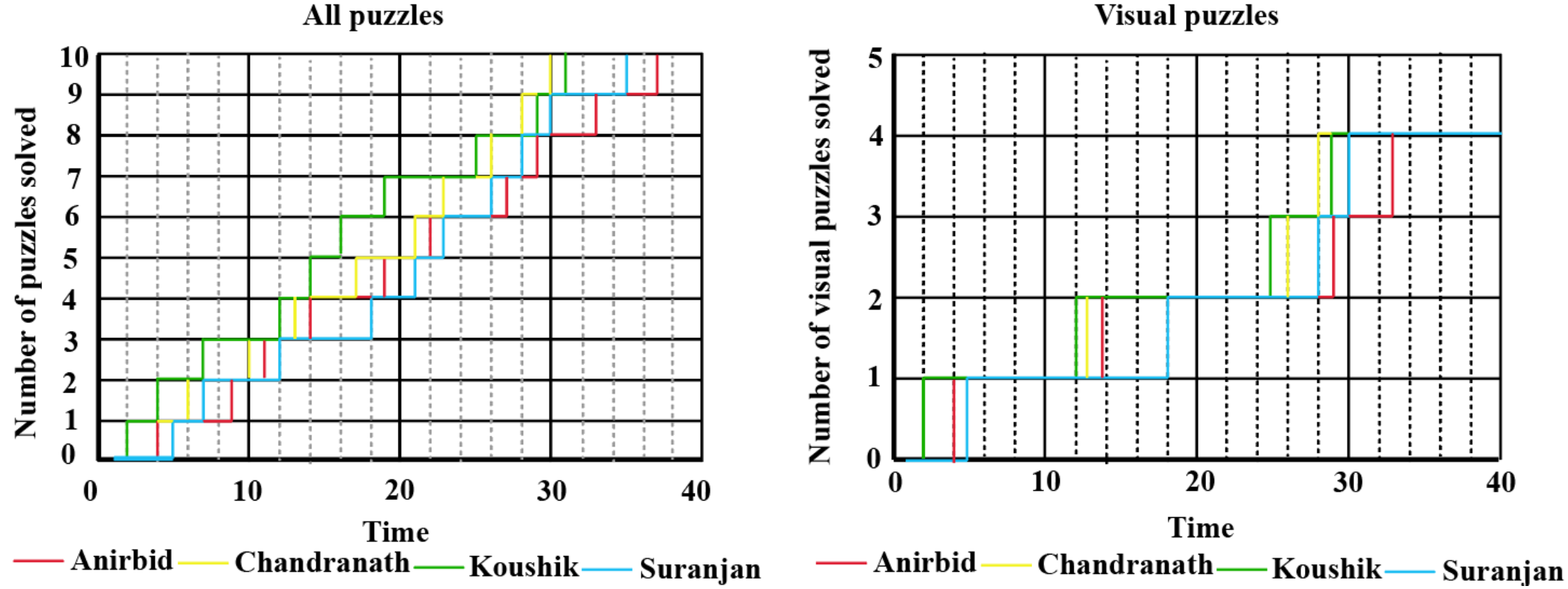
Anirbid, Chandranath, Koushik, and Suranjan participated in a puzzle solving competition. The competition comprised 10 puzzles that had to be solved in the same sequence, i.e., a competitor got access to a puzzle as soon as they solved the previous puzzle. Some of the puzzles were visual puzzles and the others were number-based puzzles. The winner of the competition was the one who solved all puzzles in the least time. The following charts describe their progress in the competition. The chart on the left shows the number of puzzles solved by each competitor at a given time (in minutes) after the start of the competition. The chart on the right shows the number of visual puzzles solved by each competitor at a given time (in minutes) after the start of the competition.

Chart for this set — reading the chart is part of the question
Q6Line GraphsMCQ

Who had solved the largest number of puzzles by the 20-th minute from the start of the competition?

Show solution

Correct answer: B

Finding who solved the most puzzles by minute 20

The left chart is a cumulative step-line: each step up means one more puzzle finished. So the number of puzzles a competitor has solved by minute 20 is simply the count of their completion times that are ≤ 20.

Reading each competitor's puzzle-by-puzzle finish times off the left chart:

CompetitorFinish times (puzzles 1→10)Puzzles done by min 20
Anirbid4, 9, 11, 14, 19, 22, 27, 29, 33, 375 (last ≤20 is 19; next is 22)
Chandranath4, 6, 10, 13, 17, 21, 23, 26, 28, 305 (last ≤20 is 17; next is 21)
Koushik2, 4, 7, 12, 14, 16, 19, 25, 29, 317 (last ≤20 is 19; next is 25)
Suranjan5, 7, 12, 18, 21, 23, 26, 28, 30, 354 (last ≤20 is 18; next is 21)

Koushik has finished 7 puzzles by minute 20 — two more than the next-best competitor.

💡 Teacher tip: In a cumulative step chart, "how many by time t" is just "how many step-times are ≤ t" — you don't need to estimate the y-value; count the risers.

Answer: Koushik (Choice B)

Q7Line GraphsTITA

How many minutes did Suranjan take to solve the third visual puzzle in the competition?

Show solution

Correct answer: 2

Finding Suranjan's time on the third visual puzzle

First we must identify which puzzles in the sequence are visual. The right chart gives each competitor's four visual-puzzle finish times. Matching those against the left chart's all-puzzle finish times tells us which sequence positions are visual.

For Suranjan:

Suranjan's visual finish (right chart)Matching all-puzzle finish (left chart)Sequence position
55Puzzle 1
1818Puzzle 4
2828Puzzle 8
3030Puzzle 9

So the visual puzzles sit at sequence positions 1, 4, 8, 9. The third visual puzzle is therefore the one at position 8.

The time taken on a single puzzle = (finish time of that puzzle) − (finish time of the previous puzzle). From the left chart, Suranjan finished puzzle 7 at minute 26 and puzzle 8 at minute 28:

28−26=2 minutes28 - 26 = 2 \text{ minutes}

💡 Teacher tip: "Time to solve puzzle k" is the gap between consecutive cumulative finish times, not the finish time itself — puzzle 1's time is measured from minute 0.

Answer: 2 minutes

Q8Line GraphsTITA

At what number in the sequence was the fourth number-based puzzle?

Show solution

Correct answer: 6

Finding the position of the fourth number-based puzzle

We first determine which of the 10 sequence positions are visual. Cross-reading the two charts, every competitor's four visual-puzzle finish times line up with their 1st, 4th, 8th, and 9th overall completions:

CompetitorVisual finish times (right chart)Matching positions (left chart)
Anirbid4, 14, 29, 331st, 4th, 8th, 9th
Chandranath4, 13, 26, 281st, 4th, 8th, 9th
Koushik2, 12, 25, 291st, 4th, 8th, 9th
Suranjan5, 18, 28, 301st, 4th, 8th, 9th

Since all four competitors agree, the visual puzzles are at positions 1, 4, 8, 9, and the remaining six are number-based:

TypeSequence positions
Visual1, 4, 8, 9
Number-based2, 3, 5, 6, 7, 10

The number-based puzzles in order are: 2 (1st), 3 (2nd), 5 (3rd), 6 (4th), 7 (5th), 10 (6th).

💡 Teacher tip: List the number-based positions in ascending order and simply count to the fourth entry — no arithmetic needed.

Answer: 6

Q9Line GraphsMCQ

Which of the following is the closest to the average time taken by Anirbid to solve the number-based puzzles in the competition?

Show solution

Correct answer: D

Finding Anirbid's average time on the number-based puzzles

Step 1 — Identify the number-based positions. Cross-reading the two charts, the visual puzzles fall at sequence positions 1, 4, 8, 9 for every competitor. Therefore the number-based puzzles are at positions 2, 3, 5, 6, 7, 10.

Step 2 — Compute Anirbid's per-puzzle times. The time on each puzzle is the gap between consecutive cumulative finish times (puzzle 1 measured from minute 0). Anirbid's finish times from the left chart are: 4, 9, 11, 14, 19, 22, 27, 29, 33, 37.

Puzzle #Finish timeTime on this puzzle
1 (V)44
2 (N)99 − 4 = 5
3 (N)1111 − 9 = 2
4 (V)1414 − 11 = 3
5 (N)1919 − 14 = 5
6 (N)2222 − 19 = 3
7 (N)2727 − 22 = 5
8 (V)2929 − 27 = 2
9 (V)3333 − 29 = 4
10 (N)3737 − 33 = 4

Step 3 — Average the six number-based times (positions 2, 3, 5, 6, 7, 10 → times 5, 2, 5, 3, 5, 4):

Average=5+2+5+3+5+46=246=4.0 minutes\text{Average} = \frac{5 + 2 + 5 + 3 + 5 + 4}{6} = \frac{24}{6} = 4.0 \text{ minutes}

💡 Teacher tip: Each individual puzzle time comes from differences of consecutive cumulative values, not the cumulative values themselves. Get the six gaps first, then average.

Answer: 4.0 minutes (Choice D)

Set · Data Tables

Anu, Bijay, Chetan, Deepak, Eshan, and Faruq are six friends. Each of them uses a mobile number from exactly one of the two mobile operators - Xitel and Yocel. During the last month, the six friends made several calls to each other. Each call was made by one of these six friends to another. The table below summarizes the number of minutes of calls that each of the six made to (outgoing minutes) and received from (incoming minutes) these friends, grouped by the operators. Some of the entries are missing. It is known that the duration of calls from Faruq to Eshan was 200 minutes. Also, there were no calls from: i. Bijay to Eshan, ii. Chetan to Anu and Chetan to Deepak, iii. Deepak to Bijay and Deepak to Faruq, iv. Eshan to Chetan and Eshan to Deepak.

FriendOperatorOutgoing to XitelOutgoing to YocelIncoming from XitelIncoming from Yocel
AnuXitel100?50225
BijayXitel?200?125
ChetanYocel50175250150
DeepakYocel100150275100
EsthanYocel?100100375
FaruqYocel0?100150

(Blank cells in the source are shown as ?. 'Esthan' is printed in the table for the friend named Eshan in the setup.)

Q10Data TablesTITA

What was the duration of calls (in minutes) from Bijay to Anu?

Show solution

Correct answer: 50

Set up the two operators first. Xitel = {Anu, Bijay}; Yocel = {Chetan, Deepak, Eshan, Faruq}. Each person's table row gives group totals: minutes they sent to Xitel users, to Yocel users, and received from each group. The "no-call" rules plus Faruq→Eshan = 200 and Faruq's outgoing-to-Xitel = 0 (so Faruq never called Anu or Bijay) let us pin every needed call.

Key deductions (in order):

  1. Anu's incoming from Xitel = 50, and only Bijay (the other Xitel user) can call Anu ⇒ Bijay→Anu = 50.
  2. Anu's outgoing to Xitel = 100 can only go to Bijay ⇒ Anu→Bijay = 100.
  3. Chetan's outgoing to Xitel = 50, and Chetan never calls Anu ⇒ Chetan→Bijay = 50.
  4. Bijay's incoming from Yocel = 125. Deepak and Faruq never call Bijay, so it is Chetan→Bijay + Eshan→Bijay =50+Eshan→Bijay=125= 50 + \text{Eshan→Bijay} = 125 ⇒ Eshan→Bijay = 75.
  5. Deepak's outgoing to Xitel = 100, and Deepak never calls Bijay ⇒ Deepak→Anu = 100.
  6. Anu's incoming from Yocel = 225. Chetan and Faruq never call Anu, so it is Deepak→Anu + Eshan→Anu =100+Eshan→Anu=225= 100 + \text{Eshan→Anu} = 225 ⇒ Eshan→Anu = 125.
  7. Faruq→Eshan = 200 is given, and the Yocel columns fix Faruq→Chetan + Faruq→Deepak = 150.

Solved directed-call table (minutes; blank = no call). The last column is each person's outgoing total to Xitel / Yocel:

From ↓ \ To →AnuBijayChetanDeepakEshanFaruqOut (X / Y)
Anu—100——100—100 / 525
Bijay50———0—50 / 200
Chetan050—0——50 / 175
Deepak1000100——0100 / 150
Eshan1257500——200 / 100
Faruq00——200—0 / 350

This question

Anu's incoming from Xitel is 50 minutes, and among Xitel users only Bijay can call Anu. So all of it is Bijay's call:

Bijay→Anu=50 minutes\text{Bijay→Anu} = 50 \text{ minutes}

Answer: 50

Q11Data TablesTITA

What was the total duration of calls (in minutes) made by Anu to friends having mobile numbers from Operator Yocel?

Show solution

Correct answer: 525

Set up the two operators first. Xitel = {Anu, Bijay}; Yocel = {Chetan, Deepak, Eshan, Faruq}. Each person's table row gives group totals: minutes they sent to Xitel users, to Yocel users, and received from each group. The "no-call" rules plus Faruq→Eshan = 200 and Faruq's outgoing-to-Xitel = 0 (so Faruq never called Anu or Bijay) let us pin every needed call.

Key deductions (in order):

  1. Anu's incoming from Xitel = 50, and only Bijay (the other Xitel user) can call Anu ⇒ Bijay→Anu = 50.
  2. Anu's outgoing to Xitel = 100 can only go to Bijay ⇒ Anu→Bijay = 100.
  3. Chetan's outgoing to Xitel = 50, and Chetan never calls Anu ⇒ Chetan→Bijay = 50.
  4. Bijay's incoming from Yocel = 125. Deepak and Faruq never call Bijay, so it is Chetan→Bijay + Eshan→Bijay =50+Eshan→Bijay=125= 50 + \text{Eshan→Bijay} = 125 ⇒ Eshan→Bijay = 75.
  5. Deepak's outgoing to Xitel = 100, and Deepak never calls Bijay ⇒ Deepak→Anu = 100.
  6. Anu's incoming from Yocel = 225. Chetan and Faruq never call Anu, so it is Deepak→Anu + Eshan→Anu =100+Eshan→Anu=225= 100 + \text{Eshan→Anu} = 225 ⇒ Eshan→Anu = 125.
  7. Faruq→Eshan = 200 is given, and the Yocel columns fix Faruq→Chetan + Faruq→Deepak = 150.

Solved directed-call table (minutes; blank = no call). The last column is each person's outgoing total to Xitel / Yocel:

From ↓ \ To →AnuBijayChetanDeepakEshanFaruqOut (X / Y)
Anu—100——100—100 / 525
Bijay50———0—50 / 200
Chetan050—0——50 / 175
Deepak1000100——0100 / 150
Eshan1257500——200 / 100
Faruq00——200—0 / 350

This question

We need Anu's outgoing to Yocel total. Since Bijay never calls Eshan, Eshan's incoming from Xitel = 100 must all come from Anu, so Anu→Eshan = 100. For Chetan, Deepak and Faruq, Anu's call equals their incoming from Xitel minus Bijay's call to them; summed, that is (250+275+100)−200=425(250 + 275 + 100) - 200 = 425. Total:

425+100=525 minutes425 + 100 = 525 \text{ minutes}

Answer: 525

Q12Data TablesTITA

What was the total duration of calls (in minutes) made by Faruq to friends having mobile numbers from Operator Yocel?

Show solution

Correct answer: 350

Set up the two operators first. Xitel = {Anu, Bijay}; Yocel = {Chetan, Deepak, Eshan, Faruq}. Each person's table row gives group totals: minutes they sent to Xitel users, to Yocel users, and received from each group. The "no-call" rules plus Faruq→Eshan = 200 and Faruq's outgoing-to-Xitel = 0 (so Faruq never called Anu or Bijay) let us pin every needed call.

Key deductions (in order):

  1. Anu's incoming from Xitel = 50, and only Bijay (the other Xitel user) can call Anu ⇒ Bijay→Anu = 50.
  2. Anu's outgoing to Xitel = 100 can only go to Bijay ⇒ Anu→Bijay = 100.
  3. Chetan's outgoing to Xitel = 50, and Chetan never calls Anu ⇒ Chetan→Bijay = 50.
  4. Bijay's incoming from Yocel = 125. Deepak and Faruq never call Bijay, so it is Chetan→Bijay + Eshan→Bijay =50+Eshan→Bijay=125= 50 + \text{Eshan→Bijay} = 125 ⇒ Eshan→Bijay = 75.
  5. Deepak's outgoing to Xitel = 100, and Deepak never calls Bijay ⇒ Deepak→Anu = 100.
  6. Anu's incoming from Yocel = 225. Chetan and Faruq never call Anu, so it is Deepak→Anu + Eshan→Anu =100+Eshan→Anu=225= 100 + \text{Eshan→Anu} = 225 ⇒ Eshan→Anu = 125.
  7. Faruq→Eshan = 200 is given, and the Yocel columns fix Faruq→Chetan + Faruq→Deepak = 150.

Solved directed-call table (minutes; blank = no call). The last column is each person's outgoing total to Xitel / Yocel:

From ↓ \ To →AnuBijayChetanDeepakEshanFaruqOut (X / Y)
Anu—100——100—100 / 525
Bijay50———0—50 / 200
Chetan050—0——50 / 175
Deepak1000100——0100 / 150
Eshan1257500——200 / 100
Faruq00——200—0 / 350

This question

Faruq only calls Yocel friends (his outgoing to Xitel is 0). He called Eshan for 200 minutes (given), and the Yocel incoming columns fix Faruq→Chetan + Faruq→Deepak = 150. So:

200+150=350 minutes200 + 150 = 350 \text{ minutes}

Answer: 350

Q13Data TablesMCQ

What was the duration of calls (in minutes) from Deepak to Chetan?

Show solution

Correct answer: A

Set up the two operators first. Xitel = {Anu, Bijay}; Yocel = {Chetan, Deepak, Eshan, Faruq}. Each person's table row gives group totals: minutes they sent to Xitel users, to Yocel users, and received from each group. The "no-call" rules plus Faruq→Eshan = 200 and Faruq's outgoing-to-Xitel = 0 (so Faruq never called Anu or Bijay) let us pin every needed call.

Key deductions (in order):

  1. Anu's incoming from Xitel = 50, and only Bijay (the other Xitel user) can call Anu ⇒ Bijay→Anu = 50.
  2. Anu's outgoing to Xitel = 100 can only go to Bijay ⇒ Anu→Bijay = 100.
  3. Chetan's outgoing to Xitel = 50, and Chetan never calls Anu ⇒ Chetan→Bijay = 50.
  4. Bijay's incoming from Yocel = 125. Deepak and Faruq never call Bijay, so it is Chetan→Bijay + Eshan→Bijay =50+Eshan→Bijay=125= 50 + \text{Eshan→Bijay} = 125 ⇒ Eshan→Bijay = 75.
  5. Deepak's outgoing to Xitel = 100, and Deepak never calls Bijay ⇒ Deepak→Anu = 100.
  6. Anu's incoming from Yocel = 225. Chetan and Faruq never call Anu, so it is Deepak→Anu + Eshan→Anu =100+Eshan→Anu=225= 100 + \text{Eshan→Anu} = 225 ⇒ Eshan→Anu = 125.
  7. Faruq→Eshan = 200 is given, and the Yocel columns fix Faruq→Chetan + Faruq→Deepak = 150.

Solved directed-call table (minutes; blank = no call). The last column is each person's outgoing total to Xitel / Yocel:

From ↓ \ To →AnuBijayChetanDeepakEshanFaruqOut (X / Y)
Anu—100——100—100 / 525
Bijay50———0—50 / 200
Chetan050—0——50 / 175
Deepak1000100——0100 / 150
Eshan1257500——200 / 100
Faruq00——200—0 / 350

This question

Chetan's incoming from Yocel = 150 comes from Deepak, Eshan and Faruq, but Eshan never calls Chetan. So it is Deepak→Chetan + Faruq→Chetan = 150. Solving the remaining Yocel balances fixes Faruq→Chetan, leaving:

Deepak→Chetan=100 minutes\text{Deepak→Chetan} = 100 \text{ minutes}

Answer: 100

Set · Mixed Charts & Caselets

Three countries — Pumpland (P), Xiland (X) and Cheeseland (C) — trade among themselves and with the (other countries in) Rest of World (ROW). All trade volumes are given in IC (international currency). The following terminology is used: Trade balance = Exports - Imports; Total trade = Exports + Imports; Normalized trade balance = Trade balance / Total trade, expressed in percentage terms. The following information is known. 1. The normalized trade balances of P, X and C are 0%, 10%, and -20%, respectively. 2. 40% of exports of X are to P. 22% of imports of P are from X. 3. 90% of exports of C are to P; 4% are to ROW. 4. 12% of exports of ROW are to X, 40% are to P. 5. The export volumes of P, in IC, to X and C are 600 and 1200, respectively. P is the only country that exports to C.

Q14Mixed Charts & CaseletsTITA

How much is exported from C to X, in IC?

Show solution

Correct answer: 48

We need the volume of Cheeseland's exports to Xiland. This can be found using only Cheeseland's data — no need to solve the entire system.

Step 1 — Find C's total imports.

Clue 5 tells us P is the only country that exports to C. We are also told P exports 1200 to C. Therefore:

IC=1200 ICI_C = 1200 \text{ IC}

Step 2 — Use C's normalized trade balance to find C's total exports.

C's normalized trade balance is −20%-20\%:

EC−ICEC+IC=−0.20\frac{E_C - I_C}{E_C + I_C} = -0.20

Substituting IC=1200I_C = 1200:

EC−1200EC+1200=−0.20\frac{E_C - 1200}{E_C + 1200} = -0.20

EC−1200=−0.20 EC−240E_C - 1200 = -0.20\,E_C - 240

1.20 EC=9601.20\,E_C = 960

EC=800 ICE_C = 800 \text{ IC}

Step 3 — Split C's exports among destinations.

From clue 3: 90%90\% of C's exports go to P, and 4%4\% go to ROW. Since a country cannot export to itself, the remaining percentage must go to X:

100%−90%−4%=6%100\% - 90\% - 4\% = 6\%

C→X=0.06×800=48 ICC \to X = 0.06 \times 800 = 48 \text{ IC}

Answer: 48

Q15Mixed Charts & CaseletsTITA

How much is exported from P to ROW, in IC?

Show solution

Correct answer: 200

To find P's exports to ROW, we need P's total exports, which requires solving the full trade system.

Step 1 — Cheeseland's exports.

P is the only exporter to C, and P→C = 1200, so IC=1200I_C = 1200. With C's normalized balance at −20%-20\%:

EC−1200EC+1200=−0.20  ⟹  1.2 EC=960  ⟹  EC=800\frac{E_C - 1200}{E_C + 1200} = -0.20 \implies 1.2\,E_C = 960 \implies E_C = 800

C's exports split: 90%→P=72090\% \to P = 720, 4%→ROW=324\% \to \text{ROW} = 32, remaining 6%→X=486\% \to X = 48.

Step 2 — Xiland's relationships.

X's normalized balance is 10%10\%:

EX−IXEX+IX=0.10  ⟹  EX=119 IX\frac{E_X - I_X}{E_X + I_X} = 0.10 \implies E_X = \frac{11}{9}\,I_X

X's exports go to P (40%40\%) and ROW (60%60\%) — not to C, since P is the only exporter to C.

X's imports come from P (600), C (48), and ROW (12%12\% of EROWE_{\text{ROW}}):

IX=648+0.12 EROWI_X = 648 + 0.12\,E_{\text{ROW}}

Step 3 — Pumpland's relationships.

P's normalized balance is 0%0\%, so EP=IPE_P = I_P.

P's exports: 600+1200+P→ROW600 + 1200 + P{\to}\text{ROW}

P's imports: X→P+C→P+ROW→P=0.4 EX+720+0.4 EROWX{\to}P + C{\to}P + \text{ROW}{\to}P = 0.4\,E_X + 720 + 0.4\,E_{\text{ROW}}

From clue 2, X→PX{\to}P is 22%22\% of P's imports:

0.4 EX=0.22 IP  ⟹  IP=2011 EX0.4\,E_X = 0.22\,I_P \implies I_P = \frac{20}{11}\,E_X

Step 4 — Solve the system.

Since EP=IP=2011EXE_P = I_P = \frac{20}{11}E_X and also IP=0.4 EX+720+0.4 EROWI_P = 0.4\,E_X + 720 + 0.4\,E_{\text{ROW}}:

2011EX=0.4 EX+720+0.4 EROW\frac{20}{11}E_X = 0.4\,E_X + 720 + 0.4\,E_{\text{ROW}}

7855EX=720+0.4 EROW⋯(1)\frac{78}{55}E_X = 720 + 0.4\,E_{\text{ROW}} \quad \cdots (1)

From X's balance and imports:

EX=119(648+0.12 EROW)=792+1175EROW⋯(2)E_X = \frac{11}{9}(648 + 0.12\,E_{\text{ROW}}) = 792 + \frac{11}{75}E_{\text{ROW}} \quad \cdots (2)

Substituting (2) into (1):

7855 ⁣(792+1175EROW)=720+0.4 EROW\frac{78}{55}\!\left(792 + \frac{11}{75}E_{\text{ROW}}\right) = 720 + 0.4\,E_{\text{ROW}}

1123.2+0.208 EROW=720+0.4 EROW1123.2 + 0.208\,E_{\text{ROW}} = 720 + 0.4\,E_{\text{ROW}}

403.2=0.192 EROW  ⟹  EROW=2100403.2 = 0.192\,E_{\text{ROW}} \implies E_{\text{ROW}} = 2100

Back-substituting: EX=1100E_X = 1100, IP=EP=2000I_P = E_P = 2000.

Step 5 — Find P → ROW.

P's total exports = 2000. Subtracting the known flows to X (600) and C (1200):

P→ROW=2000−600−1200=200 ICP{\to}\text{ROW} = 2000 - 600 - 1200 = 200 \text{ IC}

Solved export matrix (rows = exporter, columns = importer), in IC:

From \ ToPXCROWExports
P—60012002002000
X440—06601100
C72048—32800
ROW840252010082100
Imports200090012001900

Answer: 200

Q16Mixed Charts & CaseletsTITA

How much is exported from ROW to ROW, in IC?

Show solution

Correct answer: 1008

To find ROW's exports to itself, we need ROW's total exports, which requires solving the full trade system.

Step 1 — Cheeseland's exports.

P is the only exporter to C, and P→C = 1200, so IC=1200I_C = 1200. With C's normalized balance at −20%-20\%:

EC−1200EC+1200=−0.20  ⟹  1.2 EC=960  ⟹  EC=800\frac{E_C - 1200}{E_C + 1200} = -0.20 \implies 1.2\,E_C = 960 \implies E_C = 800

C's exports split: 90%→P=72090\% \to P = 720, 4%→ROW=324\% \to \text{ROW} = 32, remaining 6%→X=486\% \to X = 48.

Step 2 — Xiland's relationships.

X's normalized balance is 10%10\%:

EX−IXEX+IX=0.10  ⟹  EX=119 IX\frac{E_X - I_X}{E_X + I_X} = 0.10 \implies E_X = \frac{11}{9}\,I_X

X's exports go to P (40%40\%) and ROW (60%60\%) — not to C, since P is the only exporter to C.

X's imports: IX=600+48+0.12 EROW=648+0.12 EROWI_X = 600 + 48 + 0.12\,E_{\text{ROW}} = 648 + 0.12\,E_{\text{ROW}}

Step 3 — Pumpland's relationships.

P's normalized balance is 0%0\%, so EP=IPE_P = I_P.

From clue 2: 0.4 EX=0.22 IP  ⟹  IP=2011EX0.4\,E_X = 0.22\,I_P \implies I_P = \frac{20}{11}E_X

Also: IP=0.4 EX+720+0.4 EROWI_P = 0.4\,E_X + 720 + 0.4\,E_{\text{ROW}}

Step 4 — Solve the system.

Equating the two expressions for IPI_P:

2011EX=0.4 EX+720+0.4 EROW  ⟹  7855EX=720+0.4 EROW⋯(1)\frac{20}{11}E_X = 0.4\,E_X + 720 + 0.4\,E_{\text{ROW}} \implies \frac{78}{55}E_X = 720 + 0.4\,E_{\text{ROW}} \quad \cdots (1)

From X's balance: EX=119(648+0.12 EROW)=792+1175EROW⋯(2)E_X = \frac{11}{9}(648 + 0.12\,E_{\text{ROW}}) = 792 + \frac{11}{75}E_{\text{ROW}} \quad \cdots (2)

Substituting (2) into (1):

7855 ⁣(792+1175EROW)=720+0.4 EROW\frac{78}{55}\!\left(792 + \frac{11}{75}E_{\text{ROW}}\right) = 720 + 0.4\,E_{\text{ROW}}

1123.2+0.208 EROW=720+0.4 EROW1123.2 + 0.208\,E_{\text{ROW}} = 720 + 0.4\,E_{\text{ROW}}

403.2=0.192 EROW  ⟹  EROW=2100403.2 = 0.192\,E_{\text{ROW}} \implies E_{\text{ROW}} = 2100

Step 5 — Find ROW → ROW.

From clue 4, ROW's exports go to P (40%40\%) and X (12%12\%). The remaining share stays within ROW:

100%−40%−12%=48%100\% - 40\% - 12\% = 48\%

ROW→ROW=0.48×2100=1008 IC\text{ROW}{\to}\text{ROW} = 0.48 \times 2100 = 1008 \text{ IC}

Solved export matrix (rows = exporter, columns = importer), in IC:

From \ ToPXCROWExports
P—60012002002000
X440—06601100
C72048—32800
ROW840252010082100
Imports200090012001900

Answer: 1008

Q17Mixed Charts & CaseletsMCQ

What is the trade balance of ROW?

Show solution

Correct answer: D

To find ROW's trade balance, we need both ROW's total exports and total imports, which requires solving the full trade system.

Step 1 — Cheeseland's exports.

P is the only exporter to C, and P→C = 1200, so IC=1200I_C = 1200. With C's normalized balance at −20%-20\%:

EC−1200EC+1200=−0.20  ⟹  1.2 EC=960  ⟹  EC=800\frac{E_C - 1200}{E_C + 1200} = -0.20 \implies 1.2\,E_C = 960 \implies E_C = 800

C's exports split: 90%→P=72090\% \to P = 720, 4%→ROW=324\% \to \text{ROW} = 32, remaining 6%→X=486\% \to X = 48.

Step 2 — Xiland's relationships.

X's normalized balance is 10%10\%:

EX−IXEX+IX=0.10  ⟹  EX=119 IX\frac{E_X - I_X}{E_X + I_X} = 0.10 \implies E_X = \frac{11}{9}\,I_X

X's exports go to P (40%40\%) and ROW (60%60\%) — not to C, since P is the only exporter to C.

X's imports: IX=600+48+0.12 EROW=648+0.12 EROWI_X = 600 + 48 + 0.12\,E_{\text{ROW}} = 648 + 0.12\,E_{\text{ROW}}

Step 3 — Pumpland's relationships.

P's normalized balance is 0%0\%, so EP=IPE_P = I_P.

From clue 2: 0.4 EX=0.22 IP  ⟹  IP=2011EX0.4\,E_X = 0.22\,I_P \implies I_P = \frac{20}{11}E_X

Also: IP=0.4 EX+720+0.4 EROWI_P = 0.4\,E_X + 720 + 0.4\,E_{\text{ROW}}

Step 4 — Solve the system.

Equating the two expressions for IPI_P:

2011EX=0.4 EX+720+0.4 EROW  ⟹  7855EX=720+0.4 EROW⋯(1)\frac{20}{11}E_X = 0.4\,E_X + 720 + 0.4\,E_{\text{ROW}} \implies \frac{78}{55}E_X = 720 + 0.4\,E_{\text{ROW}} \quad \cdots (1)

From X's balance: EX=119(648+0.12 EROW)=792+1175EROW⋯(2)E_X = \frac{11}{9}(648 + 0.12\,E_{\text{ROW}}) = 792 + \frac{11}{75}E_{\text{ROW}} \quad \cdots (2)

Substituting (2) into (1):

7855 ⁣(792+1175EROW)=720+0.4 EROW\frac{78}{55}\!\left(792 + \frac{11}{75}E_{\text{ROW}}\right) = 720 + 0.4\,E_{\text{ROW}}

1123.2+0.208 EROW=720+0.4 EROW1123.2 + 0.208\,E_{\text{ROW}} = 720 + 0.4\,E_{\text{ROW}}

403.2=0.192 EROW  ⟹  EROW=2100403.2 = 0.192\,E_{\text{ROW}} \implies E_{\text{ROW}} = 2100

Back-substituting: EX=1100E_X = 1100, EP=IP=2000E_P = I_P = 2000, P→ROW=200P{\to}\text{ROW} = 200.

Step 5 — Compute ROW's trade balance.

ROW's total exports = 2100.

ROW's imports come from every exporter that sends goods to ROW: P (200), X (660), C (32), and ROW itself (1008):

IROW=200+660+32+1008=1900I_{\text{ROW}} = 200 + 660 + 32 + 1008 = 1900

💡 Teacher tip: ROW's imports are the sum of the entire ROW column in the trade matrix — including the diagonal entry where ROW exports to itself.

Trade BalanceROW=EROW−IROW=2100−1900=200\text{Trade Balance}_{\text{ROW}} = E_{\text{ROW}} - I_{\text{ROW}} = 2100 - 1900 = 200

Solved export matrix (rows = exporter, columns = importer), in IC:

From \ ToPXCROWExports
P—60012002002000
X440—06601100
C72048—32800
ROW840252010082100
Imports200090012001900

Answer: D. 200

Q18Mixed Charts & CaseletsMCQ

Which among the countries P, X, and C has/have the least total trade?

Show solution

Correct answer: C

To compare total trade across P, X, and C, we need each country's exports and imports, which requires solving the full trade system.

Step 1 — Cheeseland's exports.

P is the only exporter to C, and P→C = 1200, so IC=1200I_C = 1200. With C's normalized balance at −20%-20\%:

EC−1200EC+1200=−0.20  ⟹  1.2 EC=960  ⟹  EC=800\frac{E_C - 1200}{E_C + 1200} = -0.20 \implies 1.2\,E_C = 960 \implies E_C = 800

C's exports split: 90%→P=72090\% \to P = 720, 4%→ROW=324\% \to \text{ROW} = 32, remaining 6%→X=486\% \to X = 48.

Step 2 — Xiland's relationships.

X's normalized balance is 10%10\%:

EX−IXEX+IX=0.10  ⟹  EX=119 IX\frac{E_X - I_X}{E_X + I_X} = 0.10 \implies E_X = \frac{11}{9}\,I_X

X's exports go to P (40%40\%) and ROW (60%60\%) — not to C, since P is the only exporter to C.

X's imports: IX=600+48+0.12 EROW=648+0.12 EROWI_X = 600 + 48 + 0.12\,E_{\text{ROW}} = 648 + 0.12\,E_{\text{ROW}}

Step 3 — Pumpland's relationships.

P's normalized balance is 0%0\%, so EP=IPE_P = I_P.

From clue 2: 0.4 EX=0.22 IP  ⟹  IP=2011EX0.4\,E_X = 0.22\,I_P \implies I_P = \frac{20}{11}E_X

Also: IP=0.4 EX+720+0.4 EROWI_P = 0.4\,E_X + 720 + 0.4\,E_{\text{ROW}}

Step 4 — Solve the system.

Equating the two expressions for IPI_P:

2011EX=0.4 EX+720+0.4 EROW  ⟹  7855EX=720+0.4 EROW⋯(1)\frac{20}{11}E_X = 0.4\,E_X + 720 + 0.4\,E_{\text{ROW}} \implies \frac{78}{55}E_X = 720 + 0.4\,E_{\text{ROW}} \quad \cdots (1)

From X's balance: EX=119(648+0.12 EROW)=792+1175EROW⋯(2)E_X = \frac{11}{9}(648 + 0.12\,E_{\text{ROW}}) = 792 + \frac{11}{75}E_{\text{ROW}} \quad \cdots (2)

Substituting (2) into (1):

7855 ⁣(792+1175EROW)=720+0.4 EROW\frac{78}{55}\!\left(792 + \frac{11}{75}E_{\text{ROW}}\right) = 720 + 0.4\,E_{\text{ROW}}

1123.2+0.208 EROW=720+0.4 EROW1123.2 + 0.208\,E_{\text{ROW}} = 720 + 0.4\,E_{\text{ROW}}

403.2=0.192 EROW  ⟹  EROW=2100403.2 = 0.192\,E_{\text{ROW}} \implies E_{\text{ROW}} = 2100

Back-substituting: EX=1100E_X = 1100, IX=900I_X = 900, EP=IP=2000E_P = I_P = 2000.

Step 5 — Compare total trade.

Total trade = Exports + Imports for each country:

CountryExportsImportsTotal Trade
P200020004000
X11009002000
C80012002000

X and C are tied at 2000 IC each, which is the lowest among the three.

Solved export matrix (rows = exporter, columns = importer), in IC:

From \ ToPXCROWExports
P—60012002002000
X440—06601100
C72048—32800
ROW840252010082100
Imports200090012001900

Answer: C. Both X and C

Set · Circular Arrangements

Seven children, Aarav, Bina, Chirag, Diya, Eshan, Farhan, and Gaurav, are sitting in a circle facing inside (not necessarily in the same order) and playing a game of 'Passing the Buck'. The game is played over 10 rounds. In each round, the child holding the Buck must pass it directly to a child sitting in one of the following positions: Immediately to the left; Immediate to the right; Second to the left; or Second to the right. The game starts with Bina passing the Buck and ends with Chirag receiving the Buck. The table below provides some information about the pass types and the child receiving the Buck. Some information is missing and labelled as '?'.

RoundPass TypeReceived by
1Immediately to the leftAarav
2Second to the right?
3Immediately to the rightDiya
4??
5?Aarav
6Second to the left?
7Immediately to the leftGaurav
8Immediately to the left?
9?Farhan
10?Chirag
Q19Circular ArrangementsMCQ

Who is sitting immediately to the right of Bina?

Show solution

Correct answer: B

Finding the circular seating

The children face inwards, so each child's immediately to the left neighbour is the next seat in one fixed rotational direction, and immediately to the right is the opposite direction. Second to the left/right means skipping one seat in that direction.

The holder of each round is the receiver of the previous round; Bina holds in Round 1, and Chirag receives in Round 10.

Step-by-step deduction of the seating order

  1. Round 1: Bina passes immediately to the left → Aarav. So Aarav sits immediately to Bina's left.
  2. Round 2: Aarav passes second to the right. From Aarav, going right one seat reaches Bina, and a second seat reaches Eshan — so Eshan receives in Round 2.
  3. Round 3: Eshan passes immediately to the right → Diya. So Diya sits immediately to Eshan's right.
  4. Round 6: Aarav passes second to the left → Farhan. So Farhan sits second to Aarav's left.
  5. Round 7: Farhan passes immediately to the left → Gaurav. So Gaurav sits immediately to Farhan's left.
  6. Round 8: Gaurav passes immediately to the left → Diya (confirmed by the table). So Diya sits immediately to Gaurav's left.
  7. Round 9: Diya passes to Farhan. From Diya, Farhan is second to the right — this fixes Round 9's pass type.
  8. Round 10: Farhan passes to Chirag. From Farhan, Chirag is immediately to the right — this fixes Round 10's pass type.

Putting all the neighbour relationships together, the circular order (going in the immediately-to-the-left direction) is:

Bina→Aarav→Chirag→Farhan→Gaurav→Diya→Eshan→(back to Bina)\textbf{Bina} \to \textbf{Aarav} \to \textbf{Chirag} \to \textbf{Farhan} \to \textbf{Gaurav} \to \textbf{Diya} \to \textbf{Eshan} \to (\text{back to Bina})

Position (left-going)1234567
ChildBinaAaravChiragFarhanGauravDiyaEshan

💡 Teacher tip: Each child's immediate-left neighbour is the next name in the loop above; each child's immediate-right neighbour is the previous name in the loop.

Answering this question

We need Bina's immediate-right neighbour — the name just before Bina in the left-going loop. Reading the loop, the name before Bina is Eshan.

Answer: Eshan (Choice B)

Q20Circular ArrangementsMCQ

Who is sitting third to the left of Eshan?

Show solution

Correct answer: C

The solved circular seating

From the round-by-round pass analysis (Bina starts, Chirag receives last, and each round's holder is the previous round's receiver), the forced circular order going in the immediately-to-the-left direction is:

Bina→Aarav→Chirag→Farhan→Gaurav→Diya→Eshan→(back to Bina)\textbf{Bina} \to \textbf{Aarav} \to \textbf{Chirag} \to \textbf{Farhan} \to \textbf{Gaurav} \to \textbf{Diya} \to \textbf{Eshan} \to (\text{back to Bina})

Position (left-going)1234567
ChildBinaAaravChiragFarhanGauravDiyaEshan

Key relationships:

  • Each child's immediate-left neighbour = next name in the loop.
  • Each child's immediate-right neighbour = previous name in the loop.

Answering this question

We need the child sitting third to the left of Eshan. Starting at Eshan and stepping three seats in the immediately-to-the-left direction:

  1. 1st to the left of Eshan → Bina
  2. 2nd to the left of Eshan → Aarav
  3. 3rd to the left of Eshan → Chirag

Answer: Chirag (Choice C)

Q21Circular ArrangementsMCQ

For which of the following pass types can the total number of occurrences be uniquely determined?

Show solution

Correct answer: C

The solved circular seating and round-by-round passes

The forced circular order (going in the immediately-to-the-left direction) is:

Bina→Aarav→Chirag→Farhan→Gaurav→Diya→Eshan→(back to Bina)\textbf{Bina} \to \textbf{Aarav} \to \textbf{Chirag} \to \textbf{Farhan} \to \textbf{Gaurav} \to \textbf{Diya} \to \textbf{Eshan} \to (\text{back to Bina})

Working through all 10 rounds (holder = previous round's receiver):

RoundHolderPass typeReceiver
1BinaImmediately to the leftAarav
2AaravSecond to the rightEshan
3EshanImmediately to the rightDiya
4Diya(varies)(varies)
5(varies)(varies)Aarav
6AaravSecond to the leftFarhan
7FarhanImmediately to the leftGaurav
8GauravImmediately to the leftDiya
9DiyaSecond to the rightFarhan
10FarhanImmediately to the rightChirag

The only flexibility is in Rounds 4–5: Diya must reach Aarav in exactly two legal passes. There are three possible ways:

Round-4 receiverRound 4 typeRound 5 type
EshanImmediately to the leftSecond to the left
BinaSecond to the leftImmediately to the left
FarhanSecond to the rightSecond to the right

Tallying pass-type counts

Fixed rounds (1, 2, 3, 6, 7, 8, 9, 10):

Pass typeFixed roundsCount so far
Immediately to the left1, 7, 83
Second to the right2, 92
Immediately to the right3, 102
Second to the left61

Adding Rounds 4–5 from each scenario:

ScenarioExtra passes added
Eshan (Round 4)+1 Immediately to the left, +1 Second to the left
Bina (Round 4)+1 Second to the left, +1 Immediately to the left
Farhan (Round 4)+2 Second to the right

Final totals across scenarios:

Pass typeEshan caseBina caseFarhan caseUnique?
Immediately to the left443No (3 or 4)
Second to the right224No (2 or 4)
Immediately to the right222Yes — always 2
Second to the left221No (1 or 2)

Only Immediately to the right has the same count (2) in every possible scenario.

Answer: Immediately to the right (Choice C)

Q22Circular ArrangementsMCQ

For which of the following children is it possible to determine how many times they received the Buck?

Show solution

Correct answer: D

The solved circular seating and round-by-round passes

The forced circular order (going in the immediately-to-the-left direction) is:

Bina→Aarav→Chirag→Farhan→Gaurav→Diya→Eshan→(back to Bina)\textbf{Bina} \to \textbf{Aarav} \to \textbf{Chirag} \to \textbf{Farhan} \to \textbf{Gaurav} \to \textbf{Diya} \to \textbf{Eshan} \to (\text{back to Bina})

The full round-by-round table (holder = previous round's receiver):

RoundHolderPass typeReceiver
1BinaImmediately to the leftAarav
2AaravSecond to the rightEshan
3EshanImmediately to the rightDiya
4Diya(varies)(varies)
5(varies)(varies)Aarav
6AaravSecond to the leftFarhan
7FarhanImmediately to the leftGaurav
8GauravImmediately to the leftDiya
9DiyaSecond to the rightFarhan
10FarhanImmediately to the rightChirag

Rounds 4–5 are the only flexible part: Diya must reach Aarav in two legal passes, and the Round-4 receiver can be Eshan, Bina, or Farhan.

Counting receptions per child

Ignoring Round 4 (the one variable receiver), the fixed receptions are:

ChildFixed receiving roundsCount (excl. Round 4)
Aarav1, 52
Diya3, 82
Farhan6, 92
Gaurav71
Eshan21
Chirag101
Bina—0

Now, Round 4's receiver is Eshan, Bina, or Farhan — so only those three children's counts can change:

ChildCount if Round 4 = EshanCount if Round 4 = BinaCount if Round 4 = FarhanDeterminable?
Farhan223No (2 or 3)
Eshan211No (1 or 2)
Bina010No (0 or 1)
Gaurav111Yes — always 1

Gaurav is never the Round-4 receiver, so his reception count is fixed at 1 regardless of which scenario plays out. Among the four options, only Gaurav's count can be uniquely determined.

💡 Teacher tip: When part of a set is flexible, check whether each answer choice is ever affected by the flexible part. Only a child who cannot appear in the variable slot has a fixed count.

Answer: Gaurav (Choice D)